FabulousFusionFood's Boiling Recipes Home Page
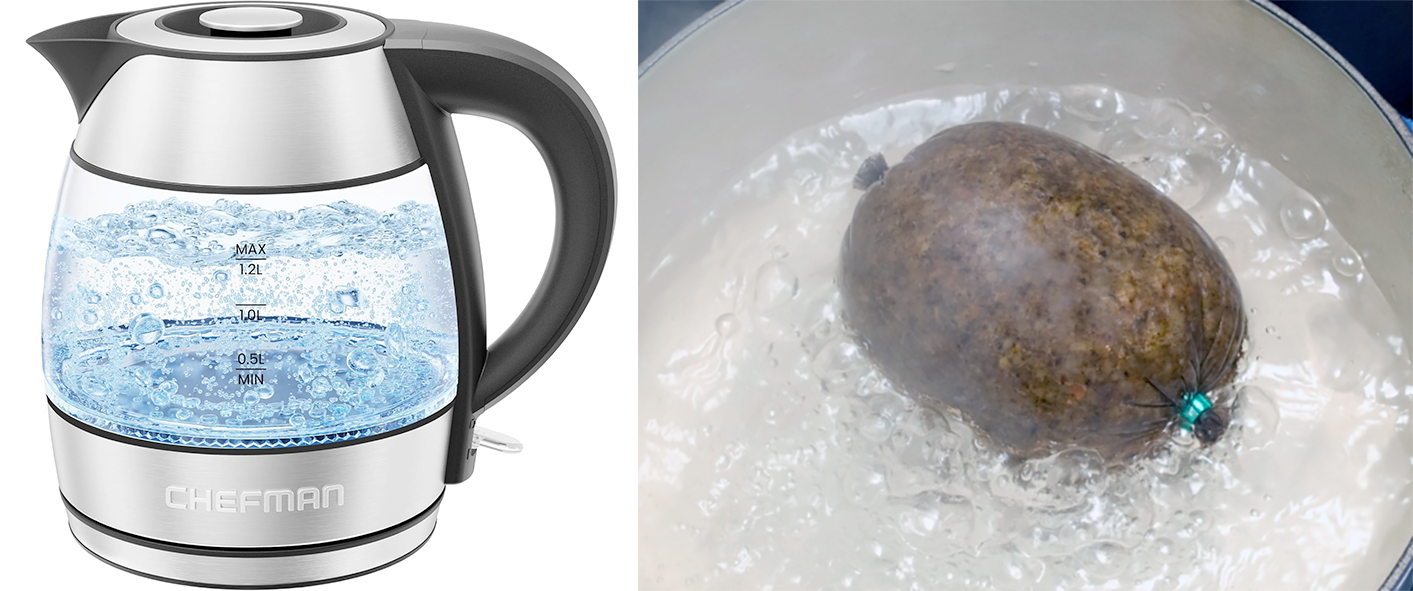 Kettle boiling (left), haggis boiling in pan (right).
Welcome to FabulousFusionFood's Boiling Recipes Page — Boiling or ebullition is the rapid phase transition from liquid to gas or vapour; the reverse of boiling is condensation. Boiling occurs when a liquid is heated to its boiling point, so that the vapour pressure of the liquid is equal to the pressure exerted on the liquid by the surrounding atmosphere. Boiling and evaporation are the two main forms of liquid vaporisation. In cookery, boiling is the process of cooking food in liquid (typically a water base) at the point where the liquid is converting to a gas. Boiling water is also used in several cooking methods including boiling, blanching, steaming, and poaching. Boiling is the method of cooking food in boiling water or other water-based liquids such as stock or milk. Simmering is gentle boiling, while in poaching the cooking liquid moves but scarcely bubbles.
After the control of fire, which was almost certainly used for direct roasting, pit ovens and leather bag based boiling are probably the next developments in cookery. Both rely on a fire heating stones or rocks. For the pit oven, the fire and stones are heated in the bottom of a pit. They're then covered with grass and leaves, which generate steam. The meat is placed on top and the whole is buried. The heat from the fire and the steam cook the food. For boiling in a leather bag, the water and food to be cooked are placed in a leather bag. The hot stones are dropped in and these bring the water and the contents of the bag to a boil. As soon as the ingredients begin to cool drop in another stone... this being the original 'boil in a bag' meal. So, you can boil food long before the invention of pottery or metal working. Indeed, boiling was almost certainly being used as a method of cooking long before the advent of farming. It lends itself to the hunter-gatherer lifestyle as a leather bag is easy to make and light to transport. It can be used to cook seafood, shellfish, game meat and any vegetables or grains that are foraged.
As a method of disinfecting water, bringing it to its boiling point at 100°C (212°F), is the oldest and most effective way since it does not affect the taste, it is effective despite contaminants or particles present in it, and is a single step process which eliminates most microbes responsible for causing intestine related diseases. The boiling point of water is 100°C (212°F) at sea level and at normal barometric pressure. In places having a proper water purification system, it is recommended only as an emergency treatment method or for obtaining potable water in the wilderness or in rural areas, as it cannot remove chemical toxins or impurities.
The boiling point of water is typically considered to be 100°C (212°F; 373K), especially at sea level. Pressure and a change in the composition of the liquid may alter the boiling point of the liquid. High elevation cooking generally takes longer since boiling point is a function of atmospheric pressure. At an elevation of about one mile (1,600 m), water boils at approximately 95 °C (203 °F; 368 K). Depending on the type of food and the elevation, the boiling water may not be hot enough to cook the food properly. Similarly, increasing the pressure as in a pressure cooker raises the temperature of the contents above the open air boiling point (which is why pressure cooking reduces the time required to cook food).
The advent of fireproof pottery allows meals to be cooked by placing the cooking vessel next to the fire. Once metalwork is developed cooking pots can be suspended over a fire, which is why stews feature in so many cuisines. During Medieval times in Europe, boiling was a major way of cooking and both savoury and sweet dishes were boiled, becoming known in English as 'puddings'. This is why, in Britain at least, black pudding, haggis, steamed cakes, Christmas pudding etc are all known as 'puddings'.
Tea and Brewing: As boiling renders water potable and safe, it's interesting how this developed to produce safe drinks in Europe and Asia. In Europe, boiled water was used to make beer, the alcohol in the beer then keeping the water safe and bacteria free for a long time after brewing. In Asia, water was boiled and made into an infusion with green or fermented tea leaves, a drink intended to be imbibed immediately.
The alphabetical list of all the boiling-based recipes on this site follows, (limited to 100 recipes per page). There are 411 recipes in total:
Page 1 of 5
| Aano Baraawe (Somali Caramel Fudge) Origin: Somalia | Boiled Collar of Bacon with Creamy Mustard Sauce Origin: Ireland | Cherry Plum Jam Origin: Britain |
| Agidi (Fermented Cornflour Pudding) Origin: Nigeria | Boiled Eels Origin: British | Chewetts on fysche day (Chewetts for Fish Days) Origin: England |
| Agidi Jollof Origin: Nigeria | Boiled Evening Primrose Roots Origin: Britain | Chia Seed Couscous Origin: Fusion |
| Ailes de raie sauce au beurre noir (Skate wings with black butter sauce) Origin: France | Boiled Fiddleheads Origin: American | Chicharrón (Fried Pork Belly) Origin: Costa Rica |
| Aliter carduos (Artichokes with Herbs) Origin: Roman | Boiled Flounders Origin: British | Chicharrón Colombiano (Colombian-Style Fried Pork Belly) Origin: Colombia |
| Aliter carduos elixos (Artichokes with Spiced Sauce) Origin: Roman | Boiled Haddock Origin: British | Chicken Stock Origin: Britain |
| Aliter de Pullo (Chicken Forcemeat, Another Way) Origin: Roman | Boiled Ham Origin: Britain | Chinese Hot Pot Origin: China |
| Aliter Dulcia IV (Another Sweet IV) Origin: Roman | Boiled Hogweed Shoots Origin: Britain | Chocolate-ginger Boiled Puddings Origin: Canada |
| Aliter in Apro (Wild Boar, Another Way) Origin: Roman | Boiled Perch Origin: British | Christmas Ham Origin: Ireland |
| Aliter in Locusta (Another Sauce for Lobster) Origin: Roman | Boiled Tench Origin: British | Chucula Origin: Ecuador |
| Aliter In Struthione Elixo (Of Boiled Ostrich, Another Way) Origin: Roman | Bollan ny Houney (Hollantide Eve Supper-dish) Origin: Manx | Chuño Phuti Origin: Bolivia |
| Aliter Leporem Conditum (Another, Seasoned Hare) Origin: Roman | Boudin Créole (Creole Black Pudding) Origin: French Guiana | Chykenes in Grauey (Chickens in Gravy) Origin: England |
| Aliter Leporem Elixum (Another, Boiled Hare) Origin: Roman | Boudin Créole Rouge (Creole Black Pudding) Origin: Guadeloupe | Chykenys in hocchee (Stuffed Chickens Cooked in Broth) Origin: England |
| Aliter Ofellae (Starters, Another Way) Origin: Roman | Bouillon Origin: Britain | Cig Dafad Mewn Dull Cig Moch (Welsh Mutton Ham) Origin: Welsh |
| Aliter Ofellae II (Starters, Another Way II) Origin: Roman | Brabusko Origin: Niger | Clotted Cream Fudge Origin: Britain |
| Andorran Meatballs Origin: Andorra | Bramborové Knedlíky (Czech Potato Dumplings) Origin: Czech | Cold Pressed Ox Tongue Origin: South Africa |
| Another Receipt for Gravy Soup Origin: Britain | Brôn (Brawn) Origin: Welsh | Collared Eel Origin: British |
| Anserem Elixum Calidum ex Iure Frigido Apiciano (Boiled Goose, Served Hot with Cold Apician Sauce) Origin: Roman | Brown Colouring Origin: Britain | Consommé Origin: Britain |
| Apple Kesari with Nutmeg Origin: India | Canarian-style New Potatoes with Mojo Sauce Origin: Spain | Cornish Hog's Pudding Origin: England |
| Arequipe Origin: Colombia | Caramelized Walnuts Origin: Britain | Cossack's Asparagus Origin: Russia |
| Arequipe Origin: Bolivia | Carduos (Artichokes with Egg) Origin: Roman | Cracas Origin: Cape Verde |
| Aros di Koko (Coconut Rice) Origin: Dominica | Caribbean Burnt Sugar (Guyana Browning Sauce) Origin: Guyana | Cranberry Hot Sauce Origin: Britain |
| Arroz con leche sin azúcar de absorción rápida (Sweet Rice Pudding, made by Rapid Absorption) Origin: Spain | Carne Mechada (Venezuelan Shredded Beef) Origin: Venezuela | Crayfish Origin: British |
| Aşure (Noah's Pudding) Origin: Northern Cyprus | Carnel of Pork (Pork Flesh) Origin: England | Cream of Puffball Soup Origin: Britain |
| Bacalao à la Gallega (Galician-style Salt Cod) Origin: Spain | Celeriac Champ Origin: Ireland | Crowberry Juice Origin: American |
| Bahamian Yellow Grits Origin: Bahamas | Cepelinai (Lithuanian Meat-filled Potato Dumplings) Origin: Lithuania | Cruibins (Barbecued Brined Pig's Trotters) Origin: Ireland |
| Balloc Broth Origin: England | Chateaubriand Sauce Origin: Britain | Csipetke (Hungarian Pinched Soup Noodles) Origin: Hungary |
| Barbel Origin: British | Chebeh Rubyan (Prawn Balls) Origin: UAE | Cuisson du Fonio à l'Eau (Fonio Cooked with Water) Origin: Guinea |
| Beef Steak and Kidney Pudding Origin: Britain | Chebeh Rubyan (Prawn Balls) Origin: Oman | Cyflaith Banwy (Banwy Toffee) Origin: Welsh |
| Black Liver Pudding Origin: Ireland | Chebeh Rubyan (Prawn Balls) Origin: Iraq | Czech Liver Dumplings Origin: Czech |
| Black Mustard Dumplings Origin: Britain | Chebeh Rubyan (Prawn Balls) Origin: Qatar | Dandelion Roots with Soy Sauce Origin: Japan |
| Bloms (Blom Meatballs) Origin: France | Chebeh Rubyan (Prawn Balls) Origin: Saudi Arabia | Delhi Pudding Origin: British |
| Boiled Alexanders Shoots Origin: Britain | Chebeh Rubyan (Prawn Balls) Origin: Kuwait | |
| Boiled and Fried Sea Kale Roots Origin: Britain | Chebeh Rubyan (Prawn Balls) Origin: Bahrain |
Page 1 of 5