FabulousFusionFood's Boiling Recipes 4th Page
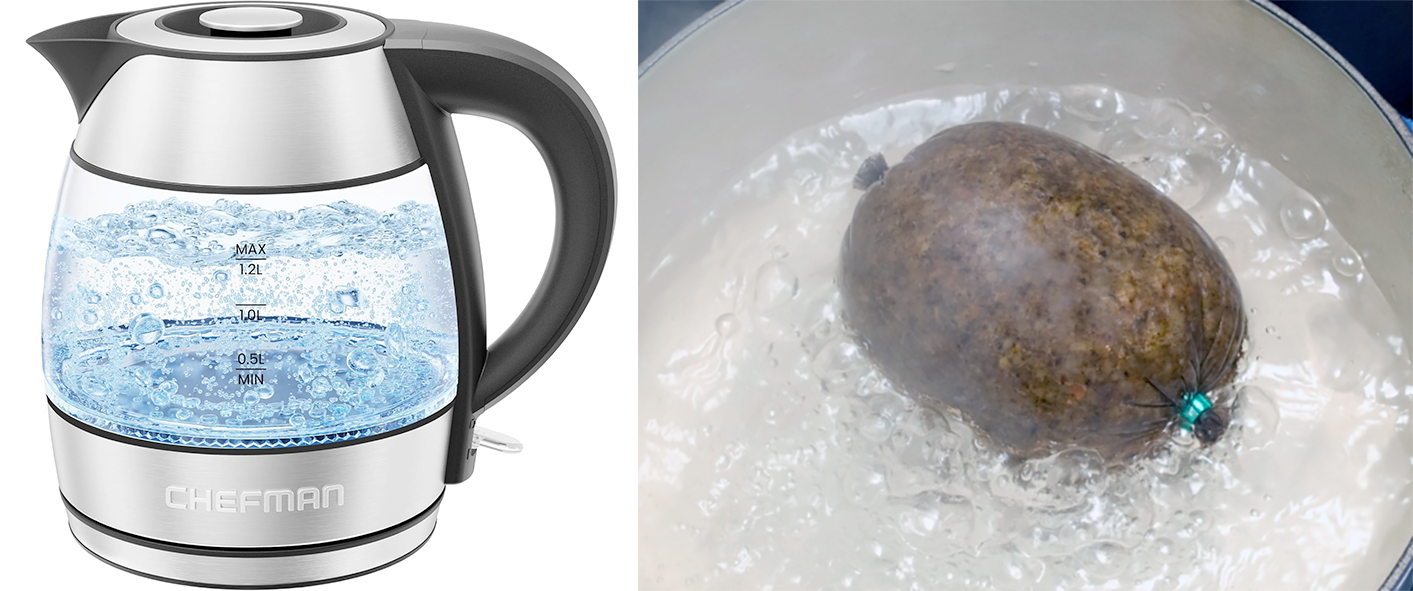 Kettle boiling (left), haggis boiling in pan (right).
Welcome to FabulousFusionFood's Boiling Recipes Page — Boiling or ebullition is the rapid phase transition from liquid to gas or vapour; the reverse of boiling is condensation. Boiling occurs when a liquid is heated to its boiling point, so that the vapour pressure of the liquid is equal to the pressure exerted on the liquid by the surrounding atmosphere. Boiling and evaporation are the two main forms of liquid vaporisation. In cookery, boiling is the process of cooking food in liquid (typically a water base) at the point where the liquid is converting to a gas. Boiling water is also used in several cooking methods including boiling, blanching, steaming, and poaching. Boiling is the method of cooking food in boiling water or other water-based liquids such as stock or milk. Simmering is gentle boiling, while in poaching the cooking liquid moves but scarcely bubbles.
After the control of fire, which was almost certainly used for direct roasting, pit ovens and leather bag based boiling are probably the next developments in cookery. Both rely on a fire heating stones or rocks. For the pit oven, the fire and stones are heated in the bottom of a pit. They're then covered with grass and leaves, which generate steam. The meat is placed on top and the whole is buried. The heat from the fire and the steam cook the food. For boiling in a leather bag, the water and food to be cooked are placed in a leather bag. The hot stones are dropped in and these bring the water and the contents of the bag to a boil. As soon as the ingredients begin to cool drop in another stone... this being the original 'boil in a bag' meal. So, you can boil food long before the invention of pottery or metal working. Indeed, boiling was almost certainly being used as a method of cooking long before the advent of farming. It lends itself to the hunter-gatherer lifestyle as a leather bag is easy to make and light to transport. It can be used to cook seafood, shellfish, game meat and any vegetables or grains that are foraged.
As a method of disinfecting water, bringing it to its boiling point at 100°C (212°F), is the oldest and most effective way since it does not affect the taste, it is effective despite contaminants or particles present in it, and is a single step process which eliminates most microbes responsible for causing intestine related diseases. The boiling point of water is 100°C (212°F) at sea level and at normal barometric pressure. In places having a proper water purification system, it is recommended only as an emergency treatment method or for obtaining potable water in the wilderness or in rural areas, as it cannot remove chemical toxins or impurities.
The boiling point of water is typically considered to be 100°C (212°F; 373K), especially at sea level. Pressure and a change in the composition of the liquid may alter the boiling point of the liquid. High elevation cooking generally takes longer since boiling point is a function of atmospheric pressure. At an elevation of about one mile (1,600 m), water boils at approximately 95 °C (203 °F; 368 K). Depending on the type of food and the elevation, the boiling water may not be hot enough to cook the food properly. Similarly, increasing the pressure as in a pressure cooker raises the temperature of the contents above the open air boiling point (which is why pressure cooking reduces the time required to cook food).
The advent of fireproof pottery allows meals to be cooked by placing the cooking vessel next to the fire. Once metalwork is developed cooking pots can be suspended over a fire, which is why stews feature in so many cuisines. During Medieval times in Europe, boiling was a major way of cooking and both savoury and sweet dishes were boiled, becoming known in English as 'puddings'. This is why, in Britain at least, black pudding, haggis, steamed cakes, Christmas pudding etc are all known as 'puddings'.
Tea and Brewing: As boiling renders water potable and safe, it's interesting how this developed to produce safe drinks in Europe and Asia. In Europe, boiled water was used to make beer, the alcohol in the beer then keeping the water safe and bacteria free for a long time after brewing. In Asia, water was boiled and made into an infusion with green or fermented tea leaves, a drink intended to be imbibed immediately.
The alphabetical list of all the boiling-based recipes on this site follows, (limited to 100 recipes per page). There are 411 recipes in total:
Page 4 of 5
| Pullum Anethatum (Aniseed Chicken) Origin: Roman | Sajta de Pollo Origin: Bolivia | Taffi (Condensed Milk Toffee) Origin: Togo |
| Pullum cum Olivis Columbadibus (Boiled Chicken with Columbadian Olives) Origin: Roman | Sakizli Muhallebi (Mastic Pudding) Origin: Turkey | Taiwanese Hot Pot Origin: Taiwan |
| Pulpo con salsa cítrica de mango (Octopus with citrus mango sauce) Origin: Easter Island | Saksak (Sago and Banana Dumpling) Origin: Papua New Guinea | Tapioca Origin: Nigeria |
| Pumpkin Ricotta gnocchi (Gnocchi de Zucca e Ricotta) Origin: Italy | Salade de tripes (Tripe Salad) Origin: Chad | Tatws Trwy Crwyn (Potatoes in Their Skins) Origin: Welsh |
| Pwdin Berwi (Boiled Pudding) Origin: Welsh | Salt Cod Origin: Britain | Tea-scented Eggs Origin: China |
| Pwdin Clwt (Clootie Dumpling) Origin: Welsh | Sanger Yena (Offal Sausages) Origin: Aruba | The Broon's Clapshot Origin: Scotland |
| Pwdin Crynu (Quaking Pudding) Origin: Welsh | Sausage Roly-poly Origin: England | The Most Kindely Way to Preserve Plums, Cherries, Gooseberries, &c. Origin: England |
| Pyggus in sauce (Pork in Sauce) Origin: England | Scots Barley Sugar Origin: Scotland | The Publisher's Pudding Origin: Britain |
| Ragi Roti Origin: India | Shellfish Seaweed Pudding Origin: Ancient | To Boil the Rice Origin: Britain |
| Rapa Nui Dumplings Origin: Easter Island | Sholeh Zard (Persian Yellow Rice Pudding) Origin: Iran | To Drie Apricocks, Peaches, Pippins or Pearplums Origin: England |
| Rasmalai Origin: India | Shuizhu niurou (Spicy Water-boiled Beef) Origin: China | To make a boiled rice pudding Origin: Britain |
| Ravjul (Maltese Ravioli) Origin: Malta | Sic Farcies eam Sepiam Coctam (Stuffed and Cooked Cuttlefish) Origin: Roman | To make a Collar of Brawn of a Breast of Pork Origin: Britain |
| Raw Fry Origin: England | Skate Curry Origin: Britain | To make a Haggas Pudding. Origin: Britain |
| Red Grout Dessert Origin: British Virgin Islands | Smoked haddock with Potato Mash Origin: Ireland | To make a Quaking Pudding Origin: Britain |
| Red Grout Dessert Origin: US Virgin Islands | Soy Chicken Wings Origin: China | To make Gingerbread Origin: Britain |
| Red Millet Asida (Brown Ugali) Origin: Uganda | Spaetzle (German Noodles) Origin: Germany | To make mince pies the best way Origin: Britain |
| Redcurrant Jus Origin: Britain | Spaetzle Noodles Origin: Germany | Togolese Yam Fufu Origin: Togo |
| Rhiwbob Rhost â Iogwrt (Limpets) Origin: Welsh | Spring Dolma Origin: Armenia | Traditional Black Pudding Origin: Britain |
| Rice Bujambura Origin: Mozambique | Spynee (Made From the Berries of Spines) Origin: England | Trinidad Paime Origin: Trinidad |
| Rice Congee Origin: Anglo-Indian | St Helena Black Pudding Origin: St Helena | Trolis Blawd Plaen (Plain Flour Trollies) Origin: Welsh |
| Risengrød (Rice Porridge) Origin: Denmark | St Kitts Coconut Dumplings Origin: Saint Kitts | Turkish Pilau Origin: British |
| Riz à l'Huile de Palme (Rice with Palm Oil) Origin: DR-Congo | Stewed Carp Origin: British | Turks and Caicos Boil Fish and Grits Origin: Turks Caicos |
| Riz à la Cannelle (Rice with Cinnamon) Origin: Cote dIvoire | Stewed Char Origin: British | Tuwo Shinkafa (Rice Flour Porridge) Origin: Nigeria |
| Riz Soumbala (Soumbala Rice) Origin: Burkina Faso | Stewed Chubb Origin: British | Ugandan Ugali Origin: Uganda |
| Rizogalo (Rice Pudding) Origin: Cyprus | Stewed Dace Origin: British | Uszka (Polish Christmas Dumplings) Origin: Poland |
| Roast Potato Gnocchi Origin: Britain | Stewed Eels I Origin: British | Varo Origin: India |
| Roast Red Bell Pepper and Garlic Sauce Origin: British | Stewed Eels II Origin: British | Vegetable Stock Origin: Britain |
| Roast Ribs of Beef Origin: Britain | Stewed Roach Origin: British | Ventrem Plenum (Stuffed Pig's Stomach) Origin: Roman |
| Roast Tomato and Bell Pepper Sauce Origin: British | Sumen (Sow's Belly) Origin: Roman | Vincentian and Grenadinian Paime Origin: Saint Vincent |
| Rolled Wheat Meal Swallow Origin: Nigeria | Sumen Plenum (Stuffed Sow's Belly) Origin: Roman | Virgin Islands Steamed Fish Origin: British Virgin Islands |
| Roman Gnocchi Origin: Britain | Sutlijaš (Bosnian Rice Pudding) Origin: Bosnia | Virgin Islands Steamed Fish Origin: US Virgin Islands |
| Russian Pierogi Origin: Russia | Sutlijaš (Serbian Rice Pudding) Origin: Serbia | Vulvulae Isiciatae (Forcemeat for Sow's Womb) Origin: Roman |
| Saffron Prawn Both Origin: Britain | Sutlijaš (Croatian Rice Pudding) Origin: Croatia | |
| Saint Lucia Paime Origin: Saint Lucia | Sutlijaš (Macedonian Rice Pudding) Origin: Macedonia |
Page 4 of 5