FabulousFusionFood's Steaming Recipes Home Page
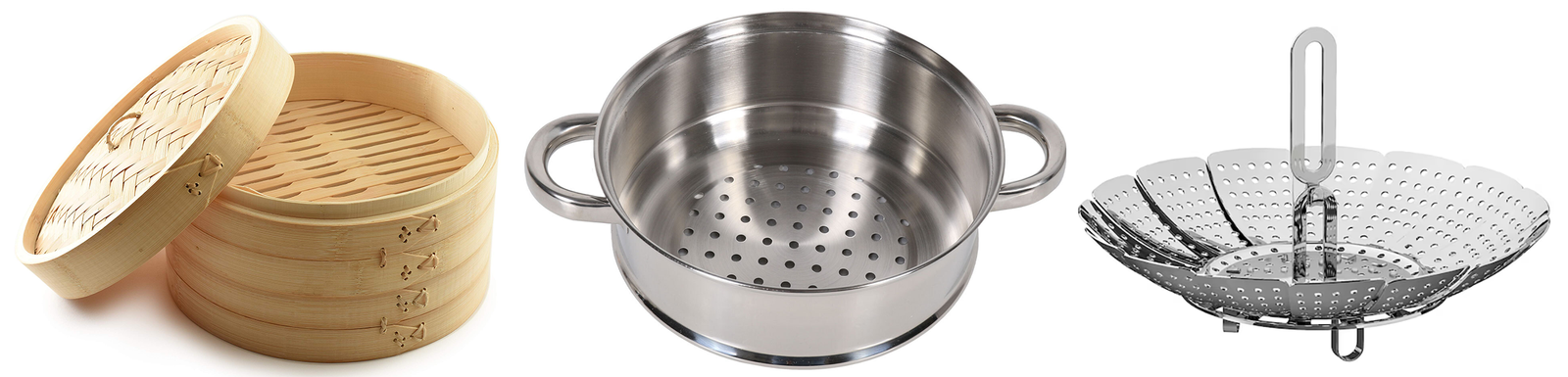 3 types of teamer. Bamboo steamer for woks, (left); steel steamer for sitting on a
saucepan (centre) adjustable steamer for use with a range of cookware (right).
Welcome to FabulousFusionFood's Steaming Recipes Page — Steaming is a method of cooking using steam. This is often done with a food steamer, a kitchen appliance made specifically to cook food with steam, but food can also be steamed in a wok or by partially submerging food (often puddings) in boiling water.
Because steaming can be achieved by heating less water or liquid, and because of the excellent thermodynamic heat transfer properties of steam, steaming can be as fast, or faster, than cooking in boiling water, as well as being more energy efficient.
Though steaming technology has been developed globally, the use of steaming for cooking food is most advanced in East Asia (particularly China and Japan where food is cooked in steamer baskets in direct contact with the steam). In the West, steaming is typically used to cook vegetables, leaving them crisper that if they're boiled. In the UK, steaming is often used for cooking puddings, but here though the food is cooked in steam the puddings are typically enclosed in bowls or other vessels and are not in direct contact with the steam.
Steaming, A History:
The oldest examples of steam cooking thus far uncovered have been found in Italy and Sardinia, created during the Bronze Age, and in Cochise County, Arizona, where steam pits were used for cooking about 10,000 years ago. In China's Yellow River Valley; early steam cookers made of stoneware have been found dating back as far as 5,000 BCE. The earliest steamers used cypress strips to isolate the food from the boiling water, designed in ways that in modern times bamboo would be used.Ancient Romans used a kind of steaming, for preparing patina recipes in a patina pan, an earthenware pot cooked directly over coals where the food is partly submerged and partly steamed.
In Asian, particularly Chinese, cookery a bamboo steamer basket sitting over boiling water in a wok is often used. The wok lid is then placed over the top of the whole steamer basket assembly, keeping the steam inside. Many woks are also sold with a metal frame that can be placed in the wok over boiling water, stews or curries so food can be steamed on top of the frame. Piles of bamboo steamer baskets can also be placed over a large steamer vessel, with a weighted lid placed on top (this is commonly used in Japan). The advantage of bamboo steamers is that absorbs excess moisture and allows heat to condense again over the delicate food.
Steel or aluminium steamers are more commonly used in Western cookery. The steamer basket sits on top of a normal saucepan, with the saucepan lid used to cover. These are typically used to cook vegetables, fish and shellfish, though sometimes small steamed puddings are also cooked in them. It is also increasingly common to cook rice, Asian style, by steaming. Note that terrines are also steamed, though this is done in a water bath in the oven (the same applies to desserts like crème brûlée)
In Britain, particularly, steaming is used to cook puddings. Here, the home-style steamers are typically more makeshift affairs. A large saucepan or stockpot is chosen and an inverted plate is set in the base, preventing the pudding from being in direct contact with the heat on the bottom of the saucepan. The pudding in a sealed basin is then set on top of the place. Boiling water is poured into the saucepan to come 1/3 to 1/2 way up the sides of the pudding. A lid is added and the entire assembly is placed over medium-high heat so the water comes to a boil. The water is maintained at a boil for several hours as the pudding cooks in its container. You can, these days, buy purpose-made pudding steamers.
Pressure cookers also often have steamer basket inserts to that vegetables can be cooked in the steam generated by the other foods cooking. Steamers (plastic or silicone) are available for microwaves, meaning that rice and other foods can be steamed in the microwave.
In African, particularly West African, cuisine, bean-based batters are steamed to make savoury cakes (like moi-moi). Sauces, such as those based on okra or irú are often steamed on top of the rice as it cooks. In Mexican and Central American cuisine, tamales are made by steaming a dough made from nixtamalized maize (called masa) in wrappers made from corn husks or banana leaves; the dough can be stuffed or left plain.
In Japan, glutinous rice is steamed to prepare mochi rice cakes. Traditional Japanese sweets or wagashi making involves steaming rice or wheat dough for making mochigashi and manju.
Probably the most famous steamed Chinese foods are dim sum, steamed filled dumplings. Rice is often steamed, though the Chinese tend to refer to this as just 'cooking' the rice. Seafood and meat dishes are steamed. For example: steamed whole fish, steamed crab, steamed pork spare ribs, steamed ground pork or beef, steamed chicken and steamed goose. Chinese steamed eggs is a savoury dish with a consistency similar to custard.
How Steaming Works
Steaming works by boiling water continuously, causing it to vaporise into steam; the steam then carries heat to the nearby food, thus cooking the food. The food is kept separate from the boiling water but has direct contact with the steam, resulting in a moist texture to the food. This differs from using a bain-marie (double boiler), in which food is not directly exposed to steam, or pressure cooking, which uses a sealed vessel — though it can be argued that a pressure cooker is capable of pressure steaming and submerged cooking.The alphabetical list of all the Steaming recipes on this site follows, (limited to 100 recipes per page). There are 297 recipes in total:
Page 1 of 3
| Aliter Dulcia (Another Kind of Dessert) Origin: Roman | Char Siu Bao (Steamed Barbecued Pork Dumplings) Origin: China | Dim Sum Dumplings Origin: China |
| Amok Trey Khmer (Cambodian Fish Amok) Origin: Cambodia | Char Siu Bao (Steamed Barbecued Pork Dumplings) Origin: Hong Kong | Dim Sum Dumplings Origin: Hong Kong |
| Asparagus in Orange Sauce Origin: Spain | Cheddar Cheese Pudding Origin: Britain | Dim Sum Dumplings Origin: Taiwan |
| Attiéké Origin: Cote dIvoire | Chicken Momos Origin: China | Ducana Origin: Antigua |
| Attiéké de Poisson (Attieke with Fried Fish) Origin: Cote dIvoire | Chikwangue (Gabonnaise Cassava Sticks) Origin: Gabon | Ducana Origin: Saint Vincent |
| Attiéké Origin: Cote dIvoire | Chimbama (Banana and Maize Meal Bread) Origin: Malawi | Duckna Origin: Montserrat |
| Aunu Senebre Origin: Papua | Chinese Steamed Eggs Origin: China | Dwmplinau Caws (Cheese Dumplings) Origin: Welsh |
| Aunu Senebre Origin: Papua New Guinea | Chinese Steamed Whole Fish Origin: China | Economical Mince Origin: Scotland |
| Bâton de Manioc (Cassava Sticks) Origin: Central Africa | Chocolat Pots de Crème Origin: France | Ekoki Origin: Cameroon |
| Baghali Shevid Polow (Lima Bean with Dill Rice) Origin: Iran | Chocolate Pudding with Whisky Sauce Origin: Scotland | Ekuru with Ata Sauce (Steamed Savoury Beans with Ata Sauce) Origin: Nigeria |
| Baked Millet Biscuits Origin: Kenya | Christmas Bread Pudding Origin: American | Enguinar 2 (Stuffed Artichokes) Origin: Armenia |
| Barbecue-poached Salmon Origin: British | Christmas Pastelles Origin: Trinidad | Eog (neu Wyniedyn) Agerog (Steamed Salmon (or Sewin)) Origin: Welsh |
| Barbecued Venison Tenderloins Origin: American | Christmas Plum Pudding Origin: Northern Ireland | Fante Kenkey Origin: Ghana |
| Basic Dhokla (Basic Steamed Rice and Dhal Cake) Origin: India | Christmas Plum Pudding Origin: Jamaica | Figgy-dowdy Origin: England |
| Bassi (Malian Couscous) Origin: Mali | Chu Hou Paste Origin: Hong Kong | Flan de Leche Origin: El Salvador |
| Batatis Mahshiya (Stuffed Potatoes) Origin: Egypt | Cloutie Dumpling Origin: Scotland | Flan de Maracuyá y Coco (Passionfruit and Coconut Flan) Origin: Mexico |
| Bebotok Sapi (Indonesian Meatloaf) Origin: Indonesia | Coconut Pitha Origin: Anglo-Indian | Foil-baked Chicken with English Mace Origin: Britain |
| Bhapa Doi (Bengali Steamed Yoghurt) Origin: India | Cod's Head and Shoulders Origin: British | Fonio Cuit à la Vapeur (Steamed Fonio) Origin: Senegal |
| Black Cap Pudding Origin: Scotland | Collegiate Pudding Origin: British | Foubey (Millet Couscous with Moringa) Origin: Niger |
| Black Cap Pudding II Origin: British | Collegiate Pudding Origin: British | Frankfurter Sausage Origin: Germany |
| Blackcap Pudding Origin: Ireland | Conkies Origin: Bahamas | Free Kirk Pudding Origin: Scotland |
| Boiled Sea Kale Flowers Origin: Britain | Conkies Origin: Guyana | Fruit Mince Pudding with Citrus Sauce Origin: Britain |
| Bonnie Prince Pudding Origin: Scotland | Cornmeal Gingerbread Pudding Origin: American | Fura Gero da Nono Origin: Nigeria |
| Boulettes de Poisson Burkinabé (Burkinabe Fish Balls) Origin: Burkina Faso | Country Pork Terrine Origin: England | Game Terrine Origin: Britain |
| Brined and Braaied Christmas Turkey Origin: South Africa | Crappit Heid Origin: Scotland | Getuk Lindri (Coconut Steamed Cassava Cake) Origin: Brunei |
| Brown Rice with Kombu Origin: Ireland | Creme Caramela (Caramel Custard) Origin: Sudan | Glutinous (Sweet) Rice Origin: Laos |
| Budget Christmas Pudding Origin: Britain | Cuisson du Fonio à la Vapeur (Fonio Cooked by Steaming) Origin: Guinea | Golden Syrup Pumpkin Pudding Origin: Britain |
| Buuz (Steamed Dumplings) Origin: Mongolia | Cum faba (Broad Beans in a Coriander Sauce) Origin: Roman | Gurnard Fillets Steamed on a Bed of Wrack Origin: England |
| Cabinet Pudding Origin: Britain | Cup Pudding Origin: Manx | Gurnard in Tamarind Sauce Origin: Fusion |
| Cameroonian Egusi Pudding Origin: Cameroon | Curry Vert avec Poisson, Cuit à Vapeur (Steamed Green Curry with Fish) Origin: France | Gwymon Codog wedi Stemio (Steamed Bladderwrack) Origin: Welsh |
| Capitaine, Sauce aux Agrumes (Steamed Catfish with Citrus Sauce) Origin: Mali | Cymas et cauliculos (Cabbage Shoots) Origin: Roman | Haam am Hée (Ham Steamed on Hay) Origin: Luxembourg |
| Cassava Pudding Origin: Solomon Islands | Daello Thiyal (Sri Lankan Cuttlefish Curry) Origin: Sri Lanka | Haiken (Chicken and Prawn Egg Rolls) Origin: Mauritius |
| Cassava Pudding Origin: Vanuatu | Dal'aa M'amra B'kaskou Watmar (Shoulder of Lamb with Couscous and Date Stuffing) Origin: Morocco | |
| Cavolo Agra (Cabbage with Bacon and Fennel Seeds) Origin: Italy | Dark Chocolate Pudding with Mocha Sauce Origin: Britain |
Page 1 of 3