FabulousFusionFood's Nut-based Recipes 42th Page
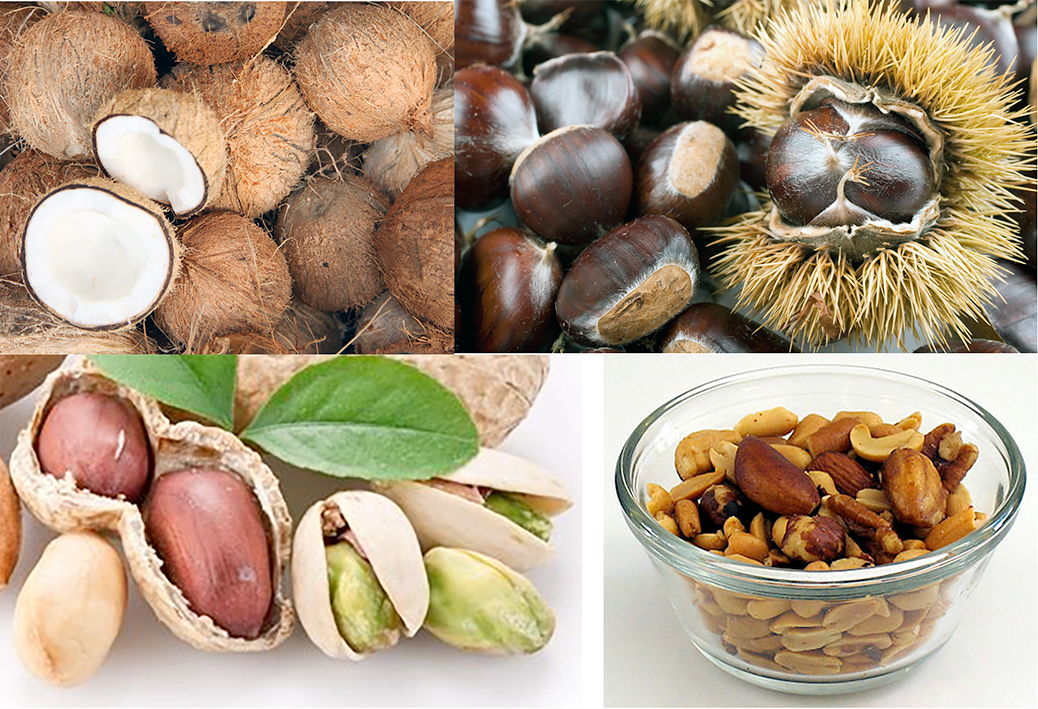 Different nuts. Clockwise: coconuts, sweet chestnuts, bowl of mixed nuts,
peanuts and pistachios.
Welcome to FabulousFusionFood's Nut-based Recipes Page —A nut is a fruit consisting of a hard or tough nutshell protecting a kernel which is usually edible. In general usage and in a culinary sense, many dry seeds are called nuts. In a botanical context, "nut" implies that the shell does not open to release the seed (indehiscent).
Most seeds come from fruit that naturally free themselves from the shell, but this is not the case in nuts such as hazelnuts, chestnuts, and acorns, which have hard shell walls and originate from a compound ovary. The general and original usage of the term is less restrictive, and many nuts (in the culinary sense), such as almonds, pistachios, and Brazil nuts, are not nuts in a botanical sense. Common usage of the term often refers to any hard-walled, edible kernel as a nut. Nuts are an energy-dense and nutrient-rich food source.
Botanically, a nut is a fruit with a woody pericarp developing from a syncarpous gynoecium. True nuts include, for example, chestnut, hazelnut and filbert. Culinarily, the term 'nut' is used much more widely, and includes examples of drupes (such as pecans and almonds) or seeds (such as pine nuts and peanuts).
Also widely known as nuts are dry drupes, which include pecans, almonds, macadamia (Macadamia integrifolia), candlenut (Aleurites moluccanus) and the water caltrop (Trapa bicornis). A drupe is an indehiscent fruit that has an outer fleshy part consisting of the exocarp, or skin, and mesocarp, or flesh, which surround a single pit or stone, the endocarp with a seed (kernel) inside. In a dry drupe, the outer parts dry up and the remaining husk is part of the ovary wall or pericarp, and the hard inner wall surrounding the seed represents the inner part of the pericarp.
Walnuts and hickories (Juglandaceae) have fruit that are difficult to classify. They are considered to be nuts under some definitions but are also referred to as drupaceous nuts.
In common use, a "tree nut" is, as the name implies, any nut coming from a tree. This most often comes up regarding food allergies; a person may be allergic specifically to peanuts (which are not tree nuts but legumes), whereas others may be allergic to the wider range of nuts that grow on trees.
The sweet potato arrived in Europe with the Columbian exchange. It is recorded, for example, in Elinor Fettiplace's Receipt Book, compiled in England in 1604.
Nuts are eaten by humans and wildlife. Because nuts generally have a high oil content, they are a significant energy source. Many seeds are edible by humans and used in cooking, eaten raw, sprouted, or roasted as a snack food, ground to make nut butters, or pressed for oil that is used in cooking and cosmetics.
Nuts used for food are a common source of food allergens. Reactions can range from mild symptoms to severe ones, a condition known as anaphylaxis, which can be life-threatening. The reaction is due to the release of histamine by the body in response to an allergen in the nuts, causing skin and other possible reactions. Many experts suggest that a person with an allergy to peanuts should avoid eating tree nuts, and vice versa.
The nuts linked to from this page are: acorn; almond; beech nuts; betel nut; brazil nut; bush mango; filbert; ginkgo nut; kola nut; candlenut; cashew; chestnut; coconut; hazelnut; macadamia; ogbono; palm nut; peanut; pecan; pine nut; pistachio; walnut.
The alphabetical list of all the nut-based recipes on this site follows, (limited to 100 recipes per page). There are 4134 recipes in total:
Page 42 of 42
| Xawaash Origin: Djibouti | Yeasted Currant Loaf Origin: Britain | Zanzibar Kashata Origin: Tanzania |
| Xerém Tradicional (Traditional Xerem) Origin: Cape Verde | Yellow Coconut Rice Origin: Tanzania | Zarzuela de Mariscos (Seafood Zarzuela) Origin: Spain |
| Xinxim (Brazilian Chicken and Crayfish in Peanut Sauce) Origin: Brazil | Yellow Curry with Swiss Chard and Tofu Origin: Fusion | Zereshk Polo Origin: Iran |
| Y Gacen Amhosibl (The Impossible Cake) Origin: Welsh | Yoghurt and Honey Pancakes with Citrus Fruit Origin: Britain | Zereshk Polo ba Morgh (Saffron Chicken with Barberry Rice) Origin: Iran |
| Yaji (Nigerian Meat Seasoning) Origin: Nigeria | Yoghurt Lamb Steaks with Minted Yoghurt Origin: Britain | Zimbabwean Sweet Potato Biscuits Origin: Zimbabwe |
| Yaji Spice (Suya Spice Blend) Origin: Nigeria | Yoghurty Flapjacks Origin: Britain | Zom (Bitter Greens with Meat) Origin: Cameroon |
| Yalanchy Sarma (Armenian Stuffed Vine Leaves) Origin: Armenia | Yorkshire Curd Tart Origin: England | Zuppa di Castagne (Chestnut Soup) Origin: Italy |
| Yam Balls Origin: West Africa | Yuletide Fruit Bread Origin: England | Zuppa di Ciliege (Stewed Cherries) Origin: San Marino |
| Yam Curry Origin: Vanuatu | Zafrani Murgh Origin: India | Zuppa Paradiso (Paradise Soup) Origin: Italy |
| Yam with Greens, Onion, and Okra Origin: Nigeria | Zafrani Mutton Korma Origin: Pakistan | Πλατσέντα Λέσβου (Lesbos Placenta) Origin: Greece |
| Yapese Taro Fritters Origin: Federated States Micronesia | Zamé Origin: Mali | |
| Yeasted Barm Brack Origin: Ireland | Zanzibar Fish Curry Origin: Tanzania |
Page 42 of 42