FabulousFusionFood's Maize/Corn-based Recipes 6th Page
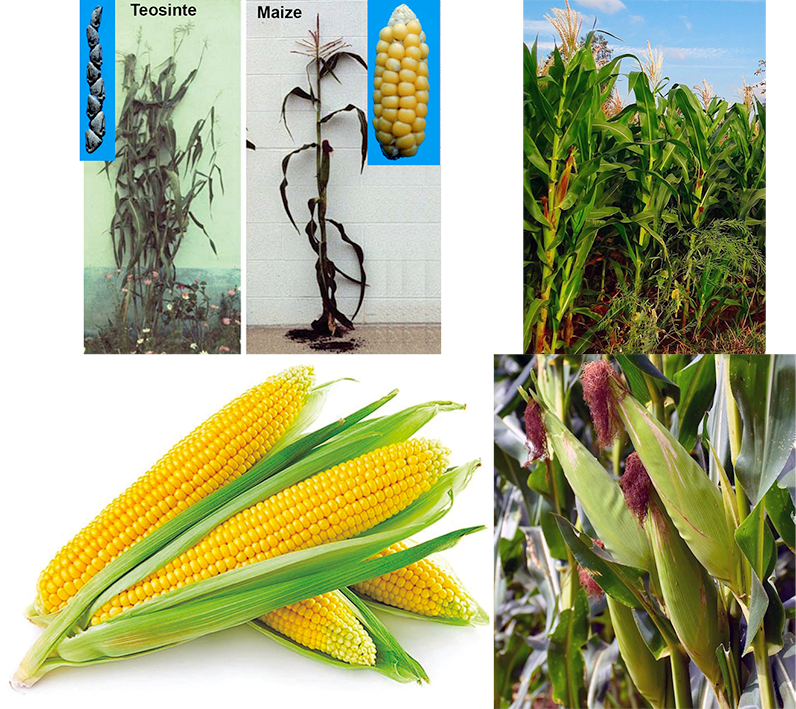 Clockwise from top left: Comparison of teosinte and maize plants, maize growing
in a field, developing ears of maize, ears of sweetcorn.
Welcome to FabulousFusionFood's Maize/Corn-based Recipes Page — Maize (/meɪz/; Zea mays), also known as corn in North American English is a tall stout grass that produces cereal grain. The maize genus Zea is relatively closely related to sorghum and sugarcane, all three lying in the PACMAD clade of Old World grasses, and much more distantly to rice and wheat, which are in the other major group of grasses, the BOP clade. It is closely related to Tripsacum, gamagrass.
Maize is the domesticated variant of the four species of teosintes, which are its crop wild relatives. The two plants have dissimilar appearance, maize having a single tall stalk with multiple leaves and teosinte being a short, bushy plant. The difference between the two is largely controlled by differences in just two genes, called grassy tillers-1 (gt1, A0A317YEZ1) and teosinte branched-1 (tb1, Q93WI2). In 2004, John Doebley identified Balsas teosinte, Zea mays subsp. parviglumis, native to the Balsas River valley in Mexico's southwestern highlands, as the crop wild relative genetically most similar to modern maize. Maize pollen dated to 7,300 years ago from San Andres, Tabasco has been found on the Caribbean coast. A primitive corn was being grown in southern Mexico, Central America, and northern South America 7,000 years ago.
Maize requires human intervention for its propagation. The kernels of its naturally-propagating teosinte ancestor fall off the cob on their own, while those of domesticated maize do not. All maize arose from a single domestication in southern Mexico about 9,000 years ago. The oldest surviving maize types are those of the Mexican highlands. Maize spread from this region to the lowlands and over the Americas along two major paths. The centre of domestication was most likely the Balsas River valley of south-central Mexico. Maize reached highland Ecuador at least 8000 years ago. It reached lower Central America by 7600 years ago, and the valleys of the Colombian Andes between 7000 and 6000 years ago.
The earliest maize plants grew a single, small ear per plant. The Olmec and Maya cultivated maize in numerous varieties throughout Mesoamerica; they cooked, ground and processed it through nixtamalization. By 3000 years ago, maize was central to Olmec culture, including their calendar, language, and myths.
After the arrival of Europeans in 1492, Spanish settlers consumed maize, and explorers and traders carried it back to Europe. Spanish settlers much preferred wheat bread to maize. Maize flour could not be substituted for wheat for communion bread, since in Christian belief at that time only wheat could undergo transubstantiation and be transformed into the body of Christ.
Maize spread to the rest of the world because of its ability to grow in diverse climates. It was cultivated in Spain just a few decades after Columbus's voyages and then spread to Italy, West Africa, the Philippines and elsewhere. By the 17th century, it was a common peasant food in Southern Europe. By the 18th century, it was the chief food of the southern French and Italian peasantry, especially as polenta in Italy.
When maize was introduced into Western farming systems, it was welcomed for its productivity. However, a widespread problem of malnutrition soon arose wherever it had become a staple food. Indigenous Americans had learned to soak maize in alkali-water – made with ashes and lime – since at least 1200–1500 BC, creating the process of nixtamalization. They did this to liberate the corn hulls, but coincidentally it also liberated the B-vitamin niacin, the lack of which caused pellagra. Once alkali processing and dietary variety were understood and applied, pellagra disappeared in the developed world. The development of high-lysine maize and the promotion of a more balanced diet have contributed to its demise. Pellagra still exists in food-poor areas and refugee camps where people survive on donated maize.
The name maize derives from the Spanish form maíz of the Taíno mahis. The Swedish botanist Carl Linnaeus used the common name maize as the species epithet in Zea mays. The name maize is preferred in formal, scientific, and international usage as a common name because it refers specifically to this one grain, unlike corn, which has a complex variety of meanings that vary by context and geographic region. Most countries primarily use the term maize, and the name corn is used mainly in the United States and a handful of other English-speaking countries. In countries that primarily use the term maize, the word corn may denote any cereal crop, varying geographically with the local staple, such as wheat in England and oats in Scotland or Ireland. The usage of corn for maize started as a shortening of "Indian corn" in 18th-century North America.
Maize is a tall annual grass with a single stem, ranging in height from 1.2 to 4m. The long narrow leaves arise from the nodes or joints, alternately on opposite sides on the stalk. Maize is monoecious, with separate male and female flowers on the same plant. At the top of the stem is the tassel, an inflorescence of male flowers; their anthers release pollen, which is dispersed by wind. Like other pollen, it is an allergen, but most of it falls within a few meters of the tassel and the risk is largely restricted to farm workers. The female inflorescence, some way down the stem from the tassel, is first seen as a silk, a bundle of soft tubular hairs, one for the carpel in each female flower, which develops into a kernel (often called a seed. Botanically, as in all grasses, it is a fruit, fused with the seed coat to form a caryopsis) when it is pollinated. A whole female inflorescence develops into an ear or corncob, enveloped by multiple leafy layers or husks. The ear leaf is the leaf most closely associated with a particular developing ear. This leaf and those above it contribute over three quarters of the carbohydrate (starch) that fills the grain.
The grains are usually yellow or white in modern varieties; other varieties have orange, red, brown, blue, purple, or black grains. They are arranged in 8 to 32 rows around the cob; there can be up to 1200 grains on a large cob. Yellow maizes derive their colour from carotenoids; red maizes are coloured by anthocyanins and phlobaphenes; and orange and green varieties may contain combinations of these pigments.
Maize is widely cultivated throughout the world, and a greater weight of maize is produced each year than any other grain. In 2020, total world production was 1.16 billion tonnes, led by the United States with 31.0% of the total (table). China produced 22.4% of the global total.
Maize and cornmeal (ground dried maize) constitute a staple food in many regions of the world. Maize is used to produce the food ingredient cornstarch. Maize starch can be hydrolyzed and enzymatically treated to produce high fructose corn syrup, a sweetener. Maize may be fermented to produce beer (common in Italy) and further distilled to produce Bourbon whiskey. Corn oil is extracted from the germ of the grain.
In prehistoric times, Mesoamerican women used a metate quern to grind maize into cornmeal. After ceramic vessels were invented the Olmec people began to cook maize together with beans, improving the nutritional value of the staple meal. Although maize naturally contains niacin, an important nutrient, it is not bioavailable without the process of nixtamalization. The Maya used nixtamal meal to make porridges and tamales. Maize is a staple of Mexican cuisine. Masa (nixtamal) is the main ingredient for tortillas, atole and many other dishes of Central American food. It is the main ingredient of corn tortilla, tamales, atole and the dishes based on these. The corn smut fungus, known as huitlacoche, which grows on maize, is a Mexican delicacy.
Coarse maize meal is made into a thick porridge in many cultures: from the polenta of Italy, the angu of Brazil, the mămăligă of Romania, to cornmeal mush in the US (or hominy grits in the Southern US) or the food called mieliepap in South Africa and sadza, nshima, ugali and other names in other parts of Africa. Introduced into Africa by the Portuguese in the 16th century, maize has become Africa's most important staple food crop.
Sweet corn (or sweetcorn), a genetic variety that is high in sugars and low in starch, is eaten in the unripe state as corn on the cob.
The alphabetical list of all the maize/corn-based recipes on this site follows, (limited to 100 recipes per page). There are 633 recipes in total:
Page 6 of 7
| Riz des Iles (Island Rice) Origin: Comoros | Sierra Leonean Pork Fried Rice Origin: Sierra Leone | Stywepap (Stiff Maize Porridge) Origin: South Africa |
| Roast Megrim with Parsley and Caper Butter Origin: England | Sint Eustatian Johnny Cakes Origin: Sint Eustatius | Succotash Origin: America |
| Roasted Maize Origin: Nigeria | Slangetjies (Pea Flour Noodles) Origin: South Africa | Succotash Origin: Equatorial Guinea |
| Romee (Cornmeal Mush) Origin: Georgia | Slappap (Soft Maize Porridge) Origin: South Africa | Suck Cream Origin: England |
| Rooibos Krummelpap (Rooibos Crumbly Maize Meal) Origin: South Africa | Smočani kačamak (Fatty porridge) Origin: Montenegro | Sugarplum Turkish Delights Origin: Britain |
| Rooibos Slappap (Rooibos Soft Maize Porridge) Origin: South Africa | Smoked Haddock Chowder Origin: Ireland | Swazi Cornbread Origin: eSwatini |
| Rooibos Stywepap (Rooibos Stiff Maize Porridge) Origin: South Africa | Smoky Sweetcorn and Avocado Salsa Origin: South Africa | Sweet Cornbread Origin: America |
| Rote Grütze (German Red Berry Dessert) Origin: Germany | Soda Bread Origin: Britain | Tagliarini with Gurnard, Parsley, Garlic and Sea Spaghetti Origin: England |
| Rwandan Ugali Origin: Rwanda | Sopa Mexicana de Flor de Calabaza (Mexican Pumpkin Flower Soup) Origin: Mexico | Taita (Eritrean Flatbread) Origin: Eritrea |
| Saba Johnny Cakes Origin: Saba | Sopa Paraaguaya (Paraguayan Cornbread) Origin: Paraguay | Tamal de Maicena Origin: Costa Rica |
| Sadza (Corn Porridge) Origin: Zimbabwe | Sopa Paraguayana (Paraguayan soup) Origin: Paraguay | Tamal de Olla Origin: Panama |
| Saffron Prawn Both Origin: Britain | Sopi di Piská (Fish Soup) Origin: Aruba | Tamales Origin: Mexico |
| Sage and Onion Stuffed Monkfish Origin: Britain | Sopi di Piská (Fish Soup) Origin: Bonaire | Tamales de pollo salvadoreños (Salvadoran Chicken Tamales) Origin: El Salvador |
| Saint Lucia Paime Origin: Saint Lucia | Sopi di Piská (Fish Soup) Origin: Curacao | Tamåles Gisu (Tamales gisu) Origin: Northern Mariana Islands |
| Salade de Papaye (Papaya Salad) Origin: Togo | Sour Milk Ginger Cake Origin: England | Tamåles Gisu (Tamales gisu) Origin: Guam |
| Salted Pilchard and Leek Pie Origin: Britain | Sour Sauce Pasty Origin: England | Tarte à la crème de noix de coco (Coconut Cream Pie) Origin: Tahiti |
| Samp Origin: eSwatini | Soused Cornish Sardines Origin: England | Tartys Choklet (Chocolate Tarts) Origin: England |
| Samp and Beans Croquettes Origin: South Africa | Southern Cornbread Origin: American | Tesen Aval (Cornish Apple Cake) Origin: England |
| Sancochi di Galinja (Chicken Stew) Origin: Aruba | Southern Fried Seasoning Origin: America | Tex-Mex Beef Tacos Origin: America |
| Sancocho de siete carnes (Seven meat stew) Origin: Dominican Republic | Southern Succotash Origin: America | Tex-Mex Quesadillas Origin: America |
| Sancocho Dominicano (Dominican Stew) Origin: Dominican Republic | Southern-fried Chicken Tacos Origin: Britain | The Ultimate Sharing Nachos Origin: Fusion |
| Saramura (Grilled Carp Fillets) Origin: Hungary | Special Fried Rice with Oxeye Daisy Greens Origin: Fusion | Thiove Origin: Mozambique |
| Sausage Roly-poly Origin: England | Speedy Chilli Bean Wraps Origin: Fusion | Three-cornered Leek Omelette Origin: Britain |
| Savoury Corn Muffins Origin: American | Spider Crab Casserole Origin: Britain | Three-cornered Leek Pesto Origin: Britain |
| Scallop Broth with Cornish Earlies Origin: England | Spider-crab Salad with Cornish Earlies Origin: Britain | Three-cornered Leeks Tempura Origin: Britain |
| Scrambled Eggs with Thee-cornered Leek Origin: Britain | Spinach and Potato Croquettes Origin: Ireland | Ting Origin: Botswana |
| Selsyg Kernowek (Cornish Sausages) Origin: England | Splytys Kernewek (Cornish Splits) Origin: England | Tirk doung (Tom Yam Goong 1) Origin: Cambodia |
| Semovita Origin: Nigeria | Sri Lankan Love Cake Origin: Sri Lanka | Tom Brown Origin: Nigeria |
| Shellfish and Leek Roly-poly Origin: Britain | St Clements Morning Quickbread Origin: Britain | Tom Brown Porridge Origin: Ghana |
| Shima Origin: Mozambique | Stargazy Pasty Origin: England | Touo du Niger (Nigerienne Touo) Origin: Niger |
| Shisa Nyama Origin: South Africa | Stewed Scallops in Milk Origin: Britain | Traditional Cornbread Origin: America |
| Shisa Nyama Origin: eSwatini | Strawberry Jelly Origin: England | Traditional Cornish Pasty Origin: Cornwall |
| Shishwala (Maize Porridge) Origin: eSwatini | Street Corn Salsa Origin: America | |
| Sidvudvu (Pumpkin Porridge) Origin: eSwatini | Stuffed Chicken Roll-ups Origin: Cornwall |
Page 6 of 7