FabulousFusionFood's Maize/Corn-based Recipes 3rd Page
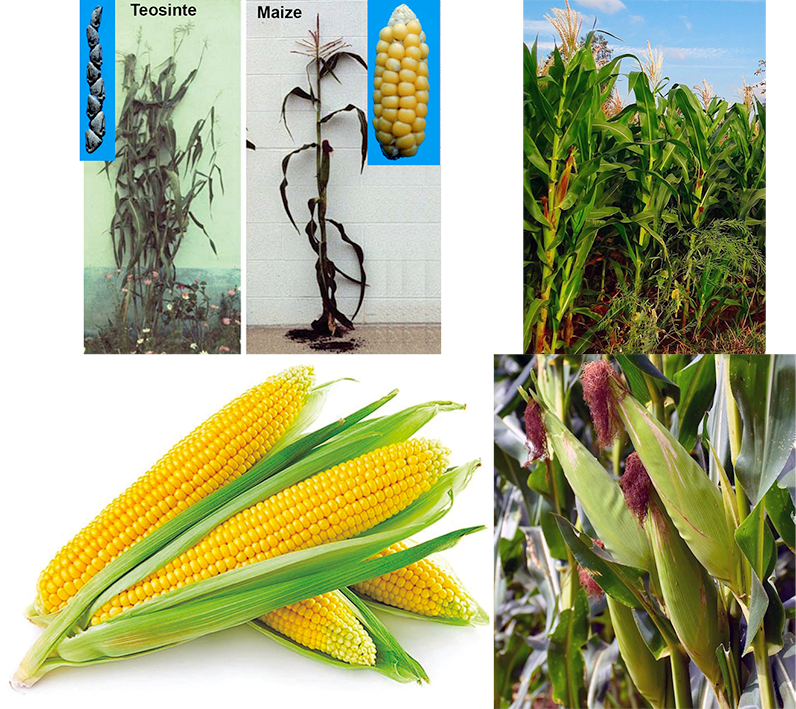 Clockwise from top left: Comparison of teosinte and maize plants, maize growing
in a field, developing ears of maize, ears of sweetcorn.
Welcome to FabulousFusionFood's Maize/Corn-based Recipes Page — Maize (/meɪz/; Zea mays), also known as corn in North American English is a tall stout grass that produces cereal grain. The maize genus Zea is relatively closely related to sorghum and sugarcane, all three lying in the PACMAD clade of Old World grasses, and much more distantly to rice and wheat, which are in the other major group of grasses, the BOP clade. It is closely related to Tripsacum, gamagrass.
Maize is the domesticated variant of the four species of teosintes, which are its crop wild relatives. The two plants have dissimilar appearance, maize having a single tall stalk with multiple leaves and teosinte being a short, bushy plant. The difference between the two is largely controlled by differences in just two genes, called grassy tillers-1 (gt1, A0A317YEZ1) and teosinte branched-1 (tb1, Q93WI2). In 2004, John Doebley identified Balsas teosinte, Zea mays subsp. parviglumis, native to the Balsas River valley in Mexico's southwestern highlands, as the crop wild relative genetically most similar to modern maize. Maize pollen dated to 7,300 years ago from San Andres, Tabasco has been found on the Caribbean coast. A primitive corn was being grown in southern Mexico, Central America, and northern South America 7,000 years ago.
Maize requires human intervention for its propagation. The kernels of its naturally-propagating teosinte ancestor fall off the cob on their own, while those of domesticated maize do not. All maize arose from a single domestication in southern Mexico about 9,000 years ago. The oldest surviving maize types are those of the Mexican highlands. Maize spread from this region to the lowlands and over the Americas along two major paths. The centre of domestication was most likely the Balsas River valley of south-central Mexico. Maize reached highland Ecuador at least 8000 years ago. It reached lower Central America by 7600 years ago, and the valleys of the Colombian Andes between 7000 and 6000 years ago.
The earliest maize plants grew a single, small ear per plant. The Olmec and Maya cultivated maize in numerous varieties throughout Mesoamerica; they cooked, ground and processed it through nixtamalization. By 3000 years ago, maize was central to Olmec culture, including their calendar, language, and myths.
After the arrival of Europeans in 1492, Spanish settlers consumed maize, and explorers and traders carried it back to Europe. Spanish settlers much preferred wheat bread to maize. Maize flour could not be substituted for wheat for communion bread, since in Christian belief at that time only wheat could undergo transubstantiation and be transformed into the body of Christ.
Maize spread to the rest of the world because of its ability to grow in diverse climates. It was cultivated in Spain just a few decades after Columbus's voyages and then spread to Italy, West Africa, the Philippines and elsewhere. By the 17th century, it was a common peasant food in Southern Europe. By the 18th century, it was the chief food of the southern French and Italian peasantry, especially as polenta in Italy.
When maize was introduced into Western farming systems, it was welcomed for its productivity. However, a widespread problem of malnutrition soon arose wherever it had become a staple food. Indigenous Americans had learned to soak maize in alkali-water – made with ashes and lime – since at least 1200–1500 BC, creating the process of nixtamalization. They did this to liberate the corn hulls, but coincidentally it also liberated the B-vitamin niacin, the lack of which caused pellagra. Once alkali processing and dietary variety were understood and applied, pellagra disappeared in the developed world. The development of high-lysine maize and the promotion of a more balanced diet have contributed to its demise. Pellagra still exists in food-poor areas and refugee camps where people survive on donated maize.
The name maize derives from the Spanish form maíz of the Taíno mahis. The Swedish botanist Carl Linnaeus used the common name maize as the species epithet in Zea mays. The name maize is preferred in formal, scientific, and international usage as a common name because it refers specifically to this one grain, unlike corn, which has a complex variety of meanings that vary by context and geographic region. Most countries primarily use the term maize, and the name corn is used mainly in the United States and a handful of other English-speaking countries. In countries that primarily use the term maize, the word corn may denote any cereal crop, varying geographically with the local staple, such as wheat in England and oats in Scotland or Ireland. The usage of corn for maize started as a shortening of "Indian corn" in 18th-century North America.
Maize is a tall annual grass with a single stem, ranging in height from 1.2 to 4m. The long narrow leaves arise from the nodes or joints, alternately on opposite sides on the stalk. Maize is monoecious, with separate male and female flowers on the same plant. At the top of the stem is the tassel, an inflorescence of male flowers; their anthers release pollen, which is dispersed by wind. Like other pollen, it is an allergen, but most of it falls within a few meters of the tassel and the risk is largely restricted to farm workers. The female inflorescence, some way down the stem from the tassel, is first seen as a silk, a bundle of soft tubular hairs, one for the carpel in each female flower, which develops into a kernel (often called a seed. Botanically, as in all grasses, it is a fruit, fused with the seed coat to form a caryopsis) when it is pollinated. A whole female inflorescence develops into an ear or corncob, enveloped by multiple leafy layers or husks. The ear leaf is the leaf most closely associated with a particular developing ear. This leaf and those above it contribute over three quarters of the carbohydrate (starch) that fills the grain.
The grains are usually yellow or white in modern varieties; other varieties have orange, red, brown, blue, purple, or black grains. They are arranged in 8 to 32 rows around the cob; there can be up to 1200 grains on a large cob. Yellow maizes derive their colour from carotenoids; red maizes are coloured by anthocyanins and phlobaphenes; and orange and green varieties may contain combinations of these pigments.
Maize is widely cultivated throughout the world, and a greater weight of maize is produced each year than any other grain. In 2020, total world production was 1.16 billion tonnes, led by the United States with 31.0% of the total (table). China produced 22.4% of the global total.
Maize and cornmeal (ground dried maize) constitute a staple food in many regions of the world. Maize is used to produce the food ingredient cornstarch. Maize starch can be hydrolyzed and enzymatically treated to produce high fructose corn syrup, a sweetener. Maize may be fermented to produce beer (common in Italy) and further distilled to produce Bourbon whiskey. Corn oil is extracted from the germ of the grain.
In prehistoric times, Mesoamerican women used a metate quern to grind maize into cornmeal. After ceramic vessels were invented the Olmec people began to cook maize together with beans, improving the nutritional value of the staple meal. Although maize naturally contains niacin, an important nutrient, it is not bioavailable without the process of nixtamalization. The Maya used nixtamal meal to make porridges and tamales. Maize is a staple of Mexican cuisine. Masa (nixtamal) is the main ingredient for tortillas, atole and many other dishes of Central American food. It is the main ingredient of corn tortilla, tamales, atole and the dishes based on these. The corn smut fungus, known as huitlacoche, which grows on maize, is a Mexican delicacy.
Coarse maize meal is made into a thick porridge in many cultures: from the polenta of Italy, the angu of Brazil, the mămăligă of Romania, to cornmeal mush in the US (or hominy grits in the Southern US) or the food called mieliepap in South Africa and sadza, nshima, ugali and other names in other parts of Africa. Introduced into Africa by the Portuguese in the 16th century, maize has become Africa's most important staple food crop.
Sweet corn (or sweetcorn), a genetic variety that is high in sugars and low in starch, is eaten in the unripe state as corn on the cob.
The alphabetical list of all the maize/corn-based recipes on this site follows, (limited to 100 recipes per page). There are 633 recipes in total:
Page 3 of 7
| Cornish Sole Curry with Cauliflower Rice Origin: England | Curds and Cream Origin: Britain | Flans de potiron (Pumpkin Flans) Origin: Saint Pierre |
| Cornish Splits Origin: England | Currant Scones Origin: England | Flying Fish with Cou Cou Origin: Barbados |
| Cornish Squab Pie Origin: Britain | Curranty 'Obbin Origin: England | Frankfurter Skewers with Garlic Toast Origin: Britain |
| Cornish Store Cake Origin: England | Curranty Bread Origin: Britain | Fried Fish with Fungi Origin: British Virgin Islands |
| Cornish Strawberry Conserve Origin: England | Curried Corn Origin: Somalia | Fried Fish with Fungi and Creole Sauce Origin: US Virgin Islands |
| Cornish Tea Biscuits Origin: England | Cuscuz de Moçambique (Mozambican Couscous) Origin: Mozambique | Fried Mackerel with Gooseberries Origin: England |
| Cornish Tea Treat Buns Origin: England | Cyw Iâr Glan Teifi (Teifiside Chicken) Origin: Welsh | Fuggan Origin: Britain |
| Cornish Tea-cakes Origin: England | Dadar Jagung (Prawn and Corn Fritters) Origin: Indonesia | Funchi Origin: Aruba |
| Cornish Under-roast Origin: England | Dakua (Groundnut and Roast Maize Balls) Origin: Nigeria | Funchi (Polenta) Origin: Bonaire |
| Cornish Wine Cake Origin: England | Dambou (Rice Couscous with Moringa) Origin: Niger | Funchi (Polenta) Origin: Curacao |
| Cornish Wrasse with Spring Onions, Cream and White Wine Origin: England | Dandelion Cornmeal Muffins Origin: America | Funchi Origin: Sint Eustatius |
| Cornmeal Chapati Origin: Fusion | Date Pasty Origin: England | Fungee Origin: Antigua |
| Cornmeal Dough Pizza Base Origin: American | Dikgobe (Mixed Beans Porridge) Origin: Botswana | Fungi Origin: US Virgin Islands |
| Cornmeal Fufu Origin: Central African Republic | Dippy Origin: England | Fura Gero da Nono Origin: Nigeria |
| Cornmeal Porridge Origin: Jamaica | Dominica Sancocho Origin: Dominica | Gaeng Phet Gai (Red Chicken Curry) Origin: Laos |
| Cou-cou Origin: Barbados | Dzowowe (Spiced Peanut Paste Balls) Origin: Ghana | Garaetteok (Korean Cylinder Rice Cakes) Origin: Korea |
| Country Pork Terrine Origin: England | Dzykka Origin: South Ossetia | Giliø kava (Acorn Coffee) Origin: Lithuania |
| Cowl Bysk (Bisque Broth) Origin: England | East African Vegetable Soup Origin: East Africa | Ginger Fairings Origin: England |
| Crab and Watercress Quiche Origin: Britain | Eggless Clotted Cream Ice Cream Origin: England | Glace à la noix de coco (Coconut Ice-Cream) Origin: French Guiana |
| Crab with Devil Sauce Origin: England | Eggless Mealie Maize Muffins Origin: South Africa | Golden Cornbread with Calendula Petals Origin: American |
| Cream-style Corn Origin: American | Ekoki Origin: Cameroon | Goosegrass Polenta with Almond Crust Origin: British |
| Creamed Apples with Strawberry Jelly Origin: England | El Indio Viejo Origin: Nicaragua | Green Mealie Soup Origin: South Africa |
| Creamed Corn Origin: American | Elote Origin: Mexico | Grovey Cake Origin: Britain |
| Creamy Buffalo Shrimp Tacos Origin: America | Ember-baked Focaccia Origin: Montenegro | Gurnard with Porthilly Sauce Origin: British |
| Creamy Samp Origin: eSwatini | Empanadas de frijoles negros y queso (Black Bean and Cheese Empanadas) Origin: Mexico | Haloua Origin: Mayotte |
| Creme de Milho Verde (Creamed Corn) Origin: Brazil | Empanadas Mexicanas de Masa (Mexican Masa Empanadas) Origin: Mexico | Ham and Broccoli Stuffed Potatoes Origin: Ireland |
| Crème de sardine au citron et cornichons (Sardine Cream with Lemon and Cornichons) Origin: France | Enchiladas de Espinaca (Spinach Enchiladas) Origin: Mexico | Hareless Potpies Origin: Britain |
| Creole Succotash Origin: America | Esquites (Mexican Street Corn) Origin: Mexico | Harina de Maiz (Dominican Cornmeal Porridge) Origin: Dominican Republic |
| Crispy Antarctic Krill Origin: China | Esquites II (Mexican Street Corn) Origin: Mexico | Harvest Drink Origin: England |
| Crispy Tilapia Origin: American | Fante Kenkey Origin: Ghana | Haupia (Hawaiian Coconut Pudding) Origin: Hawaii |
| Crockpot Brunswick Stew Origin: American | Feta Tacos with Guacamole Origin: Britain | Herby Fish Burgers Origin: Britain |
| Crockpot Costa Rican Beef and Vegetable Soup with Yellow Rice Origin: Costa Rica | Figgy 'Obbin Origin: England | Herby Pasty Origin: England |
| Crusty Garlic Potatoes Origin: Ireland | Fillet of Pork with Sea Lettuce Crust Origin: England | |
| Curau (Fresh Sweetcorn Pudding) Origin: Brazil | Fillets of John Dory with Sage Origin: Britain |
Page 3 of 7