FabulousFusionFood's Frying Recipes 9th Page
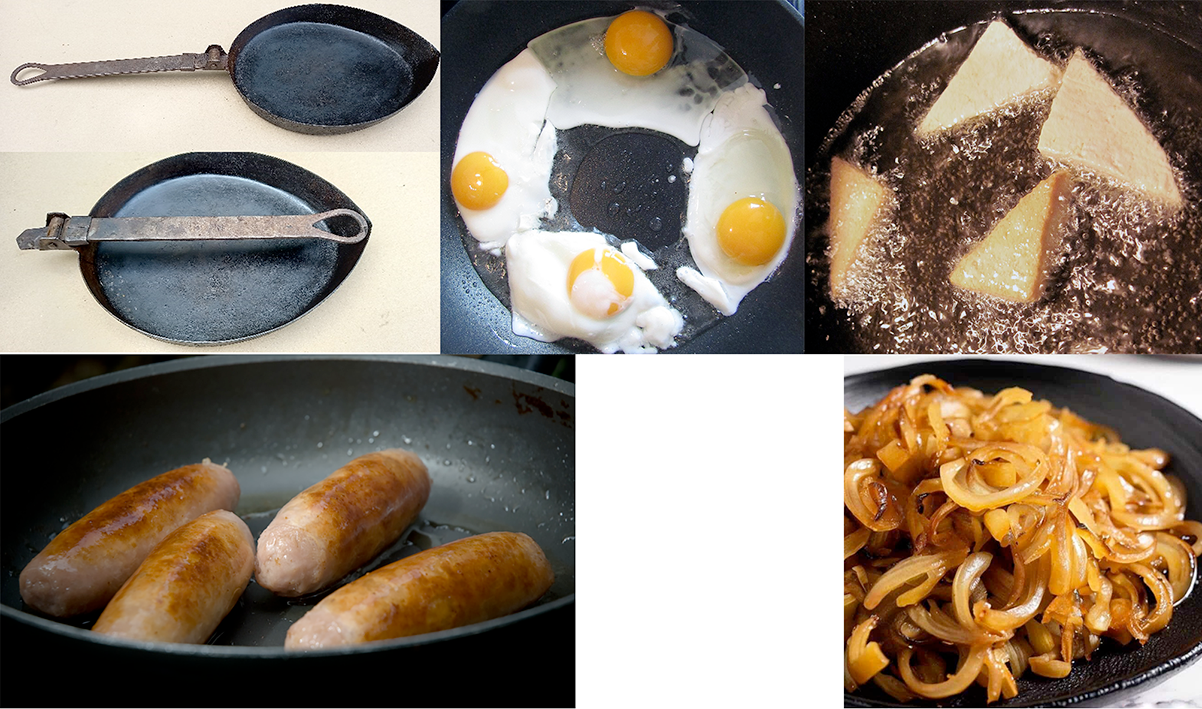 Clockwise from top left: Ancient Roman Frying pan, gentle-fried eggs,
shallow-fried tofu, sautéed onions and pan-fried sausages.
Welcome to FabulousFusionFood's Frying Recipes Page — Frying is the cooking of food in oil or another fat. Similar to sautéing, pan-fried foods are generally turned over once or twice during cooking to make sure that the food is evenly cooked, using tongs or a spatula, whilst sautéed foods are cooked by "tossing in the pan". A large variety of foods may be fried.
Historically, for frying, metalware is required as the temperature reached by cooking in hot oil generally far exceeds the boiling point of water 100°C (212°F). As such a society needs to attain bronze age metalwork before frying in hot oil becomes a viable cooking method. In the west, frying is believed to have first appeared in the Ancient Egyptian kitchen, during the Old Kingdom, around 2500 BCE. The Romans had special cookware, the fretale a special frying pan made of bronze round or oval in shape, with a lip for pouring. Though it must be mentioned here that Romans also had rectangular iron trays with handles for roasting or frying. "Oven-to-table ware," in the form of shallow pans and earthenware dishes was common — these are referred to as patellae and patinae. The fretale with a foldable handle (see image) was part of the field kit for a Roman soldier (see image). Frying may originally have been developed as a way to preserve food, as the frying process sterilises the food then bottling the fried food in the frying oil excludes air and helps prevent decay.
Frying techniques vary in the amount of fat required, the cooking time, the type of cooking vessel required, and the manipulation of the food. Sautéing, stir-frying, pan frying, shallow frying, and deep frying are all standard frying techniques. There are separate entries for stir-frying and deep frying and this page is about shallow frying methods: sautéing, pan frying and shallow frying.
Pan-frying, sautéing, and stir-frying involve cooking foods in a thin layer of fat on a hot surface, such as a frying pan, griddle, wok, or sauté pan. Stir frying involves frying quickly at very high temperatures, requiring that the food be stirred continuously to prevent it from adhering to the cooking surface and burning. Shallow frying is a type of pan frying using only enough fat to immerse approximately one-third to one-half of each piece of food; fat used in this technique is typically only used once.
Gentle frying or low-temperature frying is an oil- or fat-based cooking method used for relatively fragile or starchy foods. While gentle frying is most notably used to cook fried eggs, it is also used for delicate fish, tender cuts of meat, sausages, and as a first step in preparing fried potatoes. Low-temperature frying is useful if the frying fat scorches at higher heat levels (e.g. butter), or if the frying fat has flavour that the cook wants to preserve (e.g. olive oil). Overheated oils can produce unhealthy, even carcinogenic, compounds.
Pan frying or pan-frying is a form of frying food characterized by the use of minimal cooking oil or fat (compared to shallow frying or deep frying), typically using just enough to lubricate the pan. In the case of a greasy food such as bacon, no oil or fats may need to be added. As a form of frying, the technique relies on oil or fat as the heat transfer medium, and on correct temperature and time to not overcook or burn the food. Pan frying can serve to retain the moisture in foods such as meat and seafood. The food is typically flipped at least once to ensure that both sides are cooked properly. Pan frying takes place at lower heat than sautéing. This is because the food to be pan fried – such as chicken breasts, steak, pork chops, or fish fillets – is not cut into small pieces before cooking. It requires a lower heat so that the exterior of the food does not overcook by the time the interior reaches the proper temperature, and to keep foods in a moister state. However, the oil should always be hot enough to ensure that the moisture in the food can escape in the form of steam; the force of the steam escaping keeps the oil from soaking into the food. The same amount of oil is used as for sautéing – just enough to glaze the pan.
Sautéing or sauteing (UK: /ˈsoʊteɪɪŋ/, US: /soʊˈteɪɪŋ, sɔː-/; from French sauté, French: [sote], 'jumped', 'bounced', in reference to tossing while cooking) is a method of cooking that uses a relatively small amount of oil or fat in a shallow pan over relatively high heat. Various sauté methods exist. Ingredients for sautéing are usually cut into small pieces or thinly sliced to provide a large surface area, which facilitates fast cooking. The primary mode of heat transfer during sautéing is conduction between the pan and the food being cooked. Food that is sautéed is browned while preserving its texture, moisture, and flavour. If meat, chicken, or fish is sautéed, the sauté is often finished by deglazing the pan's residue to make a sauce. Sautéing may be compared with pan frying, in which larger pieces of food (for example, chops or steaks) are cooked quickly in oil or fat, and flipped onto both sides. Some cooks make a distinction between the two based on the depth of the oil used, while others use the terms interchangeably
Shallow frying is a hot oil-based cooking technique. Pieces of food are cooked by partial submersion in hot oil. It is typically used to prepare portion-sized cuts of meat, fish, potatoes and patties such as fritters. Shallow frying can also be used to cook vegetables. Shallow frying is distinct from deep frying, which uses enough oil to fully submerge the food to be cooked, and pan frying, which only uses a negligible depth of oil. t is a medium-high to high heat cooking process. Temperatures between 160–190°C (320–374°F) are typical, but shallow frying may be performed at temperatures as low as 150°C (302°F) for a longer period of time. The high heat promotes protein denaturation-browning and, in some cases, a Maillard reaction. Deep frying usually takes place at temperatures between 177–205°C (351–401°F) so shallow-frying can oftentimes be considered a less intense cooking technique. Foods to be shallow fried are commonly pre-portioned into single servings before being placed in oil. Since the food is only partly submerged, it must be turned over partway through the cooking process. Some cooks recommend cooking the "presentation" side of the food first.
The alphabetical list of all the frying-based recipes on this site follows, (limited to 100 recipes per page). There are 1718 recipes in total:
Page 9 of 18
| Hoisin Pork with Garlic Noodles Origin: China | Involtini Aka di Salvia (Sage and Anchovy Fritters) Origin: Italy | Köttbullar med Saltgurka, Gräddsås och Äppelströssel (Meatballs with pickles, cream sauce and apple sprinkles) Origin: Sweden |
| Hojuelas (Fried Puff Squares) Origin: Colombia | Iraqi Khobz Origin: Iraq | Ka'abur (Beef and Potato Meatballs) Origin: Tunisia |
| Holderkuechle (Elderflower Fritters) Origin: Germany | Irish Corned Beef Hash Origin: Ireland | Kabsa Seasoning Origin: Saudi Arabia |
| Home-made Kadayıf Origin: Turkey | Irish Fish Cakes Origin: Ireland | Kädili Gutap (Butternut Squash Pastries) Origin: Turkmenistan |
| Home-made Kataifi Origin: Nigeria | Irish Potato Pancakes Origin: Ireland | Kai Look Koei (Son-in-law Eggs) Origin: Thailand |
| Home-made Tortilla Chips Origin: Mexico | Irish Potato Wedges Origin: Ireland | Kalamar Tava (Turkish Fried Calamari) Origin: Turkey |
| Honduran Refried Beans Origin: Honduras | Irish Soda Bread French Toast Origin: Ireland | Kannoli tal-Irkotta (Ricotta-filled Cannelloni) Origin: Malta |
| Honey Mushroom Stuffing Origin: American | Irish Soda Farls Origin: Ireland | Kao Lengmian (Grilled Cold Noodles) Origin: China |
| Honeydew Melon with Caramelia Sauce Origin: Andorra | Irn-Bru Pakoras Origin: Scotland | Kapernschnitzel (Veal Cutlets With Capers) Origin: Germany |
| Hop Shoots with Fried Potatoes Origin: Britain | Isicia de Cauda Eius sic Facies (Make Lobster Tail Forcemeat Balls Thus) Origin: Roman | Karoo Roast Ostrich Steak Origin: eSwatini |
| Horse Mushroom Frittata Origin: Britain | Isicia de lolligine (Squid Rissoles) Origin: Roman | Kartaeuserkloeße (Carthusian Dumplings) Origin: Germany |
| Hot and Sticky Chicken Origin: Fusion | Isicia de scillis (Prawn Rissole) Origin: Roman | Kartoffelpfannkuchen (Potato Pancakes) Origin: Germany |
| Hot Sesame Beef Origin: China | Isicia Marina (Seafood Patties) Origin: Roman | Katchourie Origin: Trinidad |
| Huevos Rancheros Origin: Costa Rica | Israeli Chicken and Aubergine Shakshuka Origin: Israel | Kati rolls Origin: India |
| Huli Podi (Udupi Sambar Powder) Origin: India | Israeli Falafel Origin: Israel | Katles (Spiced Beef and Potato Cakes) Origin: Madagascar |
| Huni Roshi (Coconut Flatbread) Origin: Maldives | Israeli Pita Bread Origin: Israel | Kebapçı İskender (İskender Kebap) Origin: Turkey |
| Hush Puppies Origin: American | Isso Vade Origin: Sri Lanka | Keftedhakia (Fried Small Meatballs) Origin: Cyprus |
| Ibiharage (Burundian Fried Beans) Origin: Burundi | Italianate Warm Dandelion Salad Origin: British | Kelewele (Hot Plantain Chips) Origin: Ghana |
| Ibiharage II (Fried Beans II) Origin: Burundi | Ius Diabotanon in Pisce Frixo (A Herb Sauce for Fried Fish) Origin: Roman | Kelewele II Origin: Liberia |
| Ibirayi Bisize (Rwandan Fried Potatoes) Origin: Rwanda | Ius in Caprea (Sauce for Roebuck) Origin: Roman | Kelewele III Origin: Ghana |
| Idichakka Thoran (Raw Jackfruit Curry) Origin: India | Jaegerschnitzel (Hunter's Schnitzels) Origin: Germany | Kenyan Chapati Origin: Kenya |
| Iga Babi Jerk Pedas (Spicy Jerk Pork Chops) Origin: Turks Caicos | Jalapeño Wonton Puffs Origin: American | Khanum Budu (Egg-coated Meat Patty) Origin: Armenia |
| Igname Frite (Guinean Fried Yams) Origin: Guinea | Jalebis Origin: India | Kheulwa de Tabaski (Fried Mutton for Tabaski) Origin: Senegal |
| In ficato oenogarum (Livers of Animals Fattened on Figs, Another Way) Origin: Roman | Jamaican Jerk Chicken Origin: Jamaica | Khobz Ftir (Algerian Flatbread) Origin: Algeria |
| In porcello lactante (Suckling Pig with Sauce) Origin: Roman | Jamaican Jerk Jackfruit Origin: Jamaica | Kibbeh Origin: Lebanon |
| Indian Chilli Pickle Origin: India | Jamaican Spiced Plantains Origin: Jamaica | Kibbeh Origin: Syria |
| Indian Gulab Jamun Origin: India | Jangri Origin: India | Kieler Sprotten in Teig (Battered Kiel Sprats) Origin: Germany |
| Indian-spiced Leftover Christmas Roast Veg Origin: Britain | Jiaozi (Chinese Dumplings) Origin: China | Kima (Chopped Beef and Chilli Fry) Origin: Senegal |
| Indian-style Spicy Baby Potatoes Origin: Britain | John Dory with Cider, Apples and Cream Origin: Britain | King of the Plate Origin: American |
| Indo-Chinese Chilli Chicken Origin: India | Johnny Cakes Origin: British Virgin Islands | Kipes or Quipes Origin: Dominican Republic |
| Indonesian Soufflé Omelette Origin: Indonesia | Johnny Cakes Origin: Saint Kitts | Kirsch-Schnitzel (Veal Cutlets With Cherry Sauce) Origin: Germany |
| Ingelegde Vis (Pickled Fish) Origin: South Africa | Johnny Cakes Origin: US Virgin Islands | Kisra (Sudanese Flatbread) Origin: Sudan-a |
| Inhame Frito (Fried Yams) Origin: Sao Tome | Jolly Boys Origin: England | |
| Inswa (Boiled Termite Snack) Origin: Zambia | Jubnyeh (Sweet Cheese Fritters) Origin: Somalia |
Page 9 of 18