FabulousFusionFood's Fish-based Recipes 24th Page
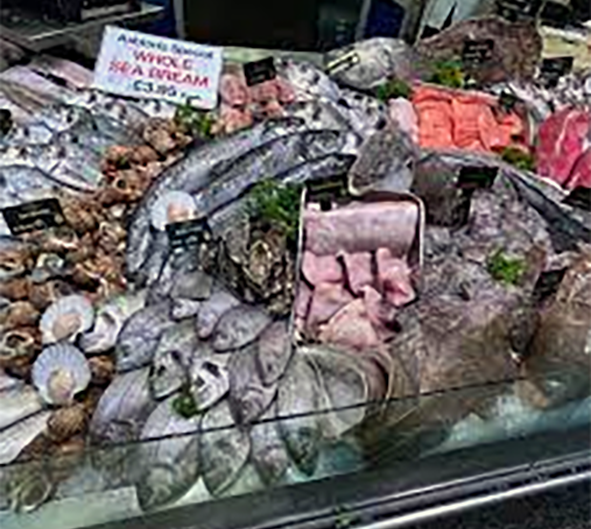 Fish displayed at a fishmonger's stall.
Welcome to FabulousFusionFood's Fish-based Recipes Page — The recipes presented here are all based on Fish (both sea-water and freshwater).
A fish (pl.: fish or fishes) is an aquatic, anamniotic, gill-bearing vertebrate animal with swimming fins and a hard skull, but lacking limbs with digits. Fish can be grouped into the more basal jawless fish and the more common jawed fish, the latter including all living cartilaginous and bony fish, as well as the extinct placoderms and acanthodians. In a break to the long tradition of grouping all fish into a single class (Pisces), contemporary phylogenetics views fish as a paraphyletic group (in that all vertebrates evolved from fishes, so tetrapods, can be classified as belonging to the lobe-finned fish but are not considered such).
Most fish are cold-blooded, their body temperature varying with the surrounding water, though some large active swimmers like white shark and tuna can hold a higher core temperature. Many fish can communicate acoustically with each other, such as during courtship displays. The study of fish is known as ichthyology.
Bony fish, distinguished by the presence of swim bladders and later ossified endoskeletons, emerged as the dominant group of fish after the end-Devonian extinction wiped out the apex predators, the placoderms. Bony fish are further divided into the lobe-finned and ray-finned fish. About 96% of all living fish species today are teleosts, a crown group of ray-finned fish that can protrude their jaws. The tetrapods, a mostly terrestrial clade of vertebrates that have dominated the top trophic levels in both aquatic and terrestrial ecosystems since the Late Paleozoic, evolved from lobe-finned fish during the Carboniferous, developing air-breathing lungs homologous to swim bladders. Despite the cladistic lineage, tetrapods are usually not considered to be fish.
Fish account for more than half of vertebrate species. As of 2016, there are over 33,000 described species of bony fish, over 1,100 species of cartilaginous fish, and over 100 hagfish and lampreys. A third of these fall within the nine largest families; from largest to smallest, these are Cyprinidae, Gobiidae, Cichlidae, Characidae, Loricariidae, Balitoridae, Serranidae, Labridae, and Scorpaenidae. About 64 families are monotypic, containing only one species.
Throughout history, humans have used fish as a food source for dietary protein. Historically and today, most fish harvested for human consumption has come by means of catching wild fish. However, fish farming, which has been practiced since about 3,500 BCE in ancient China, is becoming increasingly important in many nations. Overall, about one-sixth of the world's protein is estimated to be provided by fish. Fishing is accordingly a large global business which provides income for millions of people. The Environmental Defense Fund has a guide on which fish are safe to eat, given the state of pollution in today's world, and which fish are obtained in a sustainable way.
The word fish is inherited from Proto-Germanic, and is related to German Fisch, the Latin piscis, Old Irish īasc and Welsh pysgod, though the exact root is unknown; some authorities reconstruct a Proto-Indo-European root *peysk-, attested only in Italic, Celtic, and Germanic.
Though often used interchangeably, in biology fish and fishes have different meanings. Fish is used as a singular noun, or as a plural to describe multiple individuals from a single species. Fishes is used to describe different species or species groups.
The alphabetical list of all the fish-based recipes on this site follows, (limited to 100 recipes per page). There are 2469 recipes in total:
Page 24 of 25
| Thiou Tiir (White Rice and Fish with Palm Oil) Origin: Senegal | To ragoo a neck of veal Origin: British | Tuna and Caramelized Onion Pâté Origin: Britain |
| Thon Curry Moutarde à la Mauricienne (Mauritian-style Tuna Mustard Curry) Origin: Mauritius | To Roast a Hare Origin: British | Tuna and Cheese Sandwich Filling Origin: Britain |
| Thorion Tarikhous (Mackerel-stuffed Vine Leaves) Origin: Roman | To roast a rabbit hare fashion Origin: British | Tuna Ceviche Origin: Fusion |
| Thunna (Tuna Steaks) Origin: Roman | To Seeth Fresh Salmon (To Poach Fresh Salmon) Origin: British | Tuna with Safran and Coconut Milk (Tuna with Cumin and Coconut Milk) Origin: Seychelles |
| Tiep bou wekh (White Senegalese Rice and Fish) Origin: Senegal | Tobago Curry Conch with Dumplings Origin: Trinidad | Tuna-stuffed Tulips Origin: Britain |
| Tiga Dégué au Poisson Fumé (Smoked Fish in Peanut Sauce) Origin: Mali | Toborgee Beans Origin: Liberia | Tunny Origin: British |
| Tilapia au Four (Baked Tilapia) Origin: Chad | Tom Yam Goong 1 Origin: Thailand | Tunu Ahi Ika Origin: Easter Island |
| Tilapia Braisée (Barbecued Tilapia) Origin: Cameroon | Tom Yam Goong 2 Origin: Thailand | Tunu Supu (Tuna Soup) Origin: Vanuatu |
| Tilapia grillé avec aloco (Grilled Tilapia with Aloco) Origin: Cameroon | Tom Yam Goong Maenam Origin: Thailand | Turbot à la Bechamel Origin: British |
| Tinolang Manok (Chicken Ginger Stew) Origin: Philippines | Tom Yum Gai (Hot and Sour Chicken Soup) Origin: Thailand | Turbot à la Crème Origin: British |
| Tirk Prahok (Fish Pickle Sauce) Origin: Cambodia | Tom Yum Hed (Mushroom Tom Yum) Origin: Thailand | Turbot à la Normande Origin: British |
| Tirk Trey Chu P'em (Sweet Fish Sauce) Origin: Cambodia | Tom Yum Hed (Gang Som Pleug Tang Mo) Origin: Thailand | Turbot à la Parisienne Origin: British |
| Tirk Umpel (Tamarind Sauce) Origin: Cambodia | Tom Yum Pla (Hot and Sour Fish Soup) Origin: Thailand | Turbot au Gratin Origin: British |
| Tlayuda Origin: Mexico | Tom Yum Talay (Fish Stew) Origin: Thailand | Turbot in Kerala Red Curry Sauce Origin: India |
| To Bake Smelts Origin: British | Tomata Sauce Origin: Britain | Turbot with Cream au Gratin Origin: British |
| To boil a Capon or Hen with Oysters Origin: British | Tomates Monégasque (Monegasque Tomatoes) Origin: Monaco | Turdos Aponcomenos (Thrushes, Seasoned by the Throat) Origin: Roman |
| To Boil a Flounder or Pickerel of the French Fashion Origin: British | Tomato Sauce for Keeping I Origin: British | Turkey and Yam Pepper Soup Origin: Nigeria |
| To boil Pigeons Origin: British | Traditional Omelette Arnold Bennet Origin: British | Turks and Caicos Blackened Fish Origin: Turks Caicos |
| To Dress a Hen, Mutton or Lamb the Indian Way Origin: England | Traditional Thai Jungle Curry Origin: Thailand | Turks and Caicos Boil Fish and Grits Origin: Turks Caicos |
| To Dress Barbel Origin: British | Traybake Keralan Fish Curry Origin: Fusion | Turtures (Turtledoves) Origin: Roman |
| To Dress Shad Origin: British | Traybake Sea Bass with Asparagus and New Potatoes Origin: Britain | Tuvalu Tuna Curry Origin: Tuvalu |
| To Dress Whitebait Origin: British | Trey Cham Hoy Chia Mui Spee Chrout (Steamed Fish with Sour Mustard Greens) Origin: Cambodia | Tuvaluan Fish Curry Origin: Tuvalu |
| To force a large fowl Origin: British | Trey Kho Manor (Caramelized Fish with Pineapple) Origin: Cambodia | Tweed Kettle Origin: Scotland |
| To force cucumbers Origin: British | Tri-Tri Cakes Origin: Saint Vincent | Udang Masak Lemak Nenas (Pineapple Prawn Curry) Origin: Malaysia |
| To Fry Smelts Origin: British | Trini Curried Shrimp Patty Origin: Trinidad | Ugandan Matooke Origin: Uganda |
| To hash a calf's head Origin: British | Trinidad Crab and Callaloo Origin: Trinidad | Ugandan Smoked Fish Stew Origin: Uganda |
| To hash a calf's head white Origin: British | Trondro Gasy (Tilapia in Tomato Sauce) Origin: Madagascar | Ukwa (Breadfruit Porridge) Origin: Nigeria |
| To make a Frose Origin: England | Trota con Funghi (Trout with Mushrooms) Origin: Italy | Umu Rapa Nui Origin: Easter Island |
| To make a Pie with Parsneps and Oisters very good Origin: British | Trout à L'Aurore Origin: British | Unakkameen Thenga Chammanthy (Dry Fish Chutney) Origin: India |
| To Make Catchup to Keep Twenty Years Origin: British | Trout Kedgeree Origin: Britain | Untú de Peixe (Deep-fried Fish Balls) Origin: Guinea-Bissau |
| To make English catchup Origin: British | Trout with Genoese Sauce Origin: British | Urticae (Nettles) Origin: Roman |
| To Make Fish Sauce to Keep the Whole Year Origin: British | Tteokbokki (Spicy Rice Cake) Origin: Korea | Usupu (Eddoe Purée with Fish) Origin: Equatorial Guinea |
| To Pickle or Bake Mackerel to Keep all the Year Origin: British | Tuna alla Favignana (Favignana Tuna) Origin: Italy | |
| To ragoo a leg of mutton Origin: British | Tuna and Caramelized Onion Pâté Origin: Britain |
Page 24 of 25