FabulousFusionFood's Fish-based Recipes 21st Page
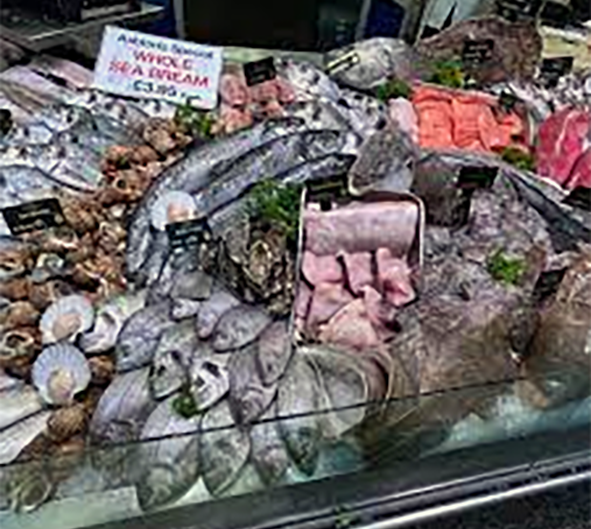 Fish displayed at a fishmonger's stall.
Welcome to FabulousFusionFood's Fish-based Recipes Page — The recipes presented here are all based on Fish (both sea-water and freshwater).
A fish (pl.: fish or fishes) is an aquatic, anamniotic, gill-bearing vertebrate animal with swimming fins and a hard skull, but lacking limbs with digits. Fish can be grouped into the more basal jawless fish and the more common jawed fish, the latter including all living cartilaginous and bony fish, as well as the extinct placoderms and acanthodians. In a break to the long tradition of grouping all fish into a single class (Pisces), contemporary phylogenetics views fish as a paraphyletic group (in that all vertebrates evolved from fishes, so tetrapods, can be classified as belonging to the lobe-finned fish but are not considered such).
Most fish are cold-blooded, their body temperature varying with the surrounding water, though some large active swimmers like white shark and tuna can hold a higher core temperature. Many fish can communicate acoustically with each other, such as during courtship displays. The study of fish is known as ichthyology.
Bony fish, distinguished by the presence of swim bladders and later ossified endoskeletons, emerged as the dominant group of fish after the end-Devonian extinction wiped out the apex predators, the placoderms. Bony fish are further divided into the lobe-finned and ray-finned fish. About 96% of all living fish species today are teleosts, a crown group of ray-finned fish that can protrude their jaws. The tetrapods, a mostly terrestrial clade of vertebrates that have dominated the top trophic levels in both aquatic and terrestrial ecosystems since the Late Paleozoic, evolved from lobe-finned fish during the Carboniferous, developing air-breathing lungs homologous to swim bladders. Despite the cladistic lineage, tetrapods are usually not considered to be fish.
Fish account for more than half of vertebrate species. As of 2016, there are over 33,000 described species of bony fish, over 1,100 species of cartilaginous fish, and over 100 hagfish and lampreys. A third of these fall within the nine largest families; from largest to smallest, these are Cyprinidae, Gobiidae, Cichlidae, Characidae, Loricariidae, Balitoridae, Serranidae, Labridae, and Scorpaenidae. About 64 families are monotypic, containing only one species.
Throughout history, humans have used fish as a food source for dietary protein. Historically and today, most fish harvested for human consumption has come by means of catching wild fish. However, fish farming, which has been practiced since about 3,500 BCE in ancient China, is becoming increasingly important in many nations. Overall, about one-sixth of the world's protein is estimated to be provided by fish. Fishing is accordingly a large global business which provides income for millions of people. The Environmental Defense Fund has a guide on which fish are safe to eat, given the state of pollution in today's world, and which fish are obtained in a sustainable way.
The word fish is inherited from Proto-Germanic, and is related to German Fisch, the Latin piscis, Old Irish īasc and Welsh pysgod, though the exact root is unknown; some authorities reconstruct a Proto-Indo-European root *peysk-, attested only in Italic, Celtic, and Germanic.
Though often used interchangeably, in biology fish and fishes have different meanings. Fish is used as a singular noun, or as a plural to describe multiple individuals from a single species. Fishes is used to describe different species or species groups.
The alphabetical list of all the fish-based recipes on this site follows, (limited to 100 recipes per page). There are 2195 recipes in total:
Page 21 of 22
| Stir-fried Squid with Herbs and Sea Aster Origin: Fusion | Tapenade Monegasque (Monaco-style Tapenade) Origin: Monaco | Thiebou Kéthiakh (Rice with Dried Fish, Seafood and Vegetables) Origin: Senegal |
| Stiw Pysgotwr (Fisherman's Stew) Origin: Welsh | Taramasalata Origin: Greece | Thieboudienne (Fish in the Manner of Dakar) Origin: Senegal |
| Stockfish Stew Origin: Nigeria | Taro aux Fruits de Mer (Taro with Seafood) Origin: Cote dIvoire | Thiéré ak Mboum (Couscous with Moringa Sauce) Origin: Senegal |
| Street Food Pad Thai Origin: Thailand | Tart de ffruyte (A Fruit Pie) Origin: England | Thiou Tiir (White Rice and Fish with Palm Oil) Origin: Senegal |
| Stufato del Pescatore (Italian Fisherman's Stew) Origin: Italy | Tartar Sauce Origin: Britain | Thon Curry Moutarde à la Mauricienne (Mauritian-style Tuna Mustard Curry) Origin: Mauritius |
| Stuffed Grilled Fish Origin: Liberia | Tarten Sawrus Eog (Savoury Salmon Tart) Origin: Welsh | Thorion Tarikhous (Mackerel-stuffed Vine Leaves) Origin: Roman |
| Stuffed Hake with Mushroom Gravy Origin: African Fusion | Tataki Gobo Origin: Japan | Thunna (Tuna Steaks) Origin: Roman |
| Stuffed Plaice Swirls Origin: Britain | Tatties an' Herrin' Origin: Scotland | Tiep bou wekh (White Senegalese Rice and Fish) Origin: Senegal |
| Stuffed Sardines Origin: Britain | Teisennau Cocos (Cockle Cakes) Origin: Welsh | Tiga Dégué au Poisson Fumé (Smoked Fish in Peanut Sauce) Origin: Mali |
| Sumen Plenum (Stuffed Sow's Belly) Origin: Roman | Teisennau Eog Dyfrdwy (Dee Salmon Fish Cakes) Origin: Welsh | Tilapia au Four (Baked Tilapia) Origin: Chad |
| Suomen Kalakeitto (Finnish Fish Soup) Origin: Finland | Telo met Bakkeljauw (Fried Cassava with Salt Cod) Origin: Suriname | Tilapia Braisée (Barbecued Tilapia) Origin: Cameroon |
| Superkanja Origin: Gambia | Tempura Origin: Japan | Tilapia grillé avec aloco (Grilled Tilapia with Aloco) Origin: Cameroon |
| Surinamese Nasi Goreng Origin: Suriname | Terrine de Congue aux Algues (Conger Terrine with Seaweed) Origin: France | Tirk Prahok (Fish Pickle Sauce) Origin: Cambodia |
| Sushi-Meshi (Sushi Rice) Origin: Japan | Terrine de la mer (Seafood terrine) Origin: France | Tirk Trey Chu P'em (Sweet Fish Sauce) Origin: Cambodia |
| Sweet and Sour Fish Patia Origin: India | Terrine de saumoun aux Quatre algues (Terrine of Salmon with Quatre Algues) Origin: France | Tirk Umpel (Tamarind Sauce) Origin: Cambodia |
| Sweet Chilli Sauce Origin: New Zealand | Thai Chicken Soup with Ginger and Lime Origin: Thailand | Tlayuda Origin: Mexico |
| Sweet Chilli Sauce Origin: New Caledonia | Thai Green Curried Cod Origin: Fusion | To Dress a Hen, Mutton or Lamb the Indian Way Origin: England |
| Sweet Potato Pottage Origin: Nigeria | Thai Green Curry of Prawn and Fish Origin: Thailand | To make a Frose Origin: England |
| Sweetbread Croquets Origin: British | Thai Green Curry with Chicken of the Woods Origin: Britain | Tobago Curry Conch with Dumplings Origin: Trinidad |
| Swordfish Steaks with Chermoula Origin: South Africa | Thai Hake Bites Origin: South Africa | Toborgee Beans Origin: Liberia |
| Swper 'Sgadan (Welsh Herring Supper) Origin: Welsh | Thai Mango Fish Curry Origin: Thailand | Tom Yam Goong 1 Origin: Thailand |
| Tacos di Pesce (Fish Tacos) Origin: Mexico | Thai Peanut Coconut Curry with Pheasant and Squash Origin: Fusion | Tom Yam Goong 2 Origin: Thailand |
| Tadjine Zdef (Mutton and Cheese Tagine) Origin: Benin | Thai Yellow Curry Paste Origin: Thailand | Tom Yam Goong Maenam Origin: Thailand |
| Tagine de Daurade (Tagine of Sea Bream) Origin: Morocco | Thai-style Nettle and Oyster Mushroom Curry Origin: Britain | Tom Yum Gai (Hot and Sour Chicken Soup) Origin: Thailand |
| Tagliarini with Gurnard, Parsley, Garlic and Sea Spaghetti Origin: England | Thai-style Pollack Curry Origin: Fusion | Tom Yum Hed (Mushroom Tom Yum) Origin: Thailand |
| Tagliatelles aux sardines et aux artichauts de Bretagne (Tagliatelle with Sardines and Breton Artichokes) Origin: France | Thai-style Red Curry of Beef, Bamboo and Apple Origin: Asian Fusion | Tom Yum Hed (Gang Som Pleug Tang Mo) Origin: Thailand |
| Tahitian Fish Origin: Norfolk Island | Thai-style Red Rock Salmon Curry Origin: Britain | Tom Yum Pla (Hot and Sour Fish Soup) Origin: Thailand |
| Tam Mak Hoong (Laotian Papaya Salad) Origin: Laos | Thai-style Red Seafood Curry Origin: Fusion | Tom Yum Talay (Fish Stew) Origin: Thailand |
| Tam Som (Lao Green Papaya Salad) Origin: Laos | Thai-style Turkey Leftovers Curry Origin: Fusion | Tomata Sauce Origin: Britain |
| Tandoori Fish Origin: India | Thakkali Meen Kari (Fish Tomato Curry) Origin: India | Tomates Monégasque (Monegasque Tomatoes) Origin: Monaco |
| Tandoori Monkfish Origin: Britain | Tharoi Thongba (Water Snail Curry) Origin: India | Tomato Sauce for Keeping I Origin: British |
| Tannia and Pineapple Fritters Origin: Saint Kitts | The Prince of Wales' Sauce Origin: Britain | Traditional Omelette Arnold Bennet Origin: British |
| Tapado (Seafood Soup) Origin: Guatemala | Thiebou dieune (Street-style Senegalese Fish and Rice) Origin: Senegal | |
| Tapenade Origin: Spain | Thiebou kéthiakh (Rice with Dried Fish and Tamarind) Origin: Senegal |
Page 21 of 22