FabulousFusionFood's Fish-based Recipes 22tn Page
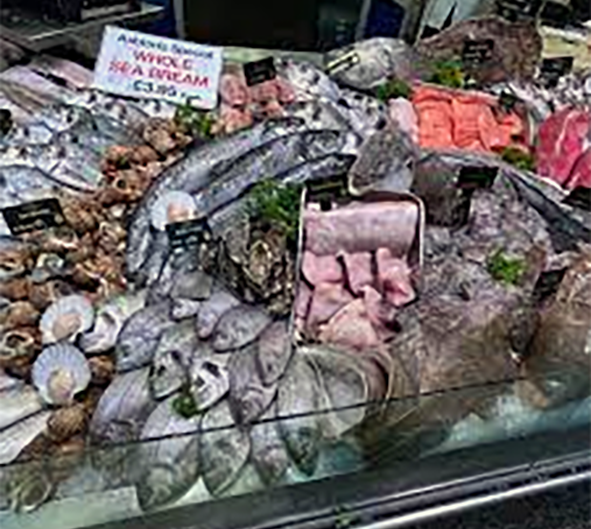 Fish displayed at a fishmonger's stall.
Welcome to FabulousFusionFood's Fish-based Recipes Page — The recipes presented here are all based on Fish (both sea-water and freshwater).
A fish (pl.: fish or fishes) is an aquatic, anamniotic, gill-bearing vertebrate animal with swimming fins and a hard skull, but lacking limbs with digits. Fish can be grouped into the more basal jawless fish and the more common jawed fish, the latter including all living cartilaginous and bony fish, as well as the extinct placoderms and acanthodians. In a break to the long tradition of grouping all fish into a single class (Pisces), contemporary phylogenetics views fish as a paraphyletic group (in that all vertebrates evolved from fishes, so tetrapods, can be classified as belonging to the lobe-finned fish but are not considered such).
Most fish are cold-blooded, their body temperature varying with the surrounding water, though some large active swimmers like white shark and tuna can hold a higher core temperature. Many fish can communicate acoustically with each other, such as during courtship displays. The study of fish is known as ichthyology.
Bony fish, distinguished by the presence of swim bladders and later ossified endoskeletons, emerged as the dominant group of fish after the end-Devonian extinction wiped out the apex predators, the placoderms. Bony fish are further divided into the lobe-finned and ray-finned fish. About 96% of all living fish species today are teleosts, a crown group of ray-finned fish that can protrude their jaws. The tetrapods, a mostly terrestrial clade of vertebrates that have dominated the top trophic levels in both aquatic and terrestrial ecosystems since the Late Paleozoic, evolved from lobe-finned fish during the Carboniferous, developing air-breathing lungs homologous to swim bladders. Despite the cladistic lineage, tetrapods are usually not considered to be fish.
Fish account for more than half of vertebrate species. As of 2016, there are over 33,000 described species of bony fish, over 1,100 species of cartilaginous fish, and over 100 hagfish and lampreys. A third of these fall within the nine largest families; from largest to smallest, these are Cyprinidae, Gobiidae, Cichlidae, Characidae, Loricariidae, Balitoridae, Serranidae, Labridae, and Scorpaenidae. About 64 families are monotypic, containing only one species.
Throughout history, humans have used fish as a food source for dietary protein. Historically and today, most fish harvested for human consumption has come by means of catching wild fish. However, fish farming, which has been practiced since about 3,500 BCE in ancient China, is becoming increasingly important in many nations. Overall, about one-sixth of the world's protein is estimated to be provided by fish. Fishing is accordingly a large global business which provides income for millions of people. The Environmental Defense Fund has a guide on which fish are safe to eat, given the state of pollution in today's world, and which fish are obtained in a sustainable way.
The word fish is inherited from Proto-Germanic, and is related to German Fisch, the Latin piscis, Old Irish īasc and Welsh pysgod, though the exact root is unknown; some authorities reconstruct a Proto-Indo-European root *peysk-, attested only in Italic, Celtic, and Germanic.
Though often used interchangeably, in biology fish and fishes have different meanings. Fish is used as a singular noun, or as a plural to describe multiple individuals from a single species. Fishes is used to describe different species or species groups.
The alphabetical list of all the fish-based recipes on this site follows, (limited to 100 recipes per page). There are 2136 recipes in total:
Page 22 of 22
| West Sumatran Fish Curry Origin: Sumatra | Xató (Salt Cod and Tuna Salad) Origin: Spain | Yemeni hawaij Origin: Yemen |
| White Crab and Cabbage Shanghai Buns Origin: China | Xerém Tradicional (Traditional Xerem) Origin: Cape Verde | Yétissé de Poisson (Fish Yetisse) Origin: Mali |
| White Curry Origin: Fusion | Xiao Long Xia (Garlic-braised Crayfish) Origin: China | Yoghurt Mint Dip Origin: Zimbabwe |
| White Fish Fritters Origin: New Zealand | Xinxim (Brazilian Chicken and Crayfish in Peanut Sauce) Origin: Brazil | Ysgwydd Oen Mewn Dull Gwledig (Rustic Lamb Shoulder Roast) Origin: Welsh |
| White Fish with Fennel Origin: Britain | Xuyi Shisanxiang Longxia (Jiangsu Crayfish Cooked with Thirteen-Spice Powder) Origin: China | Zambezi Fish Bobotie Origin: Zimbabwe |
| White Matelotte Sauce Origin: Britain | Yébésséssi (Fried Fish in Tomato and Onion Sauce) Origin: Togo | Zamné Sauté (Fried Zamne) Origin: Burkina Faso |
| White Nile Fish Origin: South Sudan | Yétissé de Poulet (Chicken Yétissé) Origin: Guinea | Zander Balaton (Poached Fillet of Zander) Origin: Hungary |
| White Oyster Sauce Origin: Britain | Yétissé de Tilapia (Tilapia in Aubergine Sauce) Origin: Guinea | Zanzibar Fish Curry Origin: Tanzania |
| Winter Mushroom and Smoked Fish Soup Origin: Fusion | Yambo Origin: Aruba | Zanzibar Pilau Origin: Tanzania |
| Worcestershire Wallfish Origin: England | Yangon Kyet Thar Hin (Yangon Chicken Curry) Origin: Myanmar | Zarzuela de Mariscos (Seafood Zarzuela) Origin: Spain |
| Wouré Burakhè Magilinri (Sweet Potato Leaf Sauce) Origin: Guinea | Yebeh (Yam and Fish in Red Palm Oil) Origin: Sierra Leone | Zupa di Pesce (Seafood Soup) Origin: Cayman Islands |
| Xarém Origin: Portugal | Yebeh (White Yam Porridge) Origin: Sierra Leone | Žuvies kukuliai (Fish Dumplings) Origin: Lithuania |
Page 22 of 22