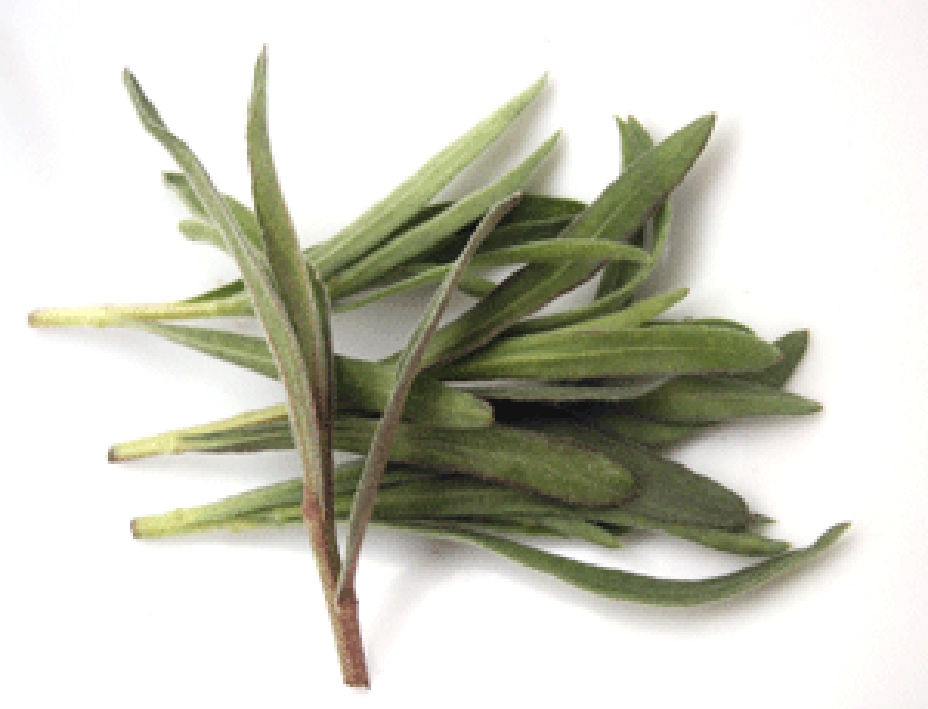
 Sprigs of tarragon
Artemisia
dracunculus
leaves.
Sprigs of tarragon
Artemisia
dracunculus
leaves.
Welcome to the summary page for FabulousFusionFood's Herb guide to Tarragon along with all the Tarragon containing recipes presented on this site, with 107 recipes in total.
This is a continuation of an entire series of pages that will, I hope, allow my visitors to better navigate this site. As well as displaying recipes by name, country and region of origin I am now planning a whole series of pages where recipes can be located by meal type and main ingredient. This page gives information about Tarragon and a listing of all the Tarragon-based recipes added to this site.
These recipes, all contain Tarragon as a major herb flavouring.
Tarragon, Artemisia dracunculus is a perennial herb in the Asteraceae (daisy) family and is closely related to wormwood. It is also sometimes known as 'dragon herb' and is a native of much of the Northern Hemisphere from easternmost Europe across central and eastern Asia to western North America, and south to northern India and Mexico (though populations in the Americas and Europe were probably naturalized by early human settlers and it is now believed that tarragon originally comes from Central Europe). Dependent on the cultivar it grows to about 20–150 cm in height. The plant has slender branched stems bearing lanceolate leaves that are 2ߝ8cm long and 2–10mm broad. The leaves are a glossy green in colour with an entire margin. The flowers tend to be produced in mid summer and are borne in small capitulae 2–4 mm diameter, each capitulum containing up to 40 yellow or greenish-yellow florets. It should be noted, however, that most French tarragon cultivars are sterile and seldom produce flowers.
Two main cultivars of tarragon are grown for culinary purposes, French Tarragon Artemisia dracunculus and Russian Tarragon Artemisia dracunculoides. French Tarragon is very aromatic and its flavour is reminiscent of fennel, liquorice and aniseed. To be truthful, Russian Tarragon is not at all fragrant and the taste is rather bitter.
Russian tarragon is closer to the wild form of the plant (originating in Central Asia) and though many recipes state that it can be substituted for French tarragon, this is not really true. Russian tarragon is not really culinarily worthwhile. The only reason it is cultivated is that it is frost resistant and can withstand northern European winters to grow the following spring. Unlike French tarragon, Russian tarragon is not typically sterile and can also grown from seed. French tarragon is typically propagated from root dvision.
In the development of French tarragon, though the plant's aromatic qualities were much improved, it also became much less hardy. Anywhere there are low winter temperatures, it can only be grown as an annual (unless it is brought indoors or grown under glass). However, I have found that if you take root cuttings, plant these before the first frosts and bring them into the house, they will give you a supply of new plants to place in your garden for the following spring.
French tarragon typically contains up to 3% essential oil, which is dominated by the phenylpropanoids methyl chavicol (estragole) and its isomer anethol. Also present are the terpene components are trans-β-ocimene, cis-β-ocimene and γ-terpineol. Present in lesser quantities are p-methoxy cinnamaldehyde, phellandrene, α- and β-pinene, camphene, limonene and eugenol.
Russian tarragon contains much less essential oil (up to 1%), the main components of which being sabinene, methyl eugenol, elemicin, isoelimicin and β-ocimene. As it contains none of the estragole present in French tarragon, Russian Tarragon has none of the sweetness of the other herbs. Indeed, the presence of the flavonoids (quercetin, patuletin) give Russian Tarragon a bitter and astringent flavour. Though it is much easier to grow in cool climates, I would say that Russian tarragon is not worthwhile culinarily. You will either need to persevere with French tarragon, or you can substitute Mexican Tarragon (also known as Winter Tarragon), which is not a true tarragon (being a member of the aster/daisy family) but which has a flavour profile almost identical to French tarragon, if a little stronger.
The English name tarragon is derived from the Old French tragonia (compare with the Greek tarchon [ταρχων], which were probably loans from the Arabic (the Modern Arabic name for the plant being at-tarkhun [الطرخون]). Though the origin of the Arabic name is not clear, it may be a loan from Classical Greek, possibly a word akin to drakon [δράκων] (dragon or snake). Indeed, the species of the name today is still dracunculus (which is the diminutive of Latin draco and means 'little dragon'). The association with dragons comes because the plant has a serpent-shaped rhizome and there used to be a wide-spread belief (based on sympathetic magic) that tarragon could not only ward off serpents and dragons, but could also heal snake bites.
Tarragon is particularly suitable for chicken, fish and egg dishes and is a critical component of Bernaise sauce and it is considered one of the four 'fines herbes' of French cuisine (along with chives, chervil and parsley). In Slovenia, tarragon is used as a flavouring for a traditional sweet cake called potica. Like many other herbs, tarragon should be used fresh and added to foods towards the end of cooking, as the aroma of tarragon diminishes significantly on drying or if it is over-cooked.
This is a continuation of an entire series of pages that will, I hope, allow my visitors to better navigate this site. As well as displaying recipes by name, country and region of origin I am now planning a whole series of pages where recipes can be located by meal type and main ingredient. This page gives information about Tarragon and a listing of all the Tarragon-based recipes added to this site.
These recipes, all contain Tarragon as a major herb flavouring.
Tarragon, Artemisia dracunculus is a perennial herb in the Asteraceae (daisy) family and is closely related to wormwood. It is also sometimes known as 'dragon herb' and is a native of much of the Northern Hemisphere from easternmost Europe across central and eastern Asia to western North America, and south to northern India and Mexico (though populations in the Americas and Europe were probably naturalized by early human settlers and it is now believed that tarragon originally comes from Central Europe). Dependent on the cultivar it grows to about 20–150 cm in height. The plant has slender branched stems bearing lanceolate leaves that are 2ߝ8cm long and 2–10mm broad. The leaves are a glossy green in colour with an entire margin. The flowers tend to be produced in mid summer and are borne in small capitulae 2–4 mm diameter, each capitulum containing up to 40 yellow or greenish-yellow florets. It should be noted, however, that most French tarragon cultivars are sterile and seldom produce flowers.
Two main cultivars of tarragon are grown for culinary purposes, French Tarragon Artemisia dracunculus and Russian Tarragon Artemisia dracunculoides. French Tarragon is very aromatic and its flavour is reminiscent of fennel, liquorice and aniseed. To be truthful, Russian Tarragon is not at all fragrant and the taste is rather bitter.
Russian tarragon is closer to the wild form of the plant (originating in Central Asia) and though many recipes state that it can be substituted for French tarragon, this is not really true. Russian tarragon is not really culinarily worthwhile. The only reason it is cultivated is that it is frost resistant and can withstand northern European winters to grow the following spring. Unlike French tarragon, Russian tarragon is not typically sterile and can also grown from seed. French tarragon is typically propagated from root dvision.
In the development of French tarragon, though the plant's aromatic qualities were much improved, it also became much less hardy. Anywhere there are low winter temperatures, it can only be grown as an annual (unless it is brought indoors or grown under glass). However, I have found that if you take root cuttings, plant these before the first frosts and bring them into the house, they will give you a supply of new plants to place in your garden for the following spring.
French tarragon typically contains up to 3% essential oil, which is dominated by the phenylpropanoids methyl chavicol (estragole) and its isomer anethol. Also present are the terpene components are trans-β-ocimene, cis-β-ocimene and γ-terpineol. Present in lesser quantities are p-methoxy cinnamaldehyde, phellandrene, α- and β-pinene, camphene, limonene and eugenol.
Russian tarragon contains much less essential oil (up to 1%), the main components of which being sabinene, methyl eugenol, elemicin, isoelimicin and β-ocimene. As it contains none of the estragole present in French tarragon, Russian Tarragon has none of the sweetness of the other herbs. Indeed, the presence of the flavonoids (quercetin, patuletin) give Russian Tarragon a bitter and astringent flavour. Though it is much easier to grow in cool climates, I would say that Russian tarragon is not worthwhile culinarily. You will either need to persevere with French tarragon, or you can substitute Mexican Tarragon (also known as Winter Tarragon), which is not a true tarragon (being a member of the aster/daisy family) but which has a flavour profile almost identical to French tarragon, if a little stronger.
The English name tarragon is derived from the Old French tragonia (compare with the Greek tarchon [ταρχων], which were probably loans from the Arabic (the Modern Arabic name for the plant being at-tarkhun [الطرخون]). Though the origin of the Arabic name is not clear, it may be a loan from Classical Greek, possibly a word akin to drakon [δράκων] (dragon or snake). Indeed, the species of the name today is still dracunculus (which is the diminutive of Latin draco and means 'little dragon'). The association with dragons comes because the plant has a serpent-shaped rhizome and there used to be a wide-spread belief (based on sympathetic magic) that tarragon could not only ward off serpents and dragons, but could also heal snake bites.
Tarragon is particularly suitable for chicken, fish and egg dishes and is a critical component of Bernaise sauce and it is considered one of the four 'fines herbes' of French cuisine (along with chives, chervil and parsley). In Slovenia, tarragon is used as a flavouring for a traditional sweet cake called potica. Like many other herbs, tarragon should be used fresh and added to foods towards the end of cooking, as the aroma of tarragon diminishes significantly on drying or if it is over-cooked.
The alphabetical list of all Tarragon recipes on this site follows, (limited to 100 recipes per page). There are 107 recipes in total:
Page 1 of 2
| Advieh Torshi (Persian Pickle Spice Blend) Origin: Iran | F'rell am Rèisleck (Trout in Riesling Sauce) Origin: Luxembourg | Pastes hern lagesek (Stargazy Pie) Origin: England |
| Asparagus and Morel Bread Pudding Origin: America | Fierkelsjhelli (Suckling Pig in Aspic) Origin: Luxembourg | Pehtranova Potica (Tarragon Potica) Origin: Slovenia |
| Asparagus Salad Origin: Britain | Fines Herbes Origin: France | Peiouns y Stewed (Stewed Pigeons) Origin: England |
| Aspic Jelly Origin: Britain | Fresh Tomato Gravy Sauce Origin: Anglo-Indian | Pickled Crow Garlic Bulbs Origin: Britain |
| Autumnal Soup with Mallow Cheeses Origin: British | Frytour of Erebes (Herb Fritters) Origin: England | Pickled Spruce Tips Rémoulade Sauce Origin: Canada |
| Béarnaise Sauce Origin: France | Garlic Roasted Chicken Origin: American | Pickled Three-cornered Leek Bulbs Origin: British |
| Béarnaise Sauce II Origin: France | Green Ravigotte Sauce Origin: Britain | Pickled Wild Leek Bulbs Origin: British |
| Bacalao à la Naranja (Cod with Orange) Origin: Spain | Grilled Chicken Breasts in Raspberry Vinegar Origin: American | Potato and Herb Terrine Origin: Ireland |
| Baked Celeriac with Wild Mushrooms and Cobnut Relish Origin: Britain | Grilled Langoustine with Herb Butter Origin: Scotland | Poulet Princesse (Chicken with Asparagus Garnish) Origin: France |
| Baked Salmon with Tarragon Origin: Scotland | Grilled Oysters with Fennel Crumbs Origin: South Africa | Rôti de Lapin Farci (Roast, Stuffed, Rabbit) Origin: France |
| Beans with Artichokes and Olives Origin: Britain | Guinea Fowl Pudding Origin: Scotland | Rabbit Pilaf Origin: Uzbekistan |
| Bermuda Onion and Potato Salad Origin: Bermuda | Guineafowl with Grapes Origin: Britain | Ravigotte Sauce Origin: Britain |
| Brown Butter Sauce Origin: Britain | Herb Crusted Cod Origin: Britain | Rillette de maquereau (Mackerel Rillette) Origin: France |
| Châteaubriand Steaks with Châteaubriand Sauce Origin: Britain | Herbed Lemon Sorbet Origin: Britain | Roast Loin of Pork a la Provencale Origin: France |
| Châteaubriand with a Shallot Red Wine Reduction Origin: France | Herbed Potato Pastry Origin: British | Saint Vincent Pig Feet Souse Origin: Saint Vincent |
| Chakapuli (Georgian Lamb and Tarragon Stew) Origin: Georgia | Iced Cucumber, Prawn and Yoghurt Soup Origin: Britain | Salad with Asparagus, Samphire and Sea-blite Origin: Britain |
| Champagne Vinaigrette Origin: Britain | Insalata di Riso (Rice Salad) Origin: Italy | Salmagundi Origin: Britain |
| Chasseur Sauce Origin: Britain | John Dory with Cider, Apples and Cream Origin: Britain | Salutiamoci (Courgette and Onion Lacto-fermented Pickles with Dulse) Origin: Italy |
| Chestnut Sauce for Turkey Origin: Britain | Jugged Pigeons Origin: Britain | Sauce à L'Estragon (Tarragon Sauce) Origin: France |
| Chicken in Apple and Whisky Sauce Origin: Scotland | Kalbsbrust mit Krauterfullung (Veal Breast with Herb Stuffing) Origin: Germany | Sauce Chivry Origin: France |
| Chicken Stock Origin: Britain | Khalia (Georgian Spicy Beef Stew) Origin: Georgia | Sauce Choron (Choron Sauce) Origin: France |
| Chicken, Leek and Celery Soup Origin: Britain | Kharcho (Georgian Beef and Rice Soup) Origin: Georgia | Seafood-stuffed Morel Mushrooms Origin: America |
| Civet of Hare Origin: Britain | Khiar Shoor (Persian Fermented Gherkins) Origin: Iran | Smoked Mackerel Pâté IV Origin: Britain |
| Classic Tartar Sauce Origin: France | Kriibsen (Crayfish, Luxembourg Style) Origin: Luxembourg | Stuffed Roast Chicken Origin: Britain |
| Clear Tarragon Sauce Origin: Britain | Le Salade Côte Cap Vert (Cape Vert Coast Salad) Origin: Senegal | Svekla Pkhali (Beet Pkhali) Origin: Georgia |
| Cock-a-Leekie Soup Origin: Scotland | Lobster and Clotted Cream Tart Origin: Britain | Tarragon and Beech Mast Vinaigrette Origin: Britain |
| Cold-smoked Haddock Origin: Britain | Mayonaise Sauce Origin: Britain | Tarragon Turkey Origin: Britain |
| Colombo d'Agneau à la Mauricienne (Mauritian-style Colombo of Lamb) Origin: Mauritius | Montpelier Butter Origin: France | Tarragon Vinegar Origin: Britain |
| Cream of Nettle and Bear Garlic Soup Origin: British | Moules à la Luxembourgeoise (Mussels, Luxembourg Style) Origin: Luxembourg | Tarragon Vinegar II Origin: Britain |
| Creole Mustard Origin: Louisiana | Mushroom Millefeuille Origin: Britain | Tartar Sauce Origin: Britain |
| Cucumber and Yoghurt Salad Origin: Armenia | New Potato Parcels Origin: Ireland | Tartare Sauce Origin: Britain |
| Economical Aspic Jelly Origin: Britain | Orange Salad Origin: Scotland | Tempeh Stroganoff with Parasol Mushrooms Origin: American |
| English Sauce for Salad Origin: Britain | Pan-fried Megrim with Tarragon Origin: England | |
| Escargot and Mushrooms in Garlic Sauce Origin: American | Pastes hern lagesek (Stargazy Pie) Origin: England |
Page 1 of 2