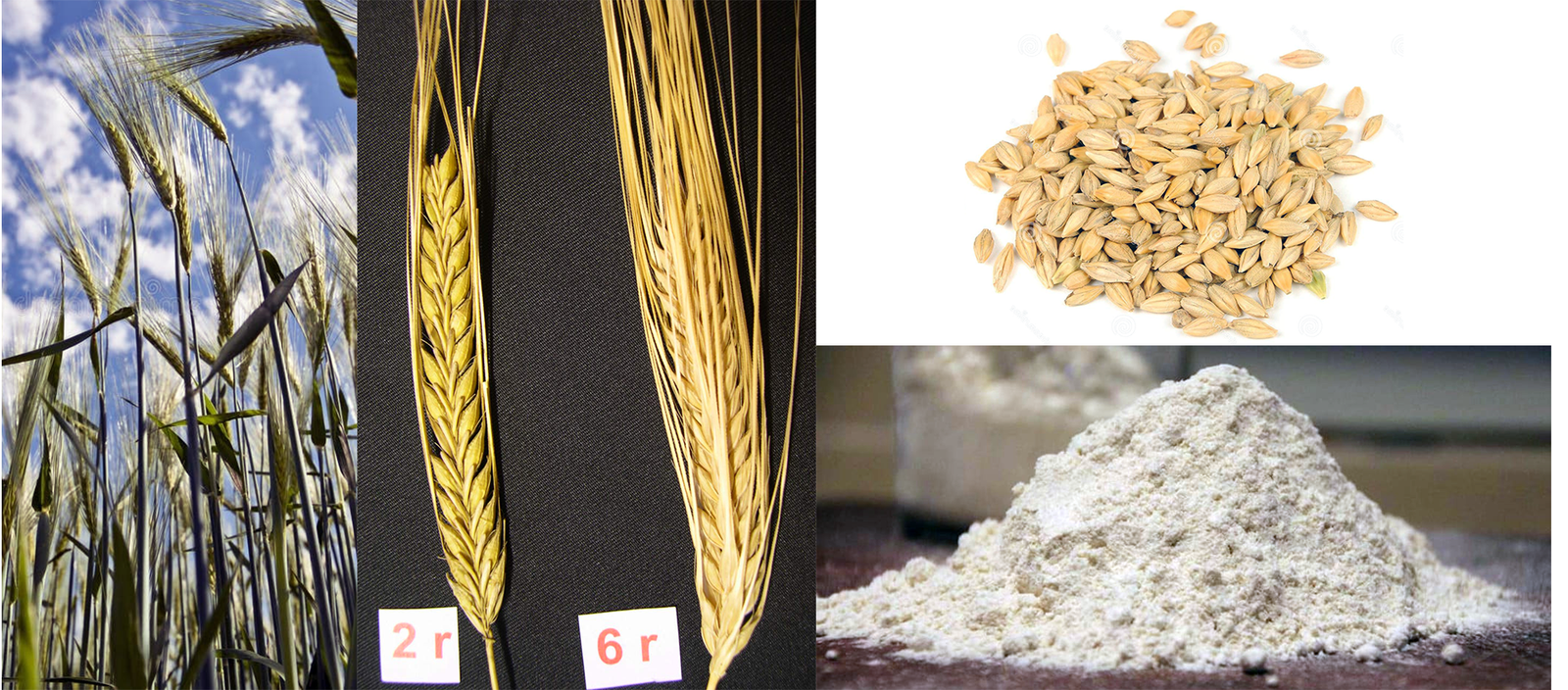
 Green barley plants in the field (left) ears to two row and six
row barley (centre) and hulled barley grains (top right) and
barley flour (bottom right).
Welcome to the summary page for FabulousFusionFood's Cook's Guide entry for Barley along with all the recipes employing Barley presented on this site, with 115 recipes in total.
This is a continuation of an entire series of pages that will, I hope, allow my visitors to better navigate this site. As well as displaying recipes by name, country and region of origin I am now planning a whole series of pages where recipes can be located by meal type and main ingredient. This page gives a listing of all the Barley recipes added to this site.
These recipes, all contain Barley as a major wild food ingredient.
Hordeum vulgare is a member of the grass family, Poaceae that lies in the Triticaceae tribe of the Pooideae subfamily of the BOP clade of true grasses. It is sister to wheat Triticum and rye Secale. and more distantly to rice within the BOP clade of grasses (Poaceae). The phylogeny of the Triticeae is complicated by hybridization between species, so there is a network of relationships rather than a simple inheritance-based tree.
Barley was one of the first grains to be domesticated in the Fertile Crescent, an area of relatively abundant water in Western Asia, around 9,000 BCE. Wild barley (H. vulgare ssp. spontaneum) ranges from North Africa and Crete in the west to Tibet in the east. A study of genome-wide diversity markers found Tibet to be an additional centre of domestication of cultivated barley. The earliest archaeological evidence of the consumption of wild barley, Hordeum spontaneum, comes from the Epipaleolithic at Ohalo II at the southern end of the Sea of Galilee, where grinding stones with traces of starch were found. The remains were dated to about 23,000 BCE. The earliest evidence for the domestication of barley, in the form of cultivars that cannot reproduce without human assistance, comes from Mesopotamia, specifically the Jarmo region of modern-day Iraq, around 9,000–7,000 BCE.
Domestication changed the morphology of the barley grain substantially, from an elongated shape to a more rounded spherical one. Wild barley has distinctive genes, alleles, and regulators with potential for resistance to abiotic or biotic stresses; these may help cultivated barley to adapt to climatic changes. Wild barley has a brittle spike; upon maturity, the spikelets separate, facilitating seed dispersal. Domesticated barley has nonshattering spikelets, making it much easier to harvest the mature ears. The nonshattering condition is caused by a mutation in one of two tightly linked genes known as Bt1 and Bt2; many cultivars possess both mutations. The nonshattering condition is recessive, so varieties of barley that exhibit this condition are homozygous for the mutant allele. Domestication in barley is followed by the change of key phenotypic traits at the genetic level.
The wild barley found currently in the Fertile Crescent may not be the progenitor of the barley cultivated in Eritrea and Ethiopia, indicating that it may have been domesticated separately in eastern Africa.
Archaeobotanical evidence shows that barley had spread throughout Eurasia by 2,000 BC. Genetic analysis demonstrates that cultivated barley followed several different routes over time. By 4200 BC domesticated barley had reached Eastern Finland. Barley has been grown in the Korean Peninsula since the Early Mumun Pottery Period (circa 1500–850 BC). Barley (Yava in Sanskrit) is mentioned many times in the Rigveda and other Indian scriptures as a principal grain in ancient India. Traces of barley cultivation have been found in post-Neolithic Bronze Age Harappan civilization 5,700–3,300 years ago. Barley beer was probably one of the first alcoholic drinks developed by Neolithic humans.
Spikelets are arranged in triplets which alternate along the rachis. In wild barley (and other Old World species of Hordeum), only the central spikelet is fertile, while the other two are reduced. This condition is retained in certain cultivars known as two-row barleys. A pair of mutations (one dominant, the other recessive) result in fertile lateral spikelets to produce six-row barleys. A mutation in one gene, vrs1, is responsible for the transition from two-row to six-row barley. Brewers in Europe tend to use two-row cultivars and breweries in North America use six-row barley (or a mix), and there are important differences in enzyme content, kernel shape, and other factors that malters and brewers must take into consideration.
In traditional taxonomy, different forms of barley were classified as different species based on morphological differences. Two-row barley with shattering spikes (wild barley) was named Hordeum spontaneum. Two-row barley with nonshattering spikes was named as H. distichon, six-row barley with nonshattering spikes as H. vulgare (or H. hexastichum), and six-row with shattering spikes as H. agriocrithon. Because these differences were driven by single-gene mutations, coupled with cytological and molecular evidence, most recent classifications treat these forms as a single species, H. vulgare.
Hulless or 'naked' barley (Hordeum vulgare var. nudum) is a form of domesticated barley with an easier-to-remove hull. Naked barley is an ancient food crop, but a new industry has developed around uses of selected hulless barley to increase the digestibility of the grain, especially for pigs and poultry. Hulless barley has been investigated for several potential new applications as whole grain, bran, and flour. Hulless barley can offer higher protein, increased beta-glucan content, and more efficient handling and processing because of the lack of hull.
The Old English word for barley was bere. This survives in the north of Scotland as bere; it is used for a strain of six-row barley grown there. Modern English barley derives from the Old English adjective bærlic, meaning 'of barley'. The word barn derives from Old English bere-aern meaning 'barley-store'. The name of the genus is from Latin hordeum, barley, likely related to Latin horrere, to bristle.
Barley is a crop that prefers relatively low temperatures, 15 to 20 °C (59 to 68 °F) in the growing season; it is grown around the world in temperate areas. It grows best in well-drained soil in full sunshine. In the tropics and subtropics, it is grown for food and straw in South Asia, North and East Africa, and in the Andes of South America. In dry regions it requires irrigation. It has a short growing season and is relatively drought-tolerant. Barley is more tolerant of soil salinity than other cereals, varying in different cultivars. It has less winter-hardiness than winter wheat and far less than rye.
Hulled barley (or covered barley) is eaten after removing the inedible, fibrous, outer husk or hull. Once removed, it is called dehulled barley (or pot barley or scotch barley). Pearl barley (or pearled barley) is de-hulled to remove most of the bran, and polished. Barley meal, a wholemeal barley flour lighter than wheat meal but darker in colour, is used in gruel. This gruel is known as سويق : sawīq in the Arab world.
With a long history of cultivation in the Middle East, barley is used in a wide range of traditional Arabic, Assyrian, Israelite, Kurdish, and Persian foodstuffs including keşkek, kashk, and murri. Barley soup is traditionally eaten during Ramadan in Saudi Arabia. Cholent or hamin (in Hebrew) is a traditional Jewish stew often eaten on the Sabbath, in numerous recipes by both Mizrahi and Ashkenazi Jews; its original form was a barley porridge.
In Eastern and Central Europe, barley is used in soups and stews such as ričet. In Africa, where it is a traditional food plant, it has the potential to improve nutrition, boost food security, foster rural development, and support sustainable landcare.
The six-row variety bere is cultivated in Orkney, Shetland, Caithness and the Western Isles of the Scottish Highlands and Islands. When milled into beremeal, it is used locally in bread, biscuits, and the traditional beremeal bannock.[
In Japanese cuisine, barley is mixed with rice and steamed as mugimeshi. The naval surgeon Takaki Kanehiro introduced it into institutional cooking to combat beriberi, endemic in the armed forces in the 19th century. It became standard prison fare, and remains a staple in the Japan Self-Defence Forces.
In Korean cuisine, a similar dish called boribap (보리밥) has been eaten since the Joseon dynasty. In Jeju Island, unripe barley rice was eaten in spring when food was short. Barley rice, hard to cook and linked to poverty, had lower status than white rice. In the 1960s and 1970s, schoolchildren's lunchboxes had to contain barley rice. Barley rice has become a nostalgic food for older people, served in specialty restaurants.
Cooked barley is 69% water, 28% carbohydrates, 2% protein, and 0.4% fat (table). In a 100-gram (3.5 oz) reference serving, cooked barley provides 515 kilojoules (123 kcal) of food energy and is a good source (10% or more of the Daily Value, DV) of essential nutrients, including, dietary fibre, the B vitamin niacin (14% DV), and dietary minerals, including iron (10% DV) and manganese (12% DV)
Barley, made into malt, is a key ingredient in beer and whisky production. Two-row barley is traditionally used in German and English beers. Six-row barley was traditionally used in US beers, but both varieties are in common usage now. Distilled from green beer, Scottish and Irish whisky are made primarily from barley. About 25% of American barley is used for malting, for which barley is the best-suited grain. Accordingly, barley is often assessed by its malting enzyme content. Barley wine is a style of strong beer from the English brewing tradition. An 18th-century alcoholic drink of the same name was made by boiling barley in water, then mixing the barley water with white wine, borage, lemon and sugar. In the 19th century, a different barley wine was prepared from recipes of ancient Greek origin.
Nonalcoholic drinks such as barley water and roasted barley tea have been made by boiling barley in water.[88] In Italy, roasted barley is sometimes used as coffee substitute, caffè d'orzo (barley coffee).
This is a continuation of an entire series of pages that will, I hope, allow my visitors to better navigate this site. As well as displaying recipes by name, country and region of origin I am now planning a whole series of pages where recipes can be located by meal type and main ingredient. This page gives a listing of all the Barley recipes added to this site.
These recipes, all contain Barley as a major wild food ingredient.
Hordeum vulgare is a member of the grass family, Poaceae that lies in the Triticaceae tribe of the Pooideae subfamily of the BOP clade of true grasses. It is sister to wheat Triticum and rye Secale. and more distantly to rice within the BOP clade of grasses (Poaceae). The phylogeny of the Triticeae is complicated by hybridization between species, so there is a network of relationships rather than a simple inheritance-based tree.
Barley was one of the first grains to be domesticated in the Fertile Crescent, an area of relatively abundant water in Western Asia, around 9,000 BCE. Wild barley (H. vulgare ssp. spontaneum) ranges from North Africa and Crete in the west to Tibet in the east. A study of genome-wide diversity markers found Tibet to be an additional centre of domestication of cultivated barley. The earliest archaeological evidence of the consumption of wild barley, Hordeum spontaneum, comes from the Epipaleolithic at Ohalo II at the southern end of the Sea of Galilee, where grinding stones with traces of starch were found. The remains were dated to about 23,000 BCE. The earliest evidence for the domestication of barley, in the form of cultivars that cannot reproduce without human assistance, comes from Mesopotamia, specifically the Jarmo region of modern-day Iraq, around 9,000–7,000 BCE.
Domestication changed the morphology of the barley grain substantially, from an elongated shape to a more rounded spherical one. Wild barley has distinctive genes, alleles, and regulators with potential for resistance to abiotic or biotic stresses; these may help cultivated barley to adapt to climatic changes. Wild barley has a brittle spike; upon maturity, the spikelets separate, facilitating seed dispersal. Domesticated barley has nonshattering spikelets, making it much easier to harvest the mature ears. The nonshattering condition is caused by a mutation in one of two tightly linked genes known as Bt1 and Bt2; many cultivars possess both mutations. The nonshattering condition is recessive, so varieties of barley that exhibit this condition are homozygous for the mutant allele. Domestication in barley is followed by the change of key phenotypic traits at the genetic level.
The wild barley found currently in the Fertile Crescent may not be the progenitor of the barley cultivated in Eritrea and Ethiopia, indicating that it may have been domesticated separately in eastern Africa.
Archaeobotanical evidence shows that barley had spread throughout Eurasia by 2,000 BC. Genetic analysis demonstrates that cultivated barley followed several different routes over time. By 4200 BC domesticated barley had reached Eastern Finland. Barley has been grown in the Korean Peninsula since the Early Mumun Pottery Period (circa 1500–850 BC). Barley (Yava in Sanskrit) is mentioned many times in the Rigveda and other Indian scriptures as a principal grain in ancient India. Traces of barley cultivation have been found in post-Neolithic Bronze Age Harappan civilization 5,700–3,300 years ago. Barley beer was probably one of the first alcoholic drinks developed by Neolithic humans.
Spikelets are arranged in triplets which alternate along the rachis. In wild barley (and other Old World species of Hordeum), only the central spikelet is fertile, while the other two are reduced. This condition is retained in certain cultivars known as two-row barleys. A pair of mutations (one dominant, the other recessive) result in fertile lateral spikelets to produce six-row barleys. A mutation in one gene, vrs1, is responsible for the transition from two-row to six-row barley. Brewers in Europe tend to use two-row cultivars and breweries in North America use six-row barley (or a mix), and there are important differences in enzyme content, kernel shape, and other factors that malters and brewers must take into consideration.
In traditional taxonomy, different forms of barley were classified as different species based on morphological differences. Two-row barley with shattering spikes (wild barley) was named Hordeum spontaneum. Two-row barley with nonshattering spikes was named as H. distichon, six-row barley with nonshattering spikes as H. vulgare (or H. hexastichum), and six-row with shattering spikes as H. agriocrithon. Because these differences were driven by single-gene mutations, coupled with cytological and molecular evidence, most recent classifications treat these forms as a single species, H. vulgare.
Hulless or 'naked' barley (Hordeum vulgare var. nudum) is a form of domesticated barley with an easier-to-remove hull. Naked barley is an ancient food crop, but a new industry has developed around uses of selected hulless barley to increase the digestibility of the grain, especially for pigs and poultry. Hulless barley has been investigated for several potential new applications as whole grain, bran, and flour. Hulless barley can offer higher protein, increased beta-glucan content, and more efficient handling and processing because of the lack of hull.
The Old English word for barley was bere. This survives in the north of Scotland as bere; it is used for a strain of six-row barley grown there. Modern English barley derives from the Old English adjective bærlic, meaning 'of barley'. The word barn derives from Old English bere-aern meaning 'barley-store'. The name of the genus is from Latin hordeum, barley, likely related to Latin horrere, to bristle.
Barley is a crop that prefers relatively low temperatures, 15 to 20 °C (59 to 68 °F) in the growing season; it is grown around the world in temperate areas. It grows best in well-drained soil in full sunshine. In the tropics and subtropics, it is grown for food and straw in South Asia, North and East Africa, and in the Andes of South America. In dry regions it requires irrigation. It has a short growing season and is relatively drought-tolerant. Barley is more tolerant of soil salinity than other cereals, varying in different cultivars. It has less winter-hardiness than winter wheat and far less than rye.
Hulled barley (or covered barley) is eaten after removing the inedible, fibrous, outer husk or hull. Once removed, it is called dehulled barley (or pot barley or scotch barley). Pearl barley (or pearled barley) is de-hulled to remove most of the bran, and polished. Barley meal, a wholemeal barley flour lighter than wheat meal but darker in colour, is used in gruel. This gruel is known as سويق : sawīq in the Arab world.
With a long history of cultivation in the Middle East, barley is used in a wide range of traditional Arabic, Assyrian, Israelite, Kurdish, and Persian foodstuffs including keşkek, kashk, and murri. Barley soup is traditionally eaten during Ramadan in Saudi Arabia. Cholent or hamin (in Hebrew) is a traditional Jewish stew often eaten on the Sabbath, in numerous recipes by both Mizrahi and Ashkenazi Jews; its original form was a barley porridge.
In Eastern and Central Europe, barley is used in soups and stews such as ričet. In Africa, where it is a traditional food plant, it has the potential to improve nutrition, boost food security, foster rural development, and support sustainable landcare.
The six-row variety bere is cultivated in Orkney, Shetland, Caithness and the Western Isles of the Scottish Highlands and Islands. When milled into beremeal, it is used locally in bread, biscuits, and the traditional beremeal bannock.[
In Japanese cuisine, barley is mixed with rice and steamed as mugimeshi. The naval surgeon Takaki Kanehiro introduced it into institutional cooking to combat beriberi, endemic in the armed forces in the 19th century. It became standard prison fare, and remains a staple in the Japan Self-Defence Forces.
In Korean cuisine, a similar dish called boribap (보리밥) has been eaten since the Joseon dynasty. In Jeju Island, unripe barley rice was eaten in spring when food was short. Barley rice, hard to cook and linked to poverty, had lower status than white rice. In the 1960s and 1970s, schoolchildren's lunchboxes had to contain barley rice. Barley rice has become a nostalgic food for older people, served in specialty restaurants.
Cooked barley is 69% water, 28% carbohydrates, 2% protein, and 0.4% fat (table). In a 100-gram (3.5 oz) reference serving, cooked barley provides 515 kilojoules (123 kcal) of food energy and is a good source (10% or more of the Daily Value, DV) of essential nutrients, including, dietary fibre, the B vitamin niacin (14% DV), and dietary minerals, including iron (10% DV) and manganese (12% DV)
Barley, made into malt, is a key ingredient in beer and whisky production. Two-row barley is traditionally used in German and English beers. Six-row barley was traditionally used in US beers, but both varieties are in common usage now. Distilled from green beer, Scottish and Irish whisky are made primarily from barley. About 25% of American barley is used for malting, for which barley is the best-suited grain. Accordingly, barley is often assessed by its malting enzyme content. Barley wine is a style of strong beer from the English brewing tradition. An 18th-century alcoholic drink of the same name was made by boiling barley in water, then mixing the barley water with white wine, borage, lemon and sugar. In the 19th century, a different barley wine was prepared from recipes of ancient Greek origin.
Nonalcoholic drinks such as barley water and roasted barley tea have been made by boiling barley in water.[88] In Italy, roasted barley is sometimes used as coffee substitute, caffè d'orzo (barley coffee).
The alphabetical list of all Barley recipes on this site follows, (limited to 100 recipes per page). There are 115 recipes in total:
Page 1 of 2
| Aliter Isicia (Another Sausage) Origin: Roman | Cornish Barley Bread Origin: Britain | Leaven Origin: Ancient |
| Aliter Isicia II (Another Sausage II) Origin: Roman | Cornish Miner's Bread Origin: Britain | Manx Broth for a Wedding Origin: Manx |
| Aliter tisanam (Barley Soup, Another Way) Origin: Roman | Couscous d'Orge à la Sauce Blanche (Barley Couscous with White Sauce) Origin: Algeria | Maza (Barley Cake) Origin: Roman |
| Ancient Egyptian Flatbread Origin: Egypt | Crempog Surgeirch (Sour-oats Pancake) Origin: Welsh | Mesru (Date and Pistachio Pastries) Origin: Mesopotamia |
| Apple Barley Pudding Origin: Ireland | Dabo Kolo (Crunchy Spice Bites) Origin: Ethiopia | Mugimeshi (Steamed Rice with Pressed Barley) Origin: Japan |
| Ardshane House Irish Stew Origin: Ireland | Djibouti Lentils Origin: Djibouti | Mullah Bamyah (Beef and Okra Stew) Origin: Sudan |
| Atar Allecha (Spiced Green Pea Purée) Origin: Egypt | Dock Rissoles Origin: Ancient | Multi-grain Mix Origin: American |
| Authentic Gochujang Origin: Korea | Doro Wot (Red Chicken Stew) Origin: Ethiopia | Mutton Broth Origin: Britain |
| Bannock Origin: Scotland | Doro Zigini (Zesty Chicken Stew) Origin: Eritrea | Mystron (Barley Gruel) Origin: Roman |
| Bara Cymysg (Maslin Bread) Origin: Welsh | Dromedary Tibs Origin: Djibouti | Naengi-guk (Shepherd's Purse Soup) Origin: Korea |
| Bara Haidd Croyw (Unleavened Barley Bread) Origin: Welsh | Easter Ledge Pudding Origin: Britain | Ohrapuuro (Finnish Barley Porridge) Origin: Finland |
| Barley Bread Origin: Ancient | Easter Ledge Pudding Origin: Ancient | Old Fashioned Barley Sugar Origin: Britain |
| Barley Gruel Origin: England | Ethiopian-spiced Chicken Origin: Ethiopia | Perfect Cock-a-leekie Soup Origin: Scotland |
| Barley Gruel Origin: Britain | Feuilles de Consoude Farcies (Stuffed Comfrey Leaves) Origin: France | Petasonem ex Musteis (Shoulder of Pork with Sweet Wine Cakes) Origin: Roman |
| Barley Kail Origin: Scotland | Forfarshire Barley Meal Scones Origin: Scotland | Pokhlyobka (Mushroom and Barley Soup) Origin: Russia |
| Barley Pudding Origin: Scotland | Fumbyree (Shelled Barley Porridge) Origin: Manx | Polentam (Polenta) Origin: Roman |
| Barley Soup Origin: Scotland | Goat Meat and Root Vegetable Stew in Ale Origin: Britain | Powsowdie Origin: Scotland |
| Barley with Mushrooms and Three-cornered Leeks Origin: British | Gochujang (Korean Fermented Chilli Paste) Origin: Korea | Puhādi (Mesopotamian Lamb Stew) Origin: Mesopotamia |
| Barley, Mushroom and Spring Onion Soup Origin: Britain | Graubünden (Barley Soup) Origin: Switzerland | Rock-baked Savoury Bannocks Origin: Britain |
| Beer Cakes Origin: Ancient | Grewel Forced (Meat Gruel) Origin: England | Rock-baked Sweet Bannocks Origin: Britain |
| Berbere Sauce Origin: Djibouti | Grovey Cake Origin: Britain | Ruggata (Almond Barley Water Cordial) Origin: Malta |
| Bolo and Trotter Potjie Origin: Namibia | Gruyau (A Gruel of Husked Barley) Origin: France | Rusks with Chickpea Leaven Origin: Cyprus |
| Bonnag Arran Oarn (Barley Meal Bonnag) Origin: Manx | Heather Ale Origin: Britain | Salated Zabady Bil Ajur (Sudanese Cucumber and Yoghurt Salad) Origin: Sudan-a |
| Boricha (Roasted Barley Tea) Origin: Korea | Honey Mushroom Stuffing Origin: American | Sattoo Origin: India |
| Cabri farci, façon afar (Stuffed Goat, Afar Style) Origin: Djibouti | Hot Winter Wood Blewit Salad Origin: Britain | Scotch Broth Origin: Scotland |
| Caldo de Arroz de Cebada (Beef and Pearl Barley Soup) Origin: Ecuador | Irish Farm Broth Origin: Ireland | Scotch Broth Soup Origin: Scotland |
| Carlin Pea, Pearl Barley and Tomato Stew Origin: Britain | Iron Age Flatbread Origin: Ancient | Scotch Broth with Pepper Dulse Origin: Scotland |
| Cawl Cig Oen (Lamb Broth) Origin: Welsh | Keşkek (Slow-cooked Lamb and Farro Stew) Origin: Turkey | Scotch Stew Origin: Scotland |
| Cawl Iâr a Ffa (Chicken and Bean Soup) Origin: Welsh | Kik Wot (Yellow Split Pea Stew) Origin: Ethiopia | Scots Barley Sugar Origin: Scotland |
| Cawl Twrci a Ffa (Turkey and Bean Soup) Origin: Welsh | Kuba (Mushroom and Barley Casserole) Origin: Czech | Sega Wot (Red Beef Stew) Origin: Ethiopia |
| Cawl Wstrys Bro Gŵyr (Gower Peninsula Oyster Broth) Origin: Welsh | Kulu'wa (Eritrean Chopped Meat) Origin: Eritrea | Siljo (Fermented Safflower Seed and Broad Bean Flour Paste) Origin: India |
| Chicken and Leek Soup with Prunes Origin: Britain | Kutia Origin: Ukraine | Silsi (Eritrean Tomato Sauce) Origin: Eritrea |
| Chickweed Soup Origin: Ancient | Kykeon (Barley Water) Origin: Roman | |
| Cholent (Beef, Bean, Barley and Potato Stew) Origin: Jewish | Lapskaus Origin: Norway |
Page 1 of 2