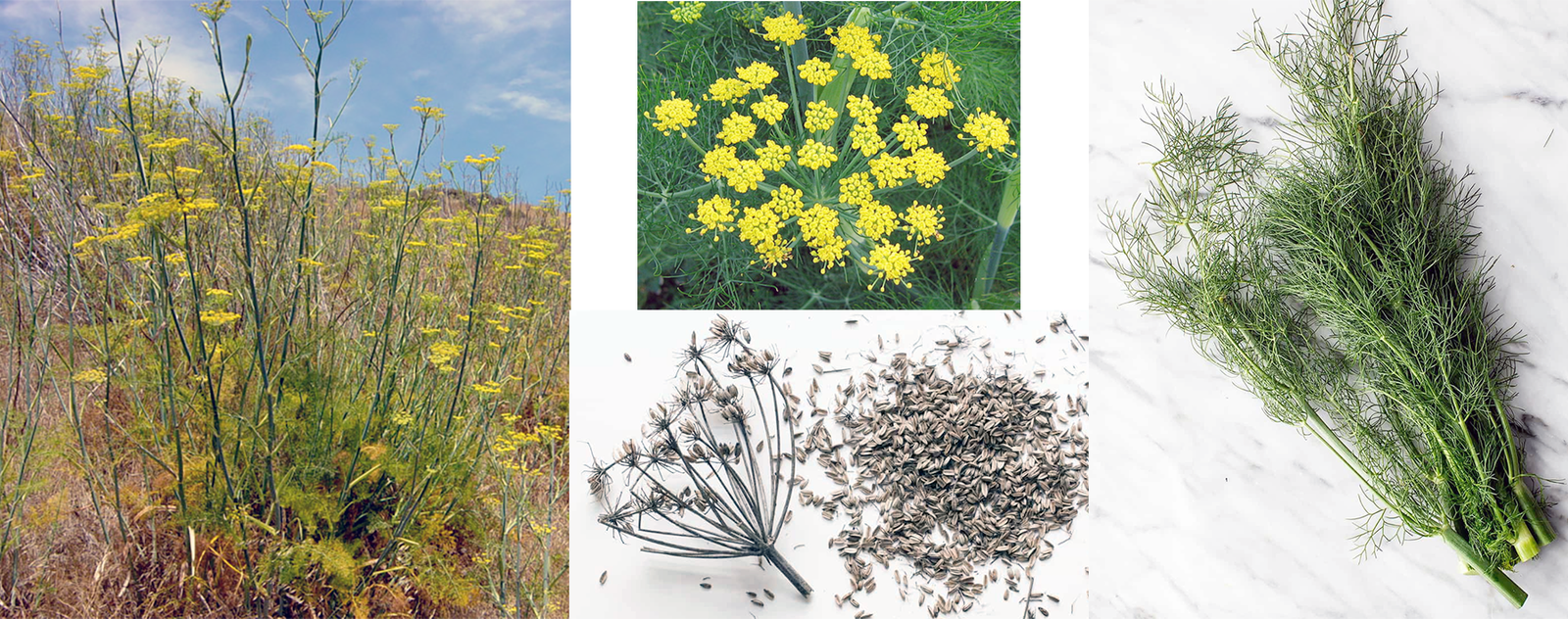
 Fennel, Foeniculum vulgare showing a mature plant in the
wild (left), close-up of the flowers (top), the seed head and
fruit (bottom) and close-up of the fronds (right).
| Common Name: Fennel |
| Scientific Name: Foeniculum vulgare |
| Other Names: Sweet Fennel |
| Family: Apiaceae |
| Range: Origin: Fennel is native to S. Europe. Naturalized in Britain |
Physical Characteristics Foeniculum vulgare is an evergreen Perennial growing to 1.5 m (5ft) by 1 m (3ft 3in) at a medium rate. It is hardy to UK zone 5 and is not frost tender. It is in leaf all year, in flower from August to October, and the seeds ripen from September to October. The species is hermaphrodite (has both male and female organs) and is pollinated by Insects. The plant is self-fertile. It is noted for attracting wildlife.
Suitable for: moist, fertile, neutral to basic soils It prefers saline soil. light (sandy), medium (loamy) and heavy (clay) soils and prefers well-drained soil. |
| Edible Parts: flowers, leaves, oil, root, seeds, stems |
 Edibility Rating: 2 Edibility Rating: 2 
|
 Known Hazards: Skin contact with the sap or essential oil is said to cause photo-sensitivity and/or dermatitis in some people[218, 222]. Ingestion of the oil can cause vomiting, seizures and pulmonary oedema[222]. Avoid for small children. Avoid if cirrhosis/liver disorders. Known Hazards: Skin contact with the sap or essential oil is said to cause photo-sensitivity and/or dermatitis in some people[218, 222]. Ingestion of the oil can cause vomiting, seizures and pulmonary oedema[222]. Avoid for small children. Avoid if cirrhosis/liver disorders.
|
Monthly Availability:
|
Welcome to the summary page for FabulousFusionFood's Wild Food guide to Fennel along with all the Fennel containing recipes presented on this site, with 298 recipes in total.
These recipes, all contain Fennel as a major wild food ingredient.
Fennel, Foeniculum vulgare,/em> is a hardy, perennial herb with yellow flowers and feathery leaves. It is indigenous to the shores of the Mediterranean but has become widely naturalized in many parts of the world, especially on dry soils near the sea coast and on riverbanks. It is a highly flavorful herb used in cooking and, along with the similar-tasting anise, is one of the primary ingredients of absinthe. Florence fennel or finocchio (UK: /fɪˈnɒkioʊ/, US: /-ˈnoʊk-/, Italian: [fiˈnɔkkjo]) is a selection with a swollen, bulb-like stem base (sometimes called bulb fennel) that is used as a vegetable.
Foeniculum vulgare is a perennial herb. The stem is hollow, erect, and glaucous green, and it can grow up to 2.1 meters (7 feet) tall. The leaves grow up to 40 centimeters (16 inches) long; they are finely dissected, with the ultimate segments filiform (threadlike), about 0.5 millimeters (1⁄64 in) wide. Its leaves are similar to those of dill, but thinner. The flowers are produced in terminal compound umbels 5–17.5 cm (2–7 in) wide, each umbel section having 20–50 tiny yellow flowers on short pedicels. The fruit is a dry schizocarp from 4–10 mm (3⁄16–3⁄8 in) long, half as wide or less, and grooved. Since the seed in the fruit is attached to the pericarp, the whole fruit is often mistakenly called "seed".
The word 'Fennel' came into Old English from Old French fenoil which in turn came from Latin faeniculum, a diminutive of faenum, meaning "hay". Indeed, it was the Romans who introduced fennel as a culinary herb into Britain.
Fennel has become naturalized along roadsides, in pastures, and in other open sites in many regions, including northern Europe, the United States, southern Canada, and much of Asia and Australia. It propagates well by both root crown and seed and is considered an invasive species and a weed in Australia and the U.S. It can drastically alter the composition and structure of many plant communities, including grasslands, coastal scrub, riparian, and wetland communities. It appears to do this by outcompeting native species for light, nutrients, and water and perhaps by exuding allelopathic substances that inhibit the growth of other plants.
The foliage, and fruit, roots and stems of the fennel plant are used in many of the culinary traditions of the world. The small flowers of wild fennel (known as fennel 'pollen') are the most potent form of fennel, but also the most expensive. Dried fennel fruit is an aromatic, anise-flavored spice, brown or green when fresh, slowly turning a dull grey as the fruit ages. For cooking, green fruits are optimal. The leaves are delicately flavored and similar in shape to dill. The bulb is a crisp vegetable that can be sautéed, stewed, braised, grilled, roasted or eaten raw. Tender young leaves are used for garnishes, as a salad, to add flavour to salads, to flavour sauces to be served with puddings, and in soups and fish sauce. Both the inflated leaf bases and the tender young shoots can be eaten like celery.
Fennel leaves are used in some parts of India as leafy green vegetables either by themselves or mixed with other vegetables, cooked to be served and consumed as part of a meal. In Syria and Lebanon, the young leaves are used to make a special kind of egg omelette (along with onions and flour) called ijjeh.
[2]. Huxley, A. The New RHS Dictionary of Gardening. 1999
[3]. Tanaka, T. Tanaka's Cyclopaedia of Edible Plants of the World.
[4]. Lim T.K. Edible Medicinal And Non-Medicinal Plants, Vols 1–12.
[5]. Thomas, G. S. Perennial Garden Plants, 2004
[6]. Milner, E. Trees of Britain and Ireland, 2011
[7]. Rose, F. & O'Reilly, C. The Wild Flower Key (Revised Edition) — How to identify wild plants, trees and shrubs in Britain and Ireland, 2006
[8]. Streeter, D. & Garrard, I. The Wild Flowers of the British Isles, 1983
[9]. Clapham, A.R.; Tutin, T.G. & Moore, D.M. Flora of the British Isles, 1987
[10]. Phillips, R. Mushrooms, 2006
[11]. Jordan, P. & Wheeler, S. The Complete Book of Mushrooms: An Illustrated Encyclopedia of Edible Mushrooms, 2011
[12]. Bunker, F. Seaweeds of Britain and Ireland, Second Edition, 2017
[13]. Facciola, S. Cornucopia II — A Source Book of Edible Plants, 1998
[14]. Hartford, R. Edible and Medicinal Wild Plants of Britain and Ireland: A Foraging and Photographic Identification Guide
(Note that the above book links are Amazon Affiliate links)
These recipes, all contain Fennel as a major wild food ingredient.
Fennel, Foeniculum vulgare,/em> is a hardy, perennial herb with yellow flowers and feathery leaves. It is indigenous to the shores of the Mediterranean but has become widely naturalized in many parts of the world, especially on dry soils near the sea coast and on riverbanks. It is a highly flavorful herb used in cooking and, along with the similar-tasting anise, is one of the primary ingredients of absinthe. Florence fennel or finocchio (UK: /fɪˈnɒkioʊ/, US: /-ˈnoʊk-/, Italian: [fiˈnɔkkjo]) is a selection with a swollen, bulb-like stem base (sometimes called bulb fennel) that is used as a vegetable.
Foeniculum vulgare is a perennial herb. The stem is hollow, erect, and glaucous green, and it can grow up to 2.1 meters (7 feet) tall. The leaves grow up to 40 centimeters (16 inches) long; they are finely dissected, with the ultimate segments filiform (threadlike), about 0.5 millimeters (1⁄64 in) wide. Its leaves are similar to those of dill, but thinner. The flowers are produced in terminal compound umbels 5–17.5 cm (2–7 in) wide, each umbel section having 20–50 tiny yellow flowers on short pedicels. The fruit is a dry schizocarp from 4–10 mm (3⁄16–3⁄8 in) long, half as wide or less, and grooved. Since the seed in the fruit is attached to the pericarp, the whole fruit is often mistakenly called "seed".
The word 'Fennel' came into Old English from Old French fenoil which in turn came from Latin faeniculum, a diminutive of faenum, meaning "hay". Indeed, it was the Romans who introduced fennel as a culinary herb into Britain.
Fennel has become naturalized along roadsides, in pastures, and in other open sites in many regions, including northern Europe, the United States, southern Canada, and much of Asia and Australia. It propagates well by both root crown and seed and is considered an invasive species and a weed in Australia and the U.S. It can drastically alter the composition and structure of many plant communities, including grasslands, coastal scrub, riparian, and wetland communities. It appears to do this by outcompeting native species for light, nutrients, and water and perhaps by exuding allelopathic substances that inhibit the growth of other plants.
The foliage, and fruit, roots and stems of the fennel plant are used in many of the culinary traditions of the world. The small flowers of wild fennel (known as fennel 'pollen') are the most potent form of fennel, but also the most expensive. Dried fennel fruit is an aromatic, anise-flavored spice, brown or green when fresh, slowly turning a dull grey as the fruit ages. For cooking, green fruits are optimal. The leaves are delicately flavored and similar in shape to dill. The bulb is a crisp vegetable that can be sautéed, stewed, braised, grilled, roasted or eaten raw. Tender young leaves are used for garnishes, as a salad, to add flavour to salads, to flavour sauces to be served with puddings, and in soups and fish sauce. Both the inflated leaf bases and the tender young shoots can be eaten like celery.
Fennel leaves are used in some parts of India as leafy green vegetables either by themselves or mixed with other vegetables, cooked to be served and consumed as part of a meal. In Syria and Lebanon, the young leaves are used to make a special kind of egg omelette (along with onions and flour) called ijjeh.
References:
[1]. David Evans Notes from field observations, tastings and cookery experiments.[2]. Huxley, A. The New RHS Dictionary of Gardening. 1999
[3]. Tanaka, T. Tanaka's Cyclopaedia of Edible Plants of the World.
[4]. Lim T.K. Edible Medicinal And Non-Medicinal Plants, Vols 1–12.
[5]. Thomas, G. S. Perennial Garden Plants, 2004
[6]. Milner, E. Trees of Britain and Ireland, 2011
[7]. Rose, F. & O'Reilly, C. The Wild Flower Key (Revised Edition) — How to identify wild plants, trees and shrubs in Britain and Ireland, 2006
[8]. Streeter, D. & Garrard, I. The Wild Flowers of the British Isles, 1983
[9]. Clapham, A.R.; Tutin, T.G. & Moore, D.M. Flora of the British Isles, 1987
[10]. Phillips, R. Mushrooms, 2006
[11]. Jordan, P. & Wheeler, S. The Complete Book of Mushrooms: An Illustrated Encyclopedia of Edible Mushrooms, 2011
[12]. Bunker, F. Seaweeds of Britain and Ireland, Second Edition, 2017
[13]. Facciola, S. Cornucopia II — A Source Book of Edible Plants, 1998
[14]. Hartford, R. Edible and Medicinal Wild Plants of Britain and Ireland: A Foraging and Photographic Identification Guide
(Note that the above book links are Amazon Affiliate links)
The alphabetical list of all Fennel recipes on this site follows, (limited to 100 recipes per page). There are 298 recipes in total:
Page 1 of 3
| Achari Masala Origin: India | Barberry Juice Origin: Britain | Carnes Vaccinae (Byzantine Beef Stew) Origin: Roman |
| Achari Roast Chicken Origin: Pakistan | Bashi Hiki Riha (Maldives Aubergine Curry) Origin: Maldives | Cauliflower, Mushroom and Carlin Peas Curry Origin: Britain |
| Ak-Ni Korma Origin: India | Bedmi Aloo Origin: India | Cavolo Agra (Cabbage with Bacon and Fennel Seeds) Origin: Italy |
| Aliter carduos (Artichokes with Herbs) Origin: Roman | Bermuda Curry Powder Origin: Bermuda | Cayman Curry Powder Origin: Cayman Islands |
| Aliter cucumeres (Cucumber with Fennel Seed) Origin: Roman | Bezar Spice Blend Origin: Bahrain | Chaat Masala Origin: India |
| Aliter Faseolus Sive Cicer (Broad Beans or Chickpeas, Another Way) Origin: Roman | Bezar Spice Blend Origin: UAE | Chaat Masala Indian Spice Blend Origin: India |
| Aliter in Apro III (Wild Boar, Another Way III) Origin: Roman | BIR Chicken Chettinad Origin: Britain | Chettinad Fish Fry Origin: India |
| Aliter in Vitulina Elixa (Sauce for Boiled Veal, Another Way) Origin: Roman | BIR Chicken Phaal Origin: Britain | Chevra Origin: South Africa |
| Aliter ius candidum in copadiis (White Sauce for Choice Cuts, Another Way) Origin: Roman | BIR Lamb Chettinad Origin: Britain | Chicken Chettinad Origin: India |
| Aliter Ius in Mullos Assos (Another Sauce for Baked Red Mullet) Origin: Roman | Biryani Masala Origin: Pakistan | Chicken Kottu Roti Origin: Sri Lanka |
| Aliter tisanam (Barley Soup, Another Way) Origin: Roman | Bis Riha (Maldives Egg Curry) Origin: Maldives | Chicken Mappas Origin: India |
| Amchar Masala Origin: Trinidad | Bizar Spice Blend Origin: Qatar | Chicken White Curry Origin: Sri Lanka |
| Amchar Masala Origin: Trinidad | Black Curry Powder Origin: Sri Lanka | Chinese Five Spice Origin: China |
| Anardana goli II Origin: India | Bo-Kaap Kerrie (Cape Malay Curry) Origin: South Africa | Chinese-style Barbecued Mackerel Origin: Fusion |
| Andhra Kodi Kura (Andhra Chicken Curry) Origin: India | Bo-Kaap Kerrie Poeier (Cape Malay Curry Powder) Origin: South Africa | Chocnut Logs Origin: Britain |
| Anguillan Barbecue Sauce Origin: Anguilla | Bombay Egg and Potato Curry Origin: Anglo-Indian | Christmas Island Crab Rendang Origin: Christmas Island |
| Antillean Barbecue Sauce Origin: Sint Maarten | Bottle Masala Origin: India | Clitocybe Odora Fritta (Fried, Breaded, Aniseed Toadstool) Origin: Italy |
| Antillean Barbecue Sauce Origin: Guadeloupe | Bouillabaisse II Origin: France | Cocos Islands Ayam Goreng (Malaysian-style Fried Chicken) Origin: Cocos Islands |
| Antillean Barbecue Sauce Origin: Martinique | Bouillabaisse III Origin: France | Coda di rospo al forno con patate (Baked Monkfish with Potatoes) Origin: Italy |
| Antillean Barbecue Sauce Origin: Saint-Martin | Bouillabaisse with Rouille and Croutons Origin: France | Coda di rospo con Barba di Frate (Monkfish with Monk's Beard Greens) Origin: Vatican City |
| Antillean Barbecue Sauce Origin: Saint Barthelemy | Bourride Origin: Britain | Cold Bruet (Cold Brewet) Origin: England |
| Aper ita conditur (Seasoned Wild Boar) Origin: Roman | Brôn (Brawn) Origin: Welsh | Compost Origin: England |
| Arni Gemisto me Horta ke Feta (Leg of Lamb Stuffed with Greens and Feta) Origin: Greece | Broudou bil Hout (Tunisian Fish Soup) Origin: Tunisia | Cornelian Cherry Conserve Origin: British |
| Asian-style Seared Sea Bass Origin: Fusion | Brown Shrimp Soup with Crisp Sesame Croûtons Origin: Britain | Cornish Cod with Samphire Origin: Britain |
| Assam Fish Curry Origin: Malaysia | Butter-roasted Megrim Sole with Mussels and Cider Origin: Northern Ireland | Country Pork Terrine Origin: England |
| Ayam Goreng (Malaysian Fried Chicken) Origin: Malaysia | Cachorra de Milho ou Mandioca (Maize or Cassava Cachorras) Origin: Mozambique | Couscous de Timbuktu Origin: Mali |
| Ayam Panggang Origin: Christmas Island | Cambaabur Origin: Djibouti | Crackled Pork Belly with Fennel and Apple Slaw Origin: Britain |
| Bột Cary (Vietnamese Curry Powder) Origin: Vietnam | Cambaabur Origin: Somalia | Creamy Chestnut Soup Origin: France |
| Bakeapple Chicken Curry Origin: Canada | Camel Braise with Grilled Date Glace Origin: Fusion | Creamy Monkfish and Shellfish Potpie Origin: Britain |
| Baked Brown Trout Origin: Scotland | Camel Nihari Origin: Pakistan | Crocodile Sandakkan Origin: Malaysia |
| Baked Mackerel with Wild Flavours Origin: Britain | Cape Curry Powder Origin: South Africa | Curry Mouan (Chicken Curry) Origin: Cambodia |
| Bambukeyo Bongara (Maldives Breadfruit Curry) Origin: Maldives | Cape Malay Seafood Curry Origin: South Africa | Durban Cornish Hen Curry Origin: South Africa |
| Banana leaf mackerel Origin: Sri Lanka | Cari Poisson (Mauritian Fish Curry) Origin: Mauritius | |
| Bara Pot Clai Bacheldre (Bacheldre Clay-pot Bread) Origin: Welsh | Carlin Pea and Glazed Halloumi Saag Origin: Britain |
Page 1 of 3