FabulousFusionFood's Milk-based Recipes 23rd Page
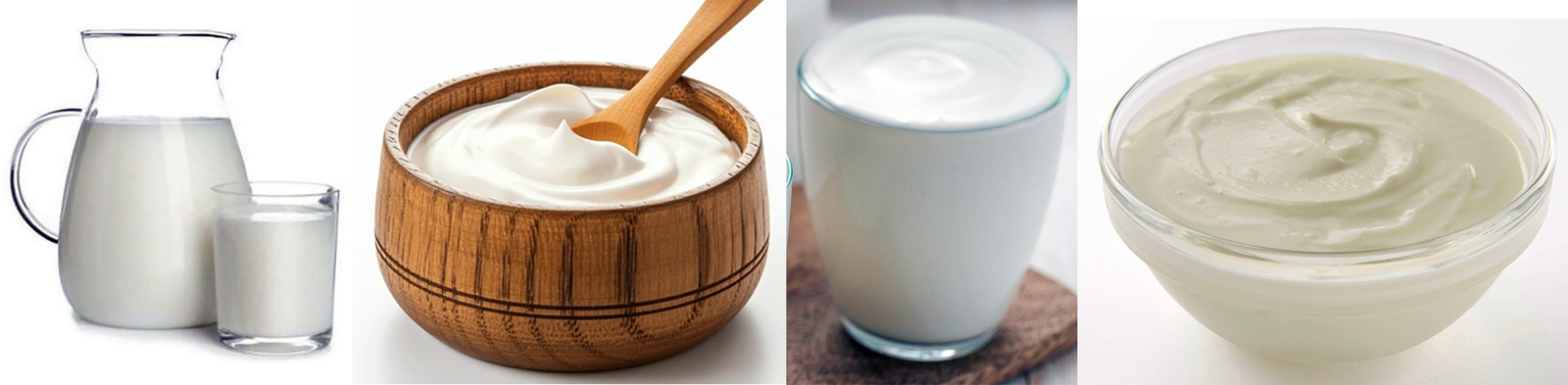 Milk, cream, kefir and yoghurt.
Welcome to FabulousFusionFood's Milk-based Recipes Page — The recipes presented here are all based on milk or cream and its derivative, yoghurt as an ingredient base. Biologically, milk is is a white liquid food produced by the mammary glands of mammals. It is the primary source of nutrition for young mammals (including breastfed human infants) before they are able to digest solid food. Milk contains many nutrients, including calcium and protein, as well as lactose and saturated fat. Immune factors and immune-modulating components in milk contribute to milk immunity. Early-lactation milk, which is called colostrum, contains antibodies and immune-modulating components that strengthen the immune system against many diseases. There are two distinct categories of milk consumption: all infant mammals drink milk directly from their mothers' bodies, and it is their primary source of nutrition; and humans obtain milk from other mammals for consumption by humans of all ages, as one component of a varied diet.
In many cultures, especially in the West, humans continue to consume milk beyond infancy, using the milk of other mammals (especially cattle, goats and sheep) as a food product. Initially, the ability to digest milk was limited to children as adults did not produce lactase, an enzyme necessary for digesting the lactose in milk. People therefore converted milk to curd, cheese, and other products to reduce the levels of lactose. Thousands of years ago, a chance mutation spread in human populations in northwestern Europe that enabled the production of lactase in adulthood. This mutation allowed milk to be used as a new source of nutrition which could sustain populations when other food sources failed. Milk is processed into a variety of products such as cream, butter, yogurt, kefir, ice cream and cheese.
Humans first learned to consume the milk of other mammals regularly following the domestication of animals during the Neolithic Revolution or the development of agriculture. This development occurred independently in several global locations from as early as 9000–7000 BC in Mesopotamia to 3500–3000 BC in the Americas. People first domesticated the most important dairy animals – cattle, sheep and goats – in Southwest Asia, although domestic cattle had been independently derived from wild aurochs populations several times since
Aside from cattle, many kinds of livestock provide milk used by humans for dairy products. These animals include water buffalo, goat, sheep, camel, donkey, horse, reindeer and yak.
Milk is an emulsion or colloid of butterfat globules within a water-based fluid that contains dissolved carbohydrates and protein aggregates with minerals. Because it is produced as a food source for the young, all of its contents provide benefits for growth. The principal requirements are energy (lipids, lactose, and protein), biosynthesis of non-essential amino acids supplied by proteins (essential amino acids and amino groups), essential fatty acids, vitamins and inorganic elements, and water.
Cream is a dairy product composed of the higher-fat layer skimmed from the top of milk before homogenization. In un-homogenized milk, the fat, which is less dense, eventually rises to the top. In the industrial production of cream, this process is accelerated by using centrifuges called "separators". In many countries, it is sold in several grades depending on the total butterfat content. It can be dried to a powder for shipment to distant markets, and contains high levels of saturated fat.
Buttermilk is a fermented dairy drink. Traditionally, it was the liquid left behind after churning butter out of cultured cream. As most modern butter in Western countries is not made with cultured cream but uncultured sweet cream, most modern buttermilk in Western countries is cultured separately. It is common in warm climates where unrefrigerated milk sours quickly. Buttermilk can be drunk straight, and it can also be used in cooking. In making soda bread, the acid in buttermilk reacts with the raising agent, sodium bicarbonate, to produce carbon dioxide which acts as the leavening agent. Buttermilk is also used in marination, especially of chicken and pork.
Kefir (/kəˈfɪər/ kə-FEER; alternative spellings: kephir or kefier; Russian: кефир [kʲɪˈfʲir]; Karachay-Balkar: гыпы) is a fermented milk drink similar to a thin yogurt or ayran that is made from kefir grains, a specific type of mesophilic symbiotic culture. It is prepared by inoculating the milk of cows, goats, or sheep with kefir grains. Kefir is a common breakfast, lunch or dinner drink consumed in countries of western Eurasia. Kefir is consumed at any time of the day, such as alongside European pastries like zelnik (zeljanica), burek and banitsa/gibanica, as well as being an ingredient in cold soups.
Yoghurt from Ottoman Turkish: یوغورت, romanized: yoğurt; also spelled yogurt, yogourt or yoghourt) is a food produced by bacterial fermentation of milk. Fermentation of sugars in the milk by these bacteria produces lactic acid, which acts on milk protein to give yogurt its texture and characteristic tart flavour. Cow's milk is most commonly used to make yogurt. Milk from water buffalo, goats, ewes, mares, camels, and yaks is also used to produce yogurt. The milk used may be homogenized or not. It may be pasteurized or raw. Each type of milk produces substantially different results. Yogurt is produced using a culture of Lactobacillus delbrueckii subsp. bulgaricus and Streptococcus thermophilus bacteria. Other lactobacilli and bifidobacteria are sometimes added during or after culturing yoghurt.
The alphabetical list of all the milk-based recipes on this site follows, (limited to 100 recipes per page). There are 2750 recipes in total:
Page 23 of 28
| Savoury Corn Muffins Origin: American | Seaweed Flour Biscuits Origin: Britain | Sill Potatis (Pickled Herring with Boiled Potatoes and Sour Cream) Origin: Sweden |
| Savoury Honey Fungus Tart Origin: Britain | Seaweed Soup II Origin: Scotland | Simaya Pashka (Easter Cheese Cake) Origin: Russia |
| Sawine (Trini Sweet Baked Noodles) Origin: Trinidad | Semilla de Jícaro (Morro Horchata) Origin: El Salvador | Simple Okra Curry Origin: Australia |
| Saws Béchamel (Béchamel Sauce) Origin: Welsh | Semita de Piña (Salvadoran Pineapple Preserves Yeasted Pastry Pie) Origin: El Salvador | Simple White Sauce Origin: British |
| Saws Bara Lawr (Laverbread Sauce) Origin: Welsh | Semolina Kasha Origin: Russia | Sindhi-style Pilau Origin: Pakistan |
| Saws Persli (Parsley Sauce) Origin: Welsh | Senegalese Soup Origin: Jamaica | Sippets à la Reine Origin: Britain |
| Saws Rhython (Cockle Sauce) Origin: Welsh | Serim (Baked Dough with Yoghurt) Origin: Armenia | Sirnica (Dalmatian Easter bread) Origin: Croatia |
| Saws Siwgwr Brown (Brown Sugar Sauce) Origin: Welsh | Seviyan (Fine Noodle Pudding) Origin: India | Sirop de Menthe au Lait (Mint Syrup with Milk) Origin: Gabon |
| Scallop and Mushroom Pie Origin: Ireland | Sex Muffins (Sex Muffins) Origin: Australia | Siwin wedi'i serio gyda Stwns Bara Lawr, Samffir, Sbigoglys a Phys (Seared Sea Trout with Laver Mash, Samphire, Spinach and Peas) Origin: Welsh |
| Scalloped Morel Mushrooms Origin: American | Sgoniau Bricyll a Chnau Ffrengig (Apricot and Walnut Scones) Origin: Welsh | Six-week Refrigerator Bran Muffins Origin: American |
| Schlesischer frischer Schinken (Silesian Fresh Ham) Origin: Germany | Sgoniau Ceirios (Cherry Scones) Origin: Welsh | Skillet Chicken Con Queso Origin: America |
| Scone and Butter Pudding Origin: Scotland | Sgoniau Melys (Sweet Scones) Origin: Welsh | Slipcoat Cheese Origin: Britain |
| Scone Pizza Base Origin: Italy | Sgoniau Sawrus (Savoury Scones) Origin: Welsh | Sloe Gin and Blackberry Jelly Origin: Britain |
| Scotch Kale Origin: Scotland | Shaah Origin: Djibouti | Sloe Syrup Bavarois Origin: Britain |
| Scotch Whisky Syllabub Origin: Scotland | Shaah Origin: Somalia | Slow Cooker Chicken Korma Origin: Britain |
| Scots Crumpets Origin: Scotland | Shahi Chicken Korma Origin: India | Slow-cooked Moorish Lamb with Buttermilk Dressing Origin: Fusion |
| Scots Marmalade Pudding Origin: Scotland | Shahi Murgh Korma (Royal Chicken Korma) Origin: India | Smetanniki (Belarusian Sour Cream Buns) Origin: Belarus |
| Scottish Baps Origin: Scotland | Shalgham Korma (Turnip Curry) Origin: India | Smočani kačamak (Fatty porridge) Origin: Montenegro |
| Scottish Flummery Origin: Scotland | Shamrock Shakes Origin: American | Smoked Chicken, Leek and Mushroom Pie Origin: Australia |
| Scottish Haricot Bean Soup Origin: Scotland | Shaped Dinner Rolls Origin: Britain | Smoked Fish Fisherman's Pie Origin: England |
| Scottish Leek and Potato Soup Origin: Scotland | Sheer Khurma Origin: Indonesia | Smoked Fish Stew Origin: Ancient |
| Scottish Marmalade Bread and Butter Pudding Origin: Scotland | Sheikh Kebab Origin: India | Smoked Haddock and Champ Cakes Origin: Northern Ireland |
| Scottish Parkin with Lemon Sauce Origin: Scotland | Shemai (Sweet Vermicelli) Origin: Bangladesh | Smoked haddock with Potato Mash Origin: Ireland |
| Scottish Pikelets Origin: Scotland | Shiamali (Semolina Cakes) Origin: Cyprus | Smoked Mackerel Pâté II Origin: Britain |
| Scottish Smokies in Hot Cream Sauce Origin: Scotland | Shida Kartli (Beef-wrapped Eggs in Tomato Sauce) Origin: South Ossetia | Smoked Salmon and Cream Cheese Pâté Origin: Britain |
| Scottish Yule Bannock Origin: Scotland | Shorshe Chingri (Bengali Prawns and Sea Blite) Origin: Bangladesh | Smoked Salmon and Haddock Pots Origin: Scotland |
| Scrambled Chanterelles Origin: Britain | Shrikhand (Sweet Yoghurt with Saffron) Origin: India | Smoked Salmon and Horseradish Potato Farls Origin: Scotland |
| Sea Aster and Cheese Strata Origin: Italy | Shrimp Sauce Origin: Britain | Smoked Salmon Mousse Origin: Scotland |
| Sea Aster Rice Origin: British | Siberian Bird Cherry Cake Origin: Russia | Smoked Salmon with Pea Pancakes Origin: Britain |
| Sea-buckthorn Cheesecake Origin: Britain | Sieden Hähnchen (Simmered Chicken) Origin: Germany | Smoked Trout Pâté Origin: Britain |
| Sea-buckthorn Parfait Origin: Britain | Sienimunaskas-kääryle (Wild Mushroom Omelette Roll) Origin: Finland | Smoky Mushroom and Chickpea Fajitas with Charred Spring Onion Salsa Origin: British |
| Sea-buckthorn Pudding Origin: Finland | Sierra Leonean Pancakes Origin: Sierra Leone | Smörgåstårta (Swedish Savoury Sandwich Cake) Origin: Sweden |
| Seafood Chowder Origin: Ireland | Sierra Leonean Rice Bread Origin: Sierra Leone | |
| Seafood Curry Origin: Scotland | Silky Chocolate Pudding Origin: American |
Page 23 of 28