FabulousFusionFood's Milk-based Recipes 19th Page
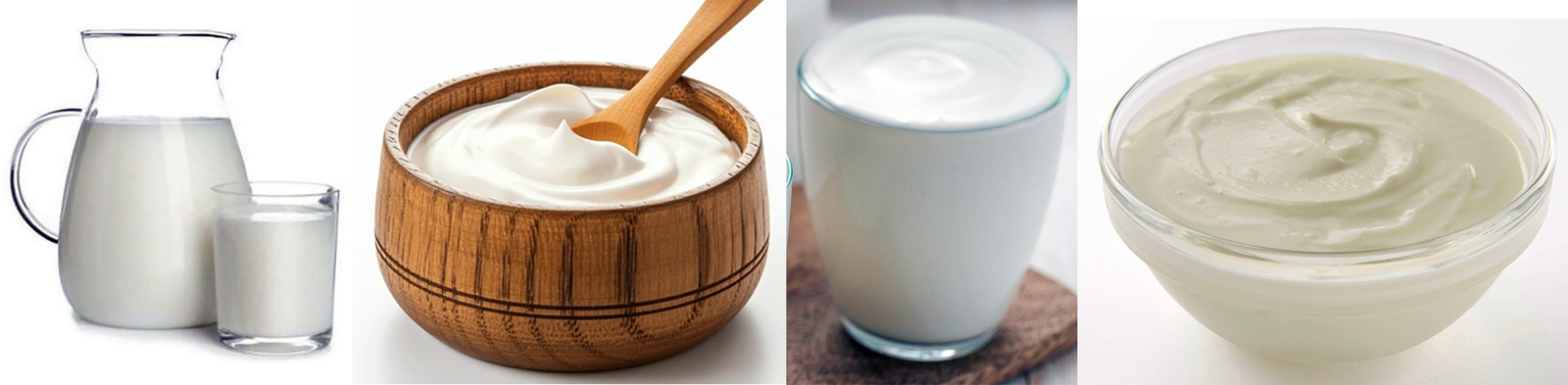 Milk, cream, kefir and yoghurt.
Welcome to FabulousFusionFood's Milk-based Recipes Page — The recipes presented here are all based on milk or cream and its derivative, yoghurt as an ingredient base. Biologically, milk is is a white liquid food produced by the mammary glands of mammals. It is the primary source of nutrition for young mammals (including breastfed human infants) before they are able to digest solid food. Milk contains many nutrients, including calcium and protein, as well as lactose and saturated fat. Immune factors and immune-modulating components in milk contribute to milk immunity. Early-lactation milk, which is called colostrum, contains antibodies and immune-modulating components that strengthen the immune system against many diseases. There are two distinct categories of milk consumption: all infant mammals drink milk directly from their mothers' bodies, and it is their primary source of nutrition; and humans obtain milk from other mammals for consumption by humans of all ages, as one component of a varied diet.
In many cultures, especially in the West, humans continue to consume milk beyond infancy, using the milk of other mammals (especially cattle, goats and sheep) as a food product. Initially, the ability to digest milk was limited to children as adults did not produce lactase, an enzyme necessary for digesting the lactose in milk. People therefore converted milk to curd, cheese, and other products to reduce the levels of lactose. Thousands of years ago, a chance mutation spread in human populations in northwestern Europe that enabled the production of lactase in adulthood. This mutation allowed milk to be used as a new source of nutrition which could sustain populations when other food sources failed. Milk is processed into a variety of products such as cream, butter, yogurt, kefir, ice cream and cheese.
Humans first learned to consume the milk of other mammals regularly following the domestication of animals during the Neolithic Revolution or the development of agriculture. This development occurred independently in several global locations from as early as 9000–7000 BC in Mesopotamia to 3500–3000 BC in the Americas. People first domesticated the most important dairy animals – cattle, sheep and goats – in Southwest Asia, although domestic cattle had been independently derived from wild aurochs populations several times since
Aside from cattle, many kinds of livestock provide milk used by humans for dairy products. These animals include water buffalo, goat, sheep, camel, donkey, horse, reindeer and yak.
Milk is an emulsion or colloid of butterfat globules within a water-based fluid that contains dissolved carbohydrates and protein aggregates with minerals. Because it is produced as a food source for the young, all of its contents provide benefits for growth. The principal requirements are energy (lipids, lactose, and protein), biosynthesis of non-essential amino acids supplied by proteins (essential amino acids and amino groups), essential fatty acids, vitamins and inorganic elements, and water.
Cream is a dairy product composed of the higher-fat layer skimmed from the top of milk before homogenization. In un-homogenized milk, the fat, which is less dense, eventually rises to the top. In the industrial production of cream, this process is accelerated by using centrifuges called "separators". In many countries, it is sold in several grades depending on the total butterfat content. It can be dried to a powder for shipment to distant markets, and contains high levels of saturated fat.
Buttermilk is a fermented dairy drink. Traditionally, it was the liquid left behind after churning butter out of cultured cream. As most modern butter in Western countries is not made with cultured cream but uncultured sweet cream, most modern buttermilk in Western countries is cultured separately. It is common in warm climates where unrefrigerated milk sours quickly. Buttermilk can be drunk straight, and it can also be used in cooking. In making soda bread, the acid in buttermilk reacts with the raising agent, sodium bicarbonate, to produce carbon dioxide which acts as the leavening agent. Buttermilk is also used in marination, especially of chicken and pork.
Kefir (/kəˈfɪər/ kə-FEER; alternative spellings: kephir or kefier; Russian: кефир [kʲɪˈfʲir]; Karachay-Balkar: гыпы) is a fermented milk drink similar to a thin yogurt or ayran that is made from kefir grains, a specific type of mesophilic symbiotic culture. It is prepared by inoculating the milk of cows, goats, or sheep with kefir grains. Kefir is a common breakfast, lunch or dinner drink consumed in countries of western Eurasia. Kefir is consumed at any time of the day, such as alongside European pastries like zelnik (zeljanica), burek and banitsa/gibanica, as well as being an ingredient in cold soups.
Yoghurt from Ottoman Turkish: یوغورت, romanized: yoğurt; also spelled yogurt, yogourt or yoghourt) is a food produced by bacterial fermentation of milk. Fermentation of sugars in the milk by these bacteria produces lactic acid, which acts on milk protein to give yogurt its texture and characteristic tart flavour. Cow's milk is most commonly used to make yogurt. Milk from water buffalo, goats, ewes, mares, camels, and yaks is also used to produce yogurt. The milk used may be homogenized or not. It may be pasteurized or raw. Each type of milk produces substantially different results. Yogurt is produced using a culture of Lactobacillus delbrueckii subsp. bulgaricus and Streptococcus thermophilus bacteria. Other lactobacilli and bifidobacteria are sometimes added during or after culturing yoghurt.
The alphabetical list of all the milk-based recipes on this site follows, (limited to 100 recipes per page). There are 2750 recipes in total:
Page 19 of 28
| Pannkakor (Swedish Pancakes) Origin: Sweden | Pastai Cocos, Tatws a Chennin (Cockle, Potato and Leek Pie) Origin: Welsh | Peksimeti (Sour Dough Fingers) Origin: Serbia |
| Pansotti di Rapallo (Pansotti with Walnut Sauce) Origin: Italy | Pastai Cymreig Cocos a Chennin (Welsh Cockle and Leek Pie) Origin: Welsh | Penzance Cake Origin: England |
| Pão Doce Origin: Sao Tome | Pastai Gocos (Cockle Pie) Origin: Welsh | Penzance Cake III Origin: England |
| Papaya Fairy Cakes with Tangy Lemon Glaze Origin: African Fusion | Pastei Bersli (Parsley Pie) Origin: Welsh | Peppermint Patties Origin: American |
| Papaya Pudding Origin: Aruba | Pastei Cannin a Chig Moch (Welsh Leek and Ham Pie) Origin: Welsh | Perfect Mashed Potatoes Origin: Britain |
| Papaya Smoothie Origin: American | Pasteis de Belém Origin: Portugal | Perfect Pumpkin Pie Origin: American |
| Papo Secos (Crusty Portuguese Rolls) Origin: Portugal | Pastel de Choclo Origin: Chile | Peshwari Naan Origin: India |
| Papo Secos (Crusty Portuguese Rolls) Origin: Angola | Pastel De Choclo (Corn Pudding) Origin: Argentina | Petits Gâteaux au Sureau (Elderberry Muffins) Origin: Switzerland |
| Papo Secos (Crusty Portuguese Rolls) Origin: Mozambique | Pastel de Jamón (Ham Cakes) Origin: Peru | Phirni (Sweet Rice Pudding) Origin: India |
| Papo Secos (East Timor Portuguese Rolls) Origin: East Timor | Pastel de Papas con Tres Quesos (Potato Cake with Three Cheeses) Origin: Peru | Piña Colada Smoothie Origin: American |
| Paprika Pork Origin: Britain | Pastel de Tres Leches Origin: El Salvador | Piadina Origin: San Marino |
| Parasol Fritters Origin: Britain | Pastelillos de Guayaba (Guava Pastries) Origin: Puerto Rico | Piadina Romagnola Origin: Italy |
| Parfait iâ Myrang Lemwn (Iced Lemon Meringue Parfait) Origin: Welsh | Pastelón de Arroz (Cheesy Beef and Rice Casserole) Origin: Dominican Republic | Pice Llaeth Enwyn (Buttermilk Pikelets) Origin: Welsh |
| Parma Ham and Horseradish Greens Strata Origin: Britain | Pastelón de Harina de Maíz (Cornmeal and Beef Casserole) Origin: Dominican Republic | Pice Pregethwr (Preacher's Pikelets) Origin: Welsh |
| Parma Ham and Squash Blossom Strata Origin: Britain | Pastelón de Papa (Dominican Cottage Pie) Origin: Dominican Republic | Pierogi z Jagodami (Polish Bilberry Dumplings) Origin: Poland |
| Parmentier de confit de canard (Confit of Duck Cottage Pie) Origin: France | Pastiera di Grano (Neapolitan Grain Pie) Origin: Italy | Pigeons in a Hole Origin: Britain |
| Parmesan Oatmeal Muffins Origin: British | Pastiera di Pasqua (Easter Ricotta Cake) Origin: Italy | Pine Pollen Pancakes Origin: Britain |
| Parsnip and Apple Soup Origin: England | Pastry Cream Origin: American | Pine Pollen Waffles Origin: Britain |
| Pasanda Sauce Origin: Britain | Patbingsu (Korean Shaved Ice with Red Bean Paste) Origin: Korea | Pineapple and Cassava Tarts Origin: Philippines |
| Paska Babka (Russian Easter Bread) Origin: Russia | Patiala Chicken Curry Origin: India | Pineapple Pulissery Origin: India |
| Paska Babka (Easter Babka) Origin: Belarus | Patina Cotidiana (Everyday Dish) Origin: Roman | Pineapple Rasmalai Origin: India |
| Paska Babka (Easter Babka) Origin: Russia | Patina Solearum ex Ovis (A Dish of Soles with Eggs) Origin: Roman | Pineapple Smoothie Origin: American |
| Paska Babka (Easter Babka) Origin: Ukraine | Patina Versatilis (Upside-down Dish) Origin: Roman | Pineapple, Apricot and Yoghurt Smoothie Origin: Britain |
| Paska Bobka (Polish Easter Bread) Origin: Poland | Patinam ex Lacte (Milk Casserole) Origin: Roman | Pineappleweed Ice Cream Origin: Britain |
| Paska Slovak (Slovakian Easter Bread) Origin: Slovakia | Pavo de Navidad (Spanish-style Christmas Turkey) Origin: Spain | Pineappleweed Posset Pots Origin: Britain |
| Paskha (Russian Easter Cheesecake) Origin: Russia | Peach Melba Cheesecake Origin: Britain | Pineappleweed Skolebrød Origin: Scotland |
| Passion Fruit and Orange Butterfly Cakes Origin: Britain | Peach Sherbet Smoothie Origin: American | Pink Leg of Lamb Origin: Turkey |
| Passion Fruit Soufflé Origin: Britain | Peach Smoothie Origin: American | Pioniono de Arquipe y Coco (Dulce de Leche and Coconut Roll) Origin: Colombia |
| Passionfruit Crème Patissière Origin: Saint Barthelemy | Peanut Butter Cheesecake Origin: Britain | Piroshki Origin: Russia |
| Pasta al Limone (Creamy Lemon Pasta with Parmesan) Origin: Italy | Peanut Butter Smoothie Origin: American | Pirozhki (Stuffed Yeasted Buns) Origin: Russia |
| Pasta with Creamy Parasol Mushrooms Origin: British | Peapod Soup Origin: Scotland | Pishme (Turkmen Dough Fritters) Origin: Turkmenistan |
| Pastai Briwgig Eidion a Nionod (Leek and Caerphilly Cheese Crumble Tart) Origin: Welsh | Pear and Blackberry Cobbler Origin: Britain | Pista Kulfi (Pistachio Ice Cream) Origin: India |
| Pastai Cenin, Panas a Chig Moch (Leek, Parsnip and Bacon Pie) Origin: Welsh | Pease Bannocks Origin: Scotland | |
| Pastai Cocos (Cockle Pie) Origin: Welsh | Pehtranova Potica (Tarragon Potica) Origin: Slovenia |
Page 19 of 28