FabulousFusionFood's Levantine Recipes Home Page
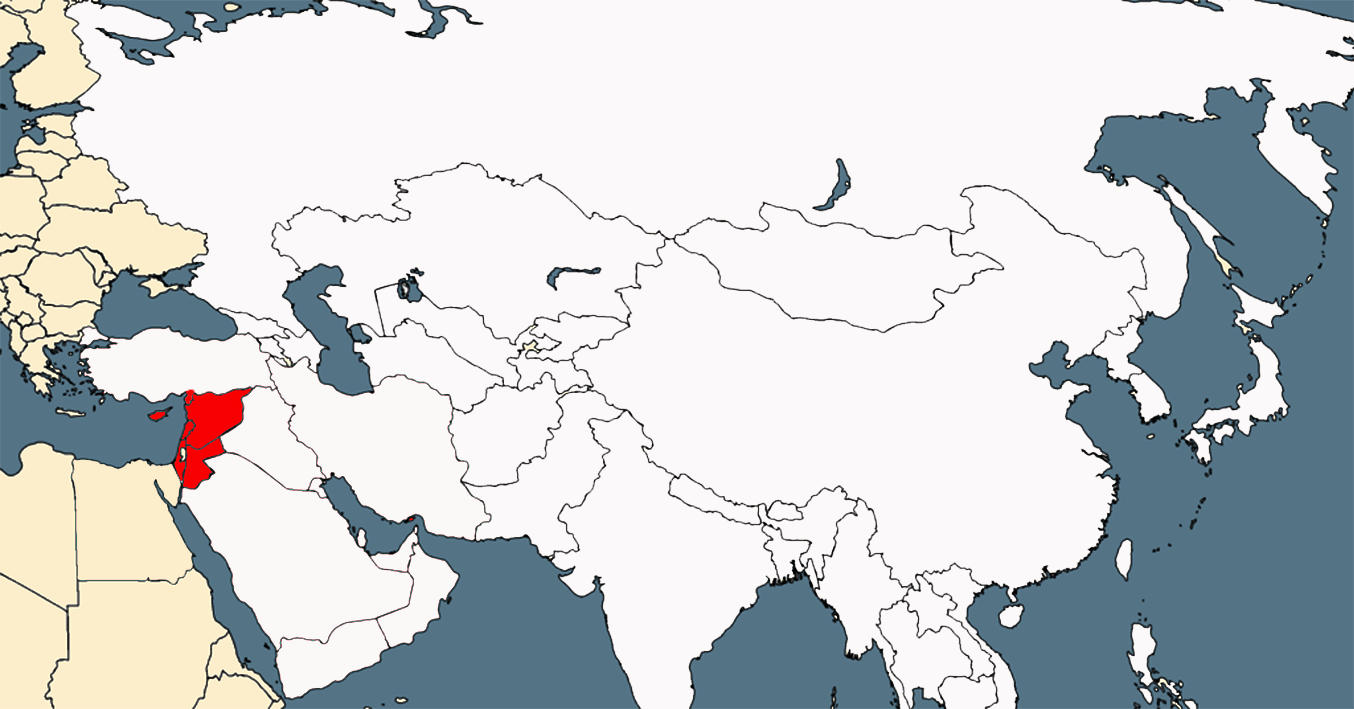 The map of Asia, with the countries of the Levant picked out in red.
Welcome to the summary page for FabulousFusionFood's Levantine recipes. This page provides links to all the Levantine recipes presented on this site, with 346 recipes in total.
These recipes, for the major part, originate in the Levant. Otherwise they are fusion recipes with major Levantine influences.
The Levant is an approximate historical geographical term referring to a large area in the Eastern Mediterranean region of West Asia and core territory of the political term Middle East. In its narrowest sense, which is in use today in archaeology and other cultural contexts, it is equivalent to Cyprus and a stretch of land bordering the Mediterranean Sea in western Asia: i.e. the historical region of Syria ('Greater Syria'), which includes present-day Israel, Jordan, Lebanon, Syria, the Palestinian territories and most of Turkey southwest of the middle Euphrates. Its overwhelming characteristic is that it represents the land bridge between Africa and Eurasia. In its widest historical sense, the Levant included all of the Eastern Mediterranean with its islands; that is, it included all of the countries along the Eastern Mediterranean shores, extending from Greece in Southern Europe to Cyrenaica, Eastern Libya in Northern Africa.
In the 13th and 14th centuries, the term levante was used for Italian maritime commerce in the Eastern Mediterranean, including Greece, Anatolia, Syria-Palestine, and Egypt, that is, the lands east of Venice. Eventually the term was restricted to the Muslim countries of Syria-Palestine and Egypt. The term entered English in the late 15th century from French. It derives from the Italian levante, meaning 'rising', implying the rising of the Sun in the east, and is broadly equivalent to the term al-Mashriq (Arabic: ٱلْمَشْرِق, [ʔal.maʃ.riq]), meaning 'the eastern place, where the Sun rises'.
In 1581, England set up the Levant Company to trade with the Ottoman Empire. The name Levant States was used to refer to the French mandate over Syria and Lebanon after World War I. This is probably the reason why the term Levant has come to be used more specifically to refer to modern Syria, Lebanon, Palestine, Israel, Jordan, and the island of Cyprus. Some scholars mistakenly believed that it derives from the name of Lebanon. Today the term is often used in conjunction with prehistoric or ancient historical references. It has the same meaning as 'Syria-Palestine' or Ash-Shaam (Arabic: ٱلشَّام, /ʔaʃ.ʃaːm/), the area that is bounded by the Taurus Mountains of Turkey in the north, the Mediterranean Sea in the west, the north Arabian Desert and Mesopotamia in the east, and Sinai in the south (which can be fully included or not). Typically, it does not include Anatolia (also known as Asia Minor), the Caucasus Mountains, or any part of the Arabian Peninsula proper. Cilicia (in Asia Minor) and the Sinai Peninsula (Asian Egypt) are sometimes included.
As a name for the contemporary region, several dictionaries consider Levant to be archaic today. Both the noun Levant and the adjective Levantine are now commonly used to describe the ancient and modern culture area formerly called Syro-Palestinian or Biblical: archaeologists now speak of the Levant and of Levantine archaeology; food scholars speak of Levantine cuisine; and the Latin Christians of the Levant continue to be called Levantine Christians.
The term Levant appears in English in 1497, and originally meant 'the East' or 'Mediterranean lands east of Italy'. It is borrowed from the French levant 'rising', referring to the rising of the sun in the east, or the point where the sun rises. The phrase is ultimately from the Latin word levare, meaning 'lift, raise'. Similar etymologies are found in Greek Ἀνατολή Anatolē (cf. Anatolia 'the direction of sunrise'), in Germanic Morgenland (lit. 'morning land'), in Italian (as in Riviera di Levante, the portion of the Liguria coast east of Genoa), in Hungarian Kelet ('east'), in Spanish and Catalan Levante and Llevant, ('the place of rising'), and in Hebrew מִזְרָח mizraḥ ('east'). Most notably, 'Orient' and its Latin source oriens meaning 'east', is literally 'rising', deriving from Latin orior 'rise'.
The notion of the Levant has undergone a dynamic process of historical evolution in usage, meaning, and understanding. While the term 'Levantine' originally referred to the European residents of the eastern Mediterranean region, it later came to refer to regional 'native' and 'minority' groups.
The term became current in English in the 16th century, along with the first English merchant adventurers in the region; English ships appeared in the Mediterranean in the 1570s, and the English merchant company signed its agreement ('capitulations') with the Ottoman Sultan in 1579. The English Levant Company was founded in 1581 to trade with the Ottoman Empire, and in 1670 the French Compagnie du Levant was founded for the same purpose. At this time, the Far East was known as the 'Upper Levant'.
These recipes, for the major part, originate in the Levant. Otherwise they are fusion recipes with major Levantine influences.
The Levant is an approximate historical geographical term referring to a large area in the Eastern Mediterranean region of West Asia and core territory of the political term Middle East. In its narrowest sense, which is in use today in archaeology and other cultural contexts, it is equivalent to Cyprus and a stretch of land bordering the Mediterranean Sea in western Asia: i.e. the historical region of Syria ('Greater Syria'), which includes present-day Israel, Jordan, Lebanon, Syria, the Palestinian territories and most of Turkey southwest of the middle Euphrates. Its overwhelming characteristic is that it represents the land bridge between Africa and Eurasia. In its widest historical sense, the Levant included all of the Eastern Mediterranean with its islands; that is, it included all of the countries along the Eastern Mediterranean shores, extending from Greece in Southern Europe to Cyrenaica, Eastern Libya in Northern Africa.
In the 13th and 14th centuries, the term levante was used for Italian maritime commerce in the Eastern Mediterranean, including Greece, Anatolia, Syria-Palestine, and Egypt, that is, the lands east of Venice. Eventually the term was restricted to the Muslim countries of Syria-Palestine and Egypt. The term entered English in the late 15th century from French. It derives from the Italian levante, meaning 'rising', implying the rising of the Sun in the east, and is broadly equivalent to the term al-Mashriq (Arabic: ٱلْمَشْرِق, [ʔal.maʃ.riq]), meaning 'the eastern place, where the Sun rises'.
In 1581, England set up the Levant Company to trade with the Ottoman Empire. The name Levant States was used to refer to the French mandate over Syria and Lebanon after World War I. This is probably the reason why the term Levant has come to be used more specifically to refer to modern Syria, Lebanon, Palestine, Israel, Jordan, and the island of Cyprus. Some scholars mistakenly believed that it derives from the name of Lebanon. Today the term is often used in conjunction with prehistoric or ancient historical references. It has the same meaning as 'Syria-Palestine' or Ash-Shaam (Arabic: ٱلشَّام, /ʔaʃ.ʃaːm/), the area that is bounded by the Taurus Mountains of Turkey in the north, the Mediterranean Sea in the west, the north Arabian Desert and Mesopotamia in the east, and Sinai in the south (which can be fully included or not). Typically, it does not include Anatolia (also known as Asia Minor), the Caucasus Mountains, or any part of the Arabian Peninsula proper. Cilicia (in Asia Minor) and the Sinai Peninsula (Asian Egypt) are sometimes included.
As a name for the contemporary region, several dictionaries consider Levant to be archaic today. Both the noun Levant and the adjective Levantine are now commonly used to describe the ancient and modern culture area formerly called Syro-Palestinian or Biblical: archaeologists now speak of the Levant and of Levantine archaeology; food scholars speak of Levantine cuisine; and the Latin Christians of the Levant continue to be called Levantine Christians.
The term Levant appears in English in 1497, and originally meant 'the East' or 'Mediterranean lands east of Italy'. It is borrowed from the French levant 'rising', referring to the rising of the sun in the east, or the point where the sun rises. The phrase is ultimately from the Latin word levare, meaning 'lift, raise'. Similar etymologies are found in Greek Ἀνατολή Anatolē (cf. Anatolia 'the direction of sunrise'), in Germanic Morgenland (lit. 'morning land'), in Italian (as in Riviera di Levante, the portion of the Liguria coast east of Genoa), in Hungarian Kelet ('east'), in Spanish and Catalan Levante and Llevant, ('the place of rising'), and in Hebrew מִזְרָח mizraḥ ('east'). Most notably, 'Orient' and its Latin source oriens meaning 'east', is literally 'rising', deriving from Latin orior 'rise'.
The notion of the Levant has undergone a dynamic process of historical evolution in usage, meaning, and understanding. While the term 'Levantine' originally referred to the European residents of the eastern Mediterranean region, it later came to refer to regional 'native' and 'minority' groups.
The term became current in English in the 16th century, along with the first English merchant adventurers in the region; English ships appeared in the Mediterranean in the 1570s, and the English merchant company signed its agreement ('capitulations') with the Ottoman Sultan in 1579. The English Levant Company was founded in 1581 to trade with the Ottoman Empire, and in 1670 the French Compagnie du Levant was founded for the same purpose. At this time, the Far East was known as the 'Upper Levant'.
The Countries in the Levant
| Arms | Flag | Name of Territory | Capital | Name in Official Language(s) |
|---|---|---|---|---|
 |
Akrotiri and Dhekelia | Episkopi | Sovereign Base Areas of Akrotiri and Dhekelia | |
 |
 |
Cyprus | Nicosia | Κυπριακή Δημοκρατία (Greek)/Kıbrıs Cumhuriyeti (Turkish) |
 |
 |
Israel | Jerusalem | מְדִינַת יִשְׂרָאֵל/دَوْلَة إِسْرَائِيل |
 |
 |
Jordan | Amman | المملكة الأردنية الهاشمية (Arabic: al-Mamlakah al-ʾUrdunniyah al-Hāshimiyah) |
 |
Lebanon | Beiruit | الجمهورية اللبنانية (Arabic: al-Jumhūrīyah al-Lubnānīyah) | |
 |
 |
Northern Cyprus (Unrecognised) |
North Nicosia | Kuzey Kıbrıs Türk Cumhuriyeti (Turkish) |
 |
 |
Palestine | Ramallah | دولة فلسطين (Arabic: Dawlat Filasṭīn) |
 |
 |
Syria | Damascus | الجمهورية العربية السورية (Arabic: al-Jumhūriyya al-ʿArabiyya as-Sūriya) |
 |
Hatay Province (Turkey) | Ankara | Türkiye Cumhuriyeti |
The alphabetical list of all the Levantine recipes on this site follows, (limited to 100 recipes per page). There are 346 recipes in total:
Page 1 of 4
| Adana Kebab Origin: Turkey | Bourek me Kima (Pastries Stuffed with Minced Meat) Origin: Cyprus | Firin Makarna (Macaroni Bake) Origin: Northern Cyprus |
| Adana Kebap Origin: Turkey | Bouti Arniou Rosto (Roast Leg of Lamb) Origin: Cyprus | Fistikli Baklava (Turkish Pistachio Baklava) Origin: Turkey |
| Afelia (Pork Marinated in Wine) Origin: Cyprus | Braaied Flatbreads Origin: Turkey | Flaounes II (Easter Cheese Cakes) Origin: Cyprus |
| Amba Sauce Origin: Israel | Bulgur Pilaf Origin: Turkey | Freekeh Mansaf Origin: Syria |
| Anamikto Siropi (Mixed Fruit Squash) Origin: Cyprus | Cacık (Turkish Cucumber and Yoghurt Salad) Origin: Turkey | Freekeh Mfalfaleh (Palestinian Freekeh Pilaf) Origin: Palestine |
| Anginares me Avgolemono (Artichokes with Egg and Lemon Sauce) Origin: Cyprus | Cacık (Yoghurt, Cucumber and Mint Dip) Origin: Northern Cyprus | Freekeh Pilaf Origin: Levant |
| Anginares Yemistes (Stuffed Artichokes) Origin: Cyprus | Cevizli Baklava (Turkish Walnut Baklava) Origin: Turkey | Gül Şurubu (Rose Syrup) Origin: Turkey |
| Arni Kappamas (Lamb and Potatoes Cooked in Tomato Sauce) Origin: Cyprus | Cheese Baklava Origin: Syria | Garlic and Yoghurt Sauce Origin: Turkey |
| Arni me Fasolia (Lamb with Haricot Beans) Origin: Cyprus | Chicken Shawarma Wrap Origin: Levant | Gebne Mankoushe (Lebanese Cheese Pizza) Origin: Lebanon |
| Arni me kounouppidhi Mesaritico (Lamb with Cauliflower à la Mesaorias) Origin: Cyprus | Chirines Brizoles (Grilled Pork Cutlets) Origin: Cyprus | Gliko Kerasi (Cherries in Syrup) Origin: Cyprus |
| Arni me Spanaki (Lamb with Spinach) Origin: Cyprus | Chirino me Kolokassi (Pork with Taro) Origin: Cyprus | Gliko Kitromilo (Bitter Oranges in Syrup) Origin: Cyprus |
| Arni Psito (Oven-baked Lamb) Origin: Cyprus | Chirnia Souvlakia (Pork Kebabs) Origin: Cyprus | Gliko Melintzanakia (Small Aubergines in Syrup) Origin: Cyprus |
| Arni Souvla (Skewered Lamb) Origin: Cyprus | Chiromeri (Cypriot Smoked Ham) Origin: Cyprus | Gliko Milo (Apples in Syrup) Origin: Cyprus |
| Arni Ttavas (Oven-roasted Lamb with Onions) Origin: Cyprus | Cilbir (Eggs on Yoghurt) Origin: Turkey | Gouroundopulo Psito (Oven-baked Suckling Pig) Origin: Cyprus |
| Aşure (Noah's Pudding) Origin: Northern Cyprus | Çiokolatalı Sos (Turkish Chocolate Sauce) Origin: Turkey | Halva Origin: Lebanon |
| Atayef (Pancakes) Origin: Lebanon | Colocassi Tsakristo (Taro and Pork Stew) Origin: Cyprus | Hamantaschen (Tricorn Purim Pastries) Origin: Israel |
| Ayran (Turkish Buttermilk) Origin: Turkey | Colokassi Mesatrico (Colocassi, Mesoorias Style) Origin: Cyprus | Hamutzim (Israeli Pickled Vegetables) Origin: Israel |
| Ayran (Turkish Cypriot Chicken and Taro Stew) Origin: Northern Cyprus | Cypriot Imam Baylidi Origin: Cyprus | Havuçlu Toplar (Turkish Carrot Balls) Origin: Turkey |
| Baba Ghanoush Origin: Jordan | Cypriot Lacham-atzeen (Spiced Minced Lamb on Flatbread) Origin: Cyprus | Helle Aşı (Helle Soup) Origin: Turkey |
| Baba Ghanoush Origin: Turkey | Cypriot Pitta Bread (Envelope Bread) Origin: Cyprus | Hinbeh B'zeit (Dandelion Greens with Caramelized Onions) Origin: Lebanon |
| Baba Ghanoush Origin: Lebanon | Cypriot Souvlaki Origin: Cyprus | Hindbeh b Zeit (Dandelion Leaves in Oil) Origin: Lebanon |
| Baba Ghanoush Origin: Palestine | Düğün Çorbası (Wedding Soup) Origin: Turkey | Home-made Kadayıf Origin: Turkey |
| Baklava Origin: Northern Cyprus | Dajaaj al Riz (Syrian Roast Chicken with Rice) Origin: Syria | Hoummi Kopanisti (Chickpea Dip) Origin: Cyprus |
| Balık Çorbası (Mackerel Soup) Origin: Turkey | Dhaktyla (Ladies' Fingers) Origin: Cyprus | Iflaghun Origin: Syria |
| Bamies Yiahni (Okra with Tomato Sauce) Origin: Cyprus | Dhiafora Khorta sto Fourno (Mixed oven-baked Vegetables) Origin: Cyprus | Imam Bayildi (The Imam Fainted) Origin: Turkey |
| Bamya Çorbası (Okra Soup) Origin: Turkey | Dhiafora Parayiemista (Mixed Stuffed Vegetables) Origin: Cyprus | Irmik Helvasi (Semolina Halva) Origin: Turkey |
| Barazek (Syrian Sesame Biscuits) Origin: Syria | Domatesli Pilav (Pilaf with Tomato) Origin: Turkey | Ispanaklı Kek (Spinach Cake) Origin: Turkey |
| Barbecued Fish with Amba Mango Sauce Origin: Israel | Ekşili Çorba (Sour Soup) Origin: Turkey | Israeli Chicken and Aubergine Shakshuka Origin: Israel |
| Bayth Mashi (Stuffed Eggs) Origin: Lebanon | Elies Tsakistes (Crushed Green Olives) Origin: Cyprus | Israeli Chicken and Rice Pilaf Origin: Israel |
| Bazlama Flatbread Origin: Turkey | Elioti (Oven-baked Olive Bread) Origin: Cyprus | Israeli Falafel Origin: Israel |
| Beyaz Peynirli Yumurta (Eggs with Feta Cheese) Origin: Turkey | Etli Kapuska (Turkish Cabbage Stew With Meat) Origin: Turkey | Israeli Halva Origin: Israel |
| Biber Salçası (Turkish Red Pepper Paste) Origin: Turkey | Ezme (Spicy Turkish Salad) Origin: Turkey | Israeli Mamul (Israeli Date Pastries) Origin: Israel |
| Boorrma (String Pastry Rolls) Origin: Lebanon | Faggi Ksidhati (Lentil Soup with Vinegar) Origin: Cyprus | |
| Borulce (Black-eyed Pea Stew) Origin: Turkey | Fasolia Soliatica (Haricot Beans, Soleas Style) Origin: Cyprus |
Page 1 of 4