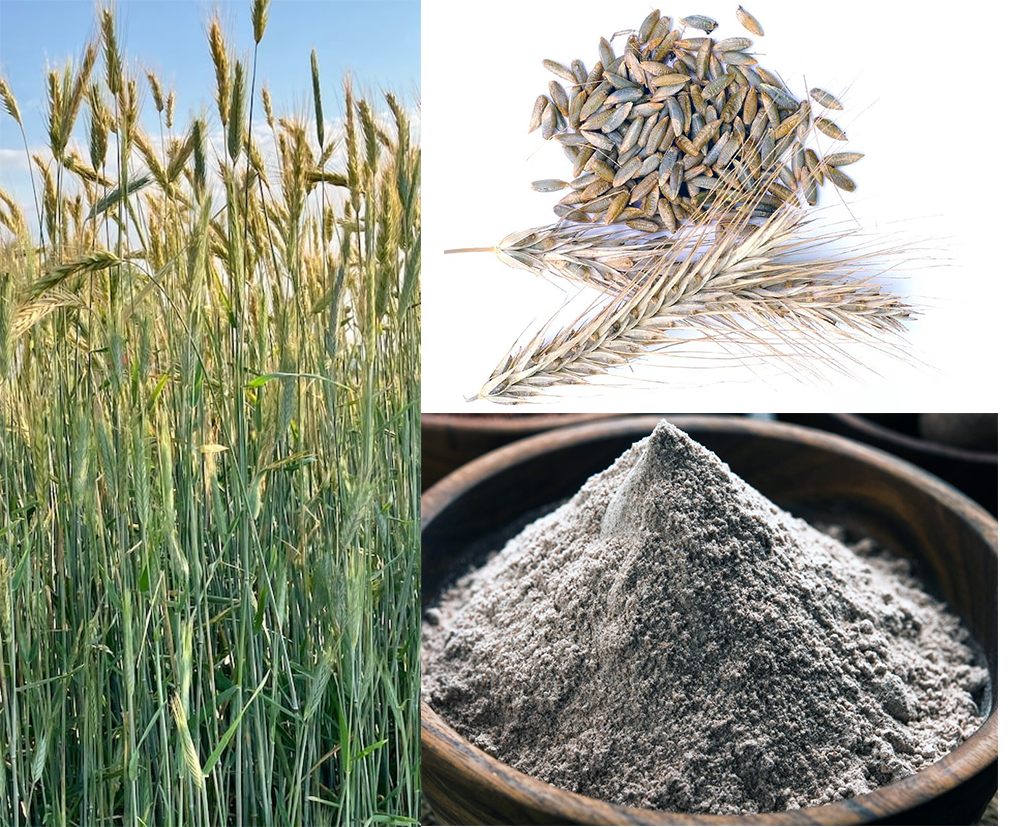
 Green rye plants in the field (left) ears of rye and rye grains
(top) and a mound of rye flour (bottom).
Welcome to the summary page for FabulousFusionFood's Cook's Guide entry for Rye along with all the recipes employing Rye presented on this site, with 47 recipes in total.
This is a continuation of an entire series of pages that will, I hope, allow my visitors to better navigate this site. As well as displaying recipes by name, country and region of origin I am now planning a whole series of pages where recipes can be located by meal type and main ingredient. This page gives a listing of all the Rye recipes added to this site.
These recipes, all contain Rye as a major wild food ingredient.
Secale cereale, commonly known as rye is a member of the grass family, Poaceae that lies in the Triticaceae tribe of the Pooideae subfamily of the BOP clade of true grasses. It is sister to wheat Triticum. It is grown principally in an area from Eastern and Northern Europe into Russia. It is much more tolerant of cold weather and poor soil than other cereals, making it useful in those regions; its vigorous growth suppresses weeds and provides abundant forage for animals early in the year. It is a member of the wheat tribe (Triticeae) which includes the cereals wheat and barley. It is likely that rye arrived in Europe as a secondary crop, meaning that it was a minor admixture in wheat as a result of Vavilovian mimicry, and was only later cultivated in its own right.
Rye grain is used for bread, beer, rye whiskey, and animal fodder. In Scandinavia, rye was a staple food in the Middle Ages, and rye crispbread remains a popular food in the region. Europe produces around half of the world's rye; relatively little is traded between countries. A wheat-rye hybrid, triticale, combines the qualities of the two parent crops and is produced in large quantities worldwide. In European folklore, the Roggenwolf ('rye wolf') is a carnivorous corn demon or Feldgeist.
Rye is a tall grass grown for its seeds; it can be an annual or a biennial. Depending on environmental conditions and variety it reaches 1 to 3 metres in height. Its leaves are blue-green, long, and pointed. The seeds are carried in a curved head or spike some 7 to 15 centimetres long. The head is composed of many spikelets, each of which holds two small flowers; the spikelets alternate left and right up the head.
The generic name Secale, related to Italian segale and French seigle meaning 'rye', is of unknown origin but may derive from a Balkan language. The English name rye derives from Old English ryge, related to Dutch rogge, German Roggen, and Russian рожь rožʹ, again all with the same meaning.
Rye is one of several cereals that grow wild in the Levant, central and eastern Turkey and adjacent areas. Evidence uncovered at the Epipalaeolithic site of Tell Abu Hureyra in the Euphrates valley of northern Syria suggests that rye was among the first cereal crops to be systematically cultivated, around 13,000 years ago. However, that claim remains controversial; critics point to inconsistencies in the radiocarbon dates, and identifications based solely on grain, rather than on chaff. The current best candidate for the ancestral species for domesticated rye is Secale segetale.
Domesticated rye occurs in small quantities at a number of Neolithic sites in Asia Minor (Anatolia, now Turkey), such as the Pre-Pottery Neolithic B Can Hasan III near Çatalhöyük, but is otherwise absent from the archaeological record until the Bronze Age of central Europe, c. 1800–1500 BCE.
It is likely that rye was brought westwards from Asia Minor as a secondary crop, meaning that it was a minor admixture in wheat as a result of Vavilovian mimicry, and was only later cultivated in its own right. Archeological evidence of this grain has been found in Roman contexts along the Rhine and the Danube and in Ireland and Britain. The Roman naturalist Pliny the Elder was dismissive of a grain that may have been rye, writing that it "is a very poor food and only serves to avert starvation". He said it was mixed with emmer "to mitigate its bitter taste, and even then is most unpleasant to the stomach".
Since the Middle Ages, people have cultivated rye widely in Central and Eastern Europe. It serves as the main bread cereal in most areas east of the France–Germany border and north of Hungary. In Southern Europe, it was cultivated on marginal lands.
Rye grows well in much poorer soils than those necessary for most cereal grains. Thus, it is an especially valuable crop in regions where the soil has sand or peat. Rye plants withstand cold better than other small grains, surviving snow cover that would kill winter wheat. Winter rye is the most popular: it is planted and begins to grow in autumn. In spring, the plants develop rapidly. This allows it to provide spring grazing, at a time when spring-planted wheat has only just germinated.
Rye is harvested like wheat with a combine harvester, which cuts the plants, threshes and winnows the grain, and releases the straw to the field where it is later pressed into bales or left as soil amendment. The resultant grain is stored in local silos or transported to regional grain elevators and combined with other lots for storage and distant shipment. Before the era of mechanised agriculture, rye harvesting was a manual task performed with scythes or sickles
Raw rye is 11% water, 76% carbohydrates, 10% protein, and 2% fat. A reference amount of 100-gram (3+1⁄2-ounce) provides 1,410 kilojoules (338 kilocalories) of food energy, and is a rich source (20% or more of the Daily Value, DV) of dietary fibre, B vitamins, such as thiamine and niacin (each at 25% DV), and several dietary minerals, including manganese (130% DV), zinc, phosphorus, and magnesium (26–27% DV).
Rye grain is refined into a flour high in gliadin but low in glutenin and rich in soluble fiber. Alkylresorcinols are phenolic lipids present in high amounts in the bran layer (e.g. pericarp, testa and aleurone layers) of wheat and rye (0.1–0.3% of dry weight). Rye bread, including pumpernickel, is made using rye flour and is a widely eaten food in Northern and Eastern Europe. In Scandinavia, rye is widely used to make crispbread (Knäckebröd); in the Middle Ages it was a staple food in the region, and it remains popular in the 21st century.
Rye grain is used to make alcoholic drinks, such as rye whiskey and rye beer. The traditional cloudy and sweet-sour low-alcohol beverage kvass is fermented from rye bread or rye flour and malt.
This is a continuation of an entire series of pages that will, I hope, allow my visitors to better navigate this site. As well as displaying recipes by name, country and region of origin I am now planning a whole series of pages where recipes can be located by meal type and main ingredient. This page gives a listing of all the Rye recipes added to this site.
These recipes, all contain Rye as a major wild food ingredient.
Secale cereale, commonly known as rye is a member of the grass family, Poaceae that lies in the Triticaceae tribe of the Pooideae subfamily of the BOP clade of true grasses. It is sister to wheat Triticum. It is grown principally in an area from Eastern and Northern Europe into Russia. It is much more tolerant of cold weather and poor soil than other cereals, making it useful in those regions; its vigorous growth suppresses weeds and provides abundant forage for animals early in the year. It is a member of the wheat tribe (Triticeae) which includes the cereals wheat and barley. It is likely that rye arrived in Europe as a secondary crop, meaning that it was a minor admixture in wheat as a result of Vavilovian mimicry, and was only later cultivated in its own right.
Rye grain is used for bread, beer, rye whiskey, and animal fodder. In Scandinavia, rye was a staple food in the Middle Ages, and rye crispbread remains a popular food in the region. Europe produces around half of the world's rye; relatively little is traded between countries. A wheat-rye hybrid, triticale, combines the qualities of the two parent crops and is produced in large quantities worldwide. In European folklore, the Roggenwolf ('rye wolf') is a carnivorous corn demon or Feldgeist.
Rye is a tall grass grown for its seeds; it can be an annual or a biennial. Depending on environmental conditions and variety it reaches 1 to 3 metres in height. Its leaves are blue-green, long, and pointed. The seeds are carried in a curved head or spike some 7 to 15 centimetres long. The head is composed of many spikelets, each of which holds two small flowers; the spikelets alternate left and right up the head.
The generic name Secale, related to Italian segale and French seigle meaning 'rye', is of unknown origin but may derive from a Balkan language. The English name rye derives from Old English ryge, related to Dutch rogge, German Roggen, and Russian рожь rožʹ, again all with the same meaning.
Rye is one of several cereals that grow wild in the Levant, central and eastern Turkey and adjacent areas. Evidence uncovered at the Epipalaeolithic site of Tell Abu Hureyra in the Euphrates valley of northern Syria suggests that rye was among the first cereal crops to be systematically cultivated, around 13,000 years ago. However, that claim remains controversial; critics point to inconsistencies in the radiocarbon dates, and identifications based solely on grain, rather than on chaff. The current best candidate for the ancestral species for domesticated rye is Secale segetale.
Domesticated rye occurs in small quantities at a number of Neolithic sites in Asia Minor (Anatolia, now Turkey), such as the Pre-Pottery Neolithic B Can Hasan III near Çatalhöyük, but is otherwise absent from the archaeological record until the Bronze Age of central Europe, c. 1800–1500 BCE.
It is likely that rye was brought westwards from Asia Minor as a secondary crop, meaning that it was a minor admixture in wheat as a result of Vavilovian mimicry, and was only later cultivated in its own right. Archeological evidence of this grain has been found in Roman contexts along the Rhine and the Danube and in Ireland and Britain. The Roman naturalist Pliny the Elder was dismissive of a grain that may have been rye, writing that it "is a very poor food and only serves to avert starvation". He said it was mixed with emmer "to mitigate its bitter taste, and even then is most unpleasant to the stomach".
Since the Middle Ages, people have cultivated rye widely in Central and Eastern Europe. It serves as the main bread cereal in most areas east of the France–Germany border and north of Hungary. In Southern Europe, it was cultivated on marginal lands.
Rye grows well in much poorer soils than those necessary for most cereal grains. Thus, it is an especially valuable crop in regions where the soil has sand or peat. Rye plants withstand cold better than other small grains, surviving snow cover that would kill winter wheat. Winter rye is the most popular: it is planted and begins to grow in autumn. In spring, the plants develop rapidly. This allows it to provide spring grazing, at a time when spring-planted wheat has only just germinated.
Rye is harvested like wheat with a combine harvester, which cuts the plants, threshes and winnows the grain, and releases the straw to the field where it is later pressed into bales or left as soil amendment. The resultant grain is stored in local silos or transported to regional grain elevators and combined with other lots for storage and distant shipment. Before the era of mechanised agriculture, rye harvesting was a manual task performed with scythes or sickles
Raw rye is 11% water, 76% carbohydrates, 10% protein, and 2% fat. A reference amount of 100-gram (3+1⁄2-ounce) provides 1,410 kilojoules (338 kilocalories) of food energy, and is a rich source (20% or more of the Daily Value, DV) of dietary fibre, B vitamins, such as thiamine and niacin (each at 25% DV), and several dietary minerals, including manganese (130% DV), zinc, phosphorus, and magnesium (26–27% DV).
Rye grain is refined into a flour high in gliadin but low in glutenin and rich in soluble fiber. Alkylresorcinols are phenolic lipids present in high amounts in the bran layer (e.g. pericarp, testa and aleurone layers) of wheat and rye (0.1–0.3% of dry weight). Rye bread, including pumpernickel, is made using rye flour and is a widely eaten food in Northern and Eastern Europe. In Scandinavia, rye is widely used to make crispbread (Knäckebröd); in the Middle Ages it was a staple food in the region, and it remains popular in the 21st century.
Rye grain is used to make alcoholic drinks, such as rye whiskey and rye beer. The traditional cloudy and sweet-sour low-alcohol beverage kvass is fermented from rye bread or rye flour and malt.
The alphabetical list of all Rye recipes on this site follows, (limited to 100 recipes per page). There are 47 recipes in total:
Page 1 of 1
| Air Fryer Cheese and Onion Pasty Origin: Britain | Knekkebrød (Norwegian Crispbread) Origin: Norway | Roastbeef Smørrebrød (Danish Roast Beef Open Sandwich) Origin: Denmark |
| Air Fryer Mince Pies Origin: Britain | Kvasivska Selianska (Village Soup) Origin: Russia | Rugbrød (Danish Rye Bread) Origin: Denmark |
| Aseeda Origin: Sudan | Kvass Origin: Belarus | Rupjmaize (Latvian Rye Bread) Origin: Latvia |
| Bagels with Halibut Cheeks Origin: Greenland | Leavened Rye Bread Origin: Estonia | Rupjmaizes Kārtojums (Latvian Layered Rye Bread Dessert) Origin: Latvia |
| Braune Kuchen (Brown Biscuits) Origin: Germany | Leivakreen (Estonian Rye Bread Mousse) Origin: Estonia | Rye Bread with Caraway Seeds Origin: British |
| Breaded Ammassat Origin: Greenland | Leivasupp (Estonian Sweet Rye Bread Soup) Origin: Estonia | Rye Sourdough Starter Origin: American |
| Cape Malay Seafood Curry Origin: South Africa | Marrow and Orange Cake with Cashew Butter Origin: Britain | Sklandrausis (Vegetable Tarts) Origin: Latvia |
| Cotagrys (Cockatrice) Origin: England | Must Leib (Estonian Black Bread) Origin: Estonia | Smoked Baltic Sprats in Mustard Sauce Sandwich Origin: Fusion |
| Dark Rye Bagels Origin: Greenland | Musti Suktinukai (Lithuanian Beef Rolls) Origin: Lithuania | Smørrebrød (Danish Open-faced Herring Sandwich) Origin: Denmark |
| Gravadlax Smørrebrød (Danish Smoked Salmon Open Sandwich) Origin: Denmark | Old Milwaukee Rye Bread Origin: American | Spekulatius (Spiced Almond Biscuits) Origin: Germany |
| Greenland Reindeer Burgers Origin: Greenland | Old-world Rye Bread Origin: American | Spiced Medlar Loaf Origin: Britain |
| Guinness Beer Bread Origin: Ireland | Ostesmørrebrød (Danish Cheese Open Sandwich) Origin: Denmark | Suomalaisruisleipa (Finnish Rye Bread) Origin: Finland |
| Home-made Kama Mixture Origin: Estonia | Potato Rye Bread Origin: Ireland | Ukrainian Borscht Origin: Ukraine |
| Karelian Lanttukukko (Karelian Pie) Origin: Finland | Pumpernickel Origin: Germany | Upma Origin: Britain |
| Kisra (Sudanese Flatbread) Origin: Sudan-a | Pumpkin and Orange Cake with Cashew Cream Origin: Britain | Vereshchaka (Pork and Beetroot Casserole) Origin: Russia |
| Kissra Origin: Sudan-a | Reuben Sandwich Origin: American |
Page 1 of 1