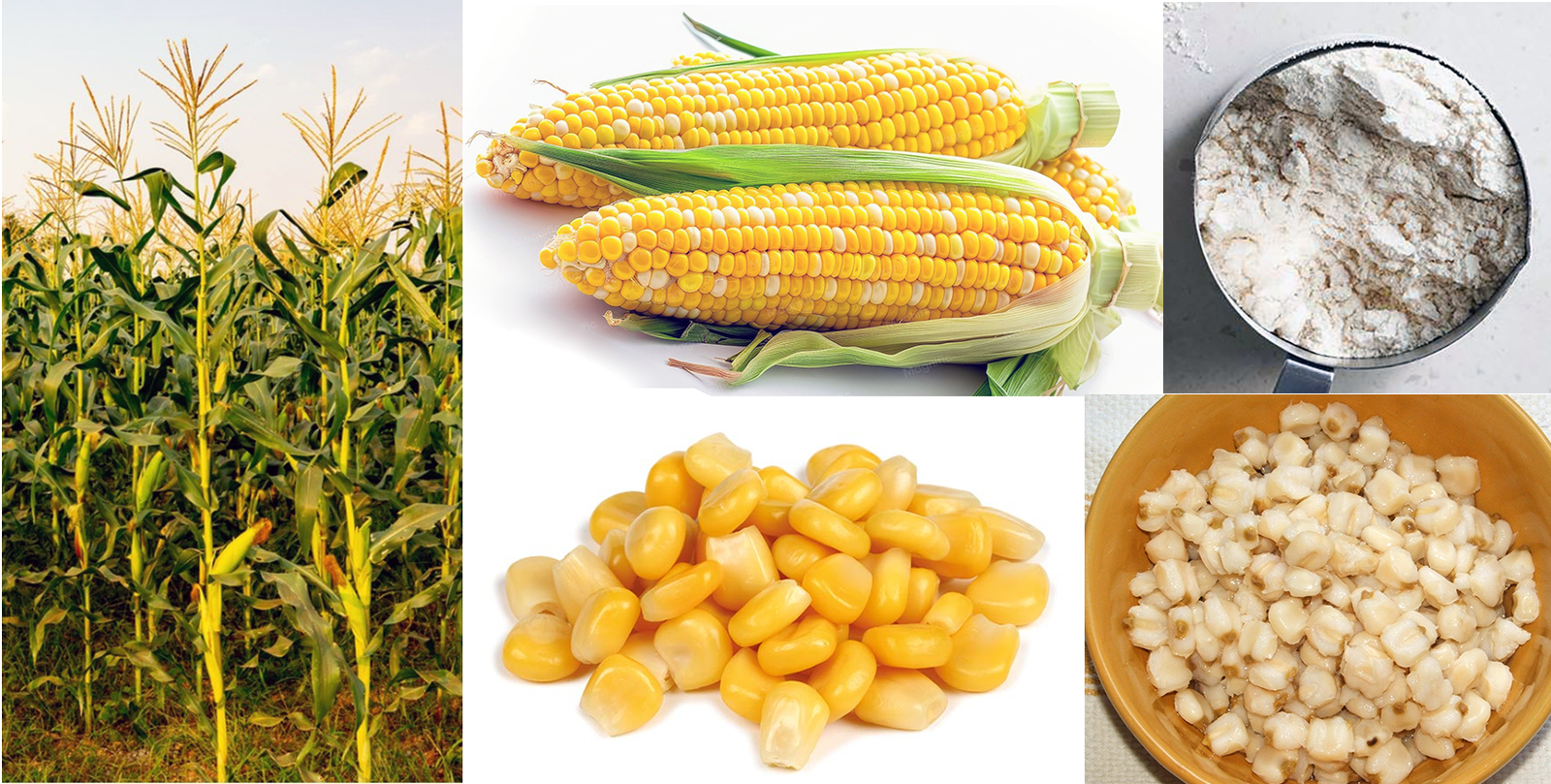
 Mature maize in the field (left) ears of mature sweetcorn, top
centre), , masa harina maize flour (top right) and corn kernels
(centre bottom) with dried hominy (bottom right).
Welcome to the summary page for FabulousFusionFood's Cook's Guide entry for Maize along with all the recipes employing Maize presented on this site, with 1839 recipes in total.
This is a continuation of an entire series of pages that will, I hope, allow my visitors to better navigate this site. As well as displaying recipes by name, country and region of origin I am now planning a whole series of pages where recipes can be located by meal type and main ingredient. This page gives a listing of all the Maize recipes added to this site.
These recipes, all contain Maize as a major wild food ingredient.
Zea mays, commonly known as maize or corn refers to the grass species, Zea mays and the grain it yields. It is a species of grass in the PACMAD grass clade. The leafy stalk of the plant gives rise to male inflorescences or tassels which produce pollen, and female inflorescences called ears. The ears yield grain, known as kernels or seeds. In modern commercial varieties, these are usually yellow or white; other varieties can be of many colors.
Maize is a tall annual grass with a single stem, ranging in height from 1.2–4m. The long narrow leaves arise from the nodes or joints, alternately on opposite sides on the stalk. Maize is monoecious, with separate male and female flowers on the same plant. At the top of the stem is the tassel, an inflorescence of male flowers; their anthers release pollen, which is dispersed by wind. The female inflorescence, some way down the stem from the tassel, is first seen as a silk, a bundle of soft tubular hairs, one for the carpel in each female flower, which develops into a kernel (often called a seed. Botanically, as in all grasses, it is a fruit, fused with the seed coat to form a caryopsis) when it is pollinated. A whole female inflorescence develops into an ear or corncob, enveloped by multiple leafy layers or husks. The ear leaf is the leaf most closely associated with a particular developing ear. This leaf and those above it contribute over three quarters of the carbohydrate (starch) that fills the grain.
Maize is the domesticated variant of the four species of teosintes, which are its crop wild relatives. Teosinte was likely used by hunter-gatherers because it added security to their food supply, being that it was adaptable to changes in climate and environment. The teosinte origin theory was proposed by the Russian botanist Nikolai Ivanovich Vavilov in 1931, and the American Nobel Prize-winner George Beadle in 1932. The two plants have dissimilar appearance, maize having a single tall stalk with multiple leaves and teosinte being a short, bushy plant. The difference between the two is largely controlled by differences in just two genes, called grassy tillers-1 (gt1, A0A317YEZ1) and teosinte branched-1 (tb1, Q93WI2). In the late 1930s, Paul Mangelsdorf suggested that domesticated maize was the result of a hybridization event between an unknown wild maize and a species of Tripsacum, a related genus; this has been refuted by modern genetic testing.
Maize pollen dated to 7,300 years ago from San Andres, Tabasco has been found on the Caribbean coast. A primitive corn was being grown in southern Mexico, Central America, and northern South America 7,000 years ago. Archaeological remains of early maize ears, found at Guila Naquitz Cave in the Oaxaca Valley, are roughly 6,250 years old; the oldest ears from caves near Tehuacan, Puebla, are 5,450 years old.
Naming: The name maize derives from the Spanish form maíz of the Taíno mahis. The Swedish botanist Carl Linnaeus used the common name maize as the species epithet in Zea mays. The name maize is preferred in formal, scientific, and international usage as a common name because it refers specifically to this one grain, unlike corn, which has a complex variety of meanings that vary by context and geographic region. Most countries primarily use the term maize, and the name corn is used mainly in the U.S. and a handful of other English-speaking countries. In countries that primarily use the term maize, the word corn may denote any cereal crop, varying geographically with the local staple, such as wheat in England and oats in Scotland or Ireland. The usage of corn for maize started as a shortening of 'Indian corn' in 18th-century North America.
Maize requires human intervention for its propagation. The kernels of its naturally-propagating teosinte ancestor fall off the cob on their own, while those of domesticated maize do not. All maize arose from a single domestication in southern Mexico about 9,000 years ago. The oldest surviving maize types are those of the Mexican highlands. Maize spread from this region to the lowlands and over the Americas along two major paths. The centre of domestication was most likely the Balsas River valley of south-central Mexico. Maize reached highland Ecuador at least 8000 years ago. It reached lower Central America by 7,600 years ago, and the valleys of the Colombian Andes between 7,000 and 6,000 years ago.
After the arrival of Europeans in 1492, Spanish settlers consumed maize, and explorers and traders carried it back to Europe. Spanish settlers much preferred wheat bread to maize. Maize flour could not be substituted for wheat for communion bread, since in Christian belief at that time only wheat could undergo transubstantiation and be transformed into the body of Christ.
Maize spread to the rest of the world because of its ability to grow in diverse climates. It was cultivated in Spain just a few decades after Columbus's voyages and then spread to Italy, West Africa, the Philippines and elsewhere. By the 17th century, it was a common peasant food in Southern Europe. By the 18th century, it was the chief food of the southern French and Italian peasantry, especially as polenta in Italy.
Maize and cornmeal (ground dried maize) constitute a staple food in many regions of the world. Maize is used to produce the food ingredient cornstarch. Maize starch can be hydrolyzed and enzymatically treated to produce high fructose corn syrup, a sweetener. Maize may be fermented and distilled to produce Bourbon whiskey. Corn oil is extracted from the germ of the grain.
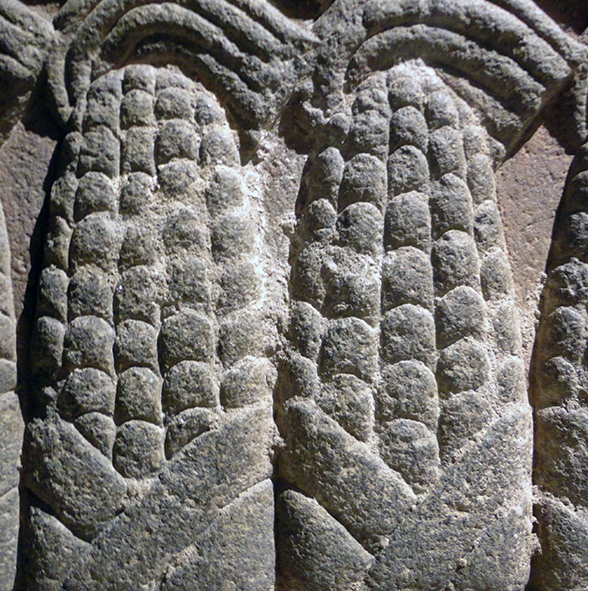
As a food, maize is used to make a wide variety of dishes including Mexican tortillas and tamales, Italian polenta, and American hominy grits. Maize protein is low in some essential amino acids, and the niacin it contains only becomes available if freed by alkali treatment. In pre-Columbian Mesoamerica, maize was deified as a maize god and depicted in sculptures.
In prehistoric times, Mesoamerican women used a metate quern to grind maize into cornmeal. Nursing mothers also used maize as a weaning gruel for their children. After ceramic vessels were invented, the Olmec people began to cook maize together with beans, improving the nutritional value of the staple meal. Although maize naturally contains niacin, an important nutrient, it is not bioavailable without the process of nixtamalization. The Maya used nixtamal meal to make porridges and tamales. Maize is a staple of Mexican cuisine. Masa (nixtamal) is the main ingredient for tortillas, atole and many other dishes of Central American cuisine. It is the main ingredient of corn tortilla, tamales, atole and the dishes based on these. The corn smut fungus, known as huitlacoche, which grows on maize, is a Mexican delicacy.
Coarse maize meal is made into a thick porridge in many cultures: from the polenta of Italy, the angu of Brazil, the mămăligă of Romania, to cornmeal mush in the U.S. (or hominy grits in the Southern U.S.) or the food called mieliepap in South Africa and sadza, nshima, ugali and other names in other parts of Africa. Introduced into Africa by the Portuguese in the 16th century, maize has become Africa's most important staple food crop.
Sweet corn, a genetic variety that is high in sugars and low in starch, is eaten in the unripe state as corn on the cob.
Raw, yellow, sweet maize kernels are composed of 76% water, 19% carbohydrates, 3% protein, and 1% fat. In a 100-gram serving, maize kernels provide 86 calories and are a good source (10–19% of the Daily Value) of the B vitamins, thiamin, niacin (if freed), pantothenic acid (B5) and folate. Maize has suboptimal amounts of the essential amino acids tryptophan and lysine, which accounts for its lower status as a protein source. The proteins of beans and legumes complement those of maize. This is the reason Native Americans planted it alongside beans and squashes in the Three Sisters polyculture.
Nixtamalization is a process for the preparation of maize (corn), or other grain, in which the grain is soaked and cooked in an alkaline solution, usually limewater (but sometimes aqueous alkali metal carbonates), washed, and then hulled. The term can also refer to the removal via an alkali process of the pericarp from other grains such as sorghum.
Nixtamalized corn has several benefits over unprocessed grain: It is more easily ground, its nutritional value is increased, flavor and aroma are improved, and mycotoxins are reduced by up to 97–100% (for aflatoxins). While cornmeal made from untreated ground maize is unable by itself to form a dough on addition of water, nixtamalized cornmeal will form a dough, called masa. These benefits make nixtamalization a crucial preliminary step for further processing of maize into food products, and the process is employed using both traditional and industrial methods in the production of tortillas and tortilla chips (but not corn chips), tamales, hominy, and many other foodstuffs.
Masa harina, used to prepare tortillas and tamales in mize that has been nictimized and then finely ground so that it can bind together to form a dough.
This is a continuation of an entire series of pages that will, I hope, allow my visitors to better navigate this site. As well as displaying recipes by name, country and region of origin I am now planning a whole series of pages where recipes can be located by meal type and main ingredient. This page gives a listing of all the Maize recipes added to this site.
These recipes, all contain Maize as a major wild food ingredient.
Zea mays, commonly known as maize or corn refers to the grass species, Zea mays and the grain it yields. It is a species of grass in the PACMAD grass clade. The leafy stalk of the plant gives rise to male inflorescences or tassels which produce pollen, and female inflorescences called ears. The ears yield grain, known as kernels or seeds. In modern commercial varieties, these are usually yellow or white; other varieties can be of many colors.
Maize is a tall annual grass with a single stem, ranging in height from 1.2–4m. The long narrow leaves arise from the nodes or joints, alternately on opposite sides on the stalk. Maize is monoecious, with separate male and female flowers on the same plant. At the top of the stem is the tassel, an inflorescence of male flowers; their anthers release pollen, which is dispersed by wind. The female inflorescence, some way down the stem from the tassel, is first seen as a silk, a bundle of soft tubular hairs, one for the carpel in each female flower, which develops into a kernel (often called a seed. Botanically, as in all grasses, it is a fruit, fused with the seed coat to form a caryopsis) when it is pollinated. A whole female inflorescence develops into an ear or corncob, enveloped by multiple leafy layers or husks. The ear leaf is the leaf most closely associated with a particular developing ear. This leaf and those above it contribute over three quarters of the carbohydrate (starch) that fills the grain.
Maize is the domesticated variant of the four species of teosintes, which are its crop wild relatives. Teosinte was likely used by hunter-gatherers because it added security to their food supply, being that it was adaptable to changes in climate and environment. The teosinte origin theory was proposed by the Russian botanist Nikolai Ivanovich Vavilov in 1931, and the American Nobel Prize-winner George Beadle in 1932. The two plants have dissimilar appearance, maize having a single tall stalk with multiple leaves and teosinte being a short, bushy plant. The difference between the two is largely controlled by differences in just two genes, called grassy tillers-1 (gt1, A0A317YEZ1) and teosinte branched-1 (tb1, Q93WI2). In the late 1930s, Paul Mangelsdorf suggested that domesticated maize was the result of a hybridization event between an unknown wild maize and a species of Tripsacum, a related genus; this has been refuted by modern genetic testing.
Maize pollen dated to 7,300 years ago from San Andres, Tabasco has been found on the Caribbean coast. A primitive corn was being grown in southern Mexico, Central America, and northern South America 7,000 years ago. Archaeological remains of early maize ears, found at Guila Naquitz Cave in the Oaxaca Valley, are roughly 6,250 years old; the oldest ears from caves near Tehuacan, Puebla, are 5,450 years old.
Naming: The name maize derives from the Spanish form maíz of the Taíno mahis. The Swedish botanist Carl Linnaeus used the common name maize as the species epithet in Zea mays. The name maize is preferred in formal, scientific, and international usage as a common name because it refers specifically to this one grain, unlike corn, which has a complex variety of meanings that vary by context and geographic region. Most countries primarily use the term maize, and the name corn is used mainly in the U.S. and a handful of other English-speaking countries. In countries that primarily use the term maize, the word corn may denote any cereal crop, varying geographically with the local staple, such as wheat in England and oats in Scotland or Ireland. The usage of corn for maize started as a shortening of 'Indian corn' in 18th-century North America.
Maize requires human intervention for its propagation. The kernels of its naturally-propagating teosinte ancestor fall off the cob on their own, while those of domesticated maize do not. All maize arose from a single domestication in southern Mexico about 9,000 years ago. The oldest surviving maize types are those of the Mexican highlands. Maize spread from this region to the lowlands and over the Americas along two major paths. The centre of domestication was most likely the Balsas River valley of south-central Mexico. Maize reached highland Ecuador at least 8000 years ago. It reached lower Central America by 7,600 years ago, and the valleys of the Colombian Andes between 7,000 and 6,000 years ago.
After the arrival of Europeans in 1492, Spanish settlers consumed maize, and explorers and traders carried it back to Europe. Spanish settlers much preferred wheat bread to maize. Maize flour could not be substituted for wheat for communion bread, since in Christian belief at that time only wheat could undergo transubstantiation and be transformed into the body of Christ.
Maize spread to the rest of the world because of its ability to grow in diverse climates. It was cultivated in Spain just a few decades after Columbus's voyages and then spread to Italy, West Africa, the Philippines and elsewhere. By the 17th century, it was a common peasant food in Southern Europe. By the 18th century, it was the chief food of the southern French and Italian peasantry, especially as polenta in Italy.
Maize and cornmeal (ground dried maize) constitute a staple food in many regions of the world. Maize is used to produce the food ingredient cornstarch. Maize starch can be hydrolyzed and enzymatically treated to produce high fructose corn syrup, a sweetener. Maize may be fermented and distilled to produce Bourbon whiskey. Corn oil is extracted from the germ of the grain.
As a food, maize is used to make a wide variety of dishes including Mexican tortillas and tamales, Italian polenta, and American hominy grits. Maize protein is low in some essential amino acids, and the niacin it contains only becomes available if freed by alkali treatment. In pre-Columbian Mesoamerica, maize was deified as a maize god and depicted in sculptures.
In prehistoric times, Mesoamerican women used a metate quern to grind maize into cornmeal. Nursing mothers also used maize as a weaning gruel for their children. After ceramic vessels were invented, the Olmec people began to cook maize together with beans, improving the nutritional value of the staple meal. Although maize naturally contains niacin, an important nutrient, it is not bioavailable without the process of nixtamalization. The Maya used nixtamal meal to make porridges and tamales. Maize is a staple of Mexican cuisine. Masa (nixtamal) is the main ingredient for tortillas, atole and many other dishes of Central American cuisine. It is the main ingredient of corn tortilla, tamales, atole and the dishes based on these. The corn smut fungus, known as huitlacoche, which grows on maize, is a Mexican delicacy.
Coarse maize meal is made into a thick porridge in many cultures: from the polenta of Italy, the angu of Brazil, the mămăligă of Romania, to cornmeal mush in the U.S. (or hominy grits in the Southern U.S.) or the food called mieliepap in South Africa and sadza, nshima, ugali and other names in other parts of Africa. Introduced into Africa by the Portuguese in the 16th century, maize has become Africa's most important staple food crop.
Sweet corn, a genetic variety that is high in sugars and low in starch, is eaten in the unripe state as corn on the cob.
Raw, yellow, sweet maize kernels are composed of 76% water, 19% carbohydrates, 3% protein, and 1% fat. In a 100-gram serving, maize kernels provide 86 calories and are a good source (10–19% of the Daily Value) of the B vitamins, thiamin, niacin (if freed), pantothenic acid (B5) and folate. Maize has suboptimal amounts of the essential amino acids tryptophan and lysine, which accounts for its lower status as a protein source. The proteins of beans and legumes complement those of maize. This is the reason Native Americans planted it alongside beans and squashes in the Three Sisters polyculture.
Nixtamalization is a process for the preparation of maize (corn), or other grain, in which the grain is soaked and cooked in an alkaline solution, usually limewater (but sometimes aqueous alkali metal carbonates), washed, and then hulled. The term can also refer to the removal via an alkali process of the pericarp from other grains such as sorghum.
Nixtamalized corn has several benefits over unprocessed grain: It is more easily ground, its nutritional value is increased, flavor and aroma are improved, and mycotoxins are reduced by up to 97–100% (for aflatoxins). While cornmeal made from untreated ground maize is unable by itself to form a dough on addition of water, nixtamalized cornmeal will form a dough, called masa. These benefits make nixtamalization a crucial preliminary step for further processing of maize into food products, and the process is employed using both traditional and industrial methods in the production of tortillas and tortilla chips (but not corn chips), tamales, hominy, and many other foodstuffs.
Masa harina, used to prepare tortillas and tamales in mize that has been nictimized and then finely ground so that it can bind together to form a dough.
The alphabetical list of all Maize recipes on this site follows, (limited to 100 recipes per page). There are 1839 recipes in total:
Page 1 of 19
| Soft Spring Roll Wrappers (Soft Spring Roll Wrappers) Origin: Fusion | Agneau au Cari (Lamb Curry) Origin: Reunion | Aliter Haedinam sive Agninam Excaldatam (Stew of Kid or Lamb, Another Way) Origin: Roman |
| 7-Up Lemon Cheesecake with Strawberry Glaze Origin: American | Air Fryer Aloo Bread Pakora Origin: Britain | Aliter Haedus sive Agnus Syringiatus (Boned Suckling Kid or Lamb, Another Way) Origin: Roman |
| A Good Sauce for Steaks Origin: British | Air Fryer Blackberry-topped Almond Sponge with Blackberry Compote Origin: Britain | Aliter in Apro II (Wild Boar, Another Way II) Origin: Roman |
| Aad Maas (Goan Pork Rib Curry) Origin: India | Air Fryer Chicken Livers Origin: Britain | Aliter in Apro III (Wild Boar, Another Way III) Origin: Roman |
| Aadun Origin: Nigeria | Air Fryer Corn on the Cob Origin: Britain | Aliter in grue vel in anate vel in pullo (Roast Duck with Damson Sauce) Origin: Roman |
| Aaloo Gosht (Mutton Curry with Potatoes) Origin: Pakistan | Air Fryer Crisp Chicken Wings with Korean Barbecue Sauce Origin: Britain | Aliter Leporem Conditum (Another, Seasoned Hare) Origin: Roman |
| Abadejo a la Pimienta Verde (Pollock with Green Pepper) Origin: Spain | Air Fryer Crispy Sichuan Duck Origin: Britain | Aliter Leporem ex Suo Iure (Another, Hare in its Own Gravy) Origin: Roman |
| Abkhazia Achamykva Origin: Abkhazia | Air Fryer Orange Chicken Origin: Fusion | Aliter Mullos (Red Mullets, Another Way) Origin: Roman |
| Abkhazia Ayladzh Origin: Abkhazia | Air Fryer Tater Tots from Scratch Origin: America | Aliter pisam sive fabam (Broad Beans and/or Split Peas) Origin: Roman |
| Abkhazia Mamalyga Origin: Abkhazia | Air-fryer Blackberry Pie Origin: Britain | Aliter Rapas (Vegetable Purée with Alexanders) Origin: Roman |
| Ablo (Togolese Corn Bread) Origin: Togo | Aish bel-Lahm (Bread with Lamb) Origin: Saudi Arabia | Aliter Sala cattabia (Another Cattanian Salad) Origin: Roman |
| Abysta (Cornmeal Polenta) Origin: Abkhazia | Ajiaco Colombiano (Colombian Ajiaco) Origin: Colombia | Aliter Sphondylos (Parsnips, Another Way) Origin: Roman |
| Achu Spice Blend Origin: Cameroon | Ajiaco Criollo (Cuban Creole Stew) Origin: Cuba | Aliter Sphondylos II (Parsnips, Another Way II) Origin: Roman |
| Acorn and Hazelnut Pap Origin: Ancient | Akassa Origin: Benin | Aliter Sphondylos III (Parsnips, Another Way III) Origin: Roman |
| Acorn Cakes Origin: Britain | Akoumé Origin: Togo | Aliter Sphondylos IV (Parsnips, Another Way IV) Origin: Roman |
| Acorn Coffee Origin: Ancient | Akume with Ademe Sauce Origin: Togo | Aliter Tubera (Truffles, Another Way) Origin: Roman |
| Acorn Coffee Origin: Britain | Al-Aïch (Chicken, Beans and Couscous) Origin: Mauritania | Aliter Tubera II (Truffles, Another Way II) Origin: Roman |
| Acorn Flour Origin: Britain | Al-Motubug (Stuffed Pastry Squares) Origin: Saudi Arabia | Aljota (Fish Soup) Origin: Malta |
| Acorn Flour Biscuits Origin: American | Alexanders and Three Cornered Leek Frittata Origin: England | Almond Shortbread II Origin: Scotland |
| Acorn Flour Pancakes Origin: Britain | Alexanders Chutney Origin: Britain | Aloo Palya (Potato Curry) Origin: India |
| Acorn Flour Tagliatelle Origin: Italy | Alfajores Paraguayos Origin: Paraguay | Alter Haedinam Sive Agninam Excaldatam (Steamed Lamb) Origin: Roman |
| Acorn Pan Bread Origin: Ancient | Alfajores Rellenos de Arequipe y Coco (Alfajores with Arequipe and Coconut Filling) Origin: Bolivia | Amandazi Origin: Rwanda |
| Acorn Tortillas Origin: American | Alfajores Uruguayos Origin: Uruguay | Ambot Tik (Goan Shark Curry) Origin: India |
| Adalu (Bean and Sweetcorn Pottage) Origin: Nigeria | Alicam vel sucum tisanae (Spelt or Barley Gruel) Origin: Roman | Ambotic Origin: Mozambique |
| Adenydd Cath Fôr gyda Saws Tartar Cyflym (Fried Skate Wings with Quick Home-made Tartar Sauce) Origin: Welsh | Aliter assaturas (Roast Meats, Another Way) Origin: Roman | Ambrosia Cake Origin: American |
| Adobo de Pollo Origin: Peru | Aliter assaturas (Roast Meats, Another Way) Origin: Roman | Amchar Masala Origin: Trinidad |
| Adun Origin: Nigeria | Aliter carduos (Artichokes with Herbs) Origin: Roman | Amchar Masala Origin: Trinidad |
| Afalau Sur Bach wedi Piclo (Pickled Crabapples) Origin: Welsh | Aliter carduos elixos (Artichokes with Spiced Sauce) Origin: Roman | Amish Country Strawberry Pie Origin: Amish |
| Afelia (Pork Marinated in Wine) Origin: Cyprus | Aliter Conchiclam Sic Facies (Legumes, Another Way, Are Made Thus) Origin: Roman | Amiwo (Beninese Maize Porridge) Origin: Benin |
| Afghan Kofta Curry Origin: Afghanistan | Aliter Cucumeres Rasos (Peeled Cubumbers, Another Way) Origin: Roman | Amiwo au Poulet (Chicken Amiwo) Origin: Benin |
| African-style Barbecue Sauce Origin: African Fusion | Aliter de Pullo (Chicken Forcemeat, Another Way) Origin: Roman | Amiwo au Poulet 2 (Amiwo with Chicken) Origin: Benin |
| Afrikanisches Pistaziendessert (African-style Pistachio Dessert) Origin: Namibia | Aliter Gruem vel Anatem (Crane or Duck, Another Way) Origin: Roman | Amulatum Aliter (Another Thick Sauce) Origin: Roman |
| Agidi (Fermented Cornflour Pudding) Origin: Nigeria | Aliter haedinam sive agninam excaldatam (Lamb Stew) Origin: Roman | |
| Agidi Jollof Origin: Nigeria | Aliter Haedinam sive Agninam Excaldatam (Stew of Kid or Lamb) Origin: Roman |
Page 1 of 19