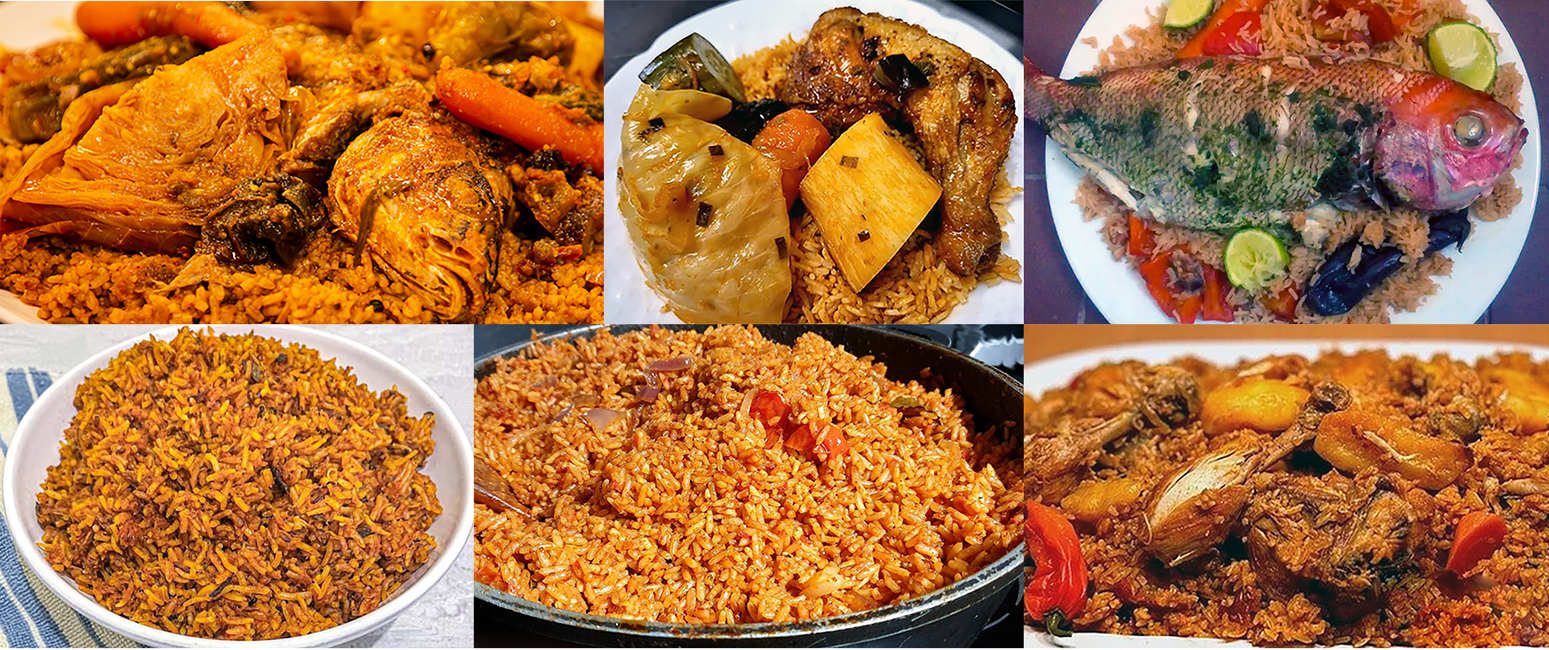
 The images show, clockwise from top left: Guinean Riz Wolof,
Malian Tieb au Poulet, thieboudienne from Senegal, benachin from
the Gambia, riz au gras from Ivory Coast, Jollof Rice from
Nigeria and Ghanaian Jollof Rice..
Welcome to the summary page for FabulousFusionFood's Cook's Guide entry for Jollof Rice along with all the recipes employing Jollof Rice presented on this site, with 52 recipes in total.
This is a continuation of an entire series of pages that will, I hope, allow my visitors to better navigate this site. As well as displaying recipes by name, country and region of origin I am now planning a whole series of pages where recipes can be located by meal type and main ingredient. This page gives a listing of all the Jollof Rice recipes added to this site.
These recipes, all contain Jollof Rice as a major wild food ingredient.
Jollof (/dʒəˈlɒf/), or jollof rice, is a rice dish from Senegal, West Africa. It is typically made with long-grain rice, tomatoes, chilis, onions, spices, and sometimes other vegetables and/or meat in a single pot, although its ingredients and preparation methods vary across different regions. In French-speaking West Africa, a variation of the dish is known as riz au gras. The Senegalese version, thieboudienne, has been recognized by UNESCO as an intangible cultural heritage dish.
The Jolof or Wolof Empire was a confederacy state that ruled parts of West Africa situated in modern-day Senegal, Mali, The Gambia and Mauritania from around the 12th century and was later known as the Jolof Kingdom. According to African food historian Fran Osseo-Asare, the origins of jollof rice can be traced to the area, where rice was grown; the original dish was known as thieboudienne or thiebou djeun, and contains rice (originally West African glaberrima rice), fish, shellfish and vegetables. If made with meat, it's called ceebu yapp. The fishing communities of Saint-Louis are considered the birthplace of thieboudienne.
Food and agriculture historian James C. McCann argued that it was unlikely that the dish could have naturally spread from Senegal to its current range since a similar cultural diffusion is not seen in 'linguistic, historical or political patterns'. Instead, he proposed that the dish spread with the Mali empire, especially the Djula tradespeople who dispersed widely to the regional commercial and urban centres, taking with them economic arts of 'blacksmithing, small-scale marketing, and rice agronomy' as well as the religion of Islam. Indeed, the dish survives in Mali as tieb au poulet
The use of New World tomatoes, tomato paste, capsicum peppers (bell, chilli, paprika), Indian curry powder, Mediterranean thyme, and Asian rice varieties, may limit the origin of the current dish to no earlier than the 19th century, there being no evidence of the ingredients being locally cultivated or imported before this period. In Senegal, oral histories credit Penda Mbaye, a cook at the residence of one of the colonial rulers in Saint-Louis, Senegal, as having created the dish when she ran out of barley and substituted rice.
Almost every country in West Africa has its own version of Jollof Rice. (The name comes from the Wolof peoples of Senegambia and the dish was originally Wolof Rice, but soon became Jollof Rice). Indeed, the name survives as Wolof Rice or Riz Wolof in the Guinean version of the dish.
Benachin is also probably an antecedent of Jollof rice, evolving into Thieboudienne (chubbagin) in Senegambia, Jollof Rice in Anglophone West Africa and riz au gras in Franchophone west Africa.
Below you will find links to various recipes for Tiebs, Benachins, Riz au Gras and Jollof Rice from countries throughout West Africa.
This is a continuation of an entire series of pages that will, I hope, allow my visitors to better navigate this site. As well as displaying recipes by name, country and region of origin I am now planning a whole series of pages where recipes can be located by meal type and main ingredient. This page gives a listing of all the Jollof Rice recipes added to this site.
These recipes, all contain Jollof Rice as a major wild food ingredient.
Jollof (/dʒəˈlɒf/), or jollof rice, is a rice dish from Senegal, West Africa. It is typically made with long-grain rice, tomatoes, chilis, onions, spices, and sometimes other vegetables and/or meat in a single pot, although its ingredients and preparation methods vary across different regions. In French-speaking West Africa, a variation of the dish is known as riz au gras. The Senegalese version, thieboudienne, has been recognized by UNESCO as an intangible cultural heritage dish.
The Jolof or Wolof Empire was a confederacy state that ruled parts of West Africa situated in modern-day Senegal, Mali, The Gambia and Mauritania from around the 12th century and was later known as the Jolof Kingdom. According to African food historian Fran Osseo-Asare, the origins of jollof rice can be traced to the area, where rice was grown; the original dish was known as thieboudienne or thiebou djeun, and contains rice (originally West African glaberrima rice), fish, shellfish and vegetables. If made with meat, it's called ceebu yapp. The fishing communities of Saint-Louis are considered the birthplace of thieboudienne.
Food and agriculture historian James C. McCann argued that it was unlikely that the dish could have naturally spread from Senegal to its current range since a similar cultural diffusion is not seen in 'linguistic, historical or political patterns'. Instead, he proposed that the dish spread with the Mali empire, especially the Djula tradespeople who dispersed widely to the regional commercial and urban centres, taking with them economic arts of 'blacksmithing, small-scale marketing, and rice agronomy' as well as the religion of Islam. Indeed, the dish survives in Mali as tieb au poulet
The use of New World tomatoes, tomato paste, capsicum peppers (bell, chilli, paprika), Indian curry powder, Mediterranean thyme, and Asian rice varieties, may limit the origin of the current dish to no earlier than the 19th century, there being no evidence of the ingredients being locally cultivated or imported before this period. In Senegal, oral histories credit Penda Mbaye, a cook at the residence of one of the colonial rulers in Saint-Louis, Senegal, as having created the dish when she ran out of barley and substituted rice.
Almost every country in West Africa has its own version of Jollof Rice. (The name comes from the Wolof peoples of Senegambia and the dish was originally Wolof Rice, but soon became Jollof Rice). Indeed, the name survives as Wolof Rice or Riz Wolof in the Guinean version of the dish.
Benachin is also probably an antecedent of Jollof rice, evolving into Thieboudienne (chubbagin) in Senegambia, Jollof Rice in Anglophone West Africa and riz au gras in Franchophone west Africa.
Below you will find links to various recipes for Tiebs, Benachins, Riz au Gras and Jollof Rice from countries throughout West Africa.
The alphabetical list of all Jollof Rice recipes on this site follows, (limited to 100 recipes per page). There are 52 recipes in total:
Page 1 of 1
| Agidi Jollof Origin: Nigeria | Ghanaian Jollof Rice Origin: Ghana | Riz au Gras (Ivorian Fat Rice) Origin: Cote dIvoire |
| Basic Jollof Rice Origin: Nigeria | Ghanaian Jollof Rice II (Ghanaian Jollof Rice) Origin: Ghana | Riz au Gras Ivorienne (Ivorian Fat Rice) Origin: Cote dIvoire |
| Beninese Jollof Rice Origin: Benin | Ghanaian Spaghetti Jollof Origin: Ghana | Riz Gras au Poulet (Fat Rice with Chicken) Origin: Burkina Faso |
| Burkinabé Riz au Gras Origin: Burkina Faso | Jollof Rice with Chicken Beef and Ham Origin: Ghana | Riz Jollof du Niger (Niger-style Jollof Rice) Origin: Niger |
| Camel Chubbagin Origin: Mauritania | Jollof Rice with Lamb Origin: Mali | Riz Wolof (Wolof Rice) Origin: Guinea |
| Cameroon Fried Rice Origin: Cameroon | Jollof Rice without Tomato Purée Origin: Nigeria | Serekunda Fish Benachin Origin: Gambia |
| Cameroonian Jellof Rice Origin: Cameroon | Kebbeh Kunda Benachin Origin: Gambia | Smoky Prawn Jollof Rice Origin: Nigeria |
| Cameroonian Jollof Rice Origin: Cameroon | Liberian Jollof Rice Origin: Liberia | Thiebou dieune (Street-style Senegalese Fish and Rice) Origin: Senegal |
| Ceebu Jën (Rice and Fish) Origin: Senegal | Liberian Jollof Rice Origin: Liberia | Thiebou Yapp Vermicelles Origin: Senegal |
| Chicken Benachin Origin: Cameroon | Marolaym Origin: Mauritania | Thieboudienne (Fish in the Manner of Dakar) Origin: Senegal |
| Chubbagin Lélé et Raabie Origin: Mauritania | Mauritanian Thieboudienne Origin: Mauritius | Tieb au Poulet (Chicken and Rice) Origin: Mali |
| Cinnamon Spiced Jollof Rice Origin: Sierra Leone | Nigerian Chicken Jollof Rice Origin: Nigeria | Tiepbouyape Origin: Senegal |
| Concoction Rice Origin: Nigeria | Njanga Rice Origin: Cameroon | Tomato-less Jollof Rice Origin: Nigeria |
| Dakhine Origin: Senegal | Ofada-Ugba Jollof (Fermented Jollof Rice) Origin: Nigeria | Vegetarian Jollof Rice Origin: Fusion |
| Dawadawa Jollof Rice with Guinea Fowl Origin: Ghana | Oven-baked Jollof Rice Origin: Nigeria | Vegetarian Jollof Rice Accompaniment Origin: Nigeria |
| Gambian Benachin Origin: Gambia | Party Jollof Rice Origin: Nigeria | Zamé Origin: Mali |
| Gari Foto Origin: Ghana | Ris Gras Burkinabé Origin: Burkina Faso | |
| Ghanaian Chicken Jollof Rice Origin: Ghana |
Page 1 of 1