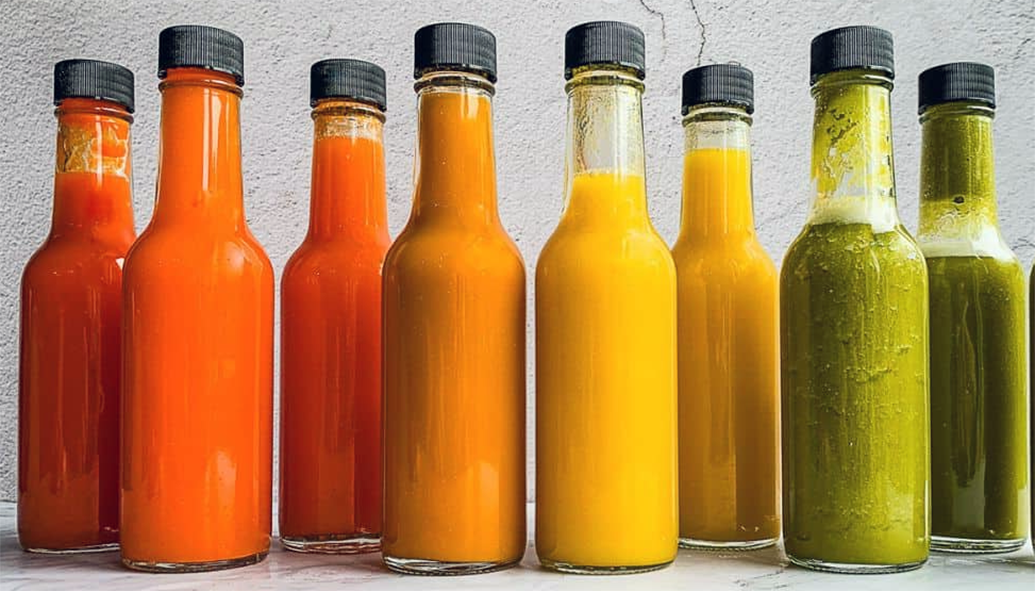
 The image above shows a range of hot sauces of different colours
ranging from red (left) to green (right)..
Welcome to the summary page for FabulousFusionFood's Cook's Guide entry for Hot Sauce along with all the recipes employing Hot Sauce presented on this site, with 82 recipes in total.
This is a continuation of an entire series of pages that will, I hope, allow my visitors to better navigate this site. As well as displaying recipes by name, country and region of origin I am now planning a whole series of pages where recipes can be located by meal type and main ingredient. This page gives a listing of all the Hot Sauce recipes added to this site.
These recipes, all contain Hot Sauce as a major wild food ingredient.
Hot sauce (also often called 'Pepper Sauce') is a type of condiment, seasoning, or salsa made from chilli peppers and other ingredients. Many commercial varieties of mass-produced hot sauce exist.
Many recipes for hot sauces exist, but the only common ingredient is some variety of chilli pepper. Many hot sauces are made by using chilli peppers as the base and can be as simple as adding salt and vinegar. Other sauces use some type of fruit or vegetables (particularly tomatoes, onions, carrots, mangoes and papaya) as the base and add the chilli peppers to make them hot. Manufacturers use many different processes from fermentation, aging in containers, and pureeing and cooking the ingredients to achieve a desired flavour. Because of their ratings on the Scoville scale, spicier peppers such as the ghost pepper, Scotch bonnet or habanero pepper are sometimes used to make hotter sauces. Alternatively, other ingredients can be used to add extra heat, such as pure capsaicin extract or mustard oil. Other common sauce ingredients include vinegar and spices. Vinegar is used primarily as a natural preservative, but flavoured vinegars can be used to alter the flavour.
The heat, or burning sensation, experienced when consuming hot sauce is caused by capsaicin and related capsaicinoids. The burning sensation is caused by the capsaicin activation of the TRPV1 heat and ligand-gated ion channel in peripheral neurones. The mechanism of action is then a chemical interaction with the neurological system. Although the 'burning' sensation does not correspond to a real stimulus, repeated and prolonged use of hot spices may harm the peripheral heat-sensing neurones; this mechanism may explain why frequent spice users become less sensitive to both spices and heat.
A general way to estimate the heat of a sauce is to look at the ingredients list. Sauces tend to vary in heat based on the kind of peppers used, and the further down the list, the less the amount of pepper:
Cayenne — Sauces made with cayenne, including most of the Louisiana-style sauces, are usually hotter than jalapeño, but milder than other sauces.
Chile de árbol — A thin and potent Mexican chilli pepper also known as bird's beak chile and rat's tail chile. Their heat index used to be between 15,000 and 30,000 Scoville units, but it can now reach over 100,000 units. In cooking substitutions, the Chile de árbol pepper can be traded with Cayenne pepper.
Habanero — Habanero pepper sauces were known as the hottest natural pepper sauces, but nowadays species like Bhut jolokia, Naga jolokia or Trinidad Scorpion Moruga are even five or ten-fold hotter.
Jalapeño — These sauces include green and red jalapeño chilis, and chipotle (ripened and smoked). Green jalapeño and chipotle are usually the mildest sauces available. Red jalapeño sauce is generally hotter.
Naga Bhut Jolokia — The pepper is also known as Bhut Jolokia, ghost pepper, ghost chilli pepper, red naga chilli, and ghost chilli. In 2007, Guinness World Records certified that the Ghost Pepper (Bhut Jolokia) was the world's hottest chilli pepper, 400 times hotter than Tabasco sauce; however, in 2011 it has since been superseded by the Trinidad Moruga Scorpion.
Piri piri — The Peri Peri pepper has been naturalized into South Africa and is also known as the African Bird's Eye pepper, Piri-Piri pepper or Pili-Pili pepper, depending on what area of the country you're in. The pepper ranges from one half to one inch in length and tapers at a blunt point. The small package packs a mighty punch with a 175,000 rating on the Scoville scale, near the Habanero, but the Peri Peri is smaller and has a much different flavour. It is most commonly used in a hot sauce, combined with other spices and seasonings because it has a very light, fresh citrus-herbal flavour that blends well with the flavours of most other ingredients.
Scotch Bonnet — Similar in heat to the Habanero are these peppers popular in the Caribbean. Often found in Jamaican hot sauces.
Tabasco peppers — Sauces made with tabasco peppers are generally hotter than cayenne pepper sauces. Along with Tabasco, a number of sauces are made using tabasco peppers.
Trinidad Moruga Scorpion The golf ball-sized chilli pepper has a tender fruit-like flavour. According to the New Mexico State University Chile Institute, the Trinidad Scorpion Moruga Blend ranks as high as 2,009,231 SHU on the Scoville scale.
Carolina Reaper — The Carolina Reaper is a super hot pepper which has been described as a roasted sweetness delivering an instant level of heat. Developed by Puckerbutt Founder Ed Currie in Rock Hill, South Carolina, the Carolina Reaper averages over 1.6 million SHU and was awarded the Guinness World Record in August 2017.
Capsaicin extract — The hottest sauces are made from capsaicin extract. These range from extremely hot pepper sauce blends to pure capsaicin extracts. These sauces are extremely hot and should be considered with caution by those not used to fiery foods. Many are too hot to consume more than a drop or two in a pot of food. These novelty sauces are typically only sold by specialty retailers and are usually more expensive.
The regions and countries most associated with hot pepper sauces (both commercial and home-made) are the Caribbean (particularly the former British Caribbean, especially Jamaica and Trinidad and Tobago). The USA, Mexico and South America in the Americas and the UK in Europe. Several hot sauces are produced in the Middle East and in Asia, with Thailand being a notable source.
A range of recipes for hot pepper sauces from across the globe are linked to in the recipe lists below:
This is a continuation of an entire series of pages that will, I hope, allow my visitors to better navigate this site. As well as displaying recipes by name, country and region of origin I am now planning a whole series of pages where recipes can be located by meal type and main ingredient. This page gives a listing of all the Hot Sauce recipes added to this site.
These recipes, all contain Hot Sauce as a major wild food ingredient.
Hot sauce (also often called 'Pepper Sauce') is a type of condiment, seasoning, or salsa made from chilli peppers and other ingredients. Many commercial varieties of mass-produced hot sauce exist.
Many recipes for hot sauces exist, but the only common ingredient is some variety of chilli pepper. Many hot sauces are made by using chilli peppers as the base and can be as simple as adding salt and vinegar. Other sauces use some type of fruit or vegetables (particularly tomatoes, onions, carrots, mangoes and papaya) as the base and add the chilli peppers to make them hot. Manufacturers use many different processes from fermentation, aging in containers, and pureeing and cooking the ingredients to achieve a desired flavour. Because of their ratings on the Scoville scale, spicier peppers such as the ghost pepper, Scotch bonnet or habanero pepper are sometimes used to make hotter sauces. Alternatively, other ingredients can be used to add extra heat, such as pure capsaicin extract or mustard oil. Other common sauce ingredients include vinegar and spices. Vinegar is used primarily as a natural preservative, but flavoured vinegars can be used to alter the flavour.
The heat, or burning sensation, experienced when consuming hot sauce is caused by capsaicin and related capsaicinoids. The burning sensation is caused by the capsaicin activation of the TRPV1 heat and ligand-gated ion channel in peripheral neurones. The mechanism of action is then a chemical interaction with the neurological system. Although the 'burning' sensation does not correspond to a real stimulus, repeated and prolonged use of hot spices may harm the peripheral heat-sensing neurones; this mechanism may explain why frequent spice users become less sensitive to both spices and heat.
A general way to estimate the heat of a sauce is to look at the ingredients list. Sauces tend to vary in heat based on the kind of peppers used, and the further down the list, the less the amount of pepper:
Cayenne — Sauces made with cayenne, including most of the Louisiana-style sauces, are usually hotter than jalapeño, but milder than other sauces.
Chile de árbol — A thin and potent Mexican chilli pepper also known as bird's beak chile and rat's tail chile. Their heat index used to be between 15,000 and 30,000 Scoville units, but it can now reach over 100,000 units. In cooking substitutions, the Chile de árbol pepper can be traded with Cayenne pepper.
Habanero — Habanero pepper sauces were known as the hottest natural pepper sauces, but nowadays species like Bhut jolokia, Naga jolokia or Trinidad Scorpion Moruga are even five or ten-fold hotter.
Jalapeño — These sauces include green and red jalapeño chilis, and chipotle (ripened and smoked). Green jalapeño and chipotle are usually the mildest sauces available. Red jalapeño sauce is generally hotter.
Naga Bhut Jolokia — The pepper is also known as Bhut Jolokia, ghost pepper, ghost chilli pepper, red naga chilli, and ghost chilli. In 2007, Guinness World Records certified that the Ghost Pepper (Bhut Jolokia) was the world's hottest chilli pepper, 400 times hotter than Tabasco sauce; however, in 2011 it has since been superseded by the Trinidad Moruga Scorpion.
Piri piri — The Peri Peri pepper has been naturalized into South Africa and is also known as the African Bird's Eye pepper, Piri-Piri pepper or Pili-Pili pepper, depending on what area of the country you're in. The pepper ranges from one half to one inch in length and tapers at a blunt point. The small package packs a mighty punch with a 175,000 rating on the Scoville scale, near the Habanero, but the Peri Peri is smaller and has a much different flavour. It is most commonly used in a hot sauce, combined with other spices and seasonings because it has a very light, fresh citrus-herbal flavour that blends well with the flavours of most other ingredients.
Scotch Bonnet — Similar in heat to the Habanero are these peppers popular in the Caribbean. Often found in Jamaican hot sauces.
Tabasco peppers — Sauces made with tabasco peppers are generally hotter than cayenne pepper sauces. Along with Tabasco, a number of sauces are made using tabasco peppers.
Trinidad Moruga Scorpion The golf ball-sized chilli pepper has a tender fruit-like flavour. According to the New Mexico State University Chile Institute, the Trinidad Scorpion Moruga Blend ranks as high as 2,009,231 SHU on the Scoville scale.
Carolina Reaper — The Carolina Reaper is a super hot pepper which has been described as a roasted sweetness delivering an instant level of heat. Developed by Puckerbutt Founder Ed Currie in Rock Hill, South Carolina, the Carolina Reaper averages over 1.6 million SHU and was awarded the Guinness World Record in August 2017.
Capsaicin extract — The hottest sauces are made from capsaicin extract. These range from extremely hot pepper sauce blends to pure capsaicin extracts. These sauces are extremely hot and should be considered with caution by those not used to fiery foods. Many are too hot to consume more than a drop or two in a pot of food. These novelty sauces are typically only sold by specialty retailers and are usually more expensive.
The regions and countries most associated with hot pepper sauces (both commercial and home-made) are the Caribbean (particularly the former British Caribbean, especially Jamaica and Trinidad and Tobago). The USA, Mexico and South America in the Americas and the UK in Europe. Several hot sauces are produced in the Middle East and in Asia, with Thailand being a notable source.
A range of recipes for hot pepper sauces from across the globe are linked to in the recipe lists below:
The alphabetical list of all Hot Sauce recipes on this site follows, (limited to 100 recipes per page). There are 82 recipes in total:
Page 1 of 1
| African Hot Sauce Origin: sub-Saharan Africa | Harissa Origin: North Africa | Piment d'Attiéké (Pepper Sauce for Attiéké) Origin: Cote dIvoire |
| Aji Chombo (Panamanian Hot Sauce) Origin: Panama | Hot Chilli Sauce Origin: Jamaica | Piquante Sauce Origin: American |
| Ají Criollo (Ecuadorian Hot Sauce) Origin: Ecuador | Hot Pepper Sauce Origin: West Africa | Pique (Puerto Rican Spiced Vinegar) Origin: Puerto Rico |
| Ají de Tamarillo (Ecuadorian Tree Tomato Hot Sauce) Origin: Ecuador | Indian Chilli Dipping Sauce Origin: Britain | Piri-Piri Sauce Origin: West Africa |
| Anguilla Habanero Hot Sauce Origin: Anguilla | Insane Trini Hot Sauce Origin: Trinidad | Poutou Origin: Mayotte |
| Antiguan Hot Sauce Origin: Antigua | Iraqi Adana Kebab Origin: Iraq | Puerto Rican Sofrito Origin: Puerto Rico |
| Bahamanian Habanero Hot Sauce Origin: Bahamas | Jamaican Pepper Sauce Origin: Jamaica | Red Zhug (Yemenite Hot Sauce) Origin: Yemen |
| Brochettes de Boeuf (Beef Kebabs) Origin: Rwanda | Javanese Sambal Bajak (Javanese Hot Sauce) Origin: Indonesia | Relajo (Salvadorean Red Chilli Sauce) Origin: El Salvador |
| Cajun Hot Sauce Origin: Cajun | Kouti (Cassava Croquettes) Origin: Guinea | Saint Lucia Papaya Hot Pepper Sauce Origin: Saint Lucia |
| Caribbean Creole Sauce Origin: US Virgin Islands | Lajiaojiang (Sichuan Sun-pickled Chilli Sauce) Origin: China | Sambal Olek Origin: Indonesia |
| Chilero Chilli Pickle Origin: Costa Rica | Laza Hot Sauce Origin: Kyrgyzstan | Sauce piquante créole (Creole Hot Sauce) Origin: Guadeloupe |
| Chilli Crisp Origin: Korea | Laza Hot Sauce Origin: China | Scotch Bonnet Hot Sauce Origin: Jamaica |
| Chilli Dip Origin: Britain | Laza Hot Sauce Origin: Uzbekistan | Scotch Bonnet Pepper Sauce Origin: Jamaica |
| Chilli Sambal Origin: Singapore | Laza Hot Sauce Origin: Kazakhstan | Shata Origin: Sudan-a |
| Chipotle Chilli Sauce Origin: Mexico | Laza Hot Sauce Origin: Russia | Sherry Pepper Sauce Origin: Bermuda |
| Chipotle Paste Origin: Mexico | Laza Hot Sauce Origin: Turkey | Shigni (Somali Hot Sauce) Origin: Somalia |
| Chiu Chow Sauce (Chinese Chilli-garlic Sauce) Origin: China | Liberian Pepper Sauce Origin: Liberia | Shito (Ghanaian Black Chilli Sauce) Origin: Ghana |
| Cranberry Hot Sauce Origin: Britain | Louisiana Hot Sauce Origin: America | Sofrito Cubano (Cuban Sofrito) Origin: Cuba |
| Dominican Hot Pepper Sauce Origin: Dominica | Mazavaroo Origin: Mauritius | Sos Ti-malice (Ti-malice Sauce) Origin: Haiti |
| Dry Rice and Fish Origin: Liberia | Mazavaroo au Limon Origin: Mauritius | Spicy Tomato Ketchup Origin: Britain |
| Fermented Sriracha Sauce Origin: Thailand | Mojo Picón (Spicy Canarian Chilli Sauce) Origin: Spain | Sweet Chilli Sauce Origin: South Africa |
| Franks Red Hot Sauce Origin: American | Molho peri-peri moçambicano (Mozambican peri-peri sauce) Origin: Mozambique | Tamarind-chilli Dipping Sauce Origin: Britain |
| French Guiana Sauce Chien Origin: French Guiana | Molho Piri-piri (Portuguese Piri-piri Sauce) Origin: Portugal | Thai Sweet Chilli Sauce Origin: Thailand |
| Fresh Sriracha Chilli Sauce Origin: Thailand | Mozambique Peri-Peri Origin: Mozambique | Trini Hot Pepper Sauce Origin: Trinidad |
| Grenadian Hot Pepper Sauce Origin: Grenada | Nevis Hot Pepper Sauce Recipe Origin: Saint Kitts | Trinidadian Hot Pepper Sauce Origin: Trinidad |
| Guava Peppersauce Origin: Turks Caicos | Obe Ata Dindin (Nigerian Red Sauce) Origin: Nigeria | Turks and Caicos Scotch Bonnet Hot Sauce Origin: Turks Caicos |
| Guyanese Hot Pepper Sauce Origin: Guyana | Peri Peri Sauce Origin: India | |
| Habanero Hot Sauce Origin: America |
Page 1 of 1