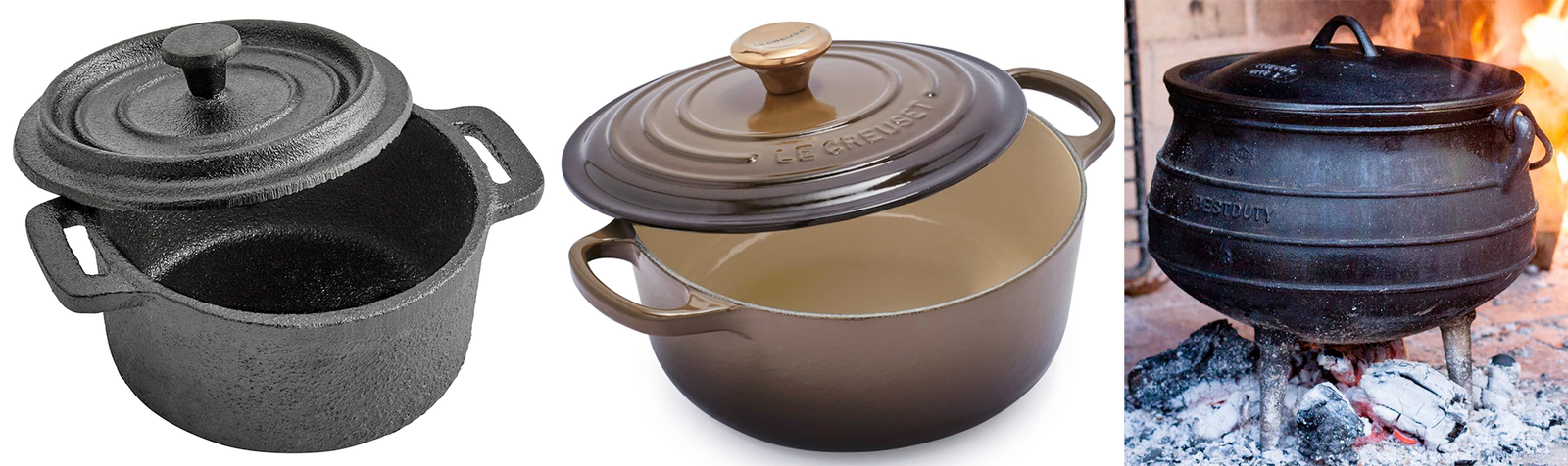
 Cast iron Dutch oven (left), French cocotte (centre) and South
African potjiekos (right).
Welcome to the summary page for FabulousFusionFood's Cook's Guide entry for Cocotte along with all the recipes employing Cocotte presented on this site, with 88 recipes in total.
This is a continuation of an entire series of pages that will, I hope, allow my visitors to better navigate this site. As well as displaying recipes by name, country and region of origin I am now planning a whole series of pages where recipes can be located by meal type and main ingredient. This page gives a listing of all the Cocotte recipes added to this site.
These recipes, all contain Cocotte as a major wild food ingredient.
The origins of metal casserole cookware (Dutch ovens in the US) are Dutch and British. During the 17th century metal cookware tended to be brass, very expensive and manufactured in sand moulds in the Netherlands. Studying the manufacture of these items, the Iron founder Abraham Derby reasoned that they cold be produced much more cheaply using cast iron. In 1706, with the of aid James Thomas, a Welshman he managed to cast iron cookware in sand using the Dutch process and was granted a patent in 1707. As a result, the resultant cookware became known as Dutch Ovens (from Dutch process ovens) and are known as such in the US even today (they are actually known as braadpan in the Netherlands).
As these cast iron pots were typically made to cook casseroles, they became known as French Casseroles and then just casseroles throughout the remainder of the world. Later advancements let to the basic cast iron cookware being enamelled on the inside, and became known as cocottes in France (French ovens in the US).
Similar vessels are the South African potjie which is more a cast iron pot-bellied pot with a round base and three legs (though in South Africa cast iron casseroles also tend to be called potjies) the Japanese tetsunabe and the sač, a traditional Balkan cast-iron oven along with the Australian Bedourie oven and Spanish cazuela.
This is a continuation of an entire series of pages that will, I hope, allow my visitors to better navigate this site. As well as displaying recipes by name, country and region of origin I am now planning a whole series of pages where recipes can be located by meal type and main ingredient. This page gives a listing of all the Cocotte recipes added to this site.
These recipes, all contain Cocotte as a major wild food ingredient.
The origins of metal casserole cookware (Dutch ovens in the US) are Dutch and British. During the 17th century metal cookware tended to be brass, very expensive and manufactured in sand moulds in the Netherlands. Studying the manufacture of these items, the Iron founder Abraham Derby reasoned that they cold be produced much more cheaply using cast iron. In 1706, with the of aid James Thomas, a Welshman he managed to cast iron cookware in sand using the Dutch process and was granted a patent in 1707. As a result, the resultant cookware became known as Dutch Ovens (from Dutch process ovens) and are known as such in the US even today (they are actually known as braadpan in the Netherlands).
As these cast iron pots were typically made to cook casseroles, they became known as French Casseroles and then just casseroles throughout the remainder of the world. Later advancements let to the basic cast iron cookware being enamelled on the inside, and became known as cocottes in France (French ovens in the US).
Similar vessels are the South African potjie which is more a cast iron pot-bellied pot with a round base and three legs (though in South Africa cast iron casseroles also tend to be called potjies) the Japanese tetsunabe and the sač, a traditional Balkan cast-iron oven along with the Australian Bedourie oven and Spanish cazuela.
The alphabetical list of all Cocotte recipes on this site follows, (limited to 100 recipes per page). There are 88 recipes in total:
Page 1 of 1
| Aromatic Pork and Potato Casserole Origin: Ireland | Guy Fawkes Gunpowder Casserole Origin: Britain | Pullum Parthicum (Parthian Chicken) Origin: Roman |
| Arroz con Cerdo (Mexican Rice and Pork) Origin: Mexico | Highland Venison Casserole with Chestnuts Origin: Scotland | Ratatouille Origin: France |
| Banana and Corn Casserole Origin: eSwatini | Imam Bayildi (Baked Aubergine Casserole) Origin: Armenia | Rhubarb and Pork Chop Casserole Origin: Britain |
| Beef in Bistort Leaves Origin: Britain | Inyama Yenkukhu (South African Chicken Casserole) Origin: South Africa | Roosterkoek with Filling II Origin: South Africa |
| Biscuit-topped Lamb Casserole Origin: America | Jersey Ormer Casserole Origin: Jersey | Savoury Chops Origin: Australia |
| Bohobe ba Polata (Lesothan Fat Cakes) Origin: Lesotho | Kuba (Mushroom and Barley Casserole) Origin: Czech | Smoked Sausage and Bean Casserole Origin: Britain |
| Bolo and Trotter Potjie Origin: Namibia | Lækker mørbradgryde (Pork Tenderloin Casserole) Origin: Denmark | Sorrel Sarma Origin: North Macedonia |
| Bonfire Chicken Casserole Origin: British | Lamb Cutlet Casserole Origin: Britain | Spider Crab Casserole Origin: Britain |
| Brinjal Casserole with Cheese Origin: Zimbabwe | Lamb Julienne with Crispy Dumplings Origin: Britain | Stoved Chicken Origin: Scotland |
| Caçarola de Frango com Cominho (Chicken Casserole with Cumin) Origin: Angola | Lamb, Apricot and Prune Casserole Origin: African Fusion | Stoved Howtowdie wi' Drappit Eggs Origin: Scotland |
| Cabbage and Bacon Origin: Ireland | Magatla (Oxtail Casserole) Origin: Botswana | Stuffed Nasturtium Leaves Origin: Fusion |
| Caccabinam Fusilem (Fluid Casserole) Origin: Roman | Microwave Casseroled Pigeons in Port Wine Origin: Britain | Suani Tadjine (Kitchen Garden Tagine) Origin: Algeria |
| Caccabinam Minorem (Small Casserole) Origin: Roman | Mini Orange Polenta Cake Origin: Fusion | Summer Lamb Casserole Origin: Britain |
| Cajun Chicken Casserole Origin: Cajun | Mogatla (Oxtail Casserole) Origin: Botswana | Sweet Potato Casserole Origin: Bermuda |
| Casserol Ceredigion (Cardiganshire Casserole) Origin: Welsh | Namibian Potbrood (Namibian Pot Bread) Origin: Namibia | Taco Casserole Origin: America |
| Casseroled Potatoes Origin: Britain | Pâtissons Farcis (Stuffed Squash) Origin: Mauritius | Tagin Lisan 'asfur (Orzo Casserole) Origin: Egypt |
| Cassoulet Mauricien (Mauritian Cassoulet) Origin: Mauritius | Paia Katsarolas (Duck Casserole) Origin: Cyprus | Tajine de Poulet au Miel et Abricots (Chicken Tagine with Honey and Apricots) Origin: Morocco |
| Cazuela Fiestera (Festival Casserole) Origin: Ecuador | Pane di Casa Origin: Italy | Thieboudienne (Fish in the Manner of Dakar) Origin: Senegal |
| Chicken and Leek Hotpot Origin: Ireland | Pastelón de Arroz (Cheesy Beef and Rice Casserole) Origin: Dominican Republic | Tishreeb Hummus (Chickpea Casserole) Origin: Iraq |
| Chicken Potjie with Dumplings Origin: Botswana | Pastelón de Harina de Maíz (Cornmeal and Beef Casserole) Origin: Dominican Republic | Tourlu (Armenian Vegetable Casserole) Origin: Armenia |
| Cig Llo â Chorbys (Veal with Lentils) Origin: Welsh | Patina Cotidiana II (Everyday Casserole II) Origin: Roman | Turkey Tetrazzini Casserole Origin: American |
| Coconut Fish Origin: Nauru | Patina de pisciculis (Dish of Small Fish) Origin: Roman | Vegetable Potjie Origin: Botswana |
| Cocotte de poulet au cidre (Chicken Casseroled in Cider) Origin: France | Patinam Apicianam (Apician Casserole) Origin: Roman | Venison and Chestnut Casserole Origin: Scotland |
| Comlek (Rabbit Casserole) Origin: Albania | Patinam ex Lacte (Milk Casserole) Origin: Roman | Vereshchaka (Pork and Beetroot Casserole) Origin: Russia |
| Curried Neck of Mutton Potjie Origin: Namibia | Pork, Potato and Fennel Casserole Origin: Ireland | Vine Leaf Sarma Origin: North Macedonia |
| Cyw Iâr Mewn Dull Cymreig (Welsh-style Chicken) Origin: Welsh | Pot Bread Origin: Southern Africa | Vodhino Casarolas (Roast Beef Casserole) Origin: Cyprus |
| Fish and Breadfruit Casserole Origin: Nauru | Potato and Bean Casserole with Tomatoes Origin: Ireland | Wild Herb Casserole Origin: Britain |
| Fruity Beef Casserole Origin: Britain | Potato Casserole Origin: Ireland | Xinjiang Lamb Casserole Origin: China |
| Gestowe Soetpatats (Slow-cooked Sweet Potatoes) Origin: South Africa | Poulet en Cocotte (French Chicken Casserole) Origin: France | |
| Green Bean and Potato Casserole Origin: American |
Page 1 of 1