FabulousFusionFood's Chinese New Year Recipes Home Page
 Chinese New Year dragon dancers with New Year symbols
Welcome to FabulousFusionFood's Chinese New Year Recipes — This is the first in my occasional series on festival foods and dishes. Known in Chinese as the "Spring Festival" (traditional Chinese: 春節; simplified Chinese: 春节; pinyin: Chūnjié), it marks the start of the spring season in the Chinese lunisolar calendar which traditionally starts with lichun, the first of the twenty-four solar terms that the festival celebrates around the time of the Chinese New Year.
The festival is also called "Lunar New Year" in English, despite the traditional Chinese calendar being lunisolar and not lunar. However, "Chinese New Year" is still a commonly used translation for people of non-Chinese backgrounds. Along with the Han Chinese inside and outside of Greater China, as many as 29 of the 55 ethnic minority groups in China also celebrate Chinese New Year. Korea, Vietnam, Singapore, Malaysia, Indonesia, and the Philippines celebrate it as an official festival.
The Chinese New Year cycles through the Chinese Zodiac, so that each year is associated with one of the zodiacal signs.
The history of the Chinese New Year festival can be traced back to more than 4000 years ago. Before the new year celebration was formed, ancient Chinese gathered around and celebrated at the end of harvest in autumn. However, the celebration is not Mid-Autumn Festival, during which Chinese gathered with family and worship the moon. In the Classic of Poetry, a poem written during Western Zhou (1045 BC – 771 BC), by an anonymous farmer, described how people cleaned up millet stack-sites, toasted to guests with mijiu, killed lambs and cooked the meat, went to their master's home, toasted to the master, and cheered for long lives together, in the 10th month of an ancient solar calendar, which was in autumn.[22] The celebration is believed to be one of the prototypes of the Chinese New Year.
The first dated Chinese new year celebration can be traced back to the Warring States period (475–221 BCE). In Lüshi Chunqiu, an exorcistic ritual called 'Big Nuo (大儺)' was recorded being carried out in the ending day of a year to expel illness in Qin. Later, after Qin unified China and the Qin dynasty was founded, the ritual was continued. It evolved to cleaning up houses thoroughly in the preceding days of Chinese New Year
The first mentioning of the celebration of the start of a new year was recorded in Han dynasty (202 BC – 220 AD). In the book Simin Yueling (四民月令), written by Eastern Han's agronomist and writer Cui Shi (崔寔), the celebration was recorded by stating 'The starting day of the first month, is called 'Zheng Ri'. I bring my wife and children, to worship ancestors and commemorate my father'. Later he wrote: 'Children, wife, grandchildren, and great-grandchildren all serve pepper wine to their parents, make their toast, and wish their parents good health. It's a thriving view'. People also went to acquaintances' homes and wished each other a happy new year. In Book of the Later Han Volume 27, 吴良, a county officer was recorded going to his prefect's house with a government secretary, toasting to the prefect and praising the prefect's merit.
Chinese New Year is the grandest ancient traditional festival in China, commonly known as 'Guo Nian'. This festival means the beginning of spring and the arrival of the new year. The customs of Chinese New Year include sticking Spring Festival couplets, buying New Year's goods, and having family dinner together.

Chinese New Year Fare:
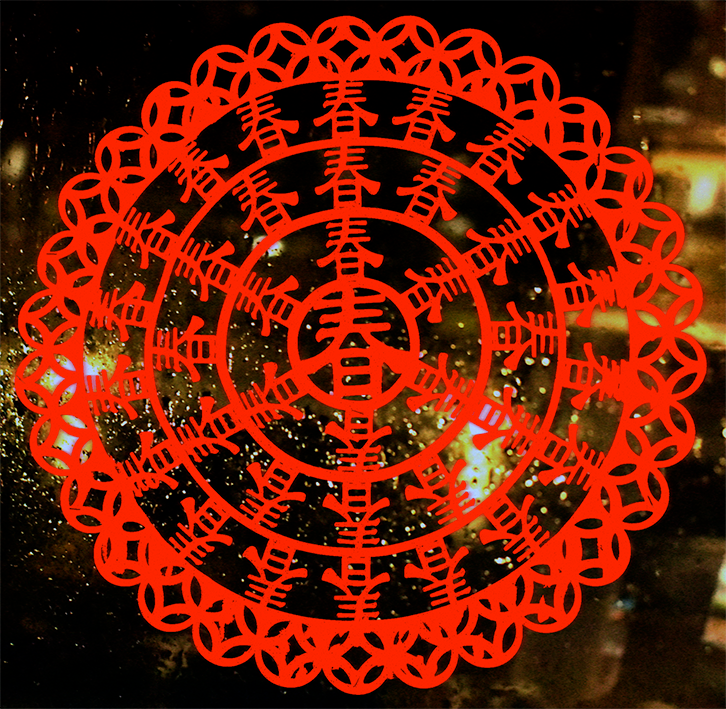 paper cutting with the character 春 ('spring')
Other traditional foods consist of noodles, fruit, dumplings, spring rolls, and Tangyuan, which are also known as sweet rice balls. Each dish served during Chinese New Year represents something special. The noodles used to make longevity noodles are usually very thin, long wheat noodles, which are longer than normal noodles, and are usually fried and served on a plate, or boiled and served in a bowl with their broth. The noodles symbolize the wish for a long life. The fruits that are typically selected would be oranges, tangerines, and pomelos, as they are round and 'golden' in color, symbolizing fullness and wealth. The pronunciations of these Chinese words are said to harbour luck and prosperity, such as the Chinese pronunciation for orange (橙 chéng), which sounds the same as the Chinese for 'success' (成). The pomelo, which is believed to bring constant prosperity, also has a pronunciation that symbolize good luck. The Chinese word for pomelos (柚 yòu) sounds similar to 'to have' (有 yǒu); disregarding its tone, however, it sounds exactly like 'again' (又 yòu). Certain Chinese characters can represent luck as well, such as the Chinese word for tangerine (桔 jú), which contains the Chinese character for luck (吉 jí). Additionally, dumplings and spring rolls symbolize wealth, whereas sweet rice balls symbolize family togetherness.
Various dishes proffering luck to the guests are served and these include dishes with long noodles for longevity, pork for luck and round or golden items (including oranges) for wealth.
Chinese New Year's Eve is usually accompanied by a dinner feast, consisting of special meats as a main course and an offering for the New Year. This meal is comparable to Thanksgiving dinner or Christmas dinner in the west. In northern China, it is customary to make jiaozi or dumplings, which are eaten at midnight. Dumplings symbolize wealth because their shape resembles a Chinese sycee. In the South, it is customary to make a glutinous new year cake (niangao) and send pieces of it as gifts to relatives and friends in the coming days.
Many families in China still follow the tradition of eating only vegetarian food on the first day of the new year, as it is believed that doing so will bring good luck into their lives for the whole year.
Chinese New Year with Element and Zodiac Sign Associations:
 The twelve signs of the Chinese zodiac.
| Year | Start Date | Element | Animal |
|---|---|---|---|
| 2026 | 17th Feb | FIRE | HORSE |
| 2027 | 6th Feb | FIRE | SHEEP |
| 2028 | 26th Jan | EARTH | MONKEY |
| 2029 | 13th Feb | EARTH | ROOSTER |
| 2030 | 3rd Feb | METAL | DOG |
| 2031 | 23rd Jan | METAL | PIG |
| 2032 | 11th Feb | WATER | RAT |
| 2033 | 31st Jan | WATER | OX |
| 2034 | 19th Feb | WOOD | TIGER |
| 2035 | 8th Feb | WOOD | HARE |
| 2036 | 28th Jan | FIRE | DRAGON |
| 2037 | 15th Feb | FIRE | SNAKE |
In 2024, Chinese New Year was added to the Intangible Cultural Heritage of Humanity list by the United Nations Educational, Scientific and Cultural Organisation. Chinese New Year is observed as a public holiday in some countries and territories, outside of China, with a sizable Chinese population. Since Chinese New Year falls on different days of the week each year, the governments of some of these countries choose to adjust working days to create a longer public holiday. In certain countries, a statutory holiday is added on the following workday if the New Year (as a public holiday) falls on a weekend. For example, in 2013, New Year's Eve (9 February) fell on a Saturday and New Year's Day (10 February) on a Sunday. The holiday may be referred to by different names depending on the country: common English terms include 'Chinese New Year', 'Lunar New Year', 'New Year Festival', and 'Spring Festival'.
The alphabetical list of all the Christmas recipes on this site follows, (limited to 100 recipes per page). There are 69 recipes in total:
Page 1 of 1
Page 1 of 1