FabulousFusionFood's Chilli-based Recipes 17th Page
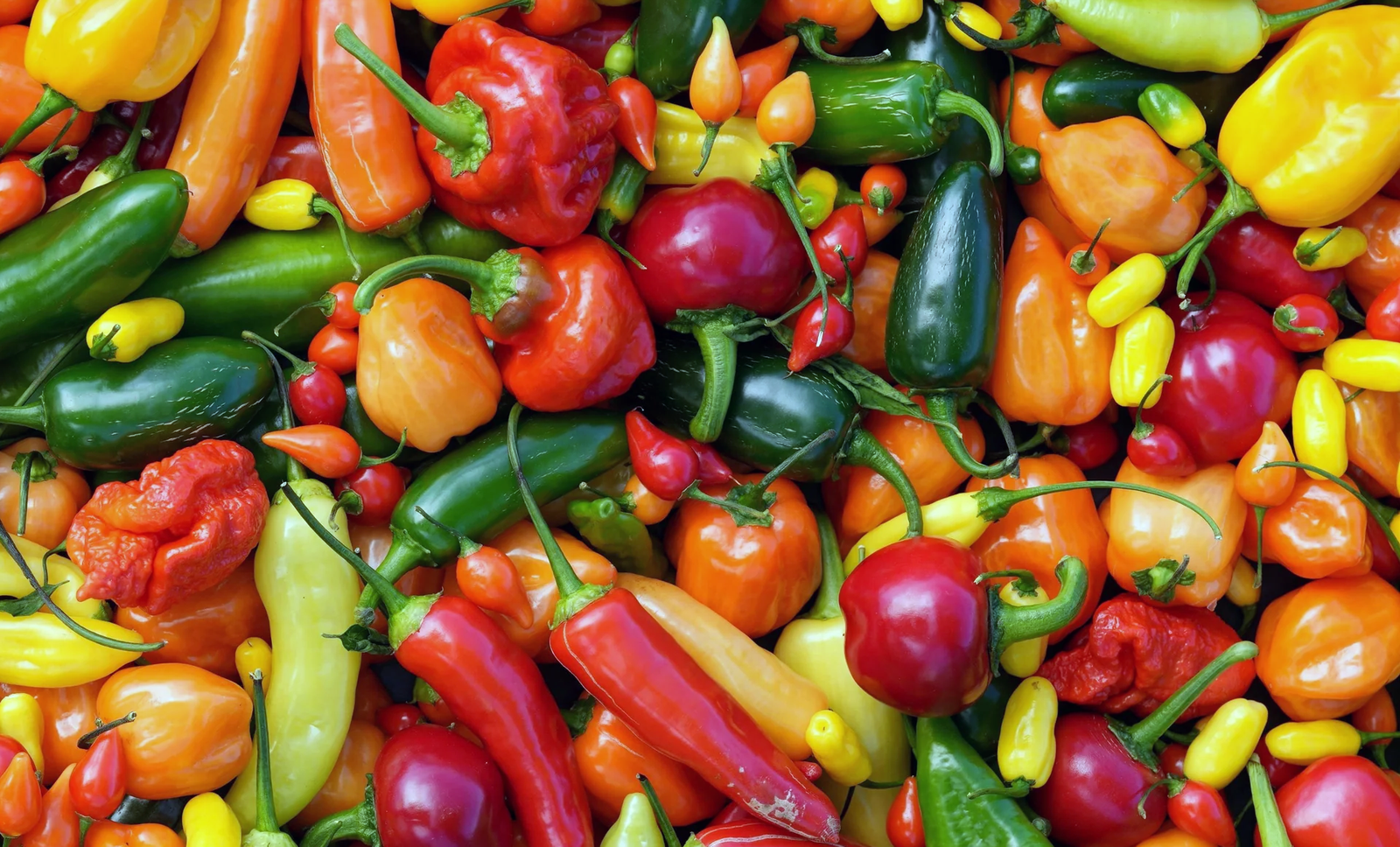 A mixture of different chilli peppers.
Welcome to FabulousFusionFood's Chilli-based Recipes Page — The recipes presented here all contain chilli peppers as a main ingredient. Chillies are the fruit of the chilli plant. Along with black pepper, they are unique spices in that they impart 'heat' to a dish without any associated bitterness. The dried and powdered fruit along with the fresh fruit and the dried fruit are all used as spices. As well as their capsaicin induced heat, chillies (depending on the variety or cultivar) can also imbue a dish with a fruity flavour. Smoked chillies are also used to impart a smokiness as well as heat to a dish.
Chilli peppers, also spelled chile or chili (from Classical Nahuatl chīlli [ˈt͡ʃiːlːi]) and known as hot peppers, are varieties of berry-fruit plants from the genus Capsicum, which are members of the nightshade family Solanaceae, cultivated for their pungency. Chilli peppers are widely used in many cuisines as a spice to add "heat" to dishes. Capsaicin and the related capsaicinoids give chillies their intensity when ingested or applied topically. Chilli peppers exhibit a range of heat and flavours. This diversity is the reason behind the availability of different types of chilli powder, each offering its own taste and heat level.
Chilli peppers originated in Central or South America and were first cultivated in Mexico. European explorers brought chillies back to the Old World in the late 16th century as part of the Columbian Exchange, which led to the cultivation of multiple varieties across the world for food and traditional medicine. Five Capsicum species have been widely cultivated: annuum, baccatum, chinense, frutescens, and pubescens.
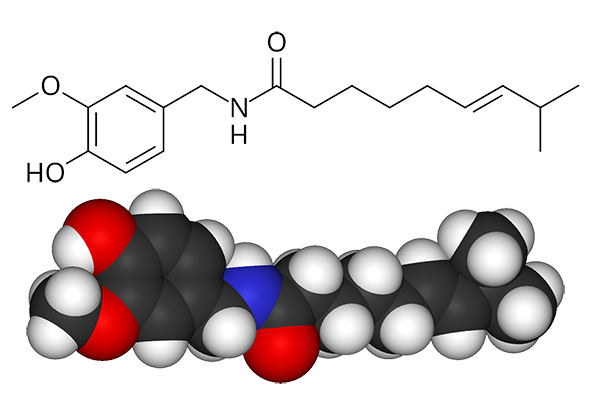 The capsaicin molecule, chemical structure (top) and space-filling model (bottom).
When peppers are consumed by mammals such as humans, capsaicin binds with pain receptors in the mouth and throat, potentially evoking pain via spinal relays to the brainstem and thalamus where heat and discomfort are perceived. However, birds are unable to perceive the hotness and so they can eat some of the hottest peppers. The intensity of the "heat" of chillies is commonly reported in Scoville heat units (SHU), invented by American pharmacist Wilbur Scoville in 1912. Historically, it was a measure of the dilution of an amount of chilli extract added to sugar syrup before its heat becomes undetectable to a panel of tasters; the more it has to be diluted to be undetectable, the more powerful the variety, and therefore the higher the rating. Since the 1980s, spice heat has been assessed quantitatively by high-performance liquid chromatography (HPLC), which measures the concentration of heat-producing capsaicinoids, typically with capsaicin content as the main measure
The alphabetical list of all the chilli-based on this site follows, (limited to 100 recipes per page). There are 2100 recipes in total:
Page 17 of 22
| Restaurant-style Dum Aloo Origin: India | Saba Curry Goat Origin: Saba | Salsa con Queso Jalapeña (Nicaraguan Cream Sauce with Cheese) Origin: Nicaragua |
| Restaurant-style Madras Curry Origin: Britain | Saba Peppasauce Origin: Saba | Salsa con Tomatillo Verde (Tangy Green Tomatillo Salsa) Origin: Mexico |
| Rhubarb and Common Hogweed Seed Chutney Origin: Britain | Saba Pigeon Pea Stew Origin: Saba | Salsa de Abacate de Guineano (Equatorial Guinean Avocado Salsa) Origin: Equatorial Guinea |
| Ribnoye Kharcho (Salmon and Walnut Soup) Origin: Georgia | Saban Pot Origin: Saba | Salsa de Chile Rojo (Red Chilli Sauce) Origin: Spain |
| Rice and Peas Origin: Jamaica | Sabat Moong Bhajji (Mung Bean Bhaji) Origin: India | Salsa de Espinacosas (Spinach Salsa) Origin: Equatorial Guinea |
| Rice Bujambura Origin: Mozambique | Sach Ko Nung Slirk S'krey Chomkak (Lemongrass Beef Kebab) Origin: Cambodia | Salsa de Frutas (Fruit Salsa) Origin: Mexico |
| Rice with Pigeon Peas Origin: Puerto Rico | Sach Ko Tirk Prahok (Beef in Fish Sauce) Origin: Cambodia | Salsa de Mango (Mexican Mango Salsa) Origin: Mexico |
| Ris Gras Burkinabé Origin: Burkina Faso | Saffe (Mutton and Cassava Leaf Stew) Origin: Sierra Leone | Salsa de Molcajete (Stone-ground Mexican Salsa) Origin: Mexico |
| Risotto al Funghi Porcini e Nepitella (Risotto with Porcini Mushrooms and Lesser Calamint) Origin: Italy | Safou a la Sauce Tomate (Bush Pears in Tomato Sauce) Origin: Cameroon | Salsa de Rajas Origin: Mexico |
| Riyenu (Chamorro Stuffing) Origin: Guam | Saint Kitts and Nevis Jerk Burger Origin: Saint Kitts | Salsa de Tomatillo (Tomatillo Salsa) Origin: Mexico |
| Riz au Gras ('Fat Rice') Origin: Benin | Saint Lucia Green Seasoning Origin: Saint Lucia | Salsa Guacamole (Creamy Guacasalsa) Origin: Mexico |
| Riz au Gras (Ivorian Fat Rice) Origin: Cote dIvoire | Saint Lucia Lambi Soup with Dumplings Origin: Saint Lucia | Salsa Jalapeña (Nicaraguan Cream Sauce) Origin: Nicaragua |
| Riz au Gras Ivorienne (Ivorian Fat Rice) Origin: Cote dIvoire | Saint Lucia Papaya Hot Pepper Sauce Origin: Saint Lucia | Salsa Macha (Arbol Chilli Oil) Origin: Mexico |
| Riz et Pois Collés (Haitian Rice with Peas) Origin: Haiti | Saint Martin Poulet de Colombo Origin: Sint Maarten | Salsa Macha Mole Origin: Mexico |
| Riz Jollof du Niger (Niger-style Jollof Rice) Origin: Niger | Saint Martin Poulet de Colombo Origin: Saint-Martin | Salsa Roja Origin: Mexico |
| Riz Wolof (Wolof Rice) Origin: Guinea | Saint Martin Sauce Chien Origin: Saint-Martin | Salsa Verde (Mexican Green Sauce) Origin: Mexico |
| Roadhouse Chili Pizza Origin: American | Saint Vincent Green Seasoning Origin: Saint Vincent | Salsa Verde de Tomatillo (Mexican Green Tomatillo Salsa) Origin: Mexico |
| Roast Chicken Noodle Soup with Chopsuey Greens Origin: Fusion | Saka saka (Congolese Cassava Leaves) Origin: Congo | Salsa Verde de Tomatillo (Tomatillo Salsa Verde) Origin: Mexico |
| Roast Tomato Bharta Origin: Anglo-Indian | Saka-saka (Mutton and Cassava Leaf Stew) Origin: Guinea | Salt Cod Fish Cakes Origin: Bahamas |
| Roasted Maize Origin: Nigeria | Sakay Origin: Madagascar | Saltfish Accra Origin: Barbados |
| Rocoto Rellenos (Stuffed Rocoto Chillies) Origin: Peru | Salade Chou Chou (Chako Salad) Origin: Mauritius | Saltfish Salad Origin: Anguilla |
| Romazava Origin: Madagascar | Salade de Zaalouk (Salad of Cooked Vegetables) Origin: Tunisia | Samaki wa Kakuango (Fried Fish with Onions) Origin: Tanzania |
| Ropa Vieja Origin: Cuba | Salade Kopto (Moringa Leaf Salad) Origin: Niger | Samaki wa Kapaka (Zanzibar Grilled Fish) Origin: Tanzania |
| Rougail de Mangues Vertes (Green Mango Rougail) Origin: Madagascar | Salat Bzainjan Eswed bel-Filfil (Aubergine and Chilli Salad) Origin: Saudi Arabia | Sambal Belacan Origin: Malaysia |
| Rougail Mangue (Mango Rougail) Origin: Reunion | Salata Aswad (Sudanese Aubergine Salad) Origin: Sudan | Sambal Kacang (Indonesian Peanut Sauce) Origin: Indonesia |
| Rougail Saucisse (Sausage Rougail) Origin: Mauritius | Salata Ducos (Green Coriander Salad) Origin: Saudi Arabia | Sambal Olek Origin: Indonesia |
| Rougaille de Poisson Salé (Salted Fish Rougaille) Origin: Mauritius | Salata Hara Origin: Saudi Arabia | Sambal Telur Origin: Malaysia |
| Royal Beef Biryani Origin: India | Salata Méchouia Nablia (Grilled Red Pepper, Chilli and Tomato Salad) Origin: Tunisia | Sambal Tomat (Tomato Sambal) Origin: Aruba |
| Rujak Brunei (Spiced Fruit Salad) Origin: Brunei | Salmi Poulet Mauriticien (Chicken Mauritius) Origin: Mauritius | Sambhar Masala Origin: India |
| Russian Dressing Origin: American | Salmon Kalia in Panch Phoron Sauce Origin: India | Samlar Machu (Cambodian Sour Soup) Origin: Cambodia |
| Rwandan Chicken Origin: Rwanda | Salmon with Acacia Seed and Tasmanian Pepper Berry Rub Origin: Australia | Samusa aux Crevettes Réunionaise (Reunion Shrimp Samosas) Origin: Reunion |
| Saag Aloo (Stir-fried Potatoes with Spinach) Origin: India | Salone-style Kibbeh Origin: Sierra Leone | Sancoche Origin: Trinidad |
| Saag Aloo (Stir-fried Potatoes with Rapeseed Greens) Origin: India | Salsa Amarilla (Yellow Cherry Tomato Salsa) Origin: Mexico | |
| Saak-er Ghanto Origin: Bangladesh | Salsa Bandera Origin: Mexico |
Page 17 of 22