FabulousFusionFood's Chilli-based Recipes 16th Page
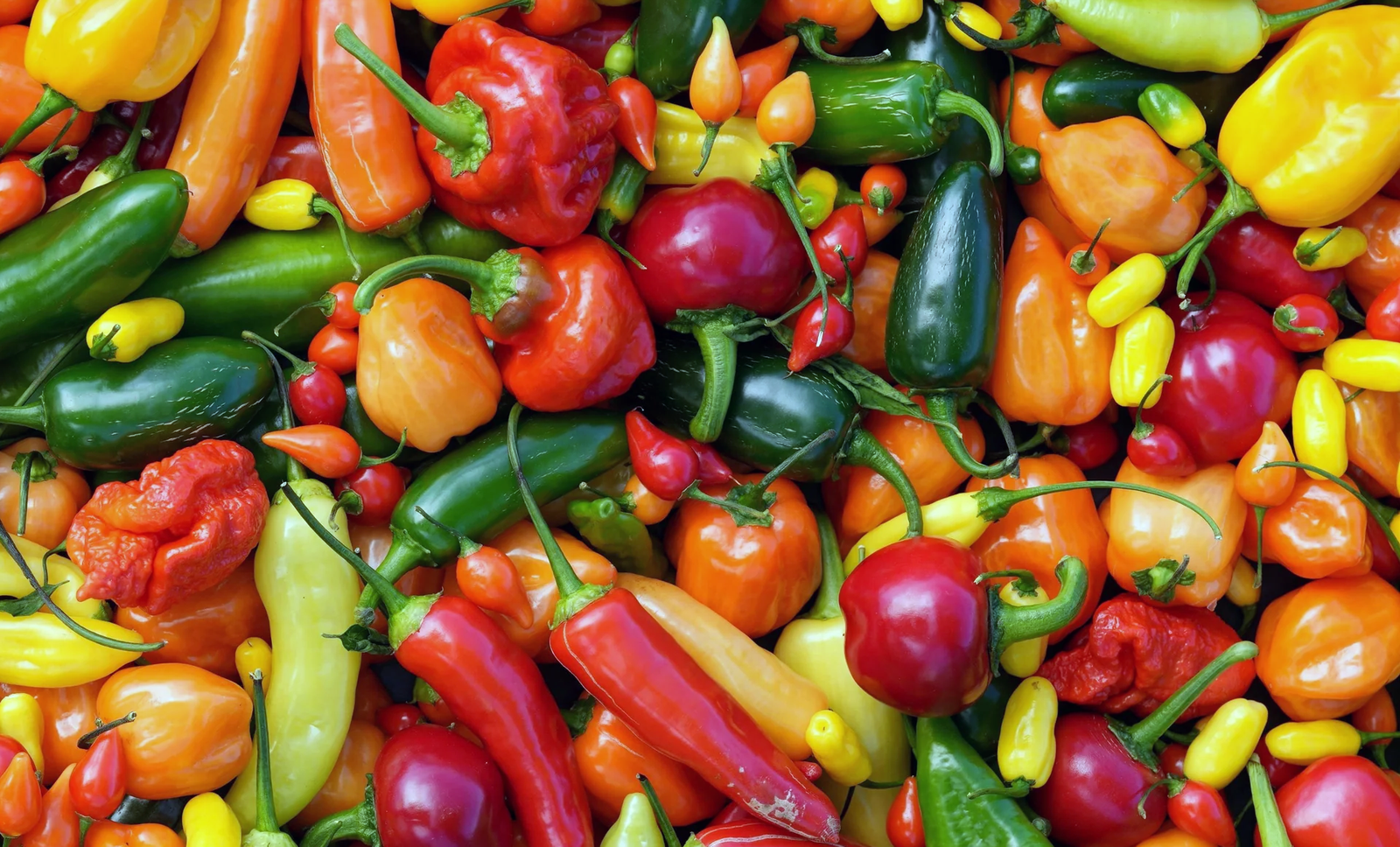 A mixture of different chilli peppers.
Welcome to FabulousFusionFood's Chilli-based Recipes Page — The recipes presented here all contain chilli peppers as a main ingredient. Chillies are the fruit of the chilli plant. Along with black pepper, they are unique spices in that they impart 'heat' to a dish without any associated bitterness. The dried and powdered fruit along with the fresh fruit and the dried fruit are all used as spices. As well as their capsaicin induced heat, chillies (depending on the variety or cultivar) can also imbue a dish with a fruity flavour. Smoked chillies are also used to impart a smokiness as well as heat to a dish.
Chilli peppers, also spelled chile or chili (from Classical Nahuatl chīlli [ˈt͡ʃiːlːi]) and known as hot peppers, are varieties of berry-fruit plants from the genus Capsicum, which are members of the nightshade family Solanaceae, cultivated for their pungency. Chilli peppers are widely used in many cuisines as a spice to add "heat" to dishes. Capsaicin and the related capsaicinoids give chillies their intensity when ingested or applied topically. Chilli peppers exhibit a range of heat and flavours. This diversity is the reason behind the availability of different types of chilli powder, each offering its own taste and heat level.
Chilli peppers originated in Central or South America and were first cultivated in Mexico. European explorers brought chillies back to the Old World in the late 16th century as part of the Columbian Exchange, which led to the cultivation of multiple varieties across the world for food and traditional medicine. Five Capsicum species have been widely cultivated: annuum, baccatum, chinense, frutescens, and pubescens.
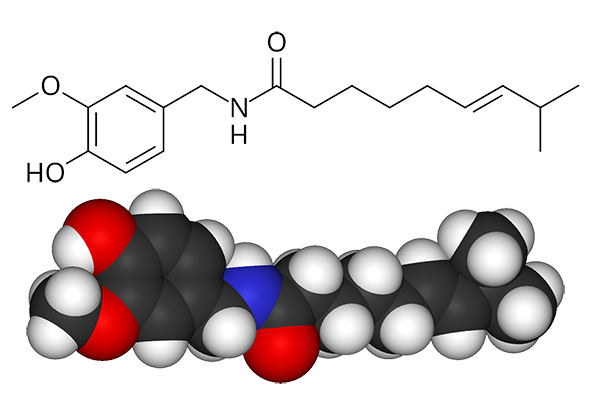 The capsaicin molecule, chemical structure (top) and space-filling model (bottom).
When peppers are consumed by mammals such as humans, capsaicin binds with pain receptors in the mouth and throat, potentially evoking pain via spinal relays to the brainstem and thalamus where heat and discomfort are perceived. However, birds are unable to perceive the hotness and so they can eat some of the hottest peppers. The intensity of the "heat" of chillies is commonly reported in Scoville heat units (SHU), invented by American pharmacist Wilbur Scoville in 1912. Historically, it was a measure of the dilution of an amount of chilli extract added to sugar syrup before its heat becomes undetectable to a panel of tasters; the more it has to be diluted to be undetectable, the more powerful the variety, and therefore the higher the rating. Since the 1980s, spice heat has been assessed quantitatively by high-performance liquid chromatography (HPLC), which measures the concentration of heat-producing capsaicinoids, typically with capsaicin content as the main measure
The alphabetical list of all the chilli-based on this site follows, (limited to 100 recipes per page). There are 2100 recipes in total:
Page 16 of 22
| Pork and Chorizo Enchiladas Origin: Mexico | Poulet Yassa (Chicken Yassa) Origin: Guinea-Bissau | Quick Doubanjiang Origin: Fusion |
| Pork and Quince Curry Origin: Britain | Poulet Yassa Burkinabé (Burkinabe Chicken Yassa) Origin: Burkina Faso | Ragoût aux épinards (Spinach Stew) Origin: Central African Republic |
| Pork Black Curry Origin: Sri Lanka | Poulet Yassa de Guinée (Guinean Poulet Yassa) Origin: Guinea | Ragoût d'Ignames et Boeuf (Beef Stew with Yams) Origin: Britain |
| Pork Fing Origin: Bhutan | Poulet Yassa Mauritanienne (Mauritanian Chicken Yassa) Origin: Mauritania | Ragoût de Porc au Citron Vert (Ragoût of Pork with Lime) Origin: Senegal |
| Pork Fong Origin: Bhutan | Poutou Origin: Mayotte | Ragout d'Igname (Yam Porridge) Origin: Burkina Faso |
| Pork Paprikash Origin: Hungary | Prawn Balti Origin: Britain | Ragoût de poisson (Creole-style fish Stew) Origin: Saint-Martin |
| Pork Pickle Curry Origin: India | Prawn Curry Origin: Bangladesh | Rajas con Crema Origin: Mexico |
| Pork Vindaloo with Vindaloo Masala Origin: Britain | Prawn Patties Origin: Trinidad | Rajmah Curry Blend Origin: India |
| Pork Vindaloo with Vindaloo Paste Origin: Britain | Prawn Phall Origin: Britain | Ras el hanout Origin: North Africa |
| Pork with Cabbage and Bananas Origin: eSwatini | Prawn Powder Origin: Anglo-Indian | Rasam Origin: Southern India |
| Porkolt Csirke (Chicken Porkolt) Origin: Hungary | Prawn Puri Origin: Britain | Rasam Powder Origin: India |
| Port of Spain Crabs and Dumplings Origin: Trinidad | Pressure Cooker Beef in Pepper Sauce Origin: American | Ravir de Deku (Deku Delight) Origin: DR-Congo |
| Portuguese Tomato Sauce Origin: Portugal | Pressure Cooker Chicken Korma Origin: Fusion | Raw Beetroot Raita Origin: India |
| Pot Roast Turkey Drumstick Origin: Fusion | Pressure Cooker Curried Beef Stew Origin: South Africa | Re-fried Beans II Origin: Mexico |
| Potage Congolaise (Congolese Soup) Origin: Congo | Prig Gang Som (Sour Curry Paste) Origin: Thailand | Red Bean Soup with Guacamole Salsa Origin: Mexico |
| Potatas a la Huancaína (Huancaínan Potatoes) Origin: Peru | Prig Nam Som (Chilli Garlic Sauce) Origin: Thailand | Red Bell Pepper Letcho Origin: Hungary |
| Potato Cakes with Mango Sauce Origin: Ireland | Prik Gaeng Panang (Panang Red Curry Paste) Origin: Thailand | Red Chicken Mole Origin: Mexico |
| Potato Chops Origin: India | Pudding Egusi (Egusi Pudding) Origin: Cameroon | Red Chilli Biscuits Origin: America |
| Poule nas sos (Chicken in Sauce) Origin: Haiti | Pudina Chutney (Indian Mint Chutney) Origin: India | Red Curry Cambogee with Meat Origin: Cambodia |
| Poulet à la Noix de Coco et aux Arachides (Chicken with Coconut and Peanuts) Origin: Gabon | Pudina Chutney (Mint Chutney) Origin: India | Red Curry Dipping Sauce Origin: Thailand |
| Poulet à la Sauce Blanche (Chicken with White Sauce) Origin: Benin | Puerto Rican Sofrito Origin: Puerto Rico | Red Lentil, Chickpea and Chilli Soup Origin: Britain |
| Poulet à la Moambe (Chicken Moambe) Origin: DR-Congo | Pulled Firecracker Brisket Origin: Britain | Red Oil Greens Origin: Liberia |
| Poulet au Citron Vert (Chicken with Limes) Origin: DR-Congo | Pumpkin and Chanterelle Tamales Origin: Mexico | Red Oil Sweet Potato Greens Origin: Liberia |
| Poulet aux Arachides de Niger (Chicken with Peanuts, Niger Style) Origin: Niger | Pumpkin and Tomato Soup Origin: West Africa | Red Schug Origin: Israel |
| Poulet aux Bananes Plantains (Chicken with Plantains) Origin: Madagascar | Pumpkin Parcels with Chilli and Lime Origin: Britain | Red Zhug (Yemenite Hot Sauce) Origin: Yemen |
| Poulet aux Maniocs (Chicken with Cassava) Origin: DR-Congo | Pumpkin Vine Tips Tarkari Origin: Nepal | Red-red with Spiced Plantains Origin: Ghana |
| Poulet Bicyclette Origin: Burkina Faso | Pupusas Origin: El Salvador | Relajo (Salvadorean Red Chilli Sauce) Origin: El Salvador |
| Poulet Boucané (Buccaneer/Smoked Chicken) Origin: Martinique | Purée d'Oseille (Hibiscus Leaf Purée) Origin: Chad | Relleno de Empanada de Pollo (Chicken Empanada Filling) Origin: Mexico |
| Poulet braisé à l'Ivorienne (Ivorian-style Roast Chicken) Origin: Cote dIvoire | Qatar Baharat Spice Blend Origin: Qatar | Rendang Curry Paste Origin: Fusion |
| Poulet Farci au Riz (Chicken Stuffed with Rice) Origin: Cote dIvoire | Qatri Chicken Curry Origin: Qatar | Rendang Daging (Malaysian Beef Rendang) Origin: Malaysia |
| Poulet Kédjénou (Kédjénou Chicken) Origin: Cote dIvoire | Queen of Oude Sauce Origin: Britain | Restaurant Tandoori Marinade Origin: India |
| Poulet Moambe (Chicken Moambe) Origin: Congo | Queen of Sheba Salad Origin: Ethiopia | Restaurant-style Chakalaka Origin: South Africa |
| Poulet Nyembwe Origin: Gabon | Quesabirria Tacos Origin: Mexico | |
| Poulet Yassa (Chicken Yassa) Origin: Gambia | Queue de Boeuf Pinon (Oxtail Pinon) Origin: Togo |
Page 16 of 22