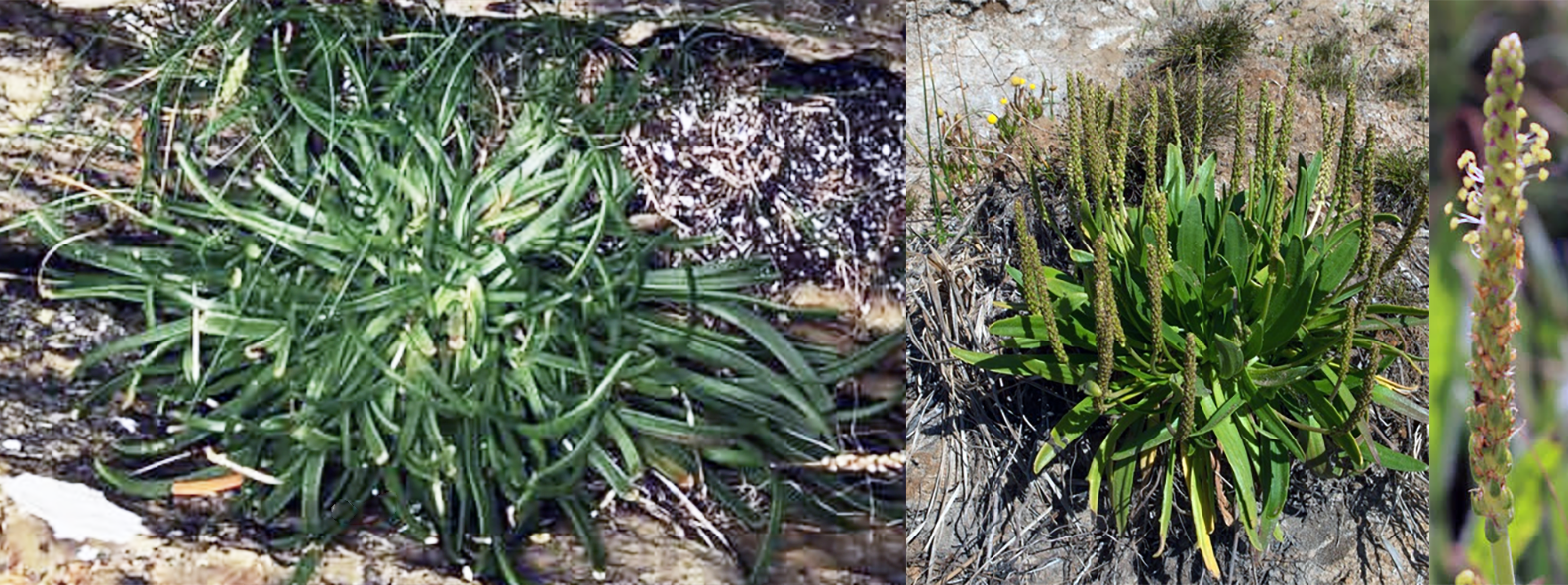
 The image, above, shows the plantain plant (Plantago
lanceolata) in its immature form, showing the rosette-like
growth pattern, a mature plant in flower and a close-up of a
flower spike.
| Common Name: Sea Plantain |
| Scientific Name: Plantago maritima subsp. maritima |
| Other Names: Seaside Plantain, Goose Tongue, Plantain by the Sea |
| Family: Plantaginaceae |
| Range: Western Europe, including Britain, from Scandanavia south and east to Spain, Hungary and Russia. |
Physical Characteristics Plantago maritima is a tender Perennial plant, growing to 20cm by 20cm in size. It is hardy to zone 6 and is not frost tender. The plant flowers from June to August and the seeds ripen from June to September. The flowers are hermaphrodite and are pollinated by wind. The plant is self-fertile and is a noted wildlife attractant.
|
| Edible Parts: Leaves, Seeds, Flower Buds |
 Edibility Rating: 3 Edibility Rating: 3 
|
 Known Hazards: None Known. Known Hazards: None Known.
|
Welcome to the summary page for FabulousFusionFood's Wild Food guide to Sea Plantain along with all the Sea Plantain containing recipes presented on this site, with 6 recipes in total.
These recipes, all contain Sea Plantain as a major wild food ingredient.
The Sea Plantain, Plantago maritima (also known as seaside plantain, Plantain by the Sea or goose tongue) is is a species of flowering plant in the plantain family Plantaginaceae. It has a subcosmopolitan distribution in temperate and Arctic regions, native to most of Europe, northwest Africa, northern and central Asia, northern North America, and southern South America. The species native to Europe, Asia and northwest Africa is a subspecies, Plantago maritima subsp. maritima. Sea Plantain cannot grow in shade and it prefers moist soil (hence is most commonly encountered in estuarine environments). It is essentially coastal in habitat.
Looking a bit like a wider, more succulent, grass stem with a slightly concave central zone, Sea Plantain plants grow in a basal rosette and have vertical flowering stalks that have tougher stems. There are 3–5 parallel veins running up the length of the leaves; a hallmark of any Plantain species, although because this species is so much more succulent, they are much less obvious than in the non-maritime members of the species. They have a slightly waxy coating on their surface and are sickle-shaped in cross-section. The flowering stalks can be up to 30cm tall in favourable conditions, and the leaves can be quite abundant. The flowering stems have tiny silvery hairs pressed into the stems, making it appear fuzzy. The blossoms are quite small and appear yellow.
Plantago maritima subsp maritima is one of Britain’s frequently encountered coastal plants. It is commonly encountered in mud flats, on the banks of estuaries and even growing among the crags on a rocky shore, but you won’t see it in sand dune habitats. In rare circumstances you might find some sea plantain growing alongside roads that are frequently salted.
The young leaves can be eaten raw or cooked. They have a delicious slightly salty flavour. Indeed, sea plantain is probably the choicest member of the genus. The succulent nature of the plant also means that the leaves are fairly low in fibres and make an acceptable addition to a mixed salad. They're particularly good finely-chopped and added to a potato salad. The leaves are canned for winter use in Alaska. The seeds can be eaten raw or cooked. The seed can be ground into a powder and used as a flour adulterant. Note, however, the the seed is very small and tedious to harvest. Like its relative, the Ribwort Plantain, the flower buds are edible, with a mildly-mushroom slightly salty flavour. They are good added to stir-fries and make a decent pickle. The seeds, if collected in large enough quantities can be ground into a flour.
Like the land borne Plantain species, Sea Plantain has a very particular mushroomy flavour, to all accounts because of endo-mycorrhizal fungi that colonise the plant’s roots – and probably help it to live in a highly salty/rocky/wet environment! This makes it perfect for mushroom risottos, quiches, tortillas, pies and so on. Its succulence also makes it very nice to eat raw in salads or as a lightly steamed vegetable side dish with lemon and olive oil. The seeds are edible in much the same way as Ribwort Plantain seeds are similar to psyllium husk. They could be harvested, dried and toasted for sprinkling on salads or soups or incorporated into crackers and granolas.
The only plant that sea plantain could be confused with is the sea arrowgrass but its leaves are much narrower and more threadlike, with a much coarser flower structure. However, Sea Arrow Grass is also edible so if you do confuse the two there's no need to worry too much — though it should be noted that the more green parts of the leaves of sea arrowgrass store hydrocyanic acid, a precursor of hydrogen cyanide. This is typically present during and after a drought. These amounts are typically very low in the UK due to the climate.
[2]. Huxley, A. The New RHS Dictionary of Gardening. 1999
[3]. Tanaka, T. Tanaka's Cyclopaedia of Edible Plants of the World.
[4]. Lim T.K. Edible Medicinal And Non-Medicinal Plants, Vols 1–12.
[5]. Thomas, G. S. Perennial Garden Plants, 2004
[6]. Milner, E. Trees of Britain and Ireland, 2011
[7]. Rose, F. & O'Reilly, C. The Wild Flower Key (Revised Edition) — How to identify wild plants, trees and shrubs in Britain and Ireland, 2006
[8]. Streeter, D. & Garrard, I. The Wild Flowers of the British Isles, 1983
[9]. Clapham, A.R.; Tutin, T.G. & Moore, D.M. Flora of the British Isles, 1987
[10]. Phillips, R. Mushrooms, 2006
[11]. Jordan, P. & Wheeler, S. The Complete Book of Mushrooms: An Illustrated Encyclopedia of Edible Mushrooms, 2011
[12]. Bunker, F. Seaweeds of Britain and Ireland, Second Edition, 2017
[13]. Facciola, S. Cornucopia II — A Source Book of Edible Plants, 1998
[14]. Hartford, R. Edible and Medicinal Wild Plants of Britain and Ireland: A Foraging and Photographic Identification Guide
(Note that the above book links are Amazon Affiliate links)
These recipes, all contain Sea Plantain as a major wild food ingredient.
The Sea Plantain, Plantago maritima (also known as seaside plantain, Plantain by the Sea or goose tongue) is is a species of flowering plant in the plantain family Plantaginaceae. It has a subcosmopolitan distribution in temperate and Arctic regions, native to most of Europe, northwest Africa, northern and central Asia, northern North America, and southern South America. The species native to Europe, Asia and northwest Africa is a subspecies, Plantago maritima subsp. maritima. Sea Plantain cannot grow in shade and it prefers moist soil (hence is most commonly encountered in estuarine environments). It is essentially coastal in habitat.
Looking a bit like a wider, more succulent, grass stem with a slightly concave central zone, Sea Plantain plants grow in a basal rosette and have vertical flowering stalks that have tougher stems. There are 3–5 parallel veins running up the length of the leaves; a hallmark of any Plantain species, although because this species is so much more succulent, they are much less obvious than in the non-maritime members of the species. They have a slightly waxy coating on their surface and are sickle-shaped in cross-section. The flowering stalks can be up to 30cm tall in favourable conditions, and the leaves can be quite abundant. The flowering stems have tiny silvery hairs pressed into the stems, making it appear fuzzy. The blossoms are quite small and appear yellow.
Plantago maritima subsp maritima is one of Britain’s frequently encountered coastal plants. It is commonly encountered in mud flats, on the banks of estuaries and even growing among the crags on a rocky shore, but you won’t see it in sand dune habitats. In rare circumstances you might find some sea plantain growing alongside roads that are frequently salted.
The young leaves can be eaten raw or cooked. They have a delicious slightly salty flavour. Indeed, sea plantain is probably the choicest member of the genus. The succulent nature of the plant also means that the leaves are fairly low in fibres and make an acceptable addition to a mixed salad. They're particularly good finely-chopped and added to a potato salad. The leaves are canned for winter use in Alaska. The seeds can be eaten raw or cooked. The seed can be ground into a powder and used as a flour adulterant. Note, however, the the seed is very small and tedious to harvest. Like its relative, the Ribwort Plantain, the flower buds are edible, with a mildly-mushroom slightly salty flavour. They are good added to stir-fries and make a decent pickle. The seeds, if collected in large enough quantities can be ground into a flour.
Like the land borne Plantain species, Sea Plantain has a very particular mushroomy flavour, to all accounts because of endo-mycorrhizal fungi that colonise the plant’s roots – and probably help it to live in a highly salty/rocky/wet environment! This makes it perfect for mushroom risottos, quiches, tortillas, pies and so on. Its succulence also makes it very nice to eat raw in salads or as a lightly steamed vegetable side dish with lemon and olive oil. The seeds are edible in much the same way as Ribwort Plantain seeds are similar to psyllium husk. They could be harvested, dried and toasted for sprinkling on salads or soups or incorporated into crackers and granolas.
The only plant that sea plantain could be confused with is the sea arrowgrass but its leaves are much narrower and more threadlike, with a much coarser flower structure. However, Sea Arrow Grass is also edible so if you do confuse the two there's no need to worry too much — though it should be noted that the more green parts of the leaves of sea arrowgrass store hydrocyanic acid, a precursor of hydrogen cyanide. This is typically present during and after a drought. These amounts are typically very low in the UK due to the climate.
References:
[1]. David Evans Notes from field observations, tastings and cookery experiments.[2]. Huxley, A. The New RHS Dictionary of Gardening. 1999
[3]. Tanaka, T. Tanaka's Cyclopaedia of Edible Plants of the World.
[4]. Lim T.K. Edible Medicinal And Non-Medicinal Plants, Vols 1–12.
[5]. Thomas, G. S. Perennial Garden Plants, 2004
[6]. Milner, E. Trees of Britain and Ireland, 2011
[7]. Rose, F. & O'Reilly, C. The Wild Flower Key (Revised Edition) — How to identify wild plants, trees and shrubs in Britain and Ireland, 2006
[8]. Streeter, D. & Garrard, I. The Wild Flowers of the British Isles, 1983
[9]. Clapham, A.R.; Tutin, T.G. & Moore, D.M. Flora of the British Isles, 1987
[10]. Phillips, R. Mushrooms, 2006
[11]. Jordan, P. & Wheeler, S. The Complete Book of Mushrooms: An Illustrated Encyclopedia of Edible Mushrooms, 2011
[12]. Bunker, F. Seaweeds of Britain and Ireland, Second Edition, 2017
[13]. Facciola, S. Cornucopia II — A Source Book of Edible Plants, 1998
[14]. Hartford, R. Edible and Medicinal Wild Plants of Britain and Ireland: A Foraging and Photographic Identification Guide
(Note that the above book links are Amazon Affiliate links)
The alphabetical list of all Sea Plantain recipes on this site follows, (limited to 100 recipes per page). There are 6 recipes in total:
Page 1 of 1
| Grilled Courgettes with Sea Plantain and Peas Origin: Britain | Plantain Seed Mix Origin: Britain | Sea Plantain Spice Blend Origin: Britain |
| Lightly-stewed Sea Plantains Origin: Britain | Sea Plantain Risotto Origin: Britain | Wild Greens Puree Origin: Britain |
Page 1 of 1