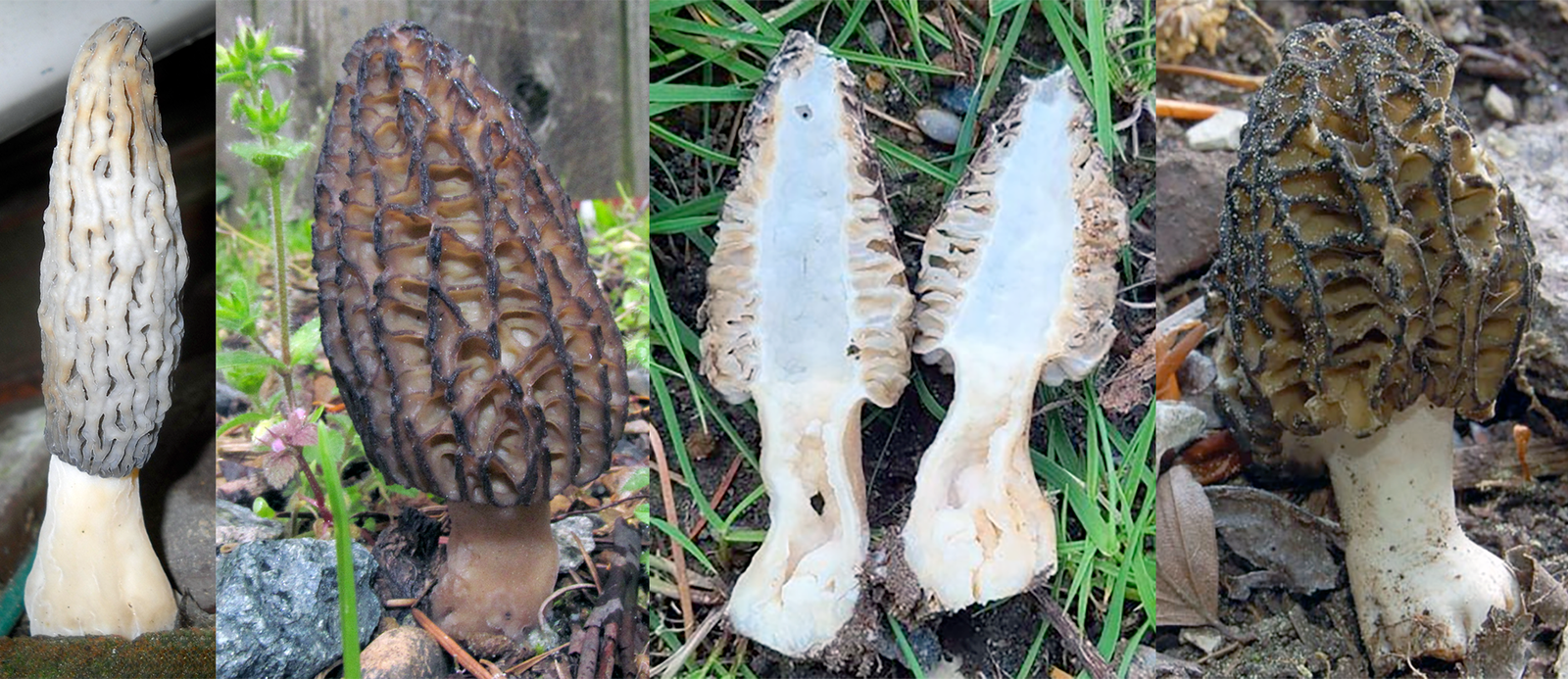
 The image, above, shows a range of pictures of Black Morel
mushrooms (Morchella importuna), showing an immature
fruiting body, a mature specimen in a garden setting, a specimen
cut in half and a specimen in an outside setting..
| Common Name: Black Morel |
| Scientific Name: Morchella importuna |
| Other Names: Morel Du (CY) |
| Family: Morchellaceae |
| Range: Europe and China (North American varieties have received new scientific names based on molecular studies) |
Physical Characteristics Morchella importuna is a saprobic fungus, growing to 6–20 cm (2.4–7.9 in) high. The cap is 3–15 cm (1.2–5.9 in) high and measures 2–9 cm (0.8–3.5 in) wide at its widest point. It is conical to widely conical or occasionally egg-shaped. Its surface has pits and ridges, with 12–20 primary vertical ridges and numerous transecting horizontal ridges, creating a laddered appearance. Morchella importuna fruit bodies grow in wood chips, gardens, fire pits, planters, and almost any disturbed ground in urban areas. It typically fruits in May.
|
| Edible Parts: Caps, Stems |
 Spore Print: Cream Spore Print: Cream
|
  Cap: Conical to Ovate Cap: Conical to Ovate
|
| Hymenium: Attachment is irregular or not applicable |
 Gills: Smooth hymenium Gills: Smooth hymenium
|
 Stipe: Bare Stipe: Bare
|
 Edibility Rating: 5 Edibility Rating: 5 
|
 Known Hazards: Morels contain small amounts of hydrazine toxins that are removed by thorough cooking; morel mushrooms should never be eaten raw. It has been reported that even cooked morels can sometimes cause mild intoxication symptoms when consumed with alcohol. Known Hazards: Morels contain small amounts of hydrazine toxins that are removed by thorough cooking; morel mushrooms should never be eaten raw. It has been reported that even cooked morels can sometimes cause mild intoxication symptoms when consumed with alcohol.
|
Monthly Availability:
|
Monthly Availability:
|
Welcome to the summary page for FabulousFusionFood's Wild Food guide to Black Morel along with all the Black Morel containing recipes presented on this site, with 29 recipes in total.
These recipes, all contain Black Morel as a major wild food ingredient.
The Black Morel, Morchella importuna (also known as Merkel, Sponge Mushroom, and Molly Moocher), is a species of honeycomb-shaped fungi and is a member of the Morchellaceae (morel) family of ascomycete (that typically reproduce sexually using non-motile spores) fungi. They prefer well-drained sandy, chalky and lime-based soils and can be found in a range of habitats, including open woodland, under ash and elm trees, and in old hedges and gardens. They are most frequent during the first three years after a forest fire. They also grow in the same spot every year so once you've spotted a morel growing area you can return again and again. It is a native of Europe and North America. It is one of the earliest of the edible mushrooms, first appearing in April and most prominent in May. Morels are beloved of gourmands, especially in France, but they do contain small amounts of toxins which are removed through cooking and should never be eaten raw. This also removes the risk of poisoning from the Helvelacea which look very similar but are poisonous if not cooked.
Morels are very variable in appearance but always have caps covered in deep honeycomb pits. The texture is brittle and the cap and stem form a single hollow chamber when cut. The caps range from being conical to being egg-shaped and even globular. The edges of the pit ridges become darker (black ) with age in contrast with the paler colour inside the pits. It is hollow and usually conical in shape, widening towards the bottom. The colours range from dark olive brown to darker brown or black. The stem is white to cream, bruising ochre or brown with age. It is usually vertically furrowed on the outside. The inside is hollow and wrinkled. At the top the stem widens to join the edge of the cap, forming a hollow depression, and clearly dividing the stem from the walls of the cap. This gap becomes more pronounced in more mature specimens. The flesh is thin and white on the inside. It has a faint pleasant smell that intensifies with drying. This mushroom is frequently found in wood-chip beds in gardens, residential estates or around commercial buildings. It is also known to appear in burned forests, disturbed grounds and occasionally under Apple trees. Closely related similar looking species of Morels also appear in short grass near coniferous trees in calcareous soil or coastal dunes.
Possible Confusion:
The False Morel (Gyromitra esculenta), pictured, but this is more lobed or brain-like rather than the pitted and honeycomb like cap of the morel. The False Morel also differs in not having a completely hollow cap. The Stinkhorn (Phallus impudicus) can also look similar to those who are unfamiliar with it, but the strong foul smell quickly denounces its identity. It appears in Summer and Autumn when Morels are no longer around. The Morel (Morchella esculenta) or Common Morel (Morchella vulgaris) can look similar, even in colour, but usually the ridges on the cap of the Black Morel have fairly regular vertical lines unlike the randomly arranged honeycomb of the other two. The ridges on a Black Morel become darker than the rest of the cap, while in Common Morel and Morel they are paler (or sometimes bruise orange red). The Semifree Morel is very closely related, but it’s easily distinguished by it’s smaller cap that is attached to the stem halfway.
The Black Morel (Morchella importuna) here described and the Semifree Morel (Morchella semilibera) are both part of a wider group colloquially called the “Black Morels”. The “Black Morels” are a large group (technically called a clade or section) of very similar species, and mycologists still haven’t established exactly how many species exist, their distribution, and how they differ from each other. The forager shouldn’t worry too much about precise distinction as all Black Morels seem to be excellent edibles. If you find a “Black Morel” with purplish or pinkish tones, not turning black with age, and growing under Pine or other coniferous trees, then you’re likely to have found the Purplish Morel (Morchella purpurascens). Although rare this species has been found in the UK. The scientific name Morchella elata was applied in the past to this and other related species but it’s no longer valid. Morchella importuna is the current name for Black Morels found in wood-chip beds and burnt grounds.
Very good, mushroomy and slightly meaty. Must be well cooked before consumption. All Morels are poisonous when raw or undercooked causing gastric upsets and other alarming symptoms. Its firm texture makes the Morel excellent for pickling and preserving by drying it also makes an excellent mushroom powder if dried and ground.
Possible Confusion:
The False Morel (Gyromitra esculenta), pictured, but this is more lobed or brain-like rather than the pitted and honeycomb like cap of the morel. The False Morel also differs in not having a completely hollow cap.
The Black Morel (Morchella importuna) can be similar, even in colour when young, but usually the ridges are arranged in fairly regular vertical lines, unlike the completely random honeycomb of the Yellow Morels. The ridges on the Black Morel also become darker than the rest of the cap with age, unlike the paler ridges of Yellow Morels.
The Common Morel (Morchella vulgaris) is very closely related to the Morel. It is usually more grey in colour specially when young. The ridges of the cap are thicker and the pits are more irregular and labyrinthic in shape. The Morel has thinner edges and polygonal shaped pits. Intermediate forms exist that may be hard to differentiate at the very young or very mature stage.
For other edible mushrooms, see the guide to edible mushrooms
[2]. Huxley, A. The New RHS Dictionary of Gardening. 1999
[3]. Tanaka, T. Tanaka's Cyclopaedia of Edible Plants of the World.
[4]. Lim T.K. Edible Medicinal And Non-Medicinal Plants, Vols 1–12.
[5]. Thomas, G. S. Perennial Garden Plants, 2004
[6]. Milner, E. Trees of Britain and Ireland, 2011
[7]. Rose, F. & O'Reilly, C. The Wild Flower Key (Revised Edition) — How to identify wild plants, trees and shrubs in Britain and Ireland, 2006
[8]. Streeter, D. & Garrard, I. The Wild Flowers of the British Isles, 1983
[9]. Clapham, A.R.; Tutin, T.G. & Moore, D.M. Flora of the British Isles, 1987
[10]. Phillips, R. Mushrooms, 2006
[11]. Jordan, P. & Wheeler, S. The Complete Book of Mushrooms: An Illustrated Encyclopedia of Edible Mushrooms, 2011
[12]. Bunker, F. Seaweeds of Britain and Ireland, Second Edition, 2017
[13]. Facciola, S. Cornucopia II — A Source Book of Edible Plants, 1998
[14]. Hartford, R. Edible and Medicinal Wild Plants of Britain and Ireland: A Foraging and Photographic Identification Guide
(Note that the above book links are Amazon Affiliate links)
These recipes, all contain Black Morel as a major wild food ingredient.
The Black Morel, Morchella importuna (also known as Merkel, Sponge Mushroom, and Molly Moocher), is a species of honeycomb-shaped fungi and is a member of the Morchellaceae (morel) family of ascomycete (that typically reproduce sexually using non-motile spores) fungi. They prefer well-drained sandy, chalky and lime-based soils and can be found in a range of habitats, including open woodland, under ash and elm trees, and in old hedges and gardens. They are most frequent during the first three years after a forest fire. They also grow in the same spot every year so once you've spotted a morel growing area you can return again and again. It is a native of Europe and North America. It is one of the earliest of the edible mushrooms, first appearing in April and most prominent in May. Morels are beloved of gourmands, especially in France, but they do contain small amounts of toxins which are removed through cooking and should never be eaten raw. This also removes the risk of poisoning from the Helvelacea which look very similar but are poisonous if not cooked.
Morels are very variable in appearance but always have caps covered in deep honeycomb pits. The texture is brittle and the cap and stem form a single hollow chamber when cut. The caps range from being conical to being egg-shaped and even globular. The edges of the pit ridges become darker (black ) with age in contrast with the paler colour inside the pits. It is hollow and usually conical in shape, widening towards the bottom. The colours range from dark olive brown to darker brown or black. The stem is white to cream, bruising ochre or brown with age. It is usually vertically furrowed on the outside. The inside is hollow and wrinkled. At the top the stem widens to join the edge of the cap, forming a hollow depression, and clearly dividing the stem from the walls of the cap. This gap becomes more pronounced in more mature specimens. The flesh is thin and white on the inside. It has a faint pleasant smell that intensifies with drying. This mushroom is frequently found in wood-chip beds in gardens, residential estates or around commercial buildings. It is also known to appear in burned forests, disturbed grounds and occasionally under Apple trees. Closely related similar looking species of Morels also appear in short grass near coniferous trees in calcareous soil or coastal dunes.
Possible Confusion:
The False Morel (Gyromitra esculenta), pictured, but this is more lobed or brain-like rather than the pitted and honeycomb like cap of the morel. The False Morel also differs in not having a completely hollow cap. The Stinkhorn (Phallus impudicus) can also look similar to those who are unfamiliar with it, but the strong foul smell quickly denounces its identity. It appears in Summer and Autumn when Morels are no longer around. The Morel (Morchella esculenta) or Common Morel (Morchella vulgaris) can look similar, even in colour, but usually the ridges on the cap of the Black Morel have fairly regular vertical lines unlike the randomly arranged honeycomb of the other two. The ridges on a Black Morel become darker than the rest of the cap, while in Common Morel and Morel they are paler (or sometimes bruise orange red). The Semifree Morel is very closely related, but it’s easily distinguished by it’s smaller cap that is attached to the stem halfway.
The Black Morel (Morchella importuna) here described and the Semifree Morel (Morchella semilibera) are both part of a wider group colloquially called the “Black Morels”. The “Black Morels” are a large group (technically called a clade or section) of very similar species, and mycologists still haven’t established exactly how many species exist, their distribution, and how they differ from each other. The forager shouldn’t worry too much about precise distinction as all Black Morels seem to be excellent edibles. If you find a “Black Morel” with purplish or pinkish tones, not turning black with age, and growing under Pine or other coniferous trees, then you’re likely to have found the Purplish Morel (Morchella purpurascens). Although rare this species has been found in the UK. The scientific name Morchella elata was applied in the past to this and other related species but it’s no longer valid. Morchella importuna is the current name for Black Morels found in wood-chip beds and burnt grounds.
Very good, mushroomy and slightly meaty. Must be well cooked before consumption. All Morels are poisonous when raw or undercooked causing gastric upsets and other alarming symptoms. Its firm texture makes the Morel excellent for pickling and preserving by drying it also makes an excellent mushroom powder if dried and ground.
Possible Confusion:
The False Morel (Gyromitra esculenta), pictured, but this is more lobed or brain-like rather than the pitted and honeycomb like cap of the morel. The False Morel also differs in not having a completely hollow cap.
The Black Morel (Morchella importuna) can be similar, even in colour when young, but usually the ridges are arranged in fairly regular vertical lines, unlike the completely random honeycomb of the Yellow Morels. The ridges on the Black Morel also become darker than the rest of the cap with age, unlike the paler ridges of Yellow Morels.
The Common Morel (Morchella vulgaris) is very closely related to the Morel. It is usually more grey in colour specially when young. The ridges of the cap are thicker and the pits are more irregular and labyrinthic in shape. The Morel has thinner edges and polygonal shaped pits. Intermediate forms exist that may be hard to differentiate at the very young or very mature stage.
For other edible mushrooms, see the guide to edible mushrooms
References:
[1]. David Evans Notes from field observations, tastings and cookery experiments.[2]. Huxley, A. The New RHS Dictionary of Gardening. 1999
[3]. Tanaka, T. Tanaka's Cyclopaedia of Edible Plants of the World.
[4]. Lim T.K. Edible Medicinal And Non-Medicinal Plants, Vols 1–12.
[5]. Thomas, G. S. Perennial Garden Plants, 2004
[6]. Milner, E. Trees of Britain and Ireland, 2011
[7]. Rose, F. & O'Reilly, C. The Wild Flower Key (Revised Edition) — How to identify wild plants, trees and shrubs in Britain and Ireland, 2006
[8]. Streeter, D. & Garrard, I. The Wild Flowers of the British Isles, 1983
[9]. Clapham, A.R.; Tutin, T.G. & Moore, D.M. Flora of the British Isles, 1987
[10]. Phillips, R. Mushrooms, 2006
[11]. Jordan, P. & Wheeler, S. The Complete Book of Mushrooms: An Illustrated Encyclopedia of Edible Mushrooms, 2011
[12]. Bunker, F. Seaweeds of Britain and Ireland, Second Edition, 2017
[13]. Facciola, S. Cornucopia II — A Source Book of Edible Plants, 1998
[14]. Hartford, R. Edible and Medicinal Wild Plants of Britain and Ireland: A Foraging and Photographic Identification Guide
(Note that the above book links are Amazon Affiliate links)
The alphabetical list of all Black Morel recipes on this site follows, (limited to 100 recipes per page). There are 29 recipes in total:
Page 1 of 1
Page 1 of 1