FabulousFusionFood's Spice Guide for Tamarind Seed Home Page
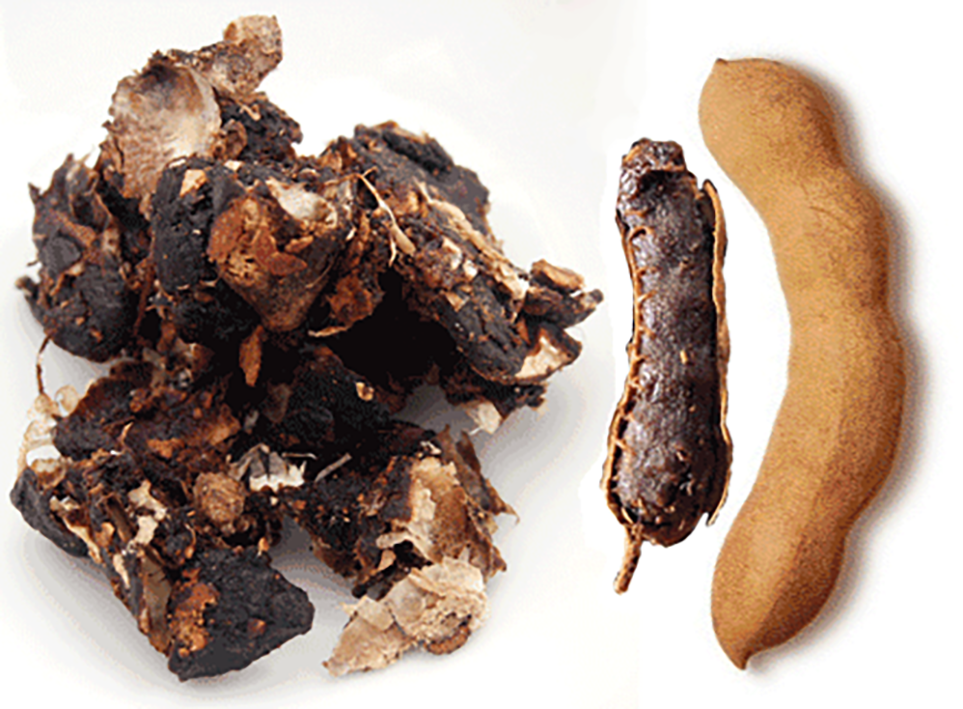 Tamarind, the pulp
of the
Tamarindus
indica pod,
with tamarind fruit
and
Tamarind, the pulp
of the
Tamarindus
indica pod,
with tamarind fruit
andprepared fruit..
Welcome to the summary page for FabulousFusionFood's Spice guide to Tamarind Seed along with all the Tamarind Seed containing recipes presented on this site, with 211 recipes in total.
This is a continuation of an entire series of pages that will, I hope, allow my visitors to better navigate this site. As well as displaying recipes by name, country and region of origin I am now planning a whole series of pages where recipes can be located by meal type and main ingredient. This page gives a listing of all the spice-based recipes added to this site.
These recipes, all contain Tamarind Seed as a major flavouring.
Tamarind (also known as Indian date) represents the fruit pods of Tamarindus indica a tropical tree that belongs to the Fabaceae (leguminous plants) family. Originally native to Tropical Africa (Dakar in Senegal is named after the Wolof word for the tamarind tree) it has by now been introduced to most of tropical Asia as well as Latin America and the Caribbean. The tree itself can grow up to 20m tall and stays evergreen in regions without a dry season. Like most of the Fabaceae it has leaves made out of between 10 and 40 leaflets. The flowers are produced in racemes and once fertilized develop into brown pod-like legumes that contains a soft pulp and many hard-coated seeds.
The fruit pulp is edible and is employed as a spice in Asian, African (it is native to Tropical Africa) and Latin American cuisines (it's also an important ingredient in the condiments, Worcester sauce and HP sauce). The pulp of a young fruit is very sour and acidic and is most often used as a component of savory dishes. The ripened fruit is sweeter and can be used in desserts and drinks, or as a snack. Crushed tamarind seeds are also an important ingredient in Thai Tamarind Paste which forms the basis of many Thai dishes, such as Pad Thai.
The most commonly found form of tamarind is in semi-dried blocks made from crushed unripe tamarind pods (in the image, above you will see images of a tamarind pod and a partly-peeled pod, revealing the pulp inside, as well as the commercially available tamarind pulp). This is both sour and tart and is typically dissolved in boiling water to make tamarind juice (the juice is then strained to remove the solids) before being added to the food to be cooked. The acidity in Tamarind fruit is due to their high concentration of tartaric acid
The English name, Tamarind, is derived directly from the Arabic, at-tamr al-hindi [التمر الهندي] (literally, 'Indian Date') which was concatenated to tamar-ind and the direct translation of the Arabic name also gives the plant's alternate English name. Spanish and Portuguese traders introduced tamarind to southern India, Asia and South and Central America (particularly Mexico) and today the fruit is an important spice ingredient in the cuisines of these regions.
This is a continuation of an entire series of pages that will, I hope, allow my visitors to better navigate this site. As well as displaying recipes by name, country and region of origin I am now planning a whole series of pages where recipes can be located by meal type and main ingredient. This page gives a listing of all the spice-based recipes added to this site.
These recipes, all contain Tamarind Seed as a major flavouring.
Tamarind (also known as Indian date) represents the fruit pods of Tamarindus indica a tropical tree that belongs to the Fabaceae (leguminous plants) family. Originally native to Tropical Africa (Dakar in Senegal is named after the Wolof word for the tamarind tree) it has by now been introduced to most of tropical Asia as well as Latin America and the Caribbean. The tree itself can grow up to 20m tall and stays evergreen in regions without a dry season. Like most of the Fabaceae it has leaves made out of between 10 and 40 leaflets. The flowers are produced in racemes and once fertilized develop into brown pod-like legumes that contains a soft pulp and many hard-coated seeds.
The fruit pulp is edible and is employed as a spice in Asian, African (it is native to Tropical Africa) and Latin American cuisines (it's also an important ingredient in the condiments, Worcester sauce and HP sauce). The pulp of a young fruit is very sour and acidic and is most often used as a component of savory dishes. The ripened fruit is sweeter and can be used in desserts and drinks, or as a snack. Crushed tamarind seeds are also an important ingredient in Thai Tamarind Paste which forms the basis of many Thai dishes, such as Pad Thai.
The most commonly found form of tamarind is in semi-dried blocks made from crushed unripe tamarind pods (in the image, above you will see images of a tamarind pod and a partly-peeled pod, revealing the pulp inside, as well as the commercially available tamarind pulp). This is both sour and tart and is typically dissolved in boiling water to make tamarind juice (the juice is then strained to remove the solids) before being added to the food to be cooked. The acidity in Tamarind fruit is due to their high concentration of tartaric acid
The English name, Tamarind, is derived directly from the Arabic, at-tamr al-hindi [التمر الهندي] (literally, 'Indian Date') which was concatenated to tamar-ind and the direct translation of the Arabic name also gives the plant's alternate English name. Spanish and Portuguese traders introduced tamarind to southern India, Asia and South and Central America (particularly Mexico) and today the fruit is an important spice ingredient in the cuisines of these regions.
The alphabetical list of all Tamarind Seed recipes on this site follows, (limited to 100 recipes per page). There are 211 recipes in total:
Page 1 of 3
| Aad Maas (Goan Pork Rib Curry) Origin: India | Chebeh Rubyan (Prawn Balls) Origin: Bahrain | Gurnard in Tamarind Sauce Origin: Fusion |
| Ambot Tik (Goan Shark Curry) Origin: India | Chicken Chaat Puri Origin: Britain | Gutti Vankaya (Stuffed Brinjal Curry) Origin: India |
| Ambul Thial (Pickled Fish Curry) Origin: Sri Lanka | Chicken Ghee Roast Origin: India | Hot Green Tamarind Chicken Origin: Indonesia |
| Ambul Thial (Pickled Fish) Origin: Sri Lanka | Chicken Guisado Origin: India | Hot Sweet Mango Chutney Origin: Anglo-Indian |
| Andhra Pappu Charu (Andhra-style Lentil Puree Curry) Origin: India | Chicken Pathia Origin: Britain | Ikan Assam Pedas (Hot-and-sour Fish Stew) Origin: Malaysia |
| Anguilla Tamarind Balls Origin: Anguilla | Chicken Seychelles Origin: Seychelles | Ikan Sabuko (Grilled Tamarind Fish) Origin: East Timor |
| Arvi aur Gosht ka Khatta Salan (Taro and Lamb in a Tangy Sauce) Origin: India | Chicken with Spices and Soy Sauce Origin: Malaysia | Imli Chutney (Tamarind Chutney) Origin: Pakistan |
| Aseed Origin: Yemen | Chinese Brown Sauce Origin: Fusion | Indonesian Peanut Sauce Origin: Indonesia |
| Ash Gourd Coconut Curry Origin: India | Christmas Island Crab Rendang Origin: Christmas Island | Iraqi Dolma Origin: Iraq |
| Assam Fish Curry Origin: Malaysia | Confiture de Tamarin (Tamarind Jam) Origin: Senegal | Isso Vade Origin: Sri Lanka |
| Ayam Bumbu Rujak (Chicken with Rujak Gravy) Origin: Indonesia | Curry Trey Ruah (Curried Snapper) Origin: Cambodia | Jamaican Curried Jackfruit Origin: Jamaica |
| Ayam Panggang (Grilled Whole Chicken) Origin: Indonesia | Daging Bumbu Bali Origin: Indonesia | Jerk Bar-B-Q Sauce Origin: Jamaica |
| Ayam Panggang Origin: Christmas Island | Dantina Soppu Gashi (Red Amaranth Curry) Origin: India | Jerk BBQ Sauce Origin: Jamaica |
| Badanekaayi Gojju (Brinjal Curry) Origin: India | Date Chutney Origin: India | Jus de Tamarin (Tamarind Drink) Origin: Senegal |
| Bangude Ghassi (Bunt-style Spicy Mangalorean Curry) Origin: India | Delicious Curry Soup Origin: Anglo-Indian | Kai Look Koei (Son-in-law Eggs) Origin: Thailand |
| Barbecue Sauce Origin: American | Diwali Coconut Chammanthi Origin: India | Kaluun iyo Bariis (Spicy Fish Sauce with Rice) Origin: Somalia |
| Bebotok Sapi (Indonesian Meatloaf) Origin: Indonesia | Durban Fish Curry Origin: South Africa | Kare Ayam Jawa (Javanese Chicken Curry) Origin: Indonesia |
| Beef in the Burmese Style Origin: Fusion | Filipino Beef Rendang Origin: Philippines | Kari Ayam (Malaysian Chicken Curry) Origin: Malaysia |
| Bermuda Rockfish Coconut Curry Origin: Bermuda | Filipino Fish Curry Origin: Philippines | Kari Ikan (Fish Curry) Origin: Malaysia |
| Boïri (Maize Dumplings) Origin: Guinea | Flaming Eggs Origin: Thailand | Kari Ikan (Malaysian Fish Curry) Origin: Malaysia |
| Boatman's Curry Origin: India | Frango Zambeziana (Zambezi Chicken) Origin: Mozambique | Kari Koko (Seychellois King Prawn and Coconut Curry) Origin: Seychelles |
| Breadfruit Curry Origin: India | Fruity Brown Sauce Origin: Britain | Kenyan Chicken Tikka Origin: Kenya |
| Brown Sauce Origin: Britain | Gaeng Som (Thai Sour Curry) Origin: Thailand | Kenyan Mchuzi wa Samaki (Swahili Fish Curry) Origin: Kenya |
| Brunei Satay Origin: Brunei | Gaeng Som (Thai Sour Curry) Origin: Thailand | Kerala-style Snake Meat Curry Origin: India |
| Budu Sauce (Fermented Anchovy Sauce) Origin: East Timor | Gaeng Som (Thai Sour Orange Curry) Origin: Thailand | Khalia (Georgian Spicy Beef Stew) Origin: Georgia |
| Budu Sauce (Grilled Tamarind Fish) Origin: Malaysia | Garlic Chilli Chicken Origin: Britain | Kharcho (Georgian Beef and Rice Soup) Origin: Georgia |
| Canh Chua Gà (Chicken Sour Soup) Origin: Vietnam | Goan Crab Claw Curry Origin: India | Khatmitthi Raani (Tamarind Chutney) Origin: India |
| Chaat Masala Indian Spice Blend Origin: India | Goan Fish Curry Origin: India | Khatta Curry Origin: India |
| Chebeh Rubyan (Prawn Balls) Origin: UAE | Goan Lamb Xacutti Origin: India | Khatta Meetha (Cabbage Curry) Origin: India |
| Chebeh Rubyan (Prawn Balls) Origin: Oman | Goan Mackerel Masala Origin: India | Kukulhu Kurandi Riha (Maldives Chicken Gizzard Curry) Origin: Maldives |
| Chebeh Rubyan (Prawn Balls) Origin: Iraq | Goan-style Mealworm and Chickpea Curry Origin: Fusion | Kunun gyada Origin: Nigeria |
| Chebeh Rubyan (Prawn Balls) Origin: Qatar | Goat in the Burmese Style Origin: Fusion | Kusabi Chutney (Safflower Seed and Tamarind Chutney) Origin: India |
| Chebeh Rubyan (Prawn Balls) Origin: Saudi Arabia | Green Coconut Chutney Origin: India | |
| Chebeh Rubyan (Prawn Balls) Origin: Kuwait | Grilled Mackerel with Spicy Dahl Origin: South Africa |
Page 1 of 3