FabulousFusionFood's Spice Guide for Ajwain Home Page
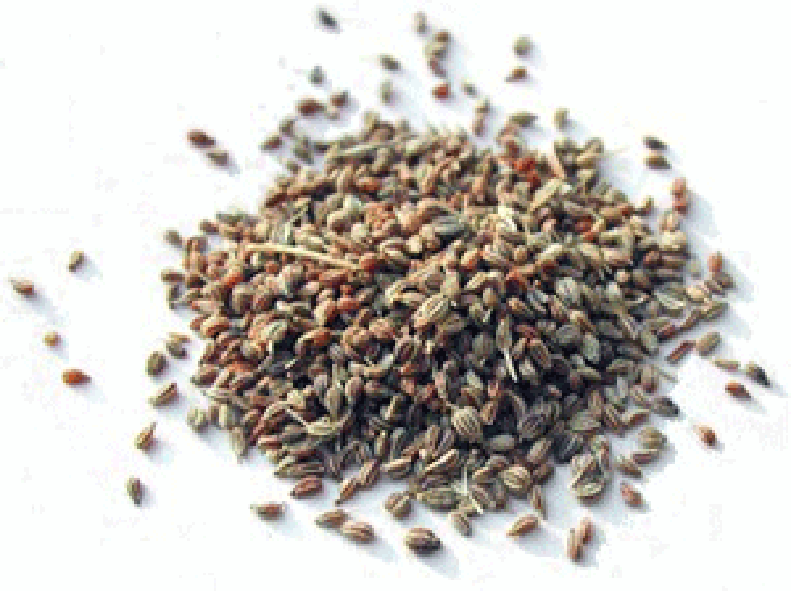 Ajwain seeds, the
seeds of Bishop's
weed,
Trachyspermum
ammi syn.
Carum
copticum.
Ajwain seeds, the
seeds of Bishop's
weed,
Trachyspermum
ammi syn.
Carum
copticum.
Welcome to the summary page for FabulousFusionFood's Spice guide to Ajwain along with all the Ajwain containing recipes presented on this site, with 22 recipes in total.
This is a continuation of an entire series of pages that will, I hope, allow my visitors to better navigate this site. As well as displaying recipes by name, country and region of origin I am now planning a whole series of pages where recipes can be located by meal type and main ingredient. This page gives a listing of all the spice-based recipes added to this site.
These recipes, all contain Ajwain as a major flavouring.
Ajwain (also known as: Carom, Ajowan, Bishop's Weed and Seeds Of Bishop's Weed) represent the seed-like fruit of the Bishop's Weed plant Trachyspermum ammi syn. Carum copticum a member of the Apiaceae (parsley) family. These fruit are generally egg-shaped in form and are either greyish in colour or are paler with vertical stripes. The parent plant is similar in appearance to parsley and probably originated in Egypt. It is primarily used in Indian cuisine, but is also used in dishes from Iran, Egypt, Ethiopia and Afghanistan. Raw ajwain smells almost exactly like thyme because it also contains thymol, but is more aromatic and less subtle in taste, as well as slightly bitter and musty. Indeed, the flavour is so strong that even a small amount can completely overwhelm the flavour of a dish. As a result, in Indian quisine ajwain is invariably either toasted by dry roasting or it is fried in ghee prior to use. This develops a subtler and more complex aroma that is similar to caraway.
The English name, ajwain is simply a Romanization of the spelling of the Hindi name ajvan [अजवायन, अजवान]. Interestingly, the Hindi name itself is derived from Sanskrit yavanaka [यवनक] or yavani [यवानी] which, in itself, is derived from the adjective yavana [यवन] 'Greek'. Which suggests that the spice arrived in India via Greece. Though today the only producers are India, Iran and Egypt (though Ajwain will actually grow in most European climates).
The spice is often added to Indian breads and is used as a flavouring to snack foods such as biscuits. It is also sometimes used as an ingredient in the Ethiopian spice mix, berbere as well as various Ethiopian stews and breads.
The seeds are rich in thymol, which explains their thyme-like flavour. English name, ajwain or ajwan is just the Romanized spelling of the Hindi name ajvan [अजवायन, अजवान].
This is a continuation of an entire series of pages that will, I hope, allow my visitors to better navigate this site. As well as displaying recipes by name, country and region of origin I am now planning a whole series of pages where recipes can be located by meal type and main ingredient. This page gives a listing of all the spice-based recipes added to this site.
These recipes, all contain Ajwain as a major flavouring.
Ajwain (also known as: Carom, Ajowan, Bishop's Weed and Seeds Of Bishop's Weed) represent the seed-like fruit of the Bishop's Weed plant Trachyspermum ammi syn. Carum copticum a member of the Apiaceae (parsley) family. These fruit are generally egg-shaped in form and are either greyish in colour or are paler with vertical stripes. The parent plant is similar in appearance to parsley and probably originated in Egypt. It is primarily used in Indian cuisine, but is also used in dishes from Iran, Egypt, Ethiopia and Afghanistan. Raw ajwain smells almost exactly like thyme because it also contains thymol, but is more aromatic and less subtle in taste, as well as slightly bitter and musty. Indeed, the flavour is so strong that even a small amount can completely overwhelm the flavour of a dish. As a result, in Indian quisine ajwain is invariably either toasted by dry roasting or it is fried in ghee prior to use. This develops a subtler and more complex aroma that is similar to caraway.
The English name, ajwain is simply a Romanization of the spelling of the Hindi name ajvan [अजवायन, अजवान]. Interestingly, the Hindi name itself is derived from Sanskrit yavanaka [यवनक] or yavani [यवानी] which, in itself, is derived from the adjective yavana [यवन] 'Greek'. Which suggests that the spice arrived in India via Greece. Though today the only producers are India, Iran and Egypt (though Ajwain will actually grow in most European climates).
The spice is often added to Indian breads and is used as a flavouring to snack foods such as biscuits. It is also sometimes used as an ingredient in the Ethiopian spice mix, berbere as well as various Ethiopian stews and breads.
The seeds are rich in thymol, which explains their thyme-like flavour. English name, ajwain or ajwan is just the Romanized spelling of the Hindi name ajvan [अजवायन, अजवान].
The alphabetical list of all Ajwain recipes on this site follows, (limited to 100 recipes per page). There are 22 recipes in total:
Page 1 of 1
| Alicha Kimem Origin: Ethiopia | Courgette Curry with Himalayan Balsam Seed Pods Origin: Britain | Rangood na Vaal (Gujarati Butter Bean Curry) Origin: India |
| Amritsar Fish and Chips Origin: India | Dhal Dhokla Origin: India | Seengre ke Satha Tori Kari (Courgette Curry with Radish Pods) Origin: India |
| Bajiyos (Djiboutian Potato Pakoras) Origin: Djibouti | Goan Lamb Xacutti Origin: India | Siljo (Fermented Safflower Seed and Broad Bean Flour Paste) Origin: India |
| Bangude Ghassi (Bunt-style Spicy Mangalorean Curry) Origin: India | Irn-Bru Pakoras Origin: Scotland | Spicy Sev (Spicy Gram Flour Threads) Origin: India |
| Biryani Masala Origin: Pakistan | Kulfa ka Saag Besan Cheela (Chickpea Pancakes with Common Purslane) Origin: India | Thepla Origin: India |
| Chaat Masala Origin: India | Masala Lamb Chops Origin: Pakistan | Wot Kimem Origin: Ethiopia |
| Chaat Masala Indian Spice Blend Origin: India | Namak Paray Origin: Pakistan | |
| Chatpate Neebu (Lemon Sour Pickle) Origin: India |
Page 1 of 1