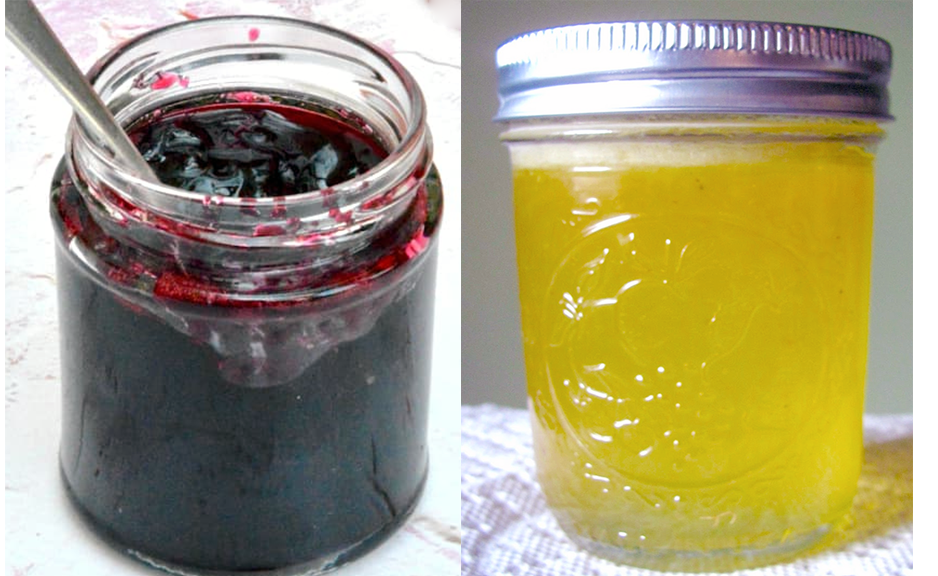
 Image of black cherry jam (left) and pineapplleweed jelly
(right)..
Welcome to the summary page for FabulousFusionFood's Cook's Guide entry for Science of Jam Making along with all the recipes employing Science of Jam Making presented on this site, with 196 recipes in total.
This is a continuation of an entire series of pages that will, I hope, allow my visitors to better navigate this site. As well as displaying recipes by name, country and region of origin I am now planning a whole series of pages where recipes can be located by meal type and main ingredient. This page gives a listing of all the Science of Jam Making recipes added to this site.
These recipes, all contain Science of Jam Making as a major wild food ingredient.
This page is about the science of how to prepare jams and jellies with jellies being strained sweetened fruit liquid and jams being made with whole fruit pulp. If you’ve ever tried your hand at jam-making, you’ll know that it’s something of a tricky process. A number of factors need to be just right to achieve a perfectly set jam – and chemistry can help explain why. There are three key chemical entities that go into jam-making: sugar, pectin, and acids. Here, we’ll look at each in turn, and how they help jam achieve its eventual consistency.
Chemically, the 'set' of a jam or jelly is dependent on the relative levels of pectin and sugar as well as the acidity of the jam/jelly. As a result it's a chemical process that was not really possible until the advent of commercially abundant sugar.
Pectin (refer to the entry on pectin for more detail). Briefly: Pectins are long, linked chains of sugar molecules, which are found naturally in plant cell walls. Although we refer to them in general as ‘pectin’, their structures are variable, as well as hard to determine; a rough general structure is given in the graphic, but in reality the overall structure can be much more complicated. Pectins are found in fruit, particularly in the peel and cores. When jam sets, pectin plays a vital role.
The pectin in fruit becomes water-soluble when it is heated. So for jelling to occur, the fruit must be heated. Too high of a temperature or cooking for too long can destroy the pectin, resulting in a poor gel. Doubling the recipe changes the length of time needed for boiling and can result in a soft gel. There is more pectin not quite ripe fruit compared to ripe fruit. For a good set, mix 1/3 unripe fruit with 2/3 ripe fruit. Recipes without added pectin use the natural pectin in the fruit to form the gel. Tart apples, sour blackberries, cranberries, currants, gooseberries, grapes, soft plums, and quinces work well in recipes without added pectin.
If making jams with low pectin fruit you can mix in high pectin fruit (like apples) to get a good 'set'. It is also possible these days to buy commercial pectin as a liquid or powder that you can add to things like rhubarb (not technically a fruit, but often cooked like them) so they will set in jams. It also means that you can use any fruit liquid or juice as the basis for a jelly.
Sugar An important part of jam is, of course, the sugar content, which is vital for the flavour and also plays a role in helping jam set. Many jam recipes recommend the use of a 1:1 ratio of fruit to sugar in jam-making. As well as sweetening the jam, the sugar also helps the pectin set – it enhances the pectin’s gel-forming capability by drawing water to itself, decreasing the ability of the pectin to remain in separate chains. Additionally, sugar imparts a preservative effect. By binding water molecules to itself, it reduces the amount of water available in the jam, to the point at which it is too low for microbial growth, helping to ensure that the jam doesn’t go off too rapidly after it’s been made! The final sugar content of jam should be between 65-69%.
Acidity Acids also help the pectin set. The charged COOH- charged groups in the pectin are usually ionised, and the negative charges on the molecules this ionisation causes can cause repulsion, and prevent the pectin chains from being able to form the gel network. To avoid this, we need the pH of the mixture to be roughly in the range of 2.8-3.3. At these more acidic pHs, the COOH groups aren’t ionised, lowering the magnitude of the repulsive forces. Fruit naturally contain acids – the most well known is citric acid, but malic acid and tartaric acid are also found in a number of fruits. Whilst some acid will be contributed by the fruit from which the jam is made, often this won’t be enough to reach the desired pH, and for this reason more must be added. This is commonly in the form of lemon juice, which contains citric acid, though powdered forms of acids can also be used.
The Science Bit Here is how, scientifically, to get a low pectin juice like grape juice to set, with the adjustments of pH, sugar content and pectin levels needed. Begin by pouring the grape juice into a beaker. Measure the pH (it will typically be around 4) then add in lemon juice or citric acid to reduce the pH to between 3 and 3.5.
Measure out 450g of the juice and pour into a saucepan then stir in the pectin to dissolve. Place over medium heat and bring to a rolling boil. At this point stir in 535g white sugar and whilst stirring to dissolve bring back to a rolling boil. (temperature will be at about 104oC), and hold for at least 2-3 minutes.
Test for set point and bottle in sterilized jars. Note: Set point is achieved when jelly forms a single lump when dripped into a glass of cold water, or when it forms a firm clump when dropped on a cold glass plate).
So this is a basic jelly with a starting pH for the fruit juice of 3–3.5, a sugar percentage of 53.5%, a juice percentage of 45% and a pectin content of 1.5%. These are the basic ratios that you will need for any jam/jelly to set. Of course, these are starting conditions and as the jelly cooks, liquid will evaporate so the final sugar concentration will end up at be between 65-69%.
This is a continuation of an entire series of pages that will, I hope, allow my visitors to better navigate this site. As well as displaying recipes by name, country and region of origin I am now planning a whole series of pages where recipes can be located by meal type and main ingredient. This page gives a listing of all the Science of Jam Making recipes added to this site.
These recipes, all contain Science of Jam Making as a major wild food ingredient.
This page is about the science of how to prepare jams and jellies with jellies being strained sweetened fruit liquid and jams being made with whole fruit pulp. If you’ve ever tried your hand at jam-making, you’ll know that it’s something of a tricky process. A number of factors need to be just right to achieve a perfectly set jam – and chemistry can help explain why. There are three key chemical entities that go into jam-making: sugar, pectin, and acids. Here, we’ll look at each in turn, and how they help jam achieve its eventual consistency.
Chemically, the 'set' of a jam or jelly is dependent on the relative levels of pectin and sugar as well as the acidity of the jam/jelly. As a result it's a chemical process that was not really possible until the advent of commercially abundant sugar.
Pectin (refer to the entry on pectin for more detail). Briefly: Pectins are long, linked chains of sugar molecules, which are found naturally in plant cell walls. Although we refer to them in general as ‘pectin’, their structures are variable, as well as hard to determine; a rough general structure is given in the graphic, but in reality the overall structure can be much more complicated. Pectins are found in fruit, particularly in the peel and cores. When jam sets, pectin plays a vital role.
The pectin in fruit becomes water-soluble when it is heated. So for jelling to occur, the fruit must be heated. Too high of a temperature or cooking for too long can destroy the pectin, resulting in a poor gel. Doubling the recipe changes the length of time needed for boiling and can result in a soft gel. There is more pectin not quite ripe fruit compared to ripe fruit. For a good set, mix 1/3 unripe fruit with 2/3 ripe fruit. Recipes without added pectin use the natural pectin in the fruit to form the gel. Tart apples, sour blackberries, cranberries, currants, gooseberries, grapes, soft plums, and quinces work well in recipes without added pectin.
If making jams with low pectin fruit you can mix in high pectin fruit (like apples) to get a good 'set'. It is also possible these days to buy commercial pectin as a liquid or powder that you can add to things like rhubarb (not technically a fruit, but often cooked like them) so they will set in jams. It also means that you can use any fruit liquid or juice as the basis for a jelly.
Sugar An important part of jam is, of course, the sugar content, which is vital for the flavour and also plays a role in helping jam set. Many jam recipes recommend the use of a 1:1 ratio of fruit to sugar in jam-making. As well as sweetening the jam, the sugar also helps the pectin set – it enhances the pectin’s gel-forming capability by drawing water to itself, decreasing the ability of the pectin to remain in separate chains. Additionally, sugar imparts a preservative effect. By binding water molecules to itself, it reduces the amount of water available in the jam, to the point at which it is too low for microbial growth, helping to ensure that the jam doesn’t go off too rapidly after it’s been made! The final sugar content of jam should be between 65-69%.
Acidity Acids also help the pectin set. The charged COOH- charged groups in the pectin are usually ionised, and the negative charges on the molecules this ionisation causes can cause repulsion, and prevent the pectin chains from being able to form the gel network. To avoid this, we need the pH of the mixture to be roughly in the range of 2.8-3.3. At these more acidic pHs, the COOH groups aren’t ionised, lowering the magnitude of the repulsive forces. Fruit naturally contain acids – the most well known is citric acid, but malic acid and tartaric acid are also found in a number of fruits. Whilst some acid will be contributed by the fruit from which the jam is made, often this won’t be enough to reach the desired pH, and for this reason more must be added. This is commonly in the form of lemon juice, which contains citric acid, though powdered forms of acids can also be used.
The Science Bit Here is how, scientifically, to get a low pectin juice like grape juice to set, with the adjustments of pH, sugar content and pectin levels needed. Begin by pouring the grape juice into a beaker. Measure the pH (it will typically be around 4) then add in lemon juice or citric acid to reduce the pH to between 3 and 3.5.
Measure out 450g of the juice and pour into a saucepan then stir in the pectin to dissolve. Place over medium heat and bring to a rolling boil. At this point stir in 535g white sugar and whilst stirring to dissolve bring back to a rolling boil. (temperature will be at about 104oC), and hold for at least 2-3 minutes.
Test for set point and bottle in sterilized jars. Note: Set point is achieved when jelly forms a single lump when dripped into a glass of cold water, or when it forms a firm clump when dropped on a cold glass plate).
So this is a basic jelly with a starting pH for the fruit juice of 3–3.5, a sugar percentage of 53.5%, a juice percentage of 45% and a pectin content of 1.5%. These are the basic ratios that you will need for any jam/jelly to set. Of course, these are starting conditions and as the jelly cooks, liquid will evaporate so the final sugar concentration will end up at be between 65-69%.
The alphabetical list of all Science of Jam Making recipes on this site follows, (limited to 100 recipes per page). There are 196 recipes in total:
Page 1 of 2
| Almond Curd Origin: Britain | Chilli Marmalad (Chilli Marmalade) Origin: South Africa | Doce de Papaia (Sweet Papaya Preserve) Origin: Mozambique |
| Apple and Lavender Jelly Origin: Britain | Colonel Gore's Seville Orange Marmalade Origin: Britain | Dulce de Piña (Pineapple Preserves) Origin: Ecuador |
| Apple and Mint Jelly Origin: Britain | Comfiture de Noix de Coco (Coconut Preserve) Origin: Senegal | Dundee Marmalade Origin: Scotland |
| Apple Butter Origin: American | Compote of Greengages Origin: Britain | Fruit Scrap Vinegar Origin: Britain |
| Apple Butter Origin: Britain | Confiture de Ananas (Pineapple Jam) Origin: Martinique | Fuchsia Berry Jam Origin: Britain |
| Apple Marmalade Origin: Britain | Confiture de Ananas (Pineapple Jam) Origin: Saint Barthelemy | Fuchsia Jelly Origin: American |
| Apricot Jam Origin: Britain | Confiture de Banane (Banana Jam) Origin: Martinique | Gelée de Genièvre (Juniper Berry Jelly) Origin: France |
| Apricot Preserve Origin: Britain | Confiture de Coco (Coconut Jam) Origin: Martinique | Gelée du Pomme au Calvados (Crab Apple and Calvados Jelly) Origin: France |
| Aspic Jelly Origin: Britain | Confiture de Coco (Coconut Jam) Origin: Saint Barthelemy | Gelée de Goyaves (Guava Jelly) Origin: Martinique |
| Bakeapple Jam Origin: Canada | Confiture de figues violettes vanille (Fig and Vanilla Jam) Origin: Mayotte | Ginger and Rhubarb Conserve Origin: Britain |
| Barberry Jam Origin: Britain | Confiture de Madd (Madd Preserve) Origin: Senegal | Green Grape Jelly Origin: Britain |
| Barberry Jelly Origin: Britain | Confiture de papaye (Papaya Jam) Origin: Cameroon | Guava Jelly Origin: Caribbean |
| Barberry Marmalade Origin: Britain | Confiture de Potiron au Gingembre (Pumpkin and Ginger Preserve) Origin: Senegal | Guelder Rose and Crabapple Jelly Origin: Britain |
| Bee Balm Flower Jelly Origin: Britain | Confiture de prunes au genièvre (Plum and Juniper Jam) Origin: France | Hawthorn Jelly Origin: Britain |
| Bergamot Jelly Origin: British | Confiture de Rhubarbe Sauvage (Alpine Dock Jam) Origin: Switzerland | Hawthorn Jelly II Origin: Britain |
| Bilberry Jam Origin: British | Confiture de Tamarin (Tamarind Jam) Origin: Senegal | Heartsease Flower Jelly Origin: Britain |
| Black Cherry Jam Origin: Britain | Confiture Goyaves (Guava Jam) Origin: Martinique | Hedgerow Jam Origin: British |
| Blackberry and Elderberry Jam Origin: British | Cornelian Cherry and Apple Jelly Origin: British | High Dumpsy Dearie Jam Origin: England |
| Blackberry Jam Origin: Britain | Cornelian Cherry Conserve Origin: British | Hips and Haws Jelly Origin: Britain |
| Blackberry Jelly Origin: Britain | Cornelian Cherry Jam Origin: Britain | Hjortron Jøm (Cloudberry Jam) Origin: Sweden |
| Blackcurrant Jam Origin: Britain | Cornelian Cherry Jelly Origin: British | Homesteaders Honey Origin: American |
| Blackcurrant Leaf Jelly Origin: Britain | Cowberry Jam Origin: British | Hot Pepper Rowan and Apple Jelly Origin: British |
| Briwfwyd â Brandi (Brandy Mincemeat) Origin: Welsh | Crab Apple and Rosehip Jelly Origin: Britain | Irish Moss Jelly Origin: Ireland |
| Briwfwyd Nadolig (Christmas Mincemeat) Origin: Welsh | Crabapple and Sloe Jelly Origin: Britain | Jam Cwrens Cochion (Redcurrant Jam) Origin: Welsh |
| Canina Honey Origin: American | Cranberry and Orange Marmalade Origin: American | Jam Cwrens Duon (Blackcurrant Jam) Origin: Welsh |
| Cape Gooseberry Jam Origin: African Fusion | Cranberry Jam Origin: Britain | Jam Damson (Damson Jam) Origin: Welsh |
| Carrot Jam Origin: British | Cranberry Jelly Origin: Britain | Jam Eirin Gwyllt (Bullace Jam) Origin: Welsh |
| Chamomile Jelly Origin: Britain | Cranberry Jelly Origin: Britain | Jam Eirin Gwyllt (Bullace (Wild Plum) Jam) Origin: Welsh |
| Cherry Blossom Jam Origin: Japan | Crema Untable de Plántanos (Banana Curd Spread) Origin: Equatorial Guinea | Jam Eirin Mair (Gooseberry Jam) Origin: Welsh |
| Cherry Blossom Jam II Origin: Britain | Crowberry Jam Origin: Greenland | Jam Grawnwin Gwyrdd (White Grape Jam) Origin: Welsh (Patagonia) |
| Cherry Jam Origin: British | Crowberry Jelly Origin: American | Jam Llaeth (Milk Jam) Origin: Welsh |
| Cherry Plum Jam Origin: Britain | Crowberry Orange Jelly Origin: American | Jam Llus (Bilberry Jam) Origin: Welsh |
| Chestnut Jam Origin: British | Damson Jam Origin: Britain | |
| Chilli Jam Origin: South Africa | Dewberry Jelly Origin: Britain |
Page 1 of 2