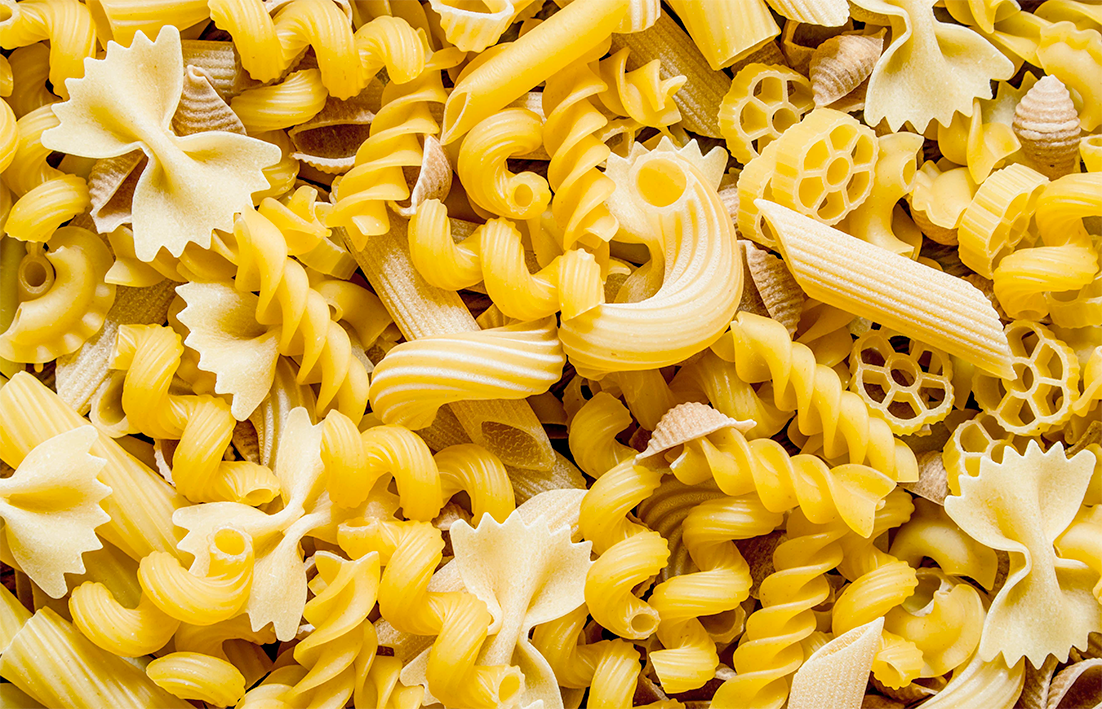
 Varieties of dried pasta shapes.
Welcome to the summary page for FabulousFusionFood's Cook's Guide entry for Pasta along with all the recipes employing Pasta presented on this site, with 124 recipes in total.
This is a continuation of an entire series of pages that will, I hope, allow my visitors to better navigate this site. As well as displaying recipes by name, country and region of origin I am now planning a whole series of pages where recipes can be located by meal type and main ingredient. This page gives a listing of all the Pasta recipes added to this site.
These recipes, all contain Pasta as a major wild food ingredient.
Pasta (UK: /ˈpæstə/, US: /ˈpɑːstə/; Italian: [ˈpasta]) is a type of food typically made from an unleavened dough of wheat flour mixed with water or eggs, and formed into sheets or other shapes, then cooked by boiling or baking. Pasta was originally only made with durum, although the definition has been expanded to include alternatives for a gluten-free diet, such as rice flour, or legumes such as beans or lentils. Pasta is believed to have developed independently in Italy and is a staple food of Italian cuisine, with evidence of Etruscans making pasta as early as 400 BCE in Italy.
Pastas are divided into two broad categories: dried (Italian: pasta secca) and fresh (Italian: pasta fresca). Most dried pasta is produced commercially via an extrusion process, although it can be produced at home. Fresh pasta is traditionally produced by hand, sometimes with the aid of simple machines. Fresh pastas available in grocery stores are produced commercially by large-scale machines.
Both dried and fresh pastas come in a number of shapes and varieties, with 310 specific forms known by over 1,300 documented names. In Italy, the names of specific pasta shapes or types often vary by locale. For example, the pasta form cavatelli is known by 28 different names depending upon the town and region. Common forms of pasta include long and short shapes, tubes, flat shapes or sheets, miniature shapes for soup, those meant to be filled or stuffed, and specialty or decorative shapes.
As a category in Italian cuisine, both fresh and dried pastas are classically used in one of three kinds of prepared dishes: as pasta asciutta (or pastasciutta), cooked pasta is plated and served with a complementary sauce or condiment; a second classification of pasta dishes is pasta in brodo, in which the pasta is part of a soup-type dish. A third category is pasta al forno, in which the pasta is incorporated into a dish that is subsequently baked in the oven. Pasta dishes are generally simple, but individual dishes vary in preparation. Some pasta dishes are served as a small first course or for light lunches, such as pasta salads. Other dishes may be portioned larger and used for dinner. Pasta sauces similarly may vary in taste, colour and texture
Etymology: Earliest appearances in the English language are in the 1830s; the word pasta comes from Italian pasta, in turn from Latin pasta, latinisation of the Ancient Greek: παστά.
Evidence of Etruscans making pasta dates back to 400 BCE. The first concrete information on pasta products in Italy dates to the 13th or 14th centuries. In the 1st-century[dubious – discuss] writings of Horace, lagana (sg.: laganum) were fine sheets of fried dough and were an everyday foodstuff. Writing in the 2nd century, Athenaeus of Naucratis provides a recipe for lagana which he attributes to the 1st-century Chrysippus of Tyana: sheets of dough made of wheat flour and the juice of crushed lettuce, then flavored with spices and deep-fried in oil. An early 5th-century cookbook describes a dish called lagana that consisted of layers of dough with meat stuffing, an ancestor of modern-day lasagna. However, the method of cooking these sheets of dough does not correspond to the modern definition of either a fresh or dry pasta product, which only had similar basic ingredients and perhaps the shape.
Historians have noted several lexical milestones relevant to pasta, none of which changes these basic characteristics. For example, the works of the 2nd-century Greek physician Galen mention itrion, homogeneous compounds made of flour and water. The Jerusalem Talmud records that itrium, a kind of boiled dough, was common in Palestine from the 3rd to 5th centuries. A dictionary compiled by the 9th-century Arab physician and lexicographer Isho bar Ali defines itriyya, the Arabic cognate, as string-like shapes made of semolina and dried before cooking.
Food historians estimate that the dish probably took hold in Italy as a result of extensive Mediterranean trading in the Middle Ages. From the 13th century, references to pasta dishes—macaroni, ravioli, gnocchi, vermicelli—crop up with increasing frequency across the Italian peninsula. In the 14th-century writer Boccaccio's collection of earthy tales, The Decameron, he recounts a mouthwatering fantasy concerning a mountain of Parmesan cheese down which pasta chefs roll macaroni and ravioli to gluttons waiting below.
In the 14th and 15th centuries, dried pasta became popular for its easy storage. This allowed people to store pasta on ships when exploring the New World. A century later, pasta was present around the globe during the voyages of discovery.
Although tomatoes were introduced to Italy in the 16th century and incorporated in Italian cuisine in the 17th century, description of the first Italian tomato sauces dates from the late 18th century: the first written record of pasta with tomato sauce can be found in the 1790 cookbook L'Apicio Moderno by Roman chef Francesco Leonardi. Before tomato sauce was introduced, pasta was eaten dry with the fingers; the liquid sauce demanded the use of a fork
Pasta is a classic Italian foodstuff made from a dough formed with durum-wheat semolina, water (and occasionally eggs). This is kneaded, flattened and then cut into a variety of shapes. The shape itself is designed to fit best with the type of sauce that it's to be served with. There are also pastas such as canellini and ravioli that are designed to be stuffed with fillings.
Since at least the time of Cato's De Agri Cultura, basic pasta dough has been made mostly of wheat flour or semolina, with durum wheat used predominantly in the south of Italy and soft wheat in the north. Regionally other grains have been used, including those from barley, buckwheat, rye, rice, and maize, as well as chestnut and chickpea flours. Liquid, often in the form of eggs, is used to turn the flour into a dough.
Fresh pasta is usually locally made with fresh ingredients unless it is destined to be shipped, in which case consideration is given to the spoilage rates of the desired ingredients such as eggs or herbs. Furthermore, fresh pasta is usually made with a mixture of eggs and all-purpose flour or "00" low-gluten flour. Since it contains eggs, it is more tender compared to dried pasta and only takes about half the time to cook. Delicate sauces are preferred for fresh pasta in order to let the pasta take front stage.
This is a continuation of an entire series of pages that will, I hope, allow my visitors to better navigate this site. As well as displaying recipes by name, country and region of origin I am now planning a whole series of pages where recipes can be located by meal type and main ingredient. This page gives a listing of all the Pasta recipes added to this site.
These recipes, all contain Pasta as a major wild food ingredient.
Pasta (UK: /ˈpæstə/, US: /ˈpɑːstə/; Italian: [ˈpasta]) is a type of food typically made from an unleavened dough of wheat flour mixed with water or eggs, and formed into sheets or other shapes, then cooked by boiling or baking. Pasta was originally only made with durum, although the definition has been expanded to include alternatives for a gluten-free diet, such as rice flour, or legumes such as beans or lentils. Pasta is believed to have developed independently in Italy and is a staple food of Italian cuisine, with evidence of Etruscans making pasta as early as 400 BCE in Italy.
Pastas are divided into two broad categories: dried (Italian: pasta secca) and fresh (Italian: pasta fresca). Most dried pasta is produced commercially via an extrusion process, although it can be produced at home. Fresh pasta is traditionally produced by hand, sometimes with the aid of simple machines. Fresh pastas available in grocery stores are produced commercially by large-scale machines.
Both dried and fresh pastas come in a number of shapes and varieties, with 310 specific forms known by over 1,300 documented names. In Italy, the names of specific pasta shapes or types often vary by locale. For example, the pasta form cavatelli is known by 28 different names depending upon the town and region. Common forms of pasta include long and short shapes, tubes, flat shapes or sheets, miniature shapes for soup, those meant to be filled or stuffed, and specialty or decorative shapes.
As a category in Italian cuisine, both fresh and dried pastas are classically used in one of three kinds of prepared dishes: as pasta asciutta (or pastasciutta), cooked pasta is plated and served with a complementary sauce or condiment; a second classification of pasta dishes is pasta in brodo, in which the pasta is part of a soup-type dish. A third category is pasta al forno, in which the pasta is incorporated into a dish that is subsequently baked in the oven. Pasta dishes are generally simple, but individual dishes vary in preparation. Some pasta dishes are served as a small first course or for light lunches, such as pasta salads. Other dishes may be portioned larger and used for dinner. Pasta sauces similarly may vary in taste, colour and texture
Etymology: Earliest appearances in the English language are in the 1830s; the word pasta comes from Italian pasta, in turn from Latin pasta, latinisation of the Ancient Greek: παστά.
Evidence of Etruscans making pasta dates back to 400 BCE. The first concrete information on pasta products in Italy dates to the 13th or 14th centuries. In the 1st-century[dubious – discuss] writings of Horace, lagana (sg.: laganum) were fine sheets of fried dough and were an everyday foodstuff. Writing in the 2nd century, Athenaeus of Naucratis provides a recipe for lagana which he attributes to the 1st-century Chrysippus of Tyana: sheets of dough made of wheat flour and the juice of crushed lettuce, then flavored with spices and deep-fried in oil. An early 5th-century cookbook describes a dish called lagana that consisted of layers of dough with meat stuffing, an ancestor of modern-day lasagna. However, the method of cooking these sheets of dough does not correspond to the modern definition of either a fresh or dry pasta product, which only had similar basic ingredients and perhaps the shape.
Historians have noted several lexical milestones relevant to pasta, none of which changes these basic characteristics. For example, the works of the 2nd-century Greek physician Galen mention itrion, homogeneous compounds made of flour and water. The Jerusalem Talmud records that itrium, a kind of boiled dough, was common in Palestine from the 3rd to 5th centuries. A dictionary compiled by the 9th-century Arab physician and lexicographer Isho bar Ali defines itriyya, the Arabic cognate, as string-like shapes made of semolina and dried before cooking.
Food historians estimate that the dish probably took hold in Italy as a result of extensive Mediterranean trading in the Middle Ages. From the 13th century, references to pasta dishes—macaroni, ravioli, gnocchi, vermicelli—crop up with increasing frequency across the Italian peninsula. In the 14th-century writer Boccaccio's collection of earthy tales, The Decameron, he recounts a mouthwatering fantasy concerning a mountain of Parmesan cheese down which pasta chefs roll macaroni and ravioli to gluttons waiting below.
In the 14th and 15th centuries, dried pasta became popular for its easy storage. This allowed people to store pasta on ships when exploring the New World. A century later, pasta was present around the globe during the voyages of discovery.
Although tomatoes were introduced to Italy in the 16th century and incorporated in Italian cuisine in the 17th century, description of the first Italian tomato sauces dates from the late 18th century: the first written record of pasta with tomato sauce can be found in the 1790 cookbook L'Apicio Moderno by Roman chef Francesco Leonardi. Before tomato sauce was introduced, pasta was eaten dry with the fingers; the liquid sauce demanded the use of a fork
Pasta is a classic Italian foodstuff made from a dough formed with durum-wheat semolina, water (and occasionally eggs). This is kneaded, flattened and then cut into a variety of shapes. The shape itself is designed to fit best with the type of sauce that it's to be served with. There are also pastas such as canellini and ravioli that are designed to be stuffed with fillings.
Since at least the time of Cato's De Agri Cultura, basic pasta dough has been made mostly of wheat flour or semolina, with durum wheat used predominantly in the south of Italy and soft wheat in the north. Regionally other grains have been used, including those from barley, buckwheat, rye, rice, and maize, as well as chestnut and chickpea flours. Liquid, often in the form of eggs, is used to turn the flour into a dough.
Fresh pasta is usually locally made with fresh ingredients unless it is destined to be shipped, in which case consideration is given to the spoilage rates of the desired ingredients such as eggs or herbs. Furthermore, fresh pasta is usually made with a mixture of eggs and all-purpose flour or "00" low-gluten flour. Since it contains eggs, it is more tender compared to dried pasta and only takes about half the time to cook. Delicate sauces are preferred for fresh pasta in order to let the pasta take front stage.
The alphabetical list of all Pasta recipes on this site follows, (limited to 100 recipes per page). There are 124 recipes in total:
Page 1 of 2
| Arabic Pasta with Beef and Yogurt Sauce Origin: Fusion | Lentil, Pasta and Vegetable Soup Origin: Britain | Pastai Cenin, Panas a Chig Moch (Leek, Parsnip and Bacon Pie) Origin: Welsh |
| Asharbal Leebia (Libyan Soup 2) Origin: Libya | Linguine and Trumpet Chanterelles Origin: Britain | Pastai Cennin (Leek Pasty) Origin: Welsh |
| Avgolemono (Egg and Lemon Soup) Origin: Greece | Linguine with Chanterelles and Leeks Origin: Italy | Pastai Cig Carw (Venison Pie) Origin: Welsh |
| Bahamian Baked Macaroni and Cheese Origin: Bahamas | Linguine with saffron, roasted garlic, herb butter and hazelnuts Origin: Britain | Pastai cig carw gyda chennin a chaead thatws rosti (Venison Pie with Leeks and Rosti Topping) Origin: Welsh |
| Brestiau Cyw Iâr gyda Phasta Lemwn a Sbigoglys (Chicken Breasts with Lemon and Spinach Pasta) Origin: Welsh | Liver and Mushrooms with Fusilli Pasta Origin: Italy | Pastai Cig Llo (Veal Pie) Origin: Welsh |
| Bucatini all'Amatriciana Origin: Italy | Loseyns (Lozenges) Origin: England | Pastai Cig oen Cymraeg a Phwmpen (Welsh Lamb and Marrow Pie) Origin: Welsh |
| Canelones Origin: Spain | Mac'N'Cheese Origin: American | Pastai Cocos, Tatws a Chennin (Cockle, Potato and Leek Pie) Origin: Welsh |
| Canelones Origin: Andorra | Macaroni Cheese Origin: Britain | Pastai Cwnhingen (Rabbit Pie) Origin: Welsh |
| Carlin Pea Ragu Origin: Britain | Microwave Pasta alla Carbonara Origin: Britain | Pastai Cymreig Cocos a Chennin (Welsh Cockle and Leek Pie) Origin: Welsh |
| Chicken Stellette Soup Origin: Italy | Minestra (Maltese Vegetable Soup) Origin: Malta | Pastai Dŵr Poeth (Hot Water Pastry) Origin: Welsh |
| Chorba Beïda (Algerian White Soup) Origin: Algeria | Orecchiette with Mushroom Sauce Origin: Italy | Pastai Gocos (Cockle Pie) Origin: Welsh |
| Chorizo and Spinach Linguine Origin: American | Oven-baked Macaroni and Cheese Origin: American | Pastai Katt (Katt Pie) Origin: Welsh |
| Cocos Penclawdd gyda Pasta Penne a Saws Gwin gyda Garlleg Gwyllt a Bara Lawr (Penclawdd Cockles with Penne Pasta and a Wild Garlic and Laverbread Wine Sauce) Origin: Welsh | Paasto Forno (Somali Pasta al Forno) Origin: Somaliland | Pastai Llygaid y Graig, Bacwn a Chenin (Limpet, Bacon and Leek Pie) Origin: Welsh |
| Crostata di Marmellata (Italian Jam Tart) Origin: Italy | Pappardelle con Ragù di Funghi Misti (Pappardelle with Mixed Mushroom Ragù) Origin: Italy | Pastai Mam (Mum's White Pastry) Origin: Welsh |
| Crostata di Marmellata (Italian Jam Tart) Origin: Italy | Pappardelle with Slow-cooked Beef and Mushrooms Origin: Britain | Pastai Nos Priodas (Wedding Night Pie) Origin: Welsh |
| Curried Prawn Noodle Soup with Stevia Origin: Fusion | Parmesan Orzo Origin: Italy | Pastai Oen Cymreig (Welsh Lamb Pie) Origin: Welsh |
| Domatossoupa (Tomato Soup) Origin: Greece | Pasta al Limone (Creamy Lemon Pasta with Parmesan) Origin: Italy | Pastai Penfro (Pembrokeshire Pies) Origin: Welsh |
| Dracula's Revenge Origin: American | Pasta al Sugo e Berbere (Pasta with Eritrean Tomato Sauce) Origin: Eritrea | Pastai Pysgotwr (Fisherman's Pie) Origin: Welsh |
| Escudella i Carn D'olla Origin: Andorra | Pasta con Cece (Pasta Soup with Chickpeas) Origin: San Marino | Pastai Tatws (Potato Pie) Origin: Welsh |
| Fajita-style Pasta Origin: Fusion | Pasta Con Sugo ai Funghi (Pasta with mixed mushroom sauce) Origin: Italy | Pastai Ystumllwynarth (Oystermouth Pie) Origin: Welsh |
| Fettucine Alfredo Origin: Italy | Pasta Crisps Origin: Britain | Pastai'r Bwthyn (Cottage-style Pie) Origin: Welsh |
| Fettucine alla Papiana (Papal Ham and Cream Carbonara) Origin: Vatican City | Pasta e Cece (Pasta Soup with Chickpeas II) Origin: San Marino | Penne with Edible Flowers Origin: Britain |
| Fiddlehead Pasta Primavera Origin: American | Pasta Frolla Origin: Italy | Penne with Fresh Pumpkin Sauce Origin: American |
| Fresh Puffball Mushroom Ragú Origin: Britain | Pasta Frolla (Italian Sweet Shortcrust Pastry) Origin: Italy | Penne with Mushroom Cream Sauce Origin: Italy |
| Harira Origin: Djibouti | Pasta Piri-piri (Piri-piri Chilli Paste) Origin: Portugal | Pepper Pasta Pie Origin: South Africa |
| Hlalem (Pasta with Beans) Origin: Tunisia | Pasta Primavera with Dryad's Saddle and Chicken of the Woods Origin: Britain | Peri-peri Prawn Pasta Origin: South Africa |
| Hlelim (Pasta, Meat and Vegetable Soup) Origin: Tunisia | Pasta Soup with Chicken Livers Origin: Britain | Pilav Limon (Lemon Pasta Pilaf) Origin: Georgia |
| Home-made Eggless Pasta (Pasta Senza Uova) Origin: Italy | Pasta with Creamy Parasol Mushrooms Origin: British | Pizzoccheri with Miso Cabbage and Spiced Breadcrumbs Origin: Fusion |
| Home-made Maggot Stew Origin: American | Pasta with Daylily Flower Buds and Mushrooms Origin: American | Prawn, Scallop and Horn of Plenty Sauce Origin: Britain |
| Home-made Pasta Dough Origin: Italy | Pasta with Mixed Wild Mushroom Sauce Origin: Britain | Ragù d'anatra (Venetian Duck Ragu) Origin: Italy |
| Karithopasta (Greek Walnut Syrup Cake) Origin: Greece | Pasta with Olives and Caperberries Origin: Britain | Rich Minestrone Soup Origin: Britain |
| Kastaneli Pasta (Chestnut Cake) Origin: Turkey | Pasta with Wild Greens Origin: Britain | Rosto Origin: Gibraltar |
| Koshari (Lentils, Pasta and Rice) Origin: Egypt | Pastai Briwgig a Llugaeorn (Pork Mince and Cranberry Mini Pies) Origin: Welsh | |
| Lasagne al Forno Origin: Italy | Pastai Briwgig Eidion a Nionod (Welsh Beef Mince and Onion Pies) Origin: Welsh |
Page 1 of 2