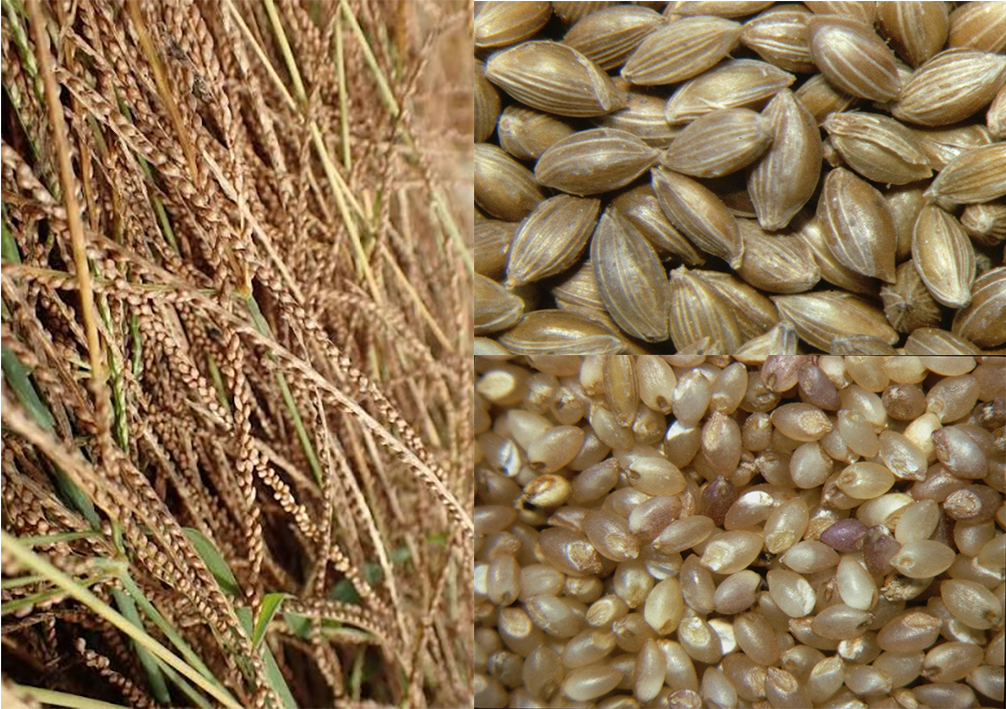
 The image above shows white fonio on the plant raceme (left),
threshed grains still in their husks (top right) and polished
husked grains (bottom right)..
Welcome to the summary page for FabulousFusionFood's Cook's Guide entry for Fonio along with all the recipes employing Fonio presented on this site, with 30 recipes in total.
This is a continuation of an entire series of pages that will, I hope, allow my visitors to better navigate this site. As well as displaying recipes by name, country and region of origin I am now planning a whole series of pages where recipes can be located by meal type and main ingredient. This page gives a listing of all the Fonio recipes added to this site.
These recipes, all contain Fonio as a major wild food ingredient.
Fonio is a domesticated small grain millet in the genus Digitaria that is grown and consumed throughout West Africa. Millets represent a range of true grass crop species in the PACMAD clade of the Poaceae (wheat, barley, rye and oats lie in the BOP clade along with the rices).
Millets represent the first grains collected in the wild and then farmed by humans, coming into cultivation during the late stone age.
Fonio, also sometimes called findi or acha, is the term for two cultivated grasses in the genus Digitaria that are important crops in parts of West Africa. It is a vital food source in many rural areas, especially in the mountains of Fouta Djalon, Guinea, but it is also cultivated in Mali, Burkina Faso, Ivory Coast, Nigeria, and Senegal.
Fonio is a glumaceous monocot belonging to the grass family Poaceae and the genus Digitaria. While hundreds of these crabgrass species exist, only a few of them are produced for their grains. It is a small annual herbaceous plant with an inflorescence containing two or three racemes. The racemes have spikelets grouped in twos, threes, or fours, with a sterile and a fertile flower producing the fonio grain. Fonio has a short growing season and is well adjusted to harsh environments. The size of its root system, which can extend down to more than one meter in depth, is advantageous in periods of drought and helps with its adaptation to poor soils. Once considered a humble and often overlooked grain commonly known as the "cereal of the poor," fonio is now gaining attention in urban West Africa. Its unique cooking properties and nutritional benefits are sparking renewed interest in this once underrated staple.
The most important type of fonio is the White Fonio, Digitaria exilis and is the most common of a diverse group of wild and domesticated Digitaria species that are harvested in the savannahs of West Africa. Fonio has the smallest seeds of all species of millet. It has potential to improve nutrition, boost food security, foster rural development, and support sustainable use of the land. Nutritious, gluten-free, and high in dietary fibre, fonio is one of the world's fastest-growing cereals, reaching maturity in as little as six to eight weeks. The grains are used to make porridge, couscous, bread, and beer.
Black Fonio, Digitaria iburua also known as iburu, is a similar crop grown in several countries of West Africa, particularly Nigeria, Togo, and Benin. Like white fonio, it is nutritious, fast-growing, and has the benefit of maturing before other grains, allowing for harvest during the 'hungry season'. However, it contains considerably more protein compared to D. exilis. However, black fonio is mostly cultivated in rural communities and is rarely sold commercially, even in West African cities.
Fonio grows in dry climates without irrigation, and is unlikely to be a successful crop in humid regions. It is planted in light (sandy to stony) soils, and will grow in poor soil. Fonio is cultivated at sea level in Gambia, Sierra Leone and Guinea-Bissau, but it is otherwise mostly cultivated in altitudes ranging between 400 and 1,500m. The growth cycle ranges from 70–130 days, depending on variety. It is mostly grown in areas with an average annual rainfall of 900–1,000mm.
Fonio plants are medium in height. Indeed, D. exilis can reach a height of 80cm, and D. iburua a height of 150cm. The ploidy level for the species ranges from diploid (2n), tetraploid (4n), to hexaploid (6n). Like many other grasses, fonio has a C4 carbon fixation, which makes it drought tolerant; however it does not tolerate high humidity.
The fonio plant grows quickly; some landraces reach maturity in 8 weeks. It is, however, a weak weed competitor at the beginning of its growth, so weeding is important in the first development stages. Fonio is labour-intensive to harvest and process. In some regions, the mature fonio plants are uprooted, but the most common method is to cut the straws with knives and sickles which often leads to wounds on the hands. Women then gather the sheaves into cylindrical stacks or horizontal beams to store the sheaves and allow them to dry before the threshing without overheating. The threshing is then done by trampling on the plants or by beating the plants with rigid rods or more flexible sticks.
Fonio plants are prone to lodging in the soil, which makes potential mechanization of the harvest processes difficult.
After threshing, fonio grains are still in their husk and the small grains make husk removal difficult and time-consuming. Traditional methods include pounding it in a mortar with sand, and then separating the grains and sand, or 'popping' it over a flame and then pounding it, which yields a toasted-color grain (a technique used among the Akposso). The invention of a simple fonio husking machine offers an easier mechanical way to dehusk.
Before consumption, fonio grains must be processed using mechanical (dehusking, milling) or thermal (precooking, parboiling, roasting) methods. Depending on the processing method, the nutrient value may be affected. Generally, parboiled fonio shows the best nutritional composition when compared to the other processing methods. However, parboiling fonio does not lead to as efficient redistribution of nutrients as is the case with parboiled rice. Additionally, the process of parboiling changes the colour of the fonio grains (making them darker) which is disliked by some consumers.
Personally, I first discovered fonio in Senegal, and I've been collecting recipes ever since. In December 2018, the European Commission approved commercialization of fonio as a novel food in the European Union, after submission by the Italian company Obà Food to manufacture and market new food products. These products include fonio pasta, revealing a desire to change fonio to be more recognizable to the European palate. My local Nigerian store sometimes stocks the grains and I tend to buy it when available (it's great prepared and served as couscous).
This is a continuation of an entire series of pages that will, I hope, allow my visitors to better navigate this site. As well as displaying recipes by name, country and region of origin I am now planning a whole series of pages where recipes can be located by meal type and main ingredient. This page gives a listing of all the Fonio recipes added to this site.
These recipes, all contain Fonio as a major wild food ingredient.
Fonio is a domesticated small grain millet in the genus Digitaria that is grown and consumed throughout West Africa. Millets represent a range of true grass crop species in the PACMAD clade of the Poaceae (wheat, barley, rye and oats lie in the BOP clade along with the rices).
Millets represent the first grains collected in the wild and then farmed by humans, coming into cultivation during the late stone age.
Fonio, also sometimes called findi or acha, is the term for two cultivated grasses in the genus Digitaria that are important crops in parts of West Africa. It is a vital food source in many rural areas, especially in the mountains of Fouta Djalon, Guinea, but it is also cultivated in Mali, Burkina Faso, Ivory Coast, Nigeria, and Senegal.
Fonio is a glumaceous monocot belonging to the grass family Poaceae and the genus Digitaria. While hundreds of these crabgrass species exist, only a few of them are produced for their grains. It is a small annual herbaceous plant with an inflorescence containing two or three racemes. The racemes have spikelets grouped in twos, threes, or fours, with a sterile and a fertile flower producing the fonio grain. Fonio has a short growing season and is well adjusted to harsh environments. The size of its root system, which can extend down to more than one meter in depth, is advantageous in periods of drought and helps with its adaptation to poor soils. Once considered a humble and often overlooked grain commonly known as the "cereal of the poor," fonio is now gaining attention in urban West Africa. Its unique cooking properties and nutritional benefits are sparking renewed interest in this once underrated staple.
The most important type of fonio is the White Fonio, Digitaria exilis and is the most common of a diverse group of wild and domesticated Digitaria species that are harvested in the savannahs of West Africa. Fonio has the smallest seeds of all species of millet. It has potential to improve nutrition, boost food security, foster rural development, and support sustainable use of the land. Nutritious, gluten-free, and high in dietary fibre, fonio is one of the world's fastest-growing cereals, reaching maturity in as little as six to eight weeks. The grains are used to make porridge, couscous, bread, and beer.
Black Fonio, Digitaria iburua also known as iburu, is a similar crop grown in several countries of West Africa, particularly Nigeria, Togo, and Benin. Like white fonio, it is nutritious, fast-growing, and has the benefit of maturing before other grains, allowing for harvest during the 'hungry season'. However, it contains considerably more protein compared to D. exilis. However, black fonio is mostly cultivated in rural communities and is rarely sold commercially, even in West African cities.
Fonio grows in dry climates without irrigation, and is unlikely to be a successful crop in humid regions. It is planted in light (sandy to stony) soils, and will grow in poor soil. Fonio is cultivated at sea level in Gambia, Sierra Leone and Guinea-Bissau, but it is otherwise mostly cultivated in altitudes ranging between 400 and 1,500m. The growth cycle ranges from 70–130 days, depending on variety. It is mostly grown in areas with an average annual rainfall of 900–1,000mm.
Fonio plants are medium in height. Indeed, D. exilis can reach a height of 80cm, and D. iburua a height of 150cm. The ploidy level for the species ranges from diploid (2n), tetraploid (4n), to hexaploid (6n). Like many other grasses, fonio has a C4 carbon fixation, which makes it drought tolerant; however it does not tolerate high humidity.
The fonio plant grows quickly; some landraces reach maturity in 8 weeks. It is, however, a weak weed competitor at the beginning of its growth, so weeding is important in the first development stages. Fonio is labour-intensive to harvest and process. In some regions, the mature fonio plants are uprooted, but the most common method is to cut the straws with knives and sickles which often leads to wounds on the hands. Women then gather the sheaves into cylindrical stacks or horizontal beams to store the sheaves and allow them to dry before the threshing without overheating. The threshing is then done by trampling on the plants or by beating the plants with rigid rods or more flexible sticks.
Fonio plants are prone to lodging in the soil, which makes potential mechanization of the harvest processes difficult.
After threshing, fonio grains are still in their husk and the small grains make husk removal difficult and time-consuming. Traditional methods include pounding it in a mortar with sand, and then separating the grains and sand, or 'popping' it over a flame and then pounding it, which yields a toasted-color grain (a technique used among the Akposso). The invention of a simple fonio husking machine offers an easier mechanical way to dehusk.
Before consumption, fonio grains must be processed using mechanical (dehusking, milling) or thermal (precooking, parboiling, roasting) methods. Depending on the processing method, the nutrient value may be affected. Generally, parboiled fonio shows the best nutritional composition when compared to the other processing methods. However, parboiling fonio does not lead to as efficient redistribution of nutrients as is the case with parboiled rice. Additionally, the process of parboiling changes the colour of the fonio grains (making them darker) which is disliked by some consumers.
Personally, I first discovered fonio in Senegal, and I've been collecting recipes ever since. In December 2018, the European Commission approved commercialization of fonio as a novel food in the European Union, after submission by the Italian company Obà Food to manufacture and market new food products. These products include fonio pasta, revealing a desire to change fonio to be more recognizable to the European palate. My local Nigerian store sometimes stocks the grains and I tend to buy it when available (it's great prepared and served as couscous).
The alphabetical list of all Fonio recipes on this site follows, (limited to 100 recipes per page). There are 30 recipes in total:
Page 1 of 1
| Bassi (Malian Couscous) Origin: Mali | Djouka Fonio Origin: Mali | Galettes de Légumes au Fonio (Vegetable Fritters with Fonio) Origin: Burkina Faso |
| Boule de Petit Mil (Fonio Balls) Origin: Chad | Fögnè Sourtinaadi (Fonio Couscous with Meatballs in Tomato Sauce) Origin: Guinea | Gâteau de figues au fonio (Fonio fig cake) Origin: Senegal |
| Buckwheat Bread Origin: Fusion | Fini N'Gomi (Fonio Fritters) Origin: Mali | Gateau de Fonio au Caramel (Fonio Cake with Caramel) Origin: Senegal |
| Couscous de Fonio au Poulet (Fonio Couscous with Chicken) Origin: Togo | Fini N’Gomi (Fonio Doughnuts) Origin: Mali | Gateaux de Fonio (Fonio Muffins) Origin: Mali |
| Crêpe Farine de Mil (Senegalese Millet Flour Crêpes) Origin: Senegal | Fonio and Oat Balls in Peanut Sauce Origin: Fusion | Gnon de Fonio Origin: Burkina Faso |
| Croquettes de fonio (Fonio croquettes) Origin: Senegal | Fonio Balls Origin: Nigeria | Herby Millet Rings Origin: African Fusion |
| Cuisson du Fonio à l'Eau (Fonio Cooked with Water) Origin: Guinea | Fonio Bread Origin: Fusion | Poulet à la mangue et fonio (Mango Chicken with Fonio) Origin: Mali |
| Cuisson du Fonio à la Vapeur (Fonio Cooked by Steaming) Origin: Guinea | Fonio Cuit à la Vapeur (Steamed Fonio) Origin: Senegal | Salade au Fonio (Fonio Salad) Origin: Mali |
| Cuisson du Fonio au Micro-ondes (Microwave-cooked Fonio) Origin: Guinea | Fonio, Sauce Gombo et Crevettes (Fonio, Okra Sauce and Prawns) Origin: Mali | Tô de Guinée (Guinean Tô) Origin: Guinea |
| Djouka de Fonio (Fonio Couscous with Vegetables) Origin: Mali | Galettes de Fonio à la Banane (Fonio Griddle Cakes with Banana) Origin: Burkina Faso | Thiéré Bassi Salté (Couscous with Meat and Tomato Sauce) Origin: Senegal |
Page 1 of 1