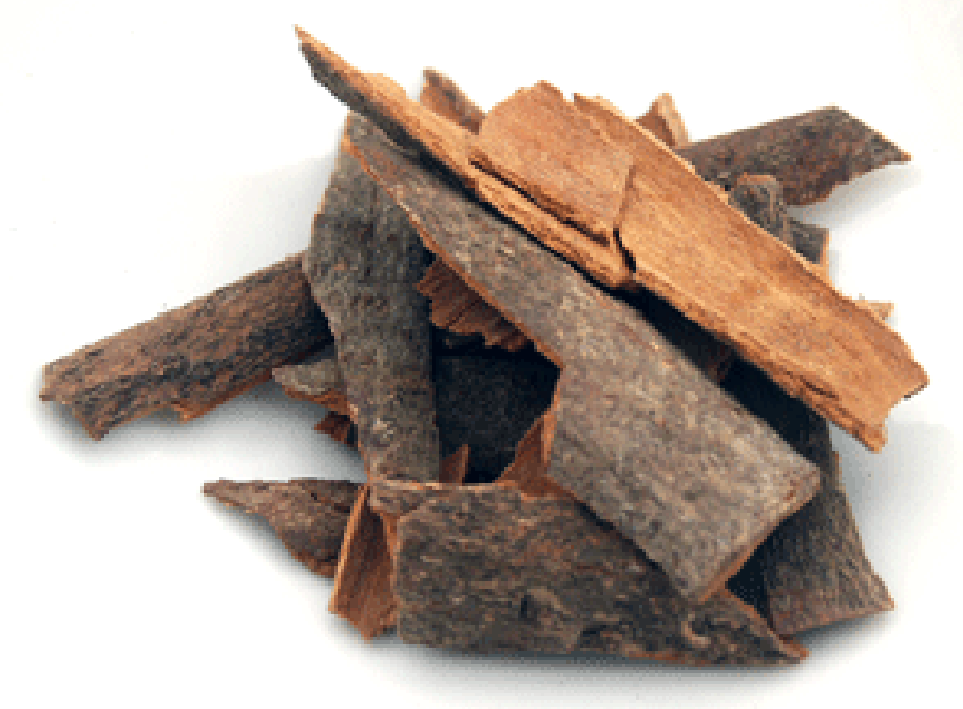
 Pile of cassia Cinnamomum aromaticum bark fragments.
Welcome to the summary page for FabulousFusionFood's Cook's Guide entry for Cassia along with all the recipes employing Cassia presented on this site, with 45 recipes in total.
This is a continuation of an entire series of pages that will, I hope, allow my visitors to better navigate this site. As well as displaying recipes by name, country and region of origin I am now planning a whole series of pages where recipes can be located by meal type and main ingredient. This page gives a listing of all the Cassia recipes added to this site.
These recipes, all contain Cassia as a major wild food ingredient.
Cassia (also sometimes known as Indonesian cinnamon) is the bark of Cinnamomum aromaticum (syn Cinnamomum cassia) is an evergreen tree native to southern China and mainland Southeast Asia west to Myanmar. Like its close relative, Cinnamon (see below), it is used primarily for its aromatic bark, which is used as a spice.
The Cassia tree grows to 10-15 m tall, with greyish bark, and hard elongated leaves 10-15 cm long, that have a decidedly reddish colour when young. Whole branches and small trees are harvested for cassia bark, unlike the small shoots used in the production of Cinnamon; this gives cassia bark a much thicker and rougher texture than that of true cinnamon. Cassia provides a much stronger flavour than cinnamon but because it is formed from the whole bark it is much tougher and more difficult to powder than cinnamon.
Cassia bark (both powdered and in whole, or 'stick' form) is used as a flavouring agent, for candies, desserts, baked goods, and meat. Due to its stronger flavour it is specified in many curry recipes, where cinnamon is less suitable and is an essential ingredient of true Chinese curries. It should be noted that almost all 'cinnamon' sold in North America is actually cassia and not true cinnamon. In Europe it is more difficult to find cassia, though it is now becoming available in more speciazied spice and wholefood shops. It is also possible to make a tea from the bark and I often make an infusion from black Indian tea, cassis, star anise, green cardamom and lemon peel.
This is a continuation of an entire series of pages that will, I hope, allow my visitors to better navigate this site. As well as displaying recipes by name, country and region of origin I am now planning a whole series of pages where recipes can be located by meal type and main ingredient. This page gives a listing of all the Cassia recipes added to this site.
These recipes, all contain Cassia as a major wild food ingredient.
Cassia (also sometimes known as Indonesian cinnamon) is the bark of Cinnamomum aromaticum (syn Cinnamomum cassia) is an evergreen tree native to southern China and mainland Southeast Asia west to Myanmar. Like its close relative, Cinnamon (see below), it is used primarily for its aromatic bark, which is used as a spice.
The Cassia tree grows to 10-15 m tall, with greyish bark, and hard elongated leaves 10-15 cm long, that have a decidedly reddish colour when young. Whole branches and small trees are harvested for cassia bark, unlike the small shoots used in the production of Cinnamon; this gives cassia bark a much thicker and rougher texture than that of true cinnamon. Cassia provides a much stronger flavour than cinnamon but because it is formed from the whole bark it is much tougher and more difficult to powder than cinnamon.
Cassia bark (both powdered and in whole, or 'stick' form) is used as a flavouring agent, for candies, desserts, baked goods, and meat. Due to its stronger flavour it is specified in many curry recipes, where cinnamon is less suitable and is an essential ingredient of true Chinese curries. It should be noted that almost all 'cinnamon' sold in North America is actually cassia and not true cinnamon. In Europe it is more difficult to find cassia, though it is now becoming available in more speciazied spice and wholefood shops. It is also possible to make a tea from the bark and I often make an infusion from black Indian tea, cassis, star anise, green cardamom and lemon peel.
The alphabetical list of all Cassia recipes on this site follows, (limited to 100 recipes per page). There are 45 recipes in total:
Page 1 of 1
| Air Fryer Crispy Sichuan Duck Origin: Britain | Dhansak Masala Origin: India | Pilau Rice Origin: Britain |
| All-purpose Tamale Seasoning Blend Origin: Mexico | Durban-style Mutton Curry with Potatoes and Dumplings Origin: South Africa | Pur Fayte Ypocras (To Make Hippocras) Origin: England |
| Aubergine, Potato and Chickpea Balti Origin: Fusion | Gestowe Soetpatats (Slow-cooked Sweet Potatoes) Origin: South Africa | Rooh Afza (Rose Water Tonic) Origin: India |
| Aubergine, Sweet Potato and Chickpea Balti Origin: South Africa | Goan Lamb Xacutti Origin: India | Saag Gosht (Lamb and Spinach Curry with Yoghurt) Origin: India |
| Balti Garam Masala Origin: India | Goda Masala Origin: India | Saffron Chicken Korma with Wholemeal Paratha Origin: India |
| Bhindi Chicken Curry Origin: Bangladesh | Henan Hu La Tang (Hot Pepper Soup) Origin: China | Sarson Saag Gosht (Lamb and Rapeseed Greens Curry with Yoghurt) Origin: India |
| BIR Lamb Rogan Josh Origin: Britain | Hong Shao Rou (Red-braised pork belly) Origin: Britain | Shatkora Beef Curry BIR Origin: Britain |
| BIR-style Hot-hot Catfish Curry Origin: Fusion | Java Chicken Origin: Fusion | Snoek Bobotie Origin: South Africa |
| Braised Asian-flavoured Pork with Simmered Wild Greens Origin: British | Khukura re Pyaj Tareko (Chicken Curry with Onion) Origin: Nepal | Soto Ayam Origin: Indonesia |
| Cayman Curry Powder Origin: Cayman Islands | Lo Sui (Chinese Master Sauce) Origin: China | Soto Ayam Origin: Malaysia |
| Cha Siu (Chinese-Surinamese roasted pork) Origin: Suriname | Mála spíosrach (Irish Spice Bag) Origin: Ireland | Soto Ayam Origin: Singapore |
| Chadian Mouloukhiyé (Jute Mallow Leaf and Beef Stew) Origin: Chad | Mbongo Tjobi Origin: Cameroon | Special Jaipuri Masala Origin: India |
| Chicken Mappas Origin: India | Mutton Kulambu (Pondicherry Mutton Curry) Origin: India | Spice-infused Oli Origin: Britain |
| Chicken Saag Origin: Britain | Naga Bhuna Karahi Origin: Britain | Vermouth di Torino (Turin Vermouth) Origin: Italy |
| Chinese-style Rib Stock Origin: Fusion | Nigeria Challenge BIR Curry Origin: Fusion | Victorian Beef Vindaloo Origin: Anglo-Indian |
Page 1 of 1