FabulousFusionFood's Chocolate-based Recipes 4th Page
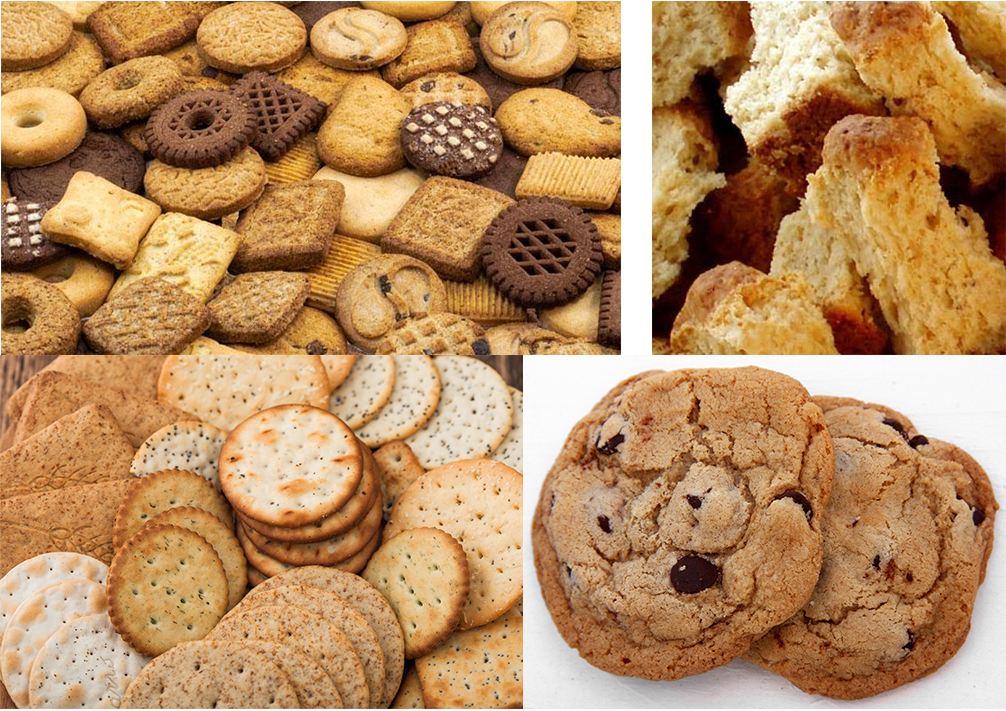 Examples of, clockwise from top left: biscuits, rusks, cookies and crackers.
Welcome to FabulousFusionFood's Chocolate-based Recipes Page — This page gives a listing of all the chocolate-based recipes added to this site. Chocolate or cocoa is a food made from roasted and ground cocoa seed kernels that is available as a liquid, solid, or paste, either on its own or as a flavouring agent in other foods. Cocoa has been consumed in some form for at least 5,300 years starting with the Mayo-Chinchipe culture in what is present-day Ecuador. Later Mesoamerican civilizations also consumed chocolate beverages, and it was introduced to Europe in the 16th century.
Chocolate is made from the seeds of the Theobroma cacao (cocoa) plant. For more information on the cocoa bean and its use as a spice see this site's spice guide entry for the cocoa bean. However, the seeds of the cacao tree have an intense bitter taste and need to be processed to make it palatable and to develop the flavour. The beans
Cocoa pods are harvested by cutting them from the tree using a machete, or by knocking them off the tree using a stick. It is important to harvest the pods when they are fully ripe, because if the pod is unripe, the beans will have a low cocoa butter content, or low sugar content, reducing the ultimate flavour. and their surrounding pulp are removed from the pods and placed in piles or bins to ferment. Micro-organisms, present naturally in the environment, ferment the pectin-containing material. Yeasts produce ethanol, lactic acid bacteria produce lactic acid, and acetic acid bacteria produce acetic acid. The fermentation process, which takes up to seven days, also produces several flavour precursors, that eventually provide the chocolate taste.
After fermentation, the beans must be dried to prevent molud growth. Climate and weather permitting, this is done by spreading the beans out in the sun from five to seven days. In some growing regions (for example, Tobago), the dried beans are then polished for sale by 'dancing the cocoa': spreading the beans onto a floor, adding oil or water, and shuffling the beans against each other using bare feet.
There is an alternative maturing process known as 'moist incubation'. Here, the beans are dried without fermentation. The nibs are then removed and hydrated in an acidic solution. They are heated for 72 hours and dried again. Gas chromatography/mass spectrometry showed that the incubated chocolate had higher levels of Strecker aldehydes, and lower levels of pyrazines.
The dried beans are then roasted and then the shell is removed to produce nibs, which are then ground to cocoa mass, unadulterated chocolate in rough form. Once the cocoa mass is liquefied by heating, it is called chocolate liquor. The liquor may also be cooled and processed into its two components: cocoa solids and cocoa butter. Baking chocolate, also called bitter chocolate, contains cocoa solids and cocoa butter in varying proportions without any added sugar. Powdered baking cocoa, which contains more fibre than cocoa butter, can be processed with alkali to produce Dutch cocoa. Much of the chocolate consumed today is in the form of sweet chocolate, a combination of cocoa solids, cocoa butter, and added vegetable oils and sugar. Milk chocolate is sweet chocolate that additionally contains milk powder or condensed milk. White chocolate contains cocoa butter, sugar, and milk, but no cocoa solids.
In terms of its etymology, cocoa is a variant of cacao, likely due to confusion with the word coco. It is ultimately derived from kakaw(a), but whether that word originates in Nahuatl or a Mixe-Zoquean language is the subject of substantial linguistic debate. Chocolate is a Spanish loanword, first recorded in English in 1604, and first recorded in Spanish in 1579. The word for chocolate drink in early Nahuatl texts is cacahuatl meaning "cacao water", which chocolate does not immediately derive from.
Drinking chocolate was the original form in the Americas, and this remained the typical means of consumption after its introduction in Europe until the end of the 18th century. Tablets, facilitating the consumption of chocolate under its solid form, have been produced since the early 19th century. Cailler (1819) and Menier (1836) are early examples. In 1830, chocolate is paired with hazelnuts, an innovation due to Kohler. Meanwhile, new processes that sped the production of chocolate emerged early in the Industrial Revolution. In 1815, Dutch chemist Coenraad van Houten introduced alkaline salts to chocolate, which reduced its bitterness. A few years thereafter, in 1828, he created a press to remove about half the natural fat (cocoa butter) from chocolate liquor, which made chocolate both cheaper to produce and more consistent in quality. This innovation introduced the modern era of chocolate, allowing the mass-production of both pure cocoa butter and cocoa powder. English chocolatier Joseph Fry discovered a way to make chocolate more easily mouldable when he mixed the ingredients of cocoa powder and sugar with melted cocoa butter. Subsequently, in 1866 his chocolate factory, Fry's, launched the first mass-produced chocolate bar, Fry's Chocolate Cream, and they became very popular.[42] Milk had sometimes been used as an addition to chocolate beverages since the mid-17th century, but in 1875 Swiss chocolatier Daniel Peter invented milk chocolate by mixing a powdered milk developed by Henri Nestlé with the liquor. In 1879, the texture and taste of chocolate was further improved when Rudolphe Lindt invented the conching machine
Today, chocolate is the second most common food flavouring after vanilla.
The alphabetical list of all the chocolate-based recipes on this site follows, (limited to 100 recipes per page). There are 440 recipes in total:
Page 4 of 5
Page 4 of 5