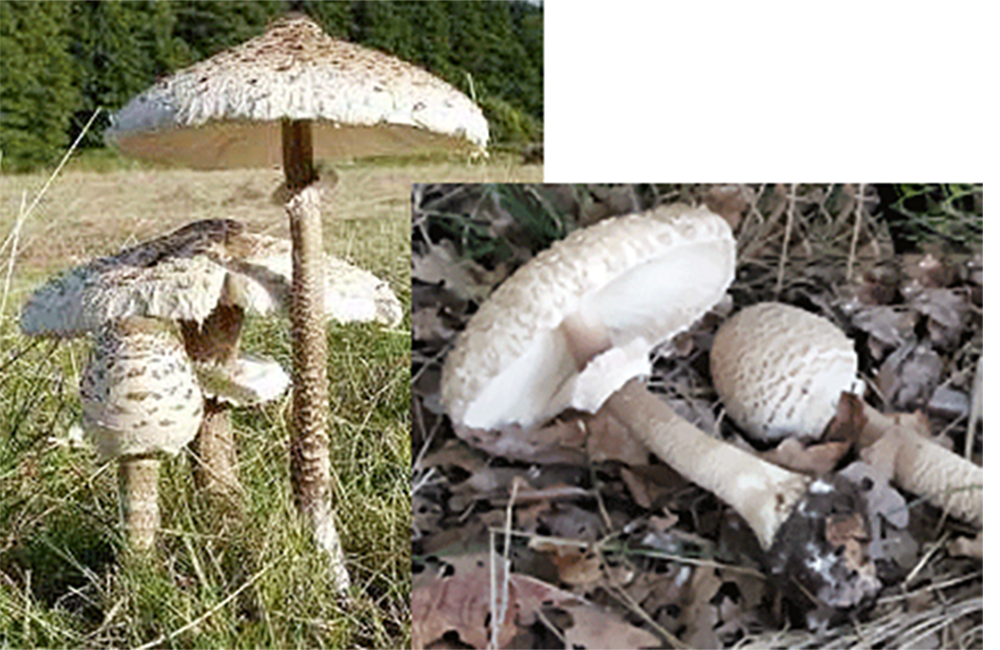
 The image, above, shows a range of pictures of Parasol Mushroom
(Macrolepiota procera), showing a classic cluster of
different-sized mushrooms in a lawn, top. Also hown are an
upright and inverted mushrooms, showing the gills, bottom left
and a cluster of smaller scotch bonnet mushrooms, bottom right..
| Common Name: Parasol Mushroom |
| Scientific Name: Macrolepiota procera |
| Other Names: Parasol, Ambarelo'r Bwgan (CY) |
| Family: Agaricaceae |
| Range: Temperate regions of Eurasia and possibly North America |
Physical Characteristics Edibility Rating: 5 Edibility Rating: 5  Macrolepiota procera is a saprophytic fungus, growing to 30cm (12 in) by 40cm (16 in) in size. They prefer well-drained soil, can be found singly or in groups in pastures, parks, open woodland, hedges and on road verges and fruit between August and November (but is most common in October).
|
| Edible Parts: Caps |
 Spore Print: White Spore Print: White
|
 Cap: Umbonate Cap: Umbonate
|
 Hymenium: Free Hymenium: Free
|
 Gills: Gills on hymenium Gills: Gills on hymenium
|
 Stipe: Has a Ring Stipe: Has a Ring
|
Edibility Rating: 4 
|
 Known Hazards: None Known. Known Hazards: None Known.
|
Monthly Availability:
|
Welcome to the summary page for FabulousFusionFood's Wild Food guide to Parasol Mushroom along with all the Parasol Mushroom containing recipes presented on this site, with 78 recipes in total.
These recipes, all contain Parasol Mushroom as a major wild food ingredient.
The Parasol Mushroom, Macrolepiota procera is a species of agaroicus fungus and is a member of the Agaricaceae family of Basidiomycota (that typically reproduce sexually using wind-borne spores) fungi that have white spore prints. It is a fairly common species on well-drained soils. It is found solitary or in groups and fairy rings in pastures and occasionally in woodland. Globally, it is widespread in temperate regions and typically fruits initially in August but is most common October and can continue fruiting through November. This is a very large mushroom that resembles a woman's parasol (hence the name). The cap is never less than 8cm in diameter and may reach up to 40cm. They are also ideal for drying and re-constitute in water particularly well and they have a pleasant, nutty aroma. They are a very sought-after edible mushroom and the firm texture makes them ideal for a wide range of culinary uses. They are also good eaten raw.
Parasol Mushrooms can grow either singly or in rings and young specimens tend to be egg-shaped that expand initially to bell-like and then a flat cap that is characterized by a dark umbo at the top. This central dome is surrounded by concentric rings of pale brown scales on a cream cap. The edge of the cap is down-turned and typically fringed with veil remnants. The gills are fine, white and free and leave a white spore print. The stems are long and slender (typically between 15 and 30cm in height), tapering from a swollen base that bears a movable double ring (which may be rubbed off). If is fibrous and hollow and is easily snapped (this renders the stem inedible and it should be discarded). The stem also has brown snake-like markings below the double ring. The flesh is thing and white wen cut (it may colour light pink, but this is not always the case). Cutting gives off a slightly earthy smell but overall the scent is nutty. Typically these mushrooms are found in pastures, parks, open woodland, hedges and on road verges, especially after a damp summer. To be safe always pick Parasol Mushrooms when they are open and ensure the gills are free, white and leave a white spore pattern. If you are uncertain of your identification then do not pick.
Large specimens can be picked readily as nothing else like them grows to the same size. However, some care should be taken not to confuse Parasol Mushrooms with the related Shaggy Parasol Mushroom (Macrolepiota rhacodes) as this mushroom can cause stomach upsets and skin rashes in those sensitive to it. Typically Shaggy Parasols are smaller than the Parasol Mushroom (less than 12cm tall) it also has a very pungent (fruity) aroma and the flesh and cap are thicker and redden when cut. Shaggy Parasols also lack patterns on their stipe, and have very shaggy cap surface. (Note that many books and recipes call this an excellent edible species, but as sensitivity can occur take care the first time you try them and always cook.)
Its firm texture makes the Parasol Mushroom excellent for pickling and preserving by drying it also makes an excellent mushroom powder if dried and ground. This mushroom is excellent in soups and stews and also makes a rather good omelette as well as being suitable for stir-fries, making fritters and frying in batter.
For other edible mushrooms, see the guide to edible mushrooms
[2]. Huxley, A. The New RHS Dictionary of Gardening. 1999
[3]. Tanaka, T. Tanaka's Cyclopaedia of Edible Plants of the World.
[4]. Lim T.K. Edible Medicinal And Non-Medicinal Plants, Vols 1–12.
[5]. Thomas, G. S. Perennial Garden Plants, 2004
[6]. Milner, E. Trees of Britain and Ireland, 2011
[7]. Rose, F. & O'Reilly, C. The Wild Flower Key (Revised Edition) — How to identify wild plants, trees and shrubs in Britain and Ireland, 2006
[8]. Streeter, D. & Garrard, I. The Wild Flowers of the British Isles, 1983
[9]. Clapham, A.R.; Tutin, T.G. & Moore, D.M. Flora of the British Isles, 1987
[10]. Phillips, R. Mushrooms, 2006
[11]. Jordan, P. & Wheeler, S. The Complete Book of Mushrooms: An Illustrated Encyclopedia of Edible Mushrooms, 2011
[12]. Bunker, F. Seaweeds of Britain and Ireland, Second Edition, 2017
[13]. Facciola, S. Cornucopia II — A Source Book of Edible Plants, 1998
[14]. Hartford, R. Edible and Medicinal Wild Plants of Britain and Ireland: A Foraging and Photographic Identification Guide
(Note that the above book links are Amazon Affiliate links)
These recipes, all contain Parasol Mushroom as a major wild food ingredient.
The Parasol Mushroom, Macrolepiota procera is a species of agaroicus fungus and is a member of the Agaricaceae family of Basidiomycota (that typically reproduce sexually using wind-borne spores) fungi that have white spore prints. It is a fairly common species on well-drained soils. It is found solitary or in groups and fairy rings in pastures and occasionally in woodland. Globally, it is widespread in temperate regions and typically fruits initially in August but is most common October and can continue fruiting through November. This is a very large mushroom that resembles a woman's parasol (hence the name). The cap is never less than 8cm in diameter and may reach up to 40cm. They are also ideal for drying and re-constitute in water particularly well and they have a pleasant, nutty aroma. They are a very sought-after edible mushroom and the firm texture makes them ideal for a wide range of culinary uses. They are also good eaten raw.
Parasol Mushrooms can grow either singly or in rings and young specimens tend to be egg-shaped that expand initially to bell-like and then a flat cap that is characterized by a dark umbo at the top. This central dome is surrounded by concentric rings of pale brown scales on a cream cap. The edge of the cap is down-turned and typically fringed with veil remnants. The gills are fine, white and free and leave a white spore print. The stems are long and slender (typically between 15 and 30cm in height), tapering from a swollen base that bears a movable double ring (which may be rubbed off). If is fibrous and hollow and is easily snapped (this renders the stem inedible and it should be discarded). The stem also has brown snake-like markings below the double ring. The flesh is thing and white wen cut (it may colour light pink, but this is not always the case). Cutting gives off a slightly earthy smell but overall the scent is nutty. Typically these mushrooms are found in pastures, parks, open woodland, hedges and on road verges, especially after a damp summer. To be safe always pick Parasol Mushrooms when they are open and ensure the gills are free, white and leave a white spore pattern. If you are uncertain of your identification then do not pick.
Large specimens can be picked readily as nothing else like them grows to the same size. However, some care should be taken not to confuse Parasol Mushrooms with the related Shaggy Parasol Mushroom (Macrolepiota rhacodes) as this mushroom can cause stomach upsets and skin rashes in those sensitive to it. Typically Shaggy Parasols are smaller than the Parasol Mushroom (less than 12cm tall) it also has a very pungent (fruity) aroma and the flesh and cap are thicker and redden when cut. Shaggy Parasols also lack patterns on their stipe, and have very shaggy cap surface. (Note that many books and recipes call this an excellent edible species, but as sensitivity can occur take care the first time you try them and always cook.)
Its firm texture makes the Parasol Mushroom excellent for pickling and preserving by drying it also makes an excellent mushroom powder if dried and ground. This mushroom is excellent in soups and stews and also makes a rather good omelette as well as being suitable for stir-fries, making fritters and frying in batter.
For other edible mushrooms, see the guide to edible mushrooms
References:
[1]. David Evans Notes from field observations, tastings and cookery experiments.[2]. Huxley, A. The New RHS Dictionary of Gardening. 1999
[3]. Tanaka, T. Tanaka's Cyclopaedia of Edible Plants of the World.
[4]. Lim T.K. Edible Medicinal And Non-Medicinal Plants, Vols 1–12.
[5]. Thomas, G. S. Perennial Garden Plants, 2004
[6]. Milner, E. Trees of Britain and Ireland, 2011
[7]. Rose, F. & O'Reilly, C. The Wild Flower Key (Revised Edition) — How to identify wild plants, trees and shrubs in Britain and Ireland, 2006
[8]. Streeter, D. & Garrard, I. The Wild Flowers of the British Isles, 1983
[9]. Clapham, A.R.; Tutin, T.G. & Moore, D.M. Flora of the British Isles, 1987
[10]. Phillips, R. Mushrooms, 2006
[11]. Jordan, P. & Wheeler, S. The Complete Book of Mushrooms: An Illustrated Encyclopedia of Edible Mushrooms, 2011
[12]. Bunker, F. Seaweeds of Britain and Ireland, Second Edition, 2017
[13]. Facciola, S. Cornucopia II — A Source Book of Edible Plants, 1998
[14]. Hartford, R. Edible and Medicinal Wild Plants of Britain and Ireland: A Foraging and Photographic Identification Guide
(Note that the above book links are Amazon Affiliate links)
The alphabetical list of all Parasol Mushroom recipes on this site follows, (limited to 100 recipes per page). There are 78 recipes in total:
Page 1 of 1
Page 1 of 1