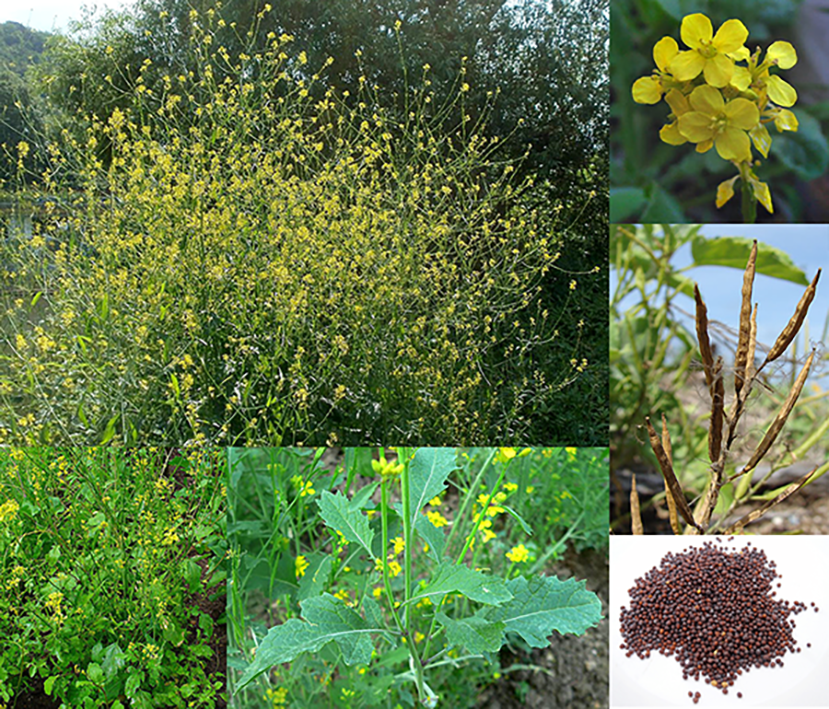
 The image, above, shows the full black mustard plant
(Brassica nigra), top left. Also show are close ups of
the leaves (bottom, centre) the flowers (top right), the mature
seed pods (centre right) and the mature seeds (mustard) [bottom
right]..
| Common Name: Black Mustard |
| Scientific Name: Rhamphospermum nigrum (previously: Brassica nigra) |
| Other Names: |
| Family: Brassicaceae or Cruciferae |
| Range: C. Europe. Occasionally naturalized in Britain |
Physical Characteristics Brassica nigra is a hardy Perennial plant, growing to 1.2m (4ft) by 0.6m (2 ft) in size. It is hardy to zone 7 and is not frost tender. The plant flowers from June to August and seeds ripen from July to September. The flowers are hermaphrodite and are pollinated by bees and flies. The plant is also self fertile.
|
| Edible Parts: Leaves, Young Stems, Seeds, Young Seed Pods, Flowers |
 Edibility Rating: 4 Edibility Rating: 4 
|
 Known Hazards: Though there had been no reports in humans, the seed pods and seeds have proven toxic to grazing animals when consumed in large quantities. Though uncommon, mustard allergy is possible in children and adolescents. Known Hazards: Though there had been no reports in humans, the seed pods and seeds have proven toxic to grazing animals when consumed in large quantities. Though uncommon, mustard allergy is possible in children and adolescents.
|
Monthly Availability: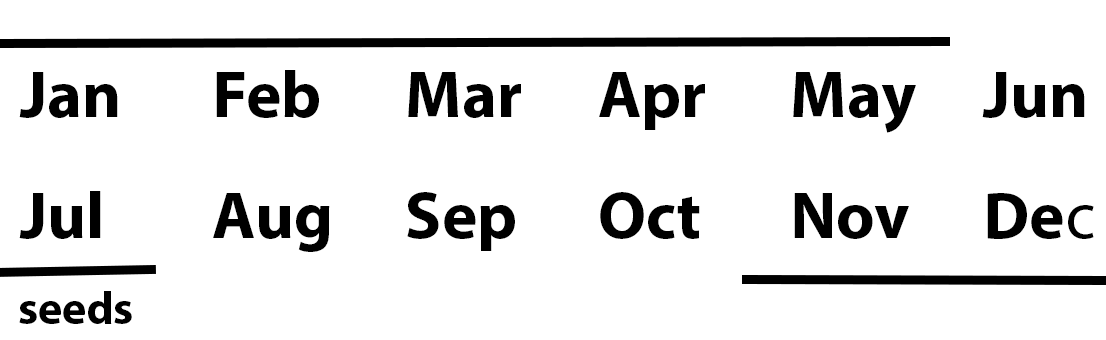
|
Welcome to the summary page for FabulousFusionFood's Wild Food guide to Black Mustard along with all the Black Mustard containing recipes presented on this site, with 117 recipes in total.
These recipes, all contain Black Mustard as a major wild food ingredient.
Black Mustard, Brassica nigra, is an annual weed, a member of the Brassicaceae (mustard/cabbage) family that's cultivated for its seeds, which are commonly used as a spice. The plant is believed be native to the Mediterranean but has been cultivated for millennia and naturalized to the whole of Europe. The plant itself is spindly in appearance and grows from 60cm to 2.5m tall with stalked leaves that are lobed and bristly. Between June and August it bears open racemes of small yellow flowers, each with four petals.
The seed pods develop after fertilization and are pressed against the stem. It is the seeds of the plant that are collected and the spice is made from the ground seeds of the plant, with the seed coats removed. The seeds themselves are tiny, about 1mm in diameter and are very flavourful, if hard to collect. These seeds are commonly used in Indian cuisine where they are thrown into hot oil or ghee after which they pop, releasing a characteristic 'nutty' flavour. A cooking oil can also be pressed from the seeds. In Britain the seeds used to be used as a garnish for cheese dishes and were a key ingredient in lemon and mustard seed chutney.
In common with other members of the Brassica family, the leaves, young stems, flowers, seed pods and seeds (mustard) of the plant are edible. The leaves and young (green) seed pods are an excellent addition to salads (note that salad leaves such as mizuna and tatsoi are actually types of mustard).
The leaves are edible raw and they're actually quite interesting to eat them that way. Leaves can be gathered throughout the winter and spring from November through to May and it's only in summer when the plant is in flower that the leaves are not worth collecting. Raw, the leaves initially have a mild and slightly nutty flavour, but after a few seconds of chewing, to be replaced by a pepperiness that reaches maximum intensity after about 20 seconds. Don't try eating too much of the leaves in one go as, like mustard, it can be too intense to bear. The heat of mustard greens and their relative, wild rocket, is due to the presence of allyl isothyocyanate. This chemical is present to try and deter browsing animals from eating the plant. In fact, the leaves are full of allyl isothyocyanate and its the mechanical act of chewing that releases allyl isothyocyanate itself which is why the heat effect from the plant is delayed. Unfortunately, allyl isothyocyanate is destroyed by cooking so serving black mustard as greens only gives you the flavour of slightly bitter cabbage. One of the few ways of preserving the pepperiness in cooking is to shred the leave and include them in dumplings which are then cooked near the end of the meal.
The seeds can be collected in July and stored as a spice or even prepared into mustard. The flowers are edible and are excellent in fritters or salads, which makes black mustard almost a year-round plant for the forager. It's also one of the few sources of leafy greens during the winter months.
[2]. Huxley, A. The New RHS Dictionary of Gardening. 1999
[3]. Tanaka, T. Tanaka's Cyclopaedia of Edible Plants of the World.
[4]. Lim T.K. Edible Medicinal And Non-Medicinal Plants, Vols 1–12.
[5]. Thomas, G. S. Perennial Garden Plants, 2004
[6]. Milner, E. Trees of Britain and Ireland, 2011
[7]. Rose, F. & O'Reilly, C. The Wild Flower Key (Revised Edition) — How to identify wild plants, trees and shrubs in Britain and Ireland, 2006
[8]. Streeter, D. & Garrard, I. The Wild Flowers of the British Isles, 1983
[9]. Clapham, A.R.; Tutin, T.G. & Moore, D.M. Flora of the British Isles, 1987
[10]. Phillips, R. Mushrooms, 2006
[11]. Jordan, P. & Wheeler, S. The Complete Book of Mushrooms: An Illustrated Encyclopedia of Edible Mushrooms, 2011
[12]. Bunker, F. Seaweeds of Britain and Ireland, Second Edition, 2017
[13]. Facciola, S. Cornucopia II — A Source Book of Edible Plants, 1998
[14]. Hartford, R. Edible and Medicinal Wild Plants of Britain and Ireland: A Foraging and Photographic Identification Guide
(Note that the above book links are Amazon Affiliate links)
These recipes, all contain Black Mustard as a major wild food ingredient.
Black Mustard, Brassica nigra, is an annual weed, a member of the Brassicaceae (mustard/cabbage) family that's cultivated for its seeds, which are commonly used as a spice. The plant is believed be native to the Mediterranean but has been cultivated for millennia and naturalized to the whole of Europe. The plant itself is spindly in appearance and grows from 60cm to 2.5m tall with stalked leaves that are lobed and bristly. Between June and August it bears open racemes of small yellow flowers, each with four petals.
The seed pods develop after fertilization and are pressed against the stem. It is the seeds of the plant that are collected and the spice is made from the ground seeds of the plant, with the seed coats removed. The seeds themselves are tiny, about 1mm in diameter and are very flavourful, if hard to collect. These seeds are commonly used in Indian cuisine where they are thrown into hot oil or ghee after which they pop, releasing a characteristic 'nutty' flavour. A cooking oil can also be pressed from the seeds. In Britain the seeds used to be used as a garnish for cheese dishes and were a key ingredient in lemon and mustard seed chutney.
In common with other members of the Brassica family, the leaves, young stems, flowers, seed pods and seeds (mustard) of the plant are edible. The leaves and young (green) seed pods are an excellent addition to salads (note that salad leaves such as mizuna and tatsoi are actually types of mustard).
The leaves are edible raw and they're actually quite interesting to eat them that way. Leaves can be gathered throughout the winter and spring from November through to May and it's only in summer when the plant is in flower that the leaves are not worth collecting. Raw, the leaves initially have a mild and slightly nutty flavour, but after a few seconds of chewing, to be replaced by a pepperiness that reaches maximum intensity after about 20 seconds. Don't try eating too much of the leaves in one go as, like mustard, it can be too intense to bear. The heat of mustard greens and their relative, wild rocket, is due to the presence of allyl isothyocyanate. This chemical is present to try and deter browsing animals from eating the plant. In fact, the leaves are full of allyl isothyocyanate and its the mechanical act of chewing that releases allyl isothyocyanate itself which is why the heat effect from the plant is delayed. Unfortunately, allyl isothyocyanate is destroyed by cooking so serving black mustard as greens only gives you the flavour of slightly bitter cabbage. One of the few ways of preserving the pepperiness in cooking is to shred the leave and include them in dumplings which are then cooked near the end of the meal.
The seeds can be collected in July and stored as a spice or even prepared into mustard. The flowers are edible and are excellent in fritters or salads, which makes black mustard almost a year-round plant for the forager. It's also one of the few sources of leafy greens during the winter months.
References:
[1]. David Evans Notes from field observations, tastings and cookery experiments.[2]. Huxley, A. The New RHS Dictionary of Gardening. 1999
[3]. Tanaka, T. Tanaka's Cyclopaedia of Edible Plants of the World.
[4]. Lim T.K. Edible Medicinal And Non-Medicinal Plants, Vols 1–12.
[5]. Thomas, G. S. Perennial Garden Plants, 2004
[6]. Milner, E. Trees of Britain and Ireland, 2011
[7]. Rose, F. & O'Reilly, C. The Wild Flower Key (Revised Edition) — How to identify wild plants, trees and shrubs in Britain and Ireland, 2006
[8]. Streeter, D. & Garrard, I. The Wild Flowers of the British Isles, 1983
[9]. Clapham, A.R.; Tutin, T.G. & Moore, D.M. Flora of the British Isles, 1987
[10]. Phillips, R. Mushrooms, 2006
[11]. Jordan, P. & Wheeler, S. The Complete Book of Mushrooms: An Illustrated Encyclopedia of Edible Mushrooms, 2011
[12]. Bunker, F. Seaweeds of Britain and Ireland, Second Edition, 2017
[13]. Facciola, S. Cornucopia II — A Source Book of Edible Plants, 1998
[14]. Hartford, R. Edible and Medicinal Wild Plants of Britain and Ireland: A Foraging and Photographic Identification Guide
(Note that the above book links are Amazon Affiliate links)
The alphabetical list of all Black Mustard recipes on this site follows, (limited to 100 recipes per page). There are 117 recipes in total:
Page 1 of 2
| Achari Masala Origin: India | Fijian Crab Curry Origin: Fiji | Meygoo Dopiyazeh (Persian Prawn, Pepper and Onion Curry) Origin: Iran |
| Aliter in Grue vel Qnate Elixa (Sauce for Boiled Crane or Duck, Another Way II) Origin: Roman | Fragrant Fijian Chicken Curry Origin: Fiji | Middle Eastern style Curry Powder Origin: Middle East |
| Aloo Bhaji Origin: India | Goan Curry Paste Origin: Anglo-Indian | Mixed Vegetable Pickle Origin: India |
| Aloo Palya (Potato Curry) Origin: India | Goan Lamb Xacutti Origin: India | Mother-in-law Masala Origin: South Africa |
| Beef Koftas with Fruity Couscous Origin: Morocco | Grain Mustard Based Fish Curry Origin: India | Mussels in Creamy Horseradish Sauce Origin: Ancient |
| Beef Madras Origin: India | Green Apple Curry Origin: Sri Lanka | Mutton Madras Origin: India |
| Black Curry Powder Origin: Sri Lanka | Guiana Colombo Powder Origin: French Guiana | Phaal Chicken Curry Origin: India |
| Black Mustard Dumplings Origin: Britain | Halibut and Tomato Curry Origin: Britain | Pork and Wild Food Curry Origin: Britain |
| Black Mustard Flowers, Mushroom and Seaweed Soup Origin: Britain | Hari Mirch ka Achar (Indian Pickled Green Chillies) Origin: India | Prawn Patia Origin: India |
| Black Mustard Leaves, Tricorn Leek and Millet Origin: Fusion | Hinga Mirsang (Green Chillies in Asafoetida) Origin: India | Rasam Origin: Southern India |
| Bo-Kaap Kerrie (Cape Malay Curry) Origin: South Africa | Hot Jalfrezi Spices Origin: African Fusion | Sabat Moong Bhajji (Mung Bean Bhaji) Origin: India |
| Bo-Kaap Kerrie Poeier (Cape Malay Curry Powder) Origin: South Africa | Indian Chilli Pickle Origin: India | Saint Barthélemy Colombo Spice Blend Origin: Saint Barthelemy |
| Bombay Aloo (Bombay Potatoes) Origin: Britain | Ius in thynno elixo (Salt Tuna with Sauce) Origin: Roman | Saint Martin Colombo Spice Blend Origin: Saint-Martin |
| Bombay Egg and Potato Curry Origin: Anglo-Indian | Jamaican Curry Chicken with Coconut Rice Origin: Jamaica | Saint Martin Colombo Spice Blend Origin: Sint Maarten |
| Burdock Flower Stem Gobi Origin: Britain | Jamaican Curry Powder Origin: Jamaica | Saint-Martin Johnny Cakes Origin: Saint-Martin |
| Burdock Pickles Origin: Britain | Kasundi Origin: Bangladesh | Sambhar (Lentil Curry) Origin: India |
| Cabbage Mallung (Curried Cabbage) Origin: Sri Lanka | Kasundi 2 (Bengali Mustard Sauce) Origin: India | Sautéed Mustard Greens Origin: Britain |
| Cajun Blackening Spices Origin: Cajun | Kesar Mango Curry Origin: India | Sbeis Piclo Du (Black Pickling Spice) Origin: Welsh |
| Cape Curry Powder Origin: South Africa | King Scallop in Molee Sauce Origin: Manx | Shatkora Beef Curry BIR Origin: Britain |
| Cari (Vietnamese Curry Powder) Origin: Vietnam | Kobi Sabji (Cabbage Sabji) Origin: India | Siljo (Fermented Safflower Seed and Broad Bean Flour Paste) Origin: India |
| Carrot Sambharo (Gujarati Carrot Salad) Origin: India | Kombdi Masala Origin: India | Simba Mbili (Swahili Curry Powder) Origin: Kenya |
| Cauliflower, Mushroom and Carlin Peas Curry Origin: Britain | Laal Chicken Curry Origin: Britain | Simba Mbili (Swahili Curry Powder) Origin: Comoros |
| Cayman Curry Powder Origin: Cayman Islands | Lamb Madras Origin: India | Simba Mbili (Swahili Curry Powder) Origin: Tanzania |
| Chertha kozhi kari (Chicken and Cashew Nut Curry) Origin: India | Leftover Ham Vindhalo Origin: Britain | Sint Maarten Johnny Cakes Origin: Sint Maarten |
| Chicken Chana Dhal (Chicken with Lentils) Origin: India | Lentil Or Potato Tempering Origin: India | Special Jaipuri Masala Origin: India |
| Chickpea, Spinach and Egg Curry Origin: Britain | Lime Pickle Origin: India | Spiced Buttermilk Origin: India |
| Classic Vindaloo Curry Origin: India | Machali aur Daal (Fish and Lentil Curry) Origin: India | Spiced Sesame Lamb Patties Origin: Fusion |
| Colombo Curry Paste Origin: Martinique | Madras Curry Paste Origin: Britain | Spicy Okra Origin: India |
| Curried Wild Mustard Greens with Beans Origin: Fusion | Maharashtrian Masala Bhat (Spicy Maharashtrian Rice) Origin: India | Sprats Moju Origin: Sri Lanka |
| Daal and Vegetable Bhuna Origin: Britain | Malawi Curry Powder Origin: Malawi | Sri Lankan Aubergine Curry Origin: Sri Lanka |
| Dock Rissoles Origin: Ancient | Maldives Meat Curry Powder Origin: Maldives | Sri Lankan Curry Powder Origin: Sri Lanka |
| Durban-style Watermelon Rind Curry Origin: South Africa | Mangalorean Spinach and Black Eyed Beans Curry Origin: India | Sri Lankan Green Bean Curry Origin: Sri Lanka |
| Egg Masala Origin: India | Mauritian Poudre de Colombo Origin: Mauritius | |
| Elumas Curry (Mutton Curry) Origin: Sri Lanka | Meat and Fish Tempering Origin: India |
Page 1 of 2