Welcome to Celtnet's Eliza Acton's Chapter 23 (Sweet Dishes, or Entremets) Page — Here you will find the full text from the twenty-third chapter: Sweet Dishes, or Entremets; of Eliza Acton's
Modern Cookery As well as the full text this page also provides links out to the overall index of the book and links to modern redactions of each and every recipe (where practicable). This site builds a complete library of Eliza Acton recipes, allowing the modern cook to make them at home today. Enjoy...
CHAPTER XXIII.
Sweet Dishes, or Entremets.

TO PREPARE CALF'S FEET STOCK.
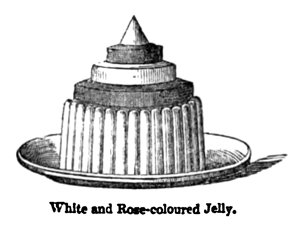 The
feet are usually sent in from the butcher's ready to be dressed, but as the are sold at a very much cheaper rate when the hair has not been cleared from them, and as they may then be depended on for supplying the utmost amount of nutriment which they contain, it is often desirable to have them altogether prepared by the cook. In former editions of this work we directed that they should be "dipped into cold water, and sprinkled with resin in fine powder; then covered with boiling water and left for a minute or two untouched before they were scraped;" and this method we had followed with entire success for a long time, but we afterwards discovered that the resin was not necessary, and that the feet could be quite as well prepared by mere scalding, or being laid into water at the
point of boiling, and kept in it for a few minutes by the side of the fire. The hair, as we have already stated in the first pages of
Chapter IX. (Veal), must be very closely scraped from them with a
blunt-edged knife; and the hoofs must be removed by being struck sharply down against the edge of a strong table or sink, the leg-bone being held tightly in the hand. The feet must afterwards be washed delicately clean before they are further used. When this has been done, divide them at the joint, split the claws, and take the fat that is between them. Should the feet be large, put a gallon of cold water to the four, but from a pint to a quart less if they be of moderate size or small. Boil them gently down until the flesh has parted entirely from the bones, and the liquor is reduced nearly or quite half; strain, and let it stand until cold; remove every particle of fat from the top before it is used, and be careful not to take the sediment.
Calf's feet (large), 4; water, 1 gallon: 6 to 7 hours.
TO CLARIFY CLLF'S FEET STOCK.
Break up a quart of the stock, put it into a clean stewpan with the whites of five large or of six small eggs, two ounces of sugar, and the strained juice of a small lemon; place it over a gentle fire, and do not stir it after the scum begins to form; when it has boiled five or six minutes, if the liquid part be clear, turn it into a jelly-bag, and pass it through a second time should it not be perfectly transparent the first. To consumptive patients, and others requiring restoratives, but forbidden to take stimulants, the jelly thus prepared is often very acceptable, and may be taken with impunity, when it would be highly injurious made with wine. More white of egg is required to clarify it than when sugar and acid are used in larger quantities, as both of these assist the process. For blanc-mage omit the lemon-juice, and mix with the clarified stock an equal proportion of cream (for an invalid, new milk), with the usual flavouring, and weight of sugar; or pour the boiling stock very gradually to some finely pounded almonds, and express it from them as directed for Quince Blancmange, allowing from six to eight ounces to the pint,
Stock, 1 quart; whites of eggs, 5; sugar, 2 oz.; juice, 1 small lemon: 5 to 8 minutes.
TO CLARIFY ISINGLASS.
The finely-cut purified isinglass, which is now in general use, requires no clarifying except for clear jellies: for all other dishes it is sufficient to dissolve, skim, and pass it through a muslin strainer. When two ounces are required for a dish, put two and a half into a delicately clean pan, and pour on it a pint of spring water which has been been gradually mixed with a teaspoon of beaten white of egg; stir these thoroughly together, and let them heat slowly by the side of a gentle fire, but do not allow the isinglass to stick to the pan. When the scum is well risen, which it will be after two or three minutes' simmering, clear it off; and continue the skimming until no more appears; then, should the quantity of liquid be more than is needed, reduce it by quick boiling to the proper point, strain it through a thin muslin, and set it by for use: it will be perfectly transparent, and may be mixed lukewarm with the clear and ready sweetened juice of various fruits, or used with the necessary proportion of syrup, for jellies flavoured with choice liqueurs. As the clarifying reduces the strength of the isinglass—or rather as a portion of it is taken up by the white of egg—an additional quarter to each ounce must be allowed for this: if the scum be laid to drain on the back of a fine sieve which has been wetted with hot water, a little very strong jelly will drip from it.
Isinglass, 2 1/2 oz.; water, 1 pint; beaten white of egg, 1 teaspoonful.
Obs.—At many Italian warehouses a preparation is now sold under the name of isinglass, which appears to us to be highly purified gelatine of some other kind. It is converted without trouble into a very transparent jelly, is free from flavour, and is less expensive than the genuine Russian isinglass; but when taken for any length of time as a restorative, its different nature becomes perceptible. It answers well for the table occasionally; but it is not suited to invalids.
SPINACH GREEN, FFOR COLOURING SWEET DIHSES,CONFECTIONERY, OR SOUPS.
Pound quite to a pulp, in a marble or Wedgwood mortar, a handful or two of young freshly-gathered spinach, then throw it into a hair sieve, and press through all the juice which can be obtained from it; pour this into a clean white jar, and place it in a pan of water that is at the point of boiling, and which must be allowed only to just simmer, afterwards; in three or four minutes the juice will be poached or set: take it then gently with a spoon, and lay it upon the back of a fine sieve to drain. If wanted for immediate use, merely mix it in the mortar with some finely-powdered sugar;* but if to be kept as a store, pound it with as much as will render the whole tolerably dry, boil it to candy-height over a very clear fire, pour it out in cakes, and keep them in a tin box or canister. For this last preparation consult the receipt for orange-flower candy.
PREPARED APPLE OR QUINCE JUICE.
Pour into a clean earthen pan two quarts of spring water, and throw into it as quickly as they can be prepared, quartered, and weighed, four pounds of nonsuches, pearmains, Ripstone pippins, or any other good boiling apples of fine flavour. When all are done, stew them gently until they are well broken, but not reduced quite to pulp; turn them into a jelly-bag, or strain the juice from them without pressure through a closely-woven cloth, which should be gathered over the fruit, and tied, and suspended above a deep pan until the juice ceases to drop from it: this, if not very clear, must be rendered so before it is used for syrup or jelly, but for all other purposes once straining it will be sufficient. Quinces are prepared in the same way, and with the same proportions of fruit and water, but they must not be too long boiled, or the juice will become red. We have found it answer well to have them simmered until they are perfectly tender, and then to leave them in their liquor in a bowl until the following day, when the juice will be rich and clear. They should be thrown into the water very quickly after they are pared and weighed, as the air will soon discolour them. The juice will form a jelly much more easily if the cores and pips be left in the fruit.
Water, 2 quarts; apples or quinces, 4 lbs.
COCOA-NUT FLAVOURED MILK.
(For sweet dishes, &c.)
Pare the dark outer rind from a very fresh nut, and grate it on a fine and exceedingly clean grater, to every three ounces pour a quart of new milk, and simmer them very softly for three quarters of an hour, or more, that a full flavour of the nut may be imparted to the milk without its being much reduced: strain it through a fine sieve, or cloth, with sufficient pressure to leave the nut almost dry: it may then be used for blanc-mange, custards, rice, and other puddings, light cakes an bread.
To each quart new milk, 3 oz. grated cocoa-nut: 3/4 to 1 hour.
Obs:—The milk of the nut when perfectly sweet and good, may be added to the other with advantage To obtain it, bore one end of the shell with a gimlet, and catch the liquid in a cup; and to extricate the kernel, break the shell with a hammer: this is better than sawing it asunder.
COMPÔTES OF FRUIT.
(Or Fruit stewed in Syrup.)
We would especially recommend these delicate and very agreeable preparations for trial to such of our readers as may be unacquainted with them, as well as to those who may have a distaste to the common "stewed fruit" of English cookery. If well made they are peculiarly delicious and refreshing, preserving the pure flavour of the fruit of which they are composed; while its acidity is much softened by the small quantity of water added to form the syrup in which it is boiled. They are also more economical than tarts or puddings, and infinitely more wholesome. In the second course pastry-crust can always be served with them, if desired, in the form of ready baked leaves, round cakes, or any more fanciful shapes; or a border of these may be fastened with a little white of egg and flour round the edge of the dish in which the compôte is served; but rice, or macaroni simply boiled, or a very plain pudding is a more usual accompaniment.
Compôtes will remain good for two or three days in a cool store-room, or somewhat longer, if gently boiled up for an instant a second time; but they contain generally too small a proportion of sugar to preserve them from mould or fermentation for many days. The syrup should be enriched with a larger quantity when they are intended for the desserts of formal dinners, as it will increase the transparency of the fruit: the juice is always beautifully clear when the compôtes are carefully prepared. They should be served in glass dishes, or in compôtiers, which are of a form adapted to them.
Compôte of spring fruit.—(Rhubarb). Take a pound of the stalks after they are pared, and cut them into short lengths; have ready a quarter of a pint of water boiled gently for ten minutes with five ounces of sugar, or with six should the fruit be very acid; put it in, and simmer it for about ten minutes. Some kinds will be tender in rather less time, some will require more.
Obs.—Good sugar in lumps should be used for these dishes. Lisbon sugar will answer for them very well on ordinary occasions, but that which is refined will render them much more delicate.
Compôte of green currants.—Spring water, half-pint; sugar, five ounces; boiled together ten minutes. One pint of green currants stripped from the stalks; simmered five minutes.
Compôte of green gooseberries.—This is an excellent compôte if made with fine sugar, and very good with any kind. Break five ounces into small lumps and pour on them half a pint of water; boil these gently for ten minutes, and clear off all the scum; then add to them a pint of fresh gooseberries freed from the tops and stalks, washed, and well drained. Simmer them gently from eight to ten minutes, and serve them hot or cold. Increase the quantity for a large dish.
Compôte of green apricots.—l;Wipe the down from a pound of quite young apricots, and stew them very gently for nearly twenty minutes in syrup made with eight ounces of sugar and three-quarters of a pint of water, boiled together the usual time.
Compôte of red currants.—A quarter of a pint of water and five ounces of sugar: ten minutes. One pint of currants freed from the stalks to be just simmered in the syrup from five to seven minutes. This receipt will serve equally for raspberries, or for a compôte of the two fruits mixed together. Either of them will be found an admirable accompaniment to a pudding of batter, custard, bread, or ground rice, and also to various other kinds of puddings, as well as to whole rice plainly boiled.
Compôte of Kentish of Flemish cherries.—Simmer five ounces of sugar with half a pint of water for ten minutes; throw into the syrup a pound of cherries weighted after they are stalked, and let them stew gently for twenty minutes: it is a great improvement to stone the fruit, but a larger quantity will be required for a dish.
Compôte of Morella cherries.—Boil together for fifteen minutes, six ounces of sugar with half a pint of water; add a pound and a quarter of ripe Morella cherries, and simmer them very softly from five to seven minutes: this is a delicious compôte. A larger proportion of sugar will often be required for it, as the fruit is very acid in some seasons, and when it is not fully ripe.
Compôte of damsons.—Four ounces of sugar and half a pint of water to be boiled for ten minutes; one pound of damsons to be added, and simmered gently from ten to twelve minutes.
Compôte of the green magnum-bonum or Mogul plum.—The green Mogul plums are often brought abundantly into the market when the fruit is thinned from the trees, and they make admirable tarts or compôtes, possessing the fine slight bitter flavour of the unripe apricot, to which they are equal. Measure a pint of the plums without their stalks, and wash them very clean; then throw them into a syrup made with seven ounces of sugar in lumps, and half a pint of water, boiled together for eight or ten minutes. Give the plums one quick boil, and then let them stew quite softly for about five minutes, or until they are tender, which occasionally will be in less time even. Take off the scum, and serve the compôte hot or cold.
Compôte of the magnum-bonum, or other large plums.—Boil six ounces of sugar with half a pint of water the usual time; take the stalks from a pound of plums, and simmer them very softly for twenty minutes. Increase the proportion of sugar if needed, and regulate the time as may be necessary for the different varieties of fruit.
Compôte of bullaces.—The large or shepherds' bullace, is very good stewed, but will require a considerable portion of sugar to render it palatable, unless it be quite ripe. Make a syrup with half a pound of sugar, and three-quarters of a pint of water, and boil in it gently from fifteen to twenty minutes, a pint and a half of the bullaces freed from their stalks.
Compôte of Siberian crabs.—To three-quarters of a pint of water add six ounces of fine sugar, boil them for ten or twelve minutes, and skim them well. Add a pound and a half of Siberian crabs without their stalks, and keep them just at the point of boiling for twenty minutes; they will them become tender without bursting. A few strips of lemon-rind and a little lemon juice are sometimes added to this compôte.
Obs.—In a dry warm summer, when fruit ripens freely, and is rich in quality, the proportion of sugar directed for these compôtes would generally be found sufficient; but in a cold or wet season, it would certainly, in many instances, require to be increased. The present slight difference in the cost of sugars, renders it a poor economy to use the raw for dishes of this class, instead of that which is well refined. To make a clear syrup it should be broken into lumps, not crushed to powder. Almost every kind of fruit may be converted into a good compôte.
COMPÔTES OF PEACHES.
Pare half a dozen ripe peaches, and stew them very softly from eighteen to twenty minutes, keeping them often turned in a light syrup, made with five ounces of sugar, and half a ping of water boiled together for ten minutes. Dish the fruit; reduce the syrup by quick boiling, pour it over the peaches, and serve them hot for a second-course dish, or cold for dessert. They should be quite ripe, and will be found delicious dressed thus. A little lemon-juice may be added to the syrup, and the blanched kernels of two or three peach or apricot stones.
Sugar, 5 oz.; water, 1/2 pint: 10 minutes. Peaches, 6: 18 to 20 minutes.
Obs.—Nectarines, without being pared, may be dressed in the same way, but will require to be stewed somewhat longer, unless they be quite ripe.
ANOTHER RECEIPT FOR STEWED PEACHES.
Should the fruit be not perfectly ripe, throw it into boiling water and keep it just simmering, until the skin can be easily stripped off. Have ready half a pound of fine sugar boiled to a light syrup with three-quarters of a pint of water; throw in the peaches, let them stew softly until quite tender, and turn them often that they may be equally done; after they are dished, add a little strained lemon-juice to the syrup, and reduce it by a few minutes' very quick boiling. The fruit is sometimes pared, divided, and stoned, then gently stewed until it is tender.
Sugar, 8 oz.; water, 3/4 pint: 10 to 12 minutes. Peaches, 6 or 7; lemon-juice, 1 large teaspoonful.
COMPÔTES OF BARBERRIES FOR DESSERT.
When the fruit is first ripe it requires, from its excessive acidity, nearly its weight of sugar to render it palatable; but after hanging some time upon the trees it becomes much mellowed in flavour, and may be sufficiently sweetened with a smaller proportion. According to the state of the fruit then, take for each pound (leaving it in bunches) from twelve to sixteen ounces of sugar, and boil it with three-quarters of a pint of water until it forms a syrup. Throw in the bunches of fruit, and simmer them for five or six minutes. If their weight of sugar be used, they will become in that time perfectly transparent. As all vessels of tin affect the colour of the barberries, they should be boiled in a copper stewpan, or in a German enamelled one, which would be far better.
Barberries, 1 lb.; sugar, 12 to 16 oz.; water, 3/4 pint : fruit simmered in syrup, 5 to 6 minutes.
BLACK CAPS PAR EXCELLENCE.
(For the Second-course, or for Dessert.)
Cut a dozen fine Norfolk biffins in two without paring them, scoop out the cores, and fill the cavities with thin strips of fresh lemon-rind and which candied orange-peel. Cover the bottom of a flat shallow tin with a thick layer of fine pale brown sugar, press the two halves of each apple together, and place them closely in the tin; pour half a bottle of raisin or of any other sweet wine over them, and be careful to moisten the tops of all; sift white sugar thickly on them, and set the tin into a very hot oven at first, that the outsides of the apples may catch or become black; then draw them to the mouth of the oven, and bake them gently until they are soft quite through. The Norfolk biffin answers for this dish far better than any other kind of apple, but the winter queening, and some few firm sorts beside, can be used for it with fair success. These for variety may be cored without being divided, and filled with orange marmalade. The black caps served hot, as a second course dish, are excellent.
Norfolk biffins, 12; rinds fresh lemons, 1 to 2; candied orange-rind, 2 to 3 oz.; pale brown sugar, 3/4 lb.; raisin or other wine, 1/2 bottle; little sifted sugar: 3/4 to 1 hour, or more.
Obs.—The apples dressed as above resemble a rich confection, and will remain good for ten days or a fortnight; sometimes much longer even. The receipt is an admirable one.
GATEAU DE POMMES.
Boil together for fifteen minutes a pound of well-refined sugar and half a pint of water; then add a couple of pounds of nonsuches, or of any other finely-flavoured apples which can be boiled easily to a smooth pulp, and the juice of a couple of small, or of one very large lemon. Stew these gently until the mixture is perfectly free from lumps, then boil it quickly, keeping it stirred, without quitting it, until it forms a very thick and dry marmalade. A few minutes before it is done add the finely grated rinds of a couple of lemons; when it leaves the bottom of the preserving-pan visible and dry, press it into moulds of tasteful form; and either store it for winter use, or if wanted for table, serve it plain for dessert, or ornament it with spikes of blanched almonds, and pour a custard round it for a second-course dish (entremets).
Sugar, 1 lb.; water, 1/2 pint: 15 minutes. Nonsuches or other apples, 2 lbs.; juice, 1 large or 2 small lemons: 2 hours or more.
GATEAU OF MIXED FRUITS. (GOOD).
Extract the juice from some fresh red currants by simmering them very gently for a few minutes over a slow fire: strain it through a folded muslin, and to one pound of it add a pound and a half of nonsuches or of fresh gathered codlings, pared, and rather deeply cored, that the fibrous part of the apple may be avoided. Boil these quite slowly until the mixture is perfectly smooth, then, to evaporate part of the moisture, let the boiling be quickened. In from twenty-five to thirty minutes draw the pan from the fire, and throw in gradually a pound and a quarter of sugar in fine powder: mix it well with the fruit, and when it is dissolved continue the boiling rapidly for twenty minutes longer, keeping the mixture constantly stirred; put it into a mould, and store it, when cold, for winter use, or serve it for dessert, or for the second course: in the latter case decorate it with spikes of blanched almonds, or pistachio-nuts, and heap solid whipped cream round it, or pour a custard into the dish. For dessert it may be garnished with dice of the palest apple-jelly,
Juice of red currants, 1 lb.; nonsuches, or codlings (pared and cored), 1 1/2 lb.; 25 to 30 minutes. Sugar, 1 1/2 lb. : 20 minutes.
Obs.—A portion of raspberries, if still in season, may be mixed with the currants for this gâteaux of fruit, see Newton solid, and damson solid, Chapter XXIV. Ripe peaches and nonsuches will likewise do well for it. Codlings answer perfectly for the preceding receipt, and the preparation is of fine colour and very pleasant flavour: it ought to cut in clear firm slices. Other varieties of fruit can be mingled in the same manner.
JELLIES.
CALF'S FEET JELLY. (ENTREMETS.)
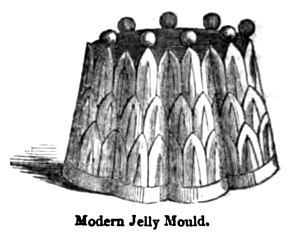 We hear inexperienced housekeep frequently complain of the difficulty of rendering this jelly perfectly transparent; but by mixing with the other ingredients, while quite cold, the whites, and the crushed shells of a sufficient number of eggs, and allowing the heat of scum which gathers on the jelly to remain undisturbed after it once forms, they will scarcely fail to obtain it clear. It should be strained through a thick flannel, or beaver-skin, bag of a conical form (placed before the fire, should the weather be at all cold, or the mixture will jelly before it has run through), and if not perfectly clear it must be strained, again and again, until it becomes so; though we generally find that once suffices. Mix thoroughly in a large stewpan five half-pints of strong calf's feet stock (see page 453), a full pint of sherry, half a pound of sugar roughly powdered, the juice of two fine lemons, the rind of one and a half cut very thin, the whites and shells of four large eggs, and half an ounce of isinglass. Let these remain a few minutes off the fire, that the sugar may dissolve more easily; then let the jelly be brought to a boil gradually, and do not stir it after it begins to heat. When it has boiled gently for sixteen minutes, draw it from the fire, and let it stand a short time before it is poured into a jelly-bag, under which a bowl should be placed to receive it. When clear and cool, put it into moulds which have been laid for some hours in water: these should always be of earthenware in preference to metal. If to be served in glasses, or roughed, the jelly will be sufficiently firm without the isinglass, or which, however, we recommend a small quantity to be thrown in always when the jelly begins to boil, as it facilitates the clearing.
Calf's feet stock, 2 1/2 pints; sugar, 1/2 lb.; sherry, 1 pint; juice of lemons, 2 large
Obs.—After the jelly has dropped through the bag, an exceedingly agreeable beverage may be obtained by pouring in some boiling water; from one to three half pints, according to the quantity of jelly which has been made. The same plan should be pursued in making orange or lemon jelly for an invalid.
Obs. 2.—As it is essential to the transparency of calf's feet jelly of all kinds that the whole of the ingredients should be quite cold when they are mixed, and as the stock can only be measured in a liquid state, to which it must be reduced by heating, the better plan is, to measure it when it is first strained from the feet, and to put apart the exact quantity required for a receipt; but when this has not been done, and it is necessary to liquefy it, it must be left until quite cold again before it is used. For the manner of preparing and clarifying it, see the beginning of this chapter.
ANOTHER RECEIPT FOR CALF'S FEET JELLY.
To four calf's feet well cleansed and divided, pour a gallon of water and let them stew until it is reduced to rather less than two quarts; or if, after the flesh has quite fallen from the bones, the liquor on being strained off should exceed that quantity, reduce it by rapid boiling in a clean uncovered pan over a very clear fire. When it is perfectly firm and cold, take it clear of fat and sediment, and add to it a bottle of sherry, which should be of good quality (for poor, thin wines are not well adapted to the purpose), three-quarters of a pound of sugar broken small, the juice of five large or of six moderate-sized lemons, and the whites, with the shells finely crushed, of seven eggs, or of more should they be very small. The rinds of three lemons, pared exceedingly thin may be thrown into the jelly for a few minutes before it is taken from the fire; or they may be put into the jelly-bag previously to its being poured through, when they will impart to it a slight and delicate flavour, without deepening its colour much. If it is to be moulded, something more than an ounce of isinglass should be dropped lightly in where the liquid becomes visible through the head of scum, when the mixture begins to boil; for if not sufficiently firm, it will break when it is dished. It may be roughed, or served in glasses without this addition; and in a liquid state will be found an admirable ingredient for Oxford, or other punch.
Calf's feet, 4; water, 1 gallon: to be reduced more than half. Sherry, 1 bottle; sugar, 3/4 lb. (more to taste); juice of 5 large lemons, or of six moderate-sized; whites and shells of 7 eggs, or more if small; rinds of lemons, 3 (for moulding, nearly 3/4 oz. of isinglass): 15 to 20 minutes.
Obs.—An excellent and wholesome jelly for young people may be made with good orange or raisin wine, instead of sherry; to either of these the juice of three or four oranges, with a small portion of the rind, may be added instead of part of the lemons.
MODERN VARIETIES OF CALF'S FEET JELLY.
In modern cookery a number of excellent jellies are made with the stock of calves' feet, variously flavoured. Many of them are compounded entirely without wine, a small quantity of fine liqueur being used as a substitute; and sometimes cinnamon, or vanilla, or Seville orange-rind with a slight portion of acid, takes place of this. For aristocratic tables, indeed, it is the present fashion to serve them very lightly and delicately flavoured. Their cost is thus materially diminished. Fresh strawberries dropped into clear calf's feet jelly just before it sets, impart a delicious fragrance to it, when they are of a choice kind; and other fruit is mingled with it often; but none has so good an effect, though many sorts when tastefully employed give an excellent appearance to it. The Belgrave mould, of which the description will be found on page 470, is well adapted for highly ornamental jellies; and we recommend its adoption for this class of dishes.
APPLE CALF's FEET JELLY.
Pour a quart of prepared apple-juice (see page 456), on a pound of fresh apples pared and cored, and simmer them until they are well broken; strain the juice, and let it stand until cold; then measure, and put a pint and a half of it into a stewpan with a quart of calf's feet stock (see page 453), nine ounces sugar broken small, or roughly pounded, the juice of two fine lemons, and the the thin rinds of one and a half, with the whites and shells of eight eggs. Let it boil gently for ten minutes, then strain it through a flannel-bag, and when cool put it into moulds. It will be very clear, and firm, and of pleasant flavour. Apples of good quality should be used for it, and the quantity of sugar must be regulated by the time of year, as the fruit will have lost much of its acidity during the latter part of the season. This receipt, which is the result of our own experiment, and which we have found very successful, was first tried just after Christmas, with pearmains and Ripstone pippins. A little syrup of preserved ginger, or a small glass of fine white brandy, would, perhaps, to some tastes, improve the jelly; but we give it simply as we have had it proved ourselves.
Prepared apple juice, 1 quart; fresh apples, 1 lb.; 1/2 to 3/4 hour. Strained juice, 1 1/2 pint; calf's feet stock, 1 quart; sugar, 9 oz.; juice of lemons 2; rind of 1 1/2; whites and shells of eggs, 8: 10 minutes.
Obs.—We would recommend the substitution of quinces for apples in this receipt as likely to afford a very agreeable variety of the jelly: or equal portions of the two fruits might answer well.
Unless the stock be very stiff, add isinglass to this, as to the calf's feet jelly, when it is to be moulded.
ORANGE CALF'S FEET JELLY.
(Author's Receipt.)
To a pint and a half of firm calf's feet stock, put a pint of strained China-orange juice mixed with that of one or two lemons; add to these six ounces of sugar, broken small, the very thin rinds of three oranges and one lemon, and the whites of six eggs with half the shells crushed small. Stir these gently over a clear fire until the head of scum begins to form, but not at all afterwards. Simmer the jelly for ten minutes from the first full boil; take it from the fire, let it stand a little, then pour it through a jelly—bag until perfectly clear. This is an original, and entirely new receipt, which we can recommend to the reader, the jelly being very pale, beautifully transparent, and delicate in flavour: it would, we think, be peculiarly acceptable to such invalids as are forbidden to take wine in any form.
The proportions both of sugar and of lemon-juice must be somewhat varied according to the season in which the oranges are used.
Strong calf's feet stock, 1 1/2 pint; strained orange-juice, mixed with a small portion of lemon-juice, 1 pint; sugar, 6 oz. ; rinds of oranges, 3; of lemon, 1: 10 minutes.
Obs.—A small pinch of isinglass thrown into the jelly when it begins to boil will much assist to clear it. When the flavour of Seville oranges is liked, two or three can be used with the sweet ones.
ORANGE ISINGLASS JELLY.
To render this perfectly transparent the juice of the fruit must be filtered, and the isinglass clarified; but it is not usual to take so much trouble for it. Strain as clear as possible, first through a sieve or muslin, then through a thick cloth or jelly bag, one quart of China orange-juice, mixed with as much lemon-juice as will give it an agreeable degree of acidity, or with a small proportion of Seville orange-juice. Dissolve two ounces and a half of isinglass in a pint of water, skim it well, throw in half a pound of sugar, and a few strips of the orange-rind, pour in the orange-juice, stir the whole well together, skim it clean without allowing it to boil, strain it through a cloth or through a muslin, many times folded, and when nearly cold put it into the moulds.* This jelly is sometimes made without any water, by dissolving the isinglass and sugar in the juice of the fruit.
Orange-juice, 1 quart; water, 1 pint; isinglass, 2 1/2 oz.; sugar, 1/2 lb.
VERY FINE ORANGE JELLY.
(Sussex Place Receipt.)
On two ounces and a half of the finest isinglass, pour a full but an exact pint of spring water; press down the isinglass and turn it over until the whole is well moistened; then place it over a gentle fire and let it dissolve gradually; remove the scum after it has simmered for two or three minutes, then pour it out, and set it aside to cool. In another pint of spring water boil a pound of highly refined sugar for five or six minutes; turn this syrup into a bowl, and when it is only just warm, throw into it the very thinly pared rinds of two fine lemons. of two Seville oranges, and of two China oranges, with the juice of five China, and of two Seville oranges, and of three lemons. When this mixture is cold, but not beginning to thicken, mix it well with the liquid isinglass, and strain it through a fine lawn sieve, or through a square of muslin folded in four; pour it into moulds which have been laid in cold water, and when wanted for the table, loosen it from them by wrapping about them, closely, a cloth which has been dipped into boiling water, and by passing a knife round the edges.
Nothing can be more refined and delicate in flavour than the above; but the appearance of the jelly may be improved by clarifying the isinglass, and its colour by boiling the fruit-rinds in the syrup for three or four minutes, and by leaving them in it until it is strained. The oranges and lemons, if good, will yield from two thirds to three-quarters of a pint of juice, and the quantity of jelly will be sufficient to fill one large high mould, or two smaller ones which contain about a pint and a quarter each.
When the isinglass is clarified, allow half an ounce more of it; take about a teaspoonful of the white of a fresh egg, beat it a little, add the pint of cold water to it, whisk them together for a minute or two, and then pour them on the isinglass; stir it occasionally as it is heating, but not after the head of scum is formed: boil it gently for two or three minutes, skim, and strain it. The oranges and lemons should be dipped into fresh water and wiped dry before they are pared; and should a muslin strainer (that is to say, a large square of common clean muslin) be used for the jelly, it should be laid after being washed in the usual manner into plenty of hot water, and then into cold, and be well rinsed in, and wrung from each.
ORANGES FILLED WITH JELLY.
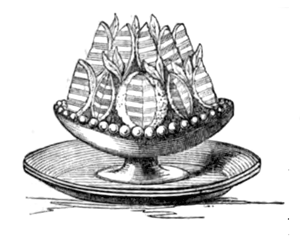 This is one of the fanciful dishes which make a pretty appearance on a supper table, and are acceptable when much variety is desired. Take some very fine China oranges, and with the point of a small knife cut out from the top of each a round about the size of a shilling ; then with the small end of a tea or an egg spoon, empty them entirely, taking great care not to break the rinds. Throw these into cold water, and make jelly of the juice, which must be well pressed from the pulp, and strained as clear as possible. Colour one half a fine rose colour with prepared cochineal, and leave the other very pale; when it is nearly cold, drain and wipe the orange rinds, and fill them with alternate stripes of the two jellies; when they are perfectly cold cut them into quarters, and dispose them tastefully in a dish with a few light branches of myrtle between them. Calf's feet or any other variety of jelly, or different blanc-manges, may be used at choice or fill the rinds; the colours, however, should contrast as much as possible.
TO MAKE ORANGE BASKETS FOR JELLY.
The oranges for these should be large. First, mark the handle of the basket evenly across the stalk end of the fruit with the back of a small knife, or with a silver one, and let it be quite half an inch wide; then trace a line across from one end of the handle to the other exactly in the middle of the orange, and when the other side is marked in the same way, cut just through the rind with the point of a penknife, being careful not to pierce the fruit itself; next, with a tea or dessertspoon, take of the quartered rind on either side of the handle; pass a penknife, under the handle itself; work the point of a spoon gently between the orange and the basket, until they are separated in every part; then take the fruit between the thumb and fingers, and press it carefully out through one of the spaces on either side of the handle.
Baskets thus made may be filled with any of the jellies of which the receipts are given here: but they should be nearly cold before they are poured in; and they ought also to be very clear. Some of the baskets may be filled with ratafias, and dished alternately with those which contain the jelly.
LEMON CALF'S FEET JELLY.
Break up a quart of strong calf's feet stock, which should have been measured while in a liquid state; let it be quite clear of fat and sediment, for which a small additional quantity should be allowed; add to it a not very full half-pint of strained lemon-juice, and ten ounces of sugar, broken small (rather more or less according to the state of the fruit), the rind of one lemon pared as thin as possible, or of from two to three when a full flavour of it is liked, and the whites with part of the shells crushed small, of five large or of six small eggs. Proceed as for the preceding jellies, and when the mixture has boiled five minutes throw in a small pinch of isinglass; continue the boiling for five or six minutes longer, draw the pan from the fire, let it stand to settle; then turn it into the jelly-bag. We have found it always perfectly clear with once passing through; but should it not be so, pour it in a second time.
Strong calf's feet stock, 1 quart; strained lemon-juice, short 1/2 pint; sugar, 10 oz. (more or less according to state of fruit) ; rind of from 1 to 3 large lemons; whites and part of shells of 5 large or 6 small eggs: 5 minutes. Pinch of isinglass: 5 minutes longer.
Obs.—About seven large lemons will produce the half pint of juice. This quantity is for one mould only. The jelly will be found almost colourless unless much of the rinds be used, and as perfectly transparent as clear spring water: it is also very agreeable in flavour. For variety, part of the juice of the fruit might be omitted, and its place supplied by maraschino, or any other rich white liqueur of appropriate flavour; and to render it safer eating, some syrup of preserved ginger would be an excellent addition.
CONSTANTIA JELLY.
Infuse in a pint of water for five minutes the rind of half a Seville orange, pared extremely thin; add an ounce of isinglass; and when this is dissolved throw in four ounces of good sugar in lumps; stir well, and simmer the whole for a few minutes, then mix with it four large wineglassesful of Constantia, and strain the jelly through a fine cloth of close texture; let it settle and cool, then pour it gently from any sediment there may be, into a mould which has been laid for an hour or two into water. We had this jelly made in the first instance for an invalid who was forbidden to take acids, and it proved so agreeable in flavour that we can recommend it for the table. The isinglass, with an additional quarter of an ounce, might be clarified, and the sugar and orange-ring boiled with it afterwards.
Water, 1 pint; rind, 1/2 Seville orange: 5 minutes. Isinglass, 1 oz.; sugar, 4 oz.: 5 to 7 minutes. Constantia, 4 large wineglassesful.
RHUBARB ISINGLASS JELLY.
(Author's Original Receipt. Good.)
A jelly of beautiful tint, and excellent flavour, may be made with fresh young rhubarb-stems, either of the giant or dwarf kind, if they be of a bright pink colour. Wash, and drain or wipe them; slice without paring them, taking them quite free from any coarse or discoloured parts. Put two pounds and a half, and a quart of water into an enamelled stewpan, which is more suitable to the purpose than any other; throw in two ounces of sugar in lumps, and boil the rhubarb very gently for twenty minutes, or until it is thoroughly stewed, but not sufficiently so to thicken the juice. Strain it through a muslin folded in four; measure a pint and a half of it; heat it afresh in a clean pan; add an ounce and a half of the finest isinglass, and six ounces or more of the best sugar in large lumps; stir it often until the isinglass is entirely dissolved, then let it boil quickly for a few minutes to throw up the scum; clear this off carefully, and strain the jelly twice through a muslin strainer,* folded as the first ; let it cool, and mould it as usual.
STRAWBERRY ISINGLASS JELLY.
A great variety of equally elegant and excellent jellies for the table may be made with clarified isinglass, clear syrup, and the juice of almost any kind of fresh fruit; but as the process of making them is nearly the same for all, we shall limit our receipts to one or two, which will serve to direct the makers for the rest. Boil together quickly for fifteen minutes one pint of water and three quarters of a pound of very good sugar; measure a quart of ripe richly-flavoured strawberries without their stalks; the scarlet answer best, from the colour they give: on these pour the boiling syrup, and let them stand all night. The next day clarify two ounces and a half of isinglass in a pint of water, as directed at the beginning of this chapter; drain the syrup from the strawberries very closely, add to it two or three tablespoonsful of red currant juice, and the clear juice of one large or two small lemons; and when the isinglass is nearly cold mix the whole, and put it into moulds. The French, who excel in these fruit-jellies, always mix the separate ingredients when they are almost cold; and they also place them over ice for an hour or so after they are moulded, which is a great advantage, as they then require less isinglass, and are in consequence much more delicate. Wen the fruit abounds, instead of throwing it into the syrup, bruise lightly from three to four pints, throw two tablespoonsful of sugar over it, and let the juice flow from it for an hour or two; then pour a little water over, and use the juice without boiling, which will give a jelly of finer flavour than the other.
Water, 1 pint; sugar, 3/4 lb.: 15 minutes. Strawberries, 1 quart; isinglass, 2 1/2 oz.; water, 1 pint (white of egg, 1 to 2 teaspoonsful); juice, 1 large or 2 small lemons.
FANCY JELLIES.
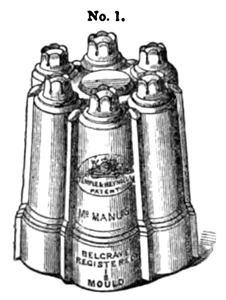
 Description of Belgrave Mould
Figure No. 1, represents the mould in its entireness. No. 2, shows the interior of it (inverted). A is a thin metal plate which when turned downwards forms the bottom of the mould, and which is perforated in places to permit the fluted columns B to pass through it. There is also a larger aperture in the middle to admit the centre cylinder. The plate is fixed, and the whole held in its place by the part which folds over the larger scallop D at either end. There is also a cover which fits to the mould, and which is pressed on it before it is dipped into water, to prevent its getting into the cylinders.

Transparent jelly is shown to much advantage, and is particularly brilliant in appearance, when moulded in shapes resembling that of the engraving here, which are now very commonly used for the purpose.
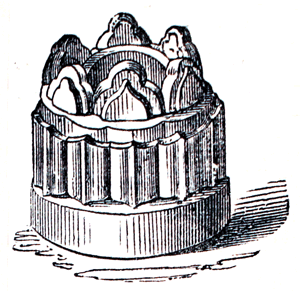
The centre spaces can be filled, after the jelly is dished, with very light whipped cream, coloured and flavoured so as to eat agreeably with it, and to please the eye as well : this may be tastefully garnished with preserved, or with fresh fruit; but one of more recent invention, called the
Belgrave mould (which is to be had of the originators, Messrs. Temple and Reynolds, Princes Street, Cavendish Square, and also at 80, Motcomb Street, Belgrave Square), is of superior construction for the purpose, as it contains a large central cylinder and six smaller ones, which when withdrawn, after the jelly—which should be poured round, but not
into them—is set, leave vacancies which can be filled either with jelly of another colour, or with fruit of different kinds (which must lie secured in its place with
just liquid jelly poured carefully in after it is arranged), or with blanc-mange, or any other isinglass-cream. The space occupied by the larger cylinder may be left empty, or filled before the jelly is served, with white or with pale-tinted whipped cream. Water, only sufficiently warm to detach the jelly from them without heating or melting it, must be poured into the cylinders to
unfix them; and to loosen the whole so as to unmould it easily, a clot wrung out of very hot water must be wound round it, or the mould must be dipped
quickly into some which is nearly or quite boiling. A dish should then be laid on it, it should be carefully reversed, and the mould lifted from it gently. It will sometimes require a slight sharp blow to detach it quite.
Italian jelly is made by half filling a mould of convenient form, and laying round upon it in a chain, as soon as it is set, some blanc-mange made rather firm, and cut of equal thickness and size, with a small round cutter ; the mould is then filled with the remainder of the jelly, which must be nearly cold, but not beginning to set. Brandied, morella cherries, drained very dry, are sometimes dropped into moulds of pale jelly; and fruits, either fresh or reserved, are arranged in them with exceedingly good effect when skilfully managed; but this is best accomplished by having a mould for the purpose, with another of smaller size fixed in it by means of slight wires, which hook on to the edge of the outer one. By pouring water into this it may easily be detached from the jelly; the fruit is then to be placed in the space left by it, and the whole filled up with more jelly: to give the proper effect, it must be recollected that the dish will be reversed when sent to table.
QUEEN MAB'S PUDDING.
(An Elegant Summer Dish.)
Throw into a pint of new milk the thin rind of a small lemon, and six or eight bitter almonds, blanched and bruised; or substitute for these half a pod of vanilla cut small, heat it slowly by the side of the fire, and keep it at the point of boiling until it is strongly flavoured, then add a small pinch of salt, and three-quarters of an ounce of the finest isinglass, or a full ounce should the weather be extremely warm; when this is dissolved, strain the milk through a muslin, and put it into a clean saucepan, with from four to five ounces and a half of sugar in lumps, and half a pint of rich cream; give the whole one boil, and then stir it briskly and by degrees, to the well-beaten yolks of six fresh eggs; next, thicken the mixture as a custard, over a gentle fire, but do not hazard its curdling; when it is of tolerable consistence, pour it out, and continue the stirring until it is half cold, then mix with it an ounce and a half of candied citron, cut in small spikes, and a couple of ounces of dried cherries, and pour it into a mould rubbed with a drop of oil: when turned out it will have the appearance of a pudding. From two to three ounces of preserved ginger, well drained and sliced, may be substituted for the cherries, and an ounce of pistachio-nuts, blanched and split, for the citron; these will make an elegant variety of the dish, and the syrup of the ginger, poured round as a sauce, will be a further improvement. Currants steamed until tender, and candied orange or lemon-rind, are often used instead of the cherries, and the well-sweetened juice of strawberries, raspberries (white or red), apricots, peaches, or syrup of pine-apple, will make an agreeable sauce; a small quantity of this last will also give a delicious flavour to the pudding itself, when mixed with the other ingredients. Cream may be substituted entirely for the milk, when its richness is considered desirable.
New milk, 1 pint; rind 1 small lemon; bitter almonds, 6 to 8 (or, vanilla, 1/2 pod); salt, few grains; isinglass, 3/4 oz. (1 oz. in sultry weather); sugar, 4 1/2 oz.; cream, 1/2 pint; yolks, 6 eggs; dried cherries, 2 oz.; candied citron, 1 1/2 oz.; (or, preserved ginger, 2 to 3 oz., and the syrup as sauce, and 1 oz. of blanched pistachio-nuts; or 4 oz. currants, steamed 20 minutes, and 2 oz. candied orange-rind). For sauce, sweetened juice of strawberries, raspberries, or plums, or pine-apple syrup.
Obs.&#sx2014;The currants should be steamed in an earthen cullender, placed over a saucepan of boiling water, and covered with the lid. It will be a
great improvement to place the pudding over ice for an hour before it is served.
NESSELRODE CREAM.
Shell and blanch (see page 342) twenty-four fine Spanish chestnuts, and put them with three-quarters of a pint of water into a small and delicately clean saucepan. When they have simmered from six to eight minutes, add to them two ounces of fine sugar, and let them stew very gently until they are perfectly tender; then drain them from the water, pound them, while still warm, to a smooth paste, and press them through the back of a fine sieve. While this is being done, dissolve half an ounce of isinglass in two or three spoonsful of water, and put to it as much cream as will, with the small quantity of water used, make half a pint, two ounces of sugar, about the third of a pod of vanilla, cut small, and well bruised, and a strip or two of fresh lemon-rind, pared extremely thin. Give these a minute's boil, and then keep them quite hot by the side of the fire, until a strong flavour of the vanilla is obtained. Now, mix gradually with the chestnuts half a pint of rich, unboiled cream, strain the other half pint through a fine muslin, and work the whole well together until it becomes
very thick; then stir to it a couple of ounces of dried cherries, cut into quarters, and two of candied citron, divided into very small dice. Press the mixture into a mould which has been rubbed with a particle of the purest salad-oil, and in a few hours it will be ready for table. The cream should be sufficiently stiff when the fruit is added, to prevent its sinking to the bottom, and both kinds should be
dry when they are used.
Chestnuts, large, 24; water, 3/4 pint; sugar, 2 oz.; isinglass, 1/2 oz.; water, 3 to 4 tablespoonsful; cream, nearly 1/2 pint; vanilla, 1/2 of pod; lemon-rind, 1/4 of 1 large: infuse 20 minutes or more. Unboiled cream, 1/2 pint; dried cherries, 2 oz.; candied citron, 2 oz.
Obs.—When vanilla cannot easily be obtained, a little noyau may be substituted for it, but a
full weight of isinglass must then be used.
CRÊME A LA COMTESSE, OR THE COUNTESS'S CREAM.
Prepare as above, boil and pound, eighteen fine sound chestnuts; mix with them gradually, after they have been pressed through a fine sieve, half a pint of rich sweet cream; dissolve in half a pint of new milk a half ounce of isinglass, then add to them from six to eight bitter almonds, blanched and bruised, with two-thirds of the rind of a small lemon, cut extremely thin, and two ounces and a half of sugar; let these simmer gently for five minutes, and then remain by the side of the fire for awhile. When the milk is strongly flavoured strain it through muslin, press the whole of it through, and stir it by degrees to the chestnuts and cream; beat the mixture smooth, and when it begins to thicken, put it into a mould rubbed with oil, or into one which has been dipped in water and shaken nearly free of the moisture. If set into a cool place, it will be ready for table in six or eight hours. It has a pretty appearance when partially stuck with pistachio-nuts, blanched, dried, and cut in spikes, their bright green colour rendering them very ornamental to dishes of this kind: as they are, however, much more expensive than almonds, they can be used more sparingly, or intermingled with spikes of the firm outer rind of candied citron.
Chestnuts, 18; water, full 1/2 pint; sugar, 1 oz. : 15 to 20 minutes, or more. Cream, 1/2 pint; new milk, 1/2 pint; isinglass, 1/2 oz.; bitter almonds, 6 to 8; lemon-rind, two-thirds of 1; sugar, 2 1/2 oz.
*
Obs.—This is a very delicate kind of sweet dish, which we can particularly recommend to our readers; it may be rendered more
recherché by a flavouring of maraschino, but must then have a little addition of isinglass. The preparation, without this last ingredient, will be found excellent iced.
AN EXCELLENT TRIFLE.
Take equal parts of wine and brandy, about a wineglassful of each, or two-thirds of good sherry or Madeira, and one of spirit, and soak in the mixture four sponge-biscuits, and half a pound of macaroons and ratafias; cover the bottom of the trifle-dish with part of these, and pour upon them a full pint of rich boiled custard made with three-quarters of a pint, or rather more, of milk and cream taken in equal portions, and six eggs; and sweetened, flavoured and thickened by the receipt of page 481; lay the remainder of the soaked cakes upon it, and pile over the whole, to the depth of two or three inches, the whipped syllabub of page 476, previously well drained; then sweeten and flavour slightly with wine only, less than half a pint of thin cream (or of cream and milk mixed); wash and wipe the whisk, and whip it to the lightest possible froth: take it off with a skimmer and heap it gently over the trifle.
Macaroons and ratafias, 1/2 lb.; wine and brandy mixed, 1/4 pint; rich boiled custard, 1 pint; whipped syllabub (see page 476); light froth to cover the whole, short 1/2 pint of cream and milk mixed; sugar, dessertspoonful; wine, 1/2 glassful.
SWISS CREAM, OR TRIFLE.
(Very Good.)
Flavour pleasantly with lemon rind and cinnamon, a pint of rich cream, after having taken from it as much as will mix smoothly to a thin batter four teaspoonsful of the finest flour; sweeten it with six ounces of well-refined sugar in lumps; place it over a clear fire in a delicately clean saucepan, and when it boils stir in the flour, and simmer it for four or five minutes, stirring it gently without ceasing; then pour it out, and when it is quite cold mix with it by degrees the strained juice of two moderate-sized and very fresh lemons. Take a quarter of a pound of macaroons, cover the bottom of a glass dish with a portion of them, pour in a part of the cream, lay the remainder of the macaroons upon it, add the rest of the cream, and ornament it with candied citron sliced thin. It should be made the day before it is wanted for table. The requisite flavour may be given to this dish by infusing in the cream the very thin rind of a lemon, part of a stick of cinnamon slightly bruised, and then straining it before the flour is added ; or, these and the sugar may be boiled together with two or three spoonsful of water, to a strongly flavoured syrup, which, after having been passed through a muslin strainer, may be stirred into the cream. Some cooks boil the cinnamon and the
grated rind of a lemon with all the other ingredients, but the cream has then to be pressed through a sieve after it is made, a process which it is always desirable to avoid. It may be flavoured with vanilla and maraschino, or with orange-blossoms at pleasure; but is
excellent made as above.
Rich cream, 1 pint; sugar, 6 oz.; rind, 1 lemon; cinnamon, 1 drachm; flour, 4 teaspoonsful; juice, 2 lemons; macaroons, 4oz.; caddied citron, 1 to 2 oz.
TIPSY CAKE, OR BRANDY TRIFLE.
The old-fashioned mode of preparing this dish was to soak a light sponge or Savoy cake in as much good French brandy as it could absorb; then to stick it full of blanched almonds cut into whole-length spikes, and to pour a rich cold boiled custard round it. It is more usual now to pour white wine over the cake, or a mixture of wine and brandy; with this the juice of half a lemon is sometimes mixed.
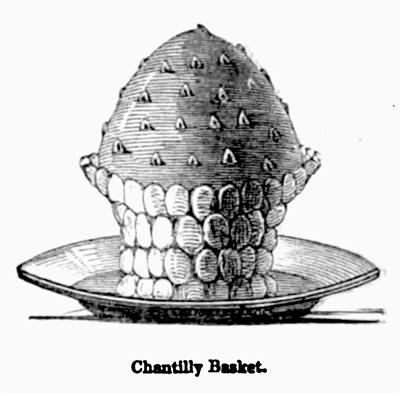 FILLED WITH WHIPPED CREAM AND FRESH STRAWBERRIES.
Take a mould of any sort that will serve to form the basket on, just dip the edge of some macaroons into melted barley sugar, and fasten them together with it; take it out of the mould, keep it in a dry place until wanted, then fill it high with whipped strawberry cream which has been drained on a sieve from the preceding day, and stick very fine ripe strawberries over it. It should not be filled until just before it is served.
VERY GOOD LEMON CREAMS MADE WITHOUT CREAM.
Pour over the very thin rinds of two moderate-sized but perfectly sound fresh lemons and half a pint of spring water, and let them remain for six hours: then add the strained juice of the lemons, and five fresh eggs well beaten and also strained; take out the lemon-rind, and stir the mixture without ceasing over a gentle fire until it has boiled softly from six to eight minutes: it will not curdle as it would did milk supply the place of the water and lemon-juice. The creams are, we think, more delicate, though not quite so thick, when the yolks only of six eggs are used for them. They will keep well for nearly a week in really cold weather.
Rinds of lemons 2; sugar, 6 oz. (or 8 when a
very sweet dish is preferred); cold water, 1/2 pint: 6 hours. Juice of lemons, 2; eggs, 5: to be boiled softly 6 to 8 minutes.
Obs.—Lemon creams may, on occasion, be more expeditiously prepared, by rasping the rind of the fruit upon the sugar which is used for them; or, by paring it thin, and boiling it for a few minutes with the lemon-juice, sugar, and water, before they are stirred to the eggs.
FRUIT CREAMS, AND ITALIAN CREAMS.
These are very quickly and easily made, by mixing with good cream a sufficient proportion of the sweetened juice of fresh fruit, or of well-made fruit jelly or jam, to flavour it: a few drops of prepared cochineal may be added to deepen the colour when it is required for any particular purpose. A quarter of a pint of strawberry or of raspberry jelly will fully flavour a pint of cream: avery little lemon-juice improves almost all compositions of this kind. When jam is used it must first be gradually mixed with the cream, and then worked through a sieve, to take out the seed or skin of the fruit. All fresh juice, for this purpose, must of course, be cold; that of strawberries is best obtained by crushing the fruit and strewing sugar over it. Peaches, pine-apple, apricots, and nectarines, may be simmered for a few minutes in a little syrup, and this, drained well from them will serve extremely well to mix with the cream when it has become thoroughly cold: the lemon-juice should be added to all of these. When the ingredients are well blended, lightly whisk or mill them to a froth; take this off with a skimmer as it rises, and lay it upon a fine sieve reversed, to drain, or if it is to be served in glasses, fill them with it at once.
Italian creams are either fruit-flavoured only, or mixed with wine like syllabubs, then whisked to a stiff froth and put into a perforated mould, into which a muslin is first laid; or into a small hair-sieve (which must also first be lined with the muslin), and left to drain until the following day, when the cream must be very gently turned out, and dished, and garnished, as fancy may direct
VERY SUPERIOR WHIPPED SYLLABUBS.
Weigh seven ounces of fine sugar and rasp on it the rinds of two fresh sound lemons of good size, then pound or roll it to powder, and put it into a bowl with the strained juice of the lemons, two large glasses of sherry, and two of brandy; when the sugar is dissolved add a pint of very fresh cream, and whisk or mill the mixture well; take off the froth as it rises, and put it into glasses. These syllabubs will remain good for several days, and should always be made if possible, four-and-twenty hours before they are wanted for table. The full flavour of the lemon-rind is obtained with less trouble than in rasping, by preparing it very thin indeed, and infusing it for some hours in the juice of the fruit.
Sugar, 7 oz.; rind and juice of lemons, 2; sherry, 2 large wineglassesful; brandy, 2 wineglassesful; cream, 1 pint.
Obs.—These proportions are sufficient for two dozens or more of syllabubs: they are often made with almost equal quantities of wine and cream, but are considered less wholesome without a portion of brandy.
BLANC-MANGES.
GOOD COMMON BLANC-MANGE, on BLANC-MANGER.
(Author's Receipt.)
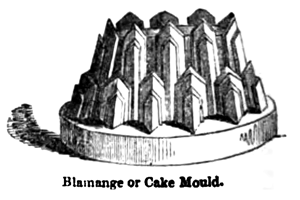 Infuse for an hour in a pint and a half of a new milk the rind of one small, or of half a large lemon and four or five bitter almonds, blanched and bruised,* then add two ounces of sugar, or rather more for persons who like the blanc-mange very sweet, and an ounce and a half of isinglass. Boil them gently over a clear fire, siring them often until this last is dissolved; take off the scum, stir in half a pint, or rather more, of rich cream, and strain the blanc-mange into a bowl; it should be moved gently with a spoon until nearly cold to prevent the cream from settling on the surface. Before it is moulded, mix with it by degrees a wineglassful of brandy.
New milk, 1 1/2 pint; rind of lemon, 1/2 large or whole small; bitter almonds, 8; infuse 1 hour. Sugar, 2 to 3 oz.; isinglass, 1 1/2 oz.: 10 minutes. Cream, 1/2 pint; brandy, 1 wineglassful.
RICHER BLANC-MANGE.
A pint of good cream with a pint of new milk, sweetened and flavoured as above (or in any other manner which good taste may dictate), with a little additional sugar, and the same proportion of isinglass, will make very good blanc-mange. Two ounces of Jordan almonds may be pounded and mixed with it, but they are not needed with the cream.
JAUMANGE, OR JAUNE MANGER, SOMETIMES CALLED DUTCH FLUMMERY.
Pour on the very thin rind of a large lemon and half a pound of sugar broken small, a pint of water, and keep them stirred over a gentle fire until they have simmered for three or four minutes, then leave the saucepan by the side of the stove that the syrup may taste well of lemon. In ten or fifteen minutes afterwards add two ounces of isinglass, and stir the mixture often until this is dissolved, then throw in the strained juice of four sound moderate-sized lemons, and a pint of sherry; mix the whole briskly with the beaten yolks of eight fresh eggs, and pass it through a delicately clean hair-sieve: next thicken it in a jar or jug placed in a pan of boiling water, turn it into a bowl, and when it has become cool and been allowed to settle for a minute or two, pour it into moulds which have been laid in water. Some persons add a small glass of brandy to it, and deduct so much from the quantity of water.
Rind of 1 lemon; sugar, 8 oz.; water, 1 pint: 3 or 4 minutes. Isinglass, 2 oz.; juice, 4 lemons; yolks of eggs, 8; wine, 1 pint; brandy (at pleasure), 1 wineglassful.
EXTREMELY GOOD STRAWBERRY BLANC-MANGE, OR BAVARIAN CREAM.
Crush slightly with a silver or wooden spoon, a quart, measured without their stalks, of fresh and richly-flavoured strawberries; strew over them eight ounces of pounded sugar, and let them stand for three or four hours; then turn them on to a fine hair-sieve reversed, and rub them through it. Melt over a gentle fire two ounces of the best isinglass in a pint of new milk, and sweeten it with four ounces of sugar ; strain it through a muslin, and mix it with a pint and a quarter of sweet thick cream; keep these stirred until they are nearly or quite cold, then pour them gradually to the strawberries, whisking them briskly together; and last of all throw in, by small portions, the strained juice of a fine sound lemon. Mould the blanc-mange, and set it in a very cool place for twelve hours or more before it is served.
Strawberries stalked, 1 quart; sugar, 8 oz.; isinglass 2 oz.; new milk, 1 pint; sugar, 4 oz.; cram, 1 1/2 pint; juice, 1 lemon.
Obs.—We have retained here the old-fashioned name of blanc-mange (or blanc-manger) because it is more familiar to many English readers than any of recent introduction; but moulded strawberry-cream would be more appropriate; as nothing can properly be called blanc manger which is not white. By mingling the cream, after it has been whisked, or whipped, the the other ingredients, the preparation becomes what is called un Fromage Bavarois, or Bavarian cream, sometimes simply, une Bavaroise.
QUINCE BLANC-MANGE.
(Delicious.)
This, if carefully made, and with ripe quinces, is one of the most richly-flavoured preparations of fruit that we have ever tasted; and the receipt, we may venture to say, will be altogether new to the reader. Dissolve in a pint of prepared juice of quinces (see page 456), an ounce of the best isinglass; next, add ten ounces of sugar, roughly pounded, and stir these together gently over a clear fire, from twenty to thirty minutes, or until the juice jellies in falling from the spoon. Remove the scum carefully, and pour the boiling jelly gradually to half a pint of thick cream, stirring them briskly together as they are mixed: they must be stirred until very nearly cold then poured into a mould which has been rubbed in every part with the smallest possible quantity of very pure salad oil, or if more convenient, into one that has been into cold water.
Obs.—This blancmanger which we had made originally on the thought of the moment for a friend, proved so very rich in flavour, that we inserted the exact receipt for it, as we had it made on our first trial ; but it might be simplified by merely boiling the juice, sugar, and isinglass, together for a few minutes, and then mixing them with the cream. An ounce and a half of isinglass and three-quarters of a pint of cream might then be used for it. The juice of other fruit may be substituted for that of the quinces,
Juice of quinces, 1 pint; isinglass, 1 oz.: 5 to 10 minutes. Sugar, 10 oz.: 20 to 30 minutes. Cream, 1/2 pint.
QUINCE BLANC-MANGE, WITH ALMOND CREAM.
When cream is not procurable, which will sometimes happen in the depth of winter, almonds, if plentifully used, will afford a very good substitute, though the finer blanc-mange is made from the foregoing receipt. On four ounces of almonds, blanched and beaten to the smoothest paste, and moistened in the pounding with a few drops of water, to prevent their oiling, pour a pint or boiling quince-juice: stir them together and turn them into a strong cloth, of which let the ends be held and twisted different ways by two persons, to express the cream from the almonds; put the juice again on the fire, with half a pound of sugar, and when it boils, throw in nearly an ounce of fine isinglass; simmer the whole for five minutes, take off the scum, stir the blanc-mange until it is nearly cold, then mould it for table. Increase the quantity both of this and of the preceding blanc-mange, when a large dish of either is required.
Quince-juice, 1 pint; Jordan almonds, 4oz.; sugar, 1/2 lb : isinglass, nearly 1 oz,: 5 minutes.
APRICOT BLANC-MANGE, OR CRÊME PARISIENNE.
Dissolve gently an ounce of fine isinglass in a pint of new milk or of thin cream, and strain it through a folded muslin; put it into a clean saucepan, with three ounces of sugar, broken into small lumps, and when it boils, stir to it half a pint of rich cream; add it, at first by spoonsful only, to eight ounces of the finest apricot jam, mix them very smoothly, and stir the whole until it is nearly cold that the jam may not sink to the bottom of the mould: a tablespoonful of lemon-juice will improve the flavour.
When cream is scarce, use milk instead, with an additional quarter of an ounce of isinglass, and enrich it by pouring it boiling on the same proportion of almonds as for the second quince blanc-mange (see page 478). Cream can in all cases be substituted entirely for the milk, when a very rich preparation is desired. Peach jam will answer admirably for this receipt; but none of any kind should be used for it which has not been passed through a sieve when made.
Isinglass, 1 oz.; new milk, 1 pint; cream, 1/2 pint: sugar, 3 oz.; apricot jam, 1/2 lb; lemon-juice, 1 tablespoonful. Or, peach jam, 1/2 lb.; cream, 1 1/2 pint.
CURRANT BLANC-MANGE.
In three-quarters of a pint of clear currant-juice, drawn from the fruit as for jelly, and strained, dissolve an ounce and a half of isinglass; add nine ounces of sugar broken small, give the whole a boil, strain it, and stir it by slow degrees to three-quarters of a pint of thick cold cream; when it is less than milk-warm pour it into the moulds. The proportions of juice and cream can be varied to the taste, and a portion of raspberries or strawberries added to the currants. Black currants would, we think, make an agreeable variety of this blanc-mange for persons who like their peculiar flavour, but we have not tried them.
Clear juice of red currant, 3/4 pint; isinglass, 1 1/2 oz.; sugar, 9 oz.; cream, 3/4 pint.
LEMON SPONGE, OR MOULDED LEMON CREAM.
Infuse in half a pint of cream the very thin rind of one large lemon, or of one and a half of smaller size; or, instead of this, rasp the fruit with the sugar which is to be used for the preparation. Add three-quarters of an ounce of fine isinglass, and when this is dissolved throw in seven ounces of sugar in small lumps. Do not boil the mixture, to reduce it, but let it be kept near the point of simmering, until the sugar and isinglass are entirely dissolved, and a full flavour of the lemon-rind has been obtained; then stir in another half-pint of cream, and strain the mixture immediately into a deep bowl or pan. When it is quite cold, add to it very gradually the strained juice of one lemon and a half; whisking the preparation well all the time; and when it begins to set, which may be known by its becoming very thick, whisk it lightly to a sponge, pour it into an oiled mould, and, to prevent its breaking when it is dished, just dip the mould into hot, but not boiling water; loosen the edges carefully, and turn out the cream: to save time and trouble the whisking may be omitted, and a plain lemon-cream take place of the sponge.
Cream, 1 pint; rind of lemons 2 middling-sized, or 1 1/2 large; isinglass, 3/4 oz.; sugar, 7 oz. juice of 1 1/2 lemon.
Obs.—For this, as for all other dishes of the kind, a little more or less of isinglass may be required according to the state of the weather, a larger proportion being needed in summer than in winter.
AN APPLE HEDGE-HOG, OR SUÉDOISE,
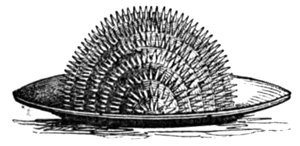 This dish is formed of apples, pared, cored without being divided, and stewed tolerably tender in a light syrup. These are placed in a dish, after being well drained, and filled with apricot, or any other rich marmalade, and arranged in two or more layers, so as to give, when the whole is complete, the form shown in the engraving. The number required must depend on the size of the dish. From three to five pounds more must be stewed down into a smooth and dry marmalade, and with this all the spaces between them are to be filled up, and the whole are to be covered with it; an icing of two eggs, beaten to a very solid froth, and mixed with two heaped teaspoonsful of sugar, must then be spread evenly over the suédoise, fine sugar sifted on this, and spikes of blanched almonds, cut lengthwise, stuck over the entire surface; the dish is then to be placed in a moderate oven until the almonds are browned but not too deeply, and the apples are hot through. It is not easy to give the required form with less than fifteen apples; eight of these may first be simmered in a syrup made with half a pint of water and six ounces of sugar, and the remainder may be thrown in after these are lifted out. Care must be taken to keep them firm. The marmalade should be sweet, and pleasantly flavoured with lemon.
[
IMPERIAL GOOSEBERRY-FOOL.‡
Simmer a pound of green gooseberries which have been freed from the buds and stalks, in three-quarters of a pint of water, until they are well broken, then strain them, and to half a pound of the juice add half a pound of sugar, broken small: boil these together for fifteen minutes. Dissolve half an ounce of isinglass in a quarter-pint of rich cream, pour them into a basin, and stir them till only lukewarm, then mix them by degrees with the sugar and gooseberry-juice, which should also have been allowed to cool; add the strained juice of half a small lemon, and mould the mixture, which should stand at least twelve hours, in a cool place, before it is turned out.
Those proportions are sufficient for a small mould only, and must be doubled for a large one. The dish is too sweet for our own taste, but as it has been highly approved by several persons who have tasted it, we give the receipt exactly as we had it tried in the first instance: it will be found extremely easy to vary it.
]
VERY GOOD OLD-FASHIONED BOILED CUSTARD.
Throw into a pint and a half of new milk, the very thin rind of a fresh lemon, and let it infuse for half an hour, then simmer them together for a few minutes, and add four ounces and a half of white sugar. Beat thoroughly the yolks of fourteen fresh eggs, mix with them another half-pint of new milk, stir the boiling milk quickly to them, take out the lemon-peel, and turn the custard into a deep jug; set this over the fire in a pan of boiling water, and keep the custard stirred gently, but without ceasing, until it begins to thicken; then move the spoon rather more quickly, making it always touch the bottom of the jug, until the mixture is brought to the point of boiling, when it must be instantly taken from the fire, or it will curdle in a moment. Pour it into a bowl, and keep it stirred until nearly cold, then add to it by degrees a wineglassful of good brandy, and two ounces of blanched almonds, cut into spikes; or omit these, at pleasure. A few bitter ones, bruised, can be boiled in the milk in lieu of lemon-peel, when their flavour is preferred.
New milk, 1 quart; rind of 1 lemon; sugar, 4 1/2 oz.; yolks of eggs, 14; salt, less than 1/4 saltspoonful.
RICH BOILED CUSTARD.
Take a small cupful from a quart of fresh cream, and simmer the remainder for a few minutes with four ounces of sugar and the rind of a lemon, or give it any other flavour that may be preferred. Beat and strain the yolks of eight eggs, mix them with the cupful of cream, and stir the rest boiling to them: thicken the custard like the preceding one.
Cream, 1 quart; sugar, 4 oz.; yolks of eggs, 8.
THE QUEEN'S CUSTARD.
On the beaten and strained yolks of twelve new-laid eggs pour a pint and a half of boiling cream which has been sweetened, with three ounces of sugar; add the smallest pinch of salt, and thicken the custard as usual. When nearly cold, flavour it with a glass and a half of noyau, maraschino, or cuirasseau, and add the sliced almonds or not at pleasure.
Yolks of eggs, 12; cream, 1 1/2 pint; sugar, 3 oz.; little salt; noyau, maraschino, or cuirasseau, 1 1/2 wineglassful.
CURRANT CUSTARD.
Boil in a pint of clear currant-juice ten ounces of sugar for three minutes, take off the scum, and pour the boiling juice on eight well-beaten eggs; thicken the custard in a jug set into a pan of water, pour it out, stir it till nearly cold, then add to it carefully, and by degrees, half a pint of rich cream, and last of all two tablespoonsful of strained lemon-juice. When the currants are very ripe omit one ounce of the sugar.
White currants and strawberries, cherries, red or white raspberries, or a mixture of any of these fruits, may be used for these custards with good effect : they are excellent.
Currant-juice, 1 pint; sugar, 10 oz.: 3 minutes. Eggs, 8; cream, 1/2 pint; lemon-juice, 2 tablespoonsful.
QUINCE OR APPLE CUSTARDS.
Add to a pint of apple-juice prepared as for jelly, a tablespoonful of strained lemon-juice, and from four to six ounces of sugar according to the acidity of the fruit; stir these boiling, quickly, and in small portions, to eight well-beaten eggs, and thicken the custard in a jug placed in a pan of boiling water, in the usual manner. A larger proportion of lemon-juice and a high flavouring of a rind can be given when approved. For quince custards, which if well made are excellent, observe the same directions as for the apple, but omit the lemon-juice. As we have before observed, all custards are much finer when made with the yolks only of the eggs, of which the number must be increased nearly half, when this is done.
Prepared apple-juice (see page 456), 1 pint; lemon-juice, 1 tablespoonful; sugar, 4 to 6 oz.; eggs, 8. Quince custards, same proportions, but no lemon-juice.
Obs.—In making lemon-creams the apple-juice may be substituted very advantageously for water, without varying the receipt in other respects.
THE DUKE'S CUSTARD.
Drain well from their juice, and then roll in dry sifted sugar, as many fine brandied Morella cherries as will cover thickly the bottom of the dish in which this is to be sent to table; arrange them in it, and pour over them from a pint to a pint and a half of rich cold boiled custard; garnish the edge with macaroons or Naples biscuits, or pile upon the custard some solid rose-coloured whipped cream, highly flavoured with brandy.
Brandied Morella cherries, 1/2 to whole pint; boiled custard, from 1 to 1 1/2 pint; thick cream, 1/2 pint or more; brandy, 1 to 2 glassesful ; sugar, 2 to 3 oz.; juice of 1/2 large lemon; prepared cochineal, or carmine, 20 to 40 drops.
CHOCOLATE CUSTARDS.
Dissolve gently by the side of the fire an ounce and a half of the best chocolate in rather more than a wineglassful of water, and then boil it until it is perfectly smooth; mix with it a pint of milk well flavoured with lemon peel or vanilla, add two ounces of fine sugar, and when the whole boils, stir it to five well-beaten eggs which have been strained. Put the custard into a jar or jug, set into a pan of boiling water, and stir it without ceasing until it is thick. Do not put it into glasses or a dish until it is nearly quite cold. These, as well as all other custards, are infinitely finer when made with the yolks only of the eggs, of which the number must then be increased. Two ounces of chocolate, a pint of milk, half a pint of cream, two or three ounces of sugar, and eight yolks of eggs, will make very superior custards of this kind.
Rasped chocolate, 1 1/2 oz.; water, 1 large wineglassful: 5 to 8 minutes. New milk, 1 pint; eggs, 5; sugar, 2 oz. Or: chocolate, 2 oz.; water, 1/4 pint; new milk, 1 pint: sugar, 2 1/2 to 3 oz.; cream, 1/2 pint; yolks of eggs, 8.
Obs.—Either of these may be moulded by dissolving from half to three quarters of an ounce of isinglass in the milk. The proportion of chocolate can be increased to the taste.
COMMON BAKED CUSTARD.
Mix a quart of new milk with eight well beaten eggs, strain the mixture through a fine sieve, and sweeten it with from five to eight ounces of sugar, according to the taste; add a small pinch of salt, and pour the custard into a deep dish with or without a lining or rim of paste, grate nutmeg or lemon rind over the top, and bake it in a very slow oven from twenty to thirty minutes, or longer, should it not be firm in the centre. A custard, if well made, and properly baked, will be quite smooth when cut, without the honey-combed appearance which a hot oven gives; and there will be no whey in the dish.
New milk, 1 quart; eggs, 8; sugar, 5 to 8 oz.; salt, 1/4 saltspoonful; nutmeg or lemon-grate: baked, slow oven, 30 to 40 minutes, or more.
A FINER BAKED CUSTARD.
Boil together gently, for five minutes, a pint and a half of milk, a few grains of salt, the very thin rind of a lemon, and six ounces of loaf sugar; stir these boiling, but very gradually, to the well-beaten yolks of ten fresh eggs, and the whites of four; strain the mixture, and add to it half a pint of good cream; let it cool, and then flavour it with a few spoonsful of brandy, or a little ratafia; finish and bake it by the directions given for the common custard above; or pour it into small well-buttered cups, and bake it very slowly from ten to twelve minutes.
FRENCH CUSTARDS OR CREAMS.
To a quart of new milk allow the yolks of twelve fresh eggs, but to equal parts of milk and cream of ten only. From six to eight ounces o sugar will sweeten the custard sufficiently for general taste, but more can be added at will; boil this for a few minutes gently in the milk with a grain or two of salt, and stir the mixture briskly to the eggs, as soon as it it taken from the fire. Butter a round deep dish, pour in the custard, and place it in a pan of water at the point of boiling, taking care that it shall not reach to within an inch of the edge; let it just simmer, and no more, from an hour to an hour and a half: when quite firm in the middle, it will be done. A very few live embers should be kept on the lid of the stewpan to prevent the steam falling from it into the custard. When none is at hand of a form to allow of this, it is better to use a charcoal fire, and to lay an oven-leaf, or tin, over the pan, and the embers in the centre. The small French furnace, shown in Chapter XXIII., is exceedingly convenient for preparations of this kind; and there is always more or less of difficulty in keeping a coal fire entirely free from smoke for any length of time. Serve the custard cold, with chopped macaroons, or ratafias, laid thickly round the edge so as to form a border an inch deep. A few petals of fresh orange-blossoms infused in the milk will give it a most agreeable flavour, very superior to that derived from the distilled water. Half a pound of vanilla, cut in short lengths, and well bruised, may be used instead of either; but the milk should then stand some time by the fire before or after it boils, and it must be strained through a muslin before it is added to the eggs, as the small seed of the vanilla would probably pass through a sieve.
The French make their custards, which they call crémes, also in small china cups, for each of which they allow one egg-yolk, and then add sufficient milk or cream to nearly fill them ; they sweeten and give them a delicate flavour; and simmer them in a pan of water until they are set.
New milk, 1 quart; yolks of eggs, 12; sugar, 6 to 8 oz. Or: new milk, 1 pint; cream, 1 pint; yolks of eggs, 10; flavouring of orange-flowers or vanilla: simmered in water-bath, 1 to 1 1/2 hour.
GERMAN PUFFS.
Pound to a perfectly smooth paste two ounces of Jordan almonds and six bitter ones; mix with them, by slow degrees, the yolks of six and the whites of three eggs. Dissolve in half a pint of rich cream, four ounces of fresh butter, and two of fine sugar; pour these hot to the eggs, stirring them briskly together, and when the mixture has become cool, flavour it with half a glass of brandy, of cuirasseau, or of orange-flower water; or, in lieu of either, with a little lemon-brandy. Butter some some cups thickly, and strew into them a few slices of candied citron, or orange-rind; pour in the mixture, and bake the puffs twenty minutes, in a slow oven.
Jordan almonds, 2 oz.; bitter almonds, 6; eggs, whites, 3—yolks, 6; cream, 1/2 pint; butter, 4 oz.; sugar, 2 oz.; brandy, cuirasseau, or orange-flower water, 1/2 wineglassful (or little lemon-brandy): 20 minutes, slow oven.
A MERINGUE OF RHUBARB, OR GREEN GOOSEBERRIES.
Weigh a pound of delicate young rhubarb-stems after they have been carefully pared and cut into short lengths; mix eight ounces of pounded sugar with them, and stew them gently until they form a smooth pulp; then quicken the boiling, and stir them often until they are reduced to a tolerably dry marmalade. When the fruit has reached this point turn it from the pan and let it stand until it is quite cold. Separate the whites of four fresh eggs carefully from the yolks, and whisk them to a froth sufficiently solid to remain standing in points when it is dropped form the whisk or fork. Common cooks sometimes fail entirely in very light preparations from not properly understanding this extremely easy process, which requires nothing beyond plenty of space in the bowl or basin used, and regular but not violent whisking until the eggs whiten, and gradually assume the appearance of snow. No drop of liquid must remain at the bottom of the basin, and the mass must be firm enough to stand up, as has been said, in points. When in this state, mingle with it four heaped tablespoonsful of dry sifted sugar, stir these gently together, and when they are quite mixed, lay them lightly over the rhubarb in a rather deep tart-dish. Place the meringue in a moderate oven and bake it for about half an hour, but ascertain, before it is served, that the centre is quite firm. The crust formed by the white of egg and which is in fact the meringue, should be of a light equal brown, and crisp quite through. If placed in an exceedingly slow oven, the underpart of it will remain half liquid, and give an uninviting appearance to the fruit when it is served. Unless the rhubarb should be very acid, six ounces of sugar will be sufficient to sweeten it for many tastes. It is a great improvement to this dish to diminish the proportion of fruit, and to pour some thick boiled custard upon it before the meringue is laid on.
Obs.—When gooseberries are substituted for spring-fruit, a pint and a half will be sufficient for this preparation, or even a smaller proportion when only one of quite moderate size is required. In the early part of their season they will be more acid even than the rhubarb, and rather more sugar must be allowed for them.
CREAMED SPRING FRUIT, OR RHUBARB TRIFLE.
Boil down the rhubarb with seven ounces of sugar, after having prepared it as above, and when it is perfectly cold, but not long before it is sent to table, pour over it about half a pint of rich boiled custard also quite cold, then heap on this some well drained, but slightly-sweetened whipped cream, which should be good and very fresh when it is whisked, but not heavily thick, or it will be less easily converted into a snow-froth. The rhubarb will be very nice if served with the whipped cream only on it.
MERINGUE OF PEARS, OR OTHER FRUIT.
Fill a deep tart-dish nearly to the brim with stewed pears, and let them be something more than half covered with their juice. Whisk to a solid froth the whites of five eggs; stir to them five tablespoonsful of dry sited sugar, and lay them lightly and equally over the fruit; put the meringue immediately into a moderate oven, and bake it half an hour. Cherries, bullaces, and damsons, with various other kinds of plums first either stewed as for compôtes (see page 457), or baked with sugar, as for winter use, answer as well as pears for this dish; which may, likewise, be made of apples, peaches, apricots, or common plums boiled down quite to a marmalade, with sufficient sugar to sweeten them moderately: the skins and stones of these last should be removed, but a few of the blanched kernels may be added to the fruit.
Dish filled with stewed pears or other fruit; whites of eggs, 5; pounded sugar, 5 tablespoonsful: baked, 1/2 hour.
AN APPLE CHARLOTTE, OR CHARLOTTE DE POMMES.
 Butter a plain mould (a round or square cake-tin will answer the purpose quite well), and line it entirely with thin slices of the crumb of a stale loaf, cut so as to fit into it with great exactness, and dipped into clarified butter. When this is done, fill the mould to the brim with apple marmalade; cover the top with slices of bread dipped in butter, and on these place a dish, a large plate, or the cover of a French stewpan with a weight upon it. Send the Charlotte to a brisk oven for three quarters of an hour should it be small, and for an hour if large. Turn it out with great care, and serve it hot. If baked in a slack oven it will not take a proper degree of colour, and it will be liable to break in the dishing. The strips of bread must of course join very perfectly, for if any spaces were left between them the syrup of the fruit would escape and destroy the good appearance of the dish: should there not have been sufficient marmalade prepared to fill the mould entirely, a jar of quince or apricot jam, or of preserved cherries even, may be added to it with advantage. The butter should be well drained from the Charlotte before it is taken from the mould; and sugar may be sifted thickly over it before it is served, or it may be covered with any kind of clear red jelly.
A more elegant, and we think an easier mode of forming the crust, is to line the mould with small rounds of bread stamped out with a plain cake or paste cutter, then dipped in butter, and placed with the edges sufficiently one over the other to hold the fruit securely : the strips of bread are sometimes arranged in the same way.
3/4 to 1 hour, quick oven.
MARMALADE FOR THE CHARLOTTE.
Weigh three pounds of good boiling apples, after they have been pared, cored, and quartered; put them into a stewpan with six ounces of fresh butter, three quarters of a pound of sugar beaten to powder, three quarters of a teaspoonful of pounded cinnamon, and the strained juice of a lemon; let these stew over a gentle fire, until they form a perfectly smooth and dry marmalade; keep them often stirred that they may not burn, and let them cool before they are put into the crust. This quantity is for a moderate-sized Charlotte.
A CHARLOTTE A LA PARISIENNE.
This dish is sometimes called in England a Vienna cake; and it is known here also, we believe, as a Gâteaux de Bordeaux. Cut horizontally into half-inch slices a Savoy or sponge cake, and cover each slice with a different kind of preserve; replace them in their original form, and spread equally over the cake an icing made with the whites of three eggs, add four ounces of the finest pounded sugar; sift more sugar over it in every part, and put it into a very gentle oven to dry. The eggs should be whisked to snow before they are used. One kind of preserve, instead of several, can be used for this dish; and a rice or a pound cake may supply the place of the Savoy or sponge biscuit.
A GERTRUDE A LA CREME.
Slice a plain pound or rice cake as for the Charlotte à la Parisienne, and take a round out of the centre of each slice with a tin-cutter before the preserve is laid on; replace the whole in its original form, ice the outside with a green or rose coloured icing at pleasure, and dry it in a gentle oven; or decorate it instead with leaves of almond paste, fastening them to it with white of egg. Just before it is sent to table, fill it with well-drained whipped cream, flavoured as for a trifle or in any other way to the taste.
POMMES AU BEURRE.
(Buttered apples. Excellent.)
Pare six or eight fine apples of a firm but good boiling kind, each core without piercing them through, or dividing them; fill the cavities with fresh butter, put a quarter of a pound more, cut small, into a stewpan just large enough to contain the apples in a single layer, place them closely together on it, and stew them as softly as possible, turning them occasionally until they are almost sufficiently tender to serve; then strew upon them as much sifted sugar as will sweeten the dish highly, and a teaspoonful of pounded cinnamon; shake these well in and upon the fruit, and stew it for a few minutes longer. Lift it out, arrange it in a hot dish, put into each apple as much warm apricot jam as it will contain, and lay a small quantity on the top; pour the syrup from the pan round, but not on the fruit, and serve it immediately.
Apples, 6 to 8; fresh butter, 4 oz., just simmered till tender. Sugar, 6 to 8 oz.; cinnamon, 1 teaspoonful : 5 minutes. Apricot jam as needed.
Obs.—Particular care must be taken to keep the apples entire; they should rather steam in a gentle heat than boil. It is impossible to specify the precise time which will render them sufficiently tender, as this must depend greatly on the time of year and the sort of fruit. If the stewpan were placed in a very slow oven, the more regular heat of it would perhaps be better in its effect than the stewing.
SUÉDOISE OF PEACHES.
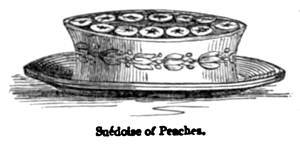 Pare and divide four fine, ripe peaches, and let them just simmer from five to eight minutes in a syrup made with the third of a pint of water and three ounces of very white sugar, boiled together for fifteen minutes; lift them out carefully into a deep dish, and pour about half the syrup over them, and into the remaining half throw a couple of pounds more of quite ripe peaches, and boil them to a perfectly smooth dry pulp or marmalade, with as much additional sugar in fine powder, as the nature of the fruit may require. Lift the other peaches from the syrup, and reduce it by very quick boiling, more than half. Spread a deep layer of the marmalade in a dish, arrange the peaches symmetrically round it, and fill all the spaces between them with the marmalade; place the half of a blanched peach-kernel in each, pour the reduced syrup equally over the surface, and form a border round the dish with Italian macaroons, or, in lieu of these, with candied citron, sliced very thin, and cut into leaves with a small paste-cutter. A little lemon-juice brings out the flavour of all preparations of peaches, and may be added with good effect to this. When the fruit is scarce, the marmalade (which ought to be very white) may be made in part, or entirely, with nonsuches. The better to preserve their form, the peaches are sometimes merely wiped, and then boiled tolerably tender in the syrup before they are pared or split. Half a pint of water, and from five to six ounces of sugar must then he allowed for them. If any of those used for the marmalade should not be quite ripe, it will be better to pass it through a sieve, when partially done, to prevent its being lumpy.
Large ripe peaches, pared and halved, 4: simmered in syrup, 5 to 8 minutes. Marmalade: peaches (or nonsuches) 2 lbs.; sugar, 1/2 to 3/4 lb.: 3/4 to 1 hour, or more. Strained lemon-juice, 1 tablespoonful. Citron, or macaroons, as needed.
Peaches, if boiled whole in syrup, 15 to 18 minutes.
Obs.—The number of peaches can, at pleasure, be increased to six, and three or four of the halves can be piled above the others in the centre of the dish.
AROCē DOCē. (OR SWEET RICE, A LA PORTUGAISE.)
Wash thoroughly, then drain, and wipe dry in a soft cloth half a pound of the best Carolina rice. Pour to it three pints of new milk, and when it has gently stewed for half an hour, add eight ounces of sugar broken into small lumps, let it boil until it is dry and tender, and when it is nearly so, stir to it two ounces of blanched almonds, chopped* or pounded. Turn the rice when done into shallow dishes or soup plates, and shake it until the surface is smooth; then sift over it rather thickly through a muslin, some freshly-powdered cinnamon, which will give it the appearance of a baked pudding. Serve it cold. It will remain good for several days. This is quite the best sweet preparation of rice that we have ever eaten, and it is a very favourite dish in Portugal, whence the receipt was derived. One or two bitter almonds, pounded with the sweet ones, might a little improve its flavour, and a few spoonsful of rich cream could occasionally be substituted for a small portion of the milk, but it should not be added until the preparation is three parts done.
Rice, 8 oz.; milk, 3 pints: 30 minutes. Sugar, 8 oz.: 1 hour or more. Pounded almonds, 2 oz.; cinnamon, 1 teaspoonful.
Obs.—The rice must be frequently stirred while boiling, particularly after it begins to thicken; and it will be better not to add the entire quantity of milk at first, as from a quarter to half a pint less will sometimes prove sufficient. The grain should be thoroughly tender, but dry and unbroken.
COCOA-NUT DOCE.
This is merely fine fresh lightly grated cocoa-nut stewed until tender in syrup, made with one pound of sugar to half a pint of water (or more to the taste) and devoured with orange-flower water.
BUTTERED CHERRIES. (CERISES AU BEURRE.)
Cut four ounces of the crumb of a stale loaf into dice, and fry them a light brown in an ounce and a half of fresh butter; take them up, pour the butter from the pan, and put in another ounce and a half; to this add a pound of Kentish cherries without their stalks, and when they are quite warmed through, strew in amongst them four ounces of sugar, and keep the whole well turned over a moderate fire; pour in gradually half a pint of hot water, and in fifteen minutes the cherries will be tender. Lay the fried bread into a hot dish, pour the cherries on it, and serve them directly.
Bread, 4 oz.; butter, 1 1/2 oz. Cherries, 1 lb.; butter, 1 1/2 oz.: 10 minutes. Sugar, 4 oz.; water, 1/2 pint: 15 minutes.
Obs.—Black-heart cherries may be used for this dish instead of Kentish ones: it is an improvement to stone the fruit. We think our readers generally would prefer to the above Morella cherries stewed from five to seven minutes, in syrup (made by boiling five ounces of sugar in half pint of water, for a quarter of an hour), and poured hot on the fried bread. Two pounds of the fruit, when it is stoned, will be required for a full-size dish.
SWEET MACARONI.
Drop gently into a pint and a half of new milk, when it is boiling fast, four ounces of pipe macaroni, add a grain or two of salt, and some thin strips of lemon or orange rind: cinnamon can be substituted for these when preferred. Simmer the macaroni by a gentle fire until it is tolerably tender, then add from two to three ounces of sugar broken small, and boil it till the pipes are soft, and swollen to their full size; drain and arrange it in a hot dish; stir the milk quickly to the well-beaten yolks of three large, or of four small eggs, shake them round briskly over the fire until they thicken, pour them over the macaroni and serve it immediately; or instead of the eggs, heat and sweeten some very rich cream, pour it on the drained macaroni, and dust finely-powdered cinnamon over through a muslin, or strew it thickly with crushed macaroons. For variety, cover it with the German sauce of page 403, milled to a light froth.
New milk, 1 1/2 pint; pipe macaroni, 4 oz.; strips of lemon-rind or cinnamon; sugar, 2 to 3 oz.: 3/4 to 1 hour, or more.
BERMUDA WITCHES.
Slice equally some rice, pound, or Savoy cake, not more than the sixth of an inch thick; take off the brown edges, and spread one half of it with Guava jelly, or, if more convenient, with fine strawberry, raspberry, or currant jelly of the best quality (see Norman receipt, 478); on this strew thickly some cocoa-nut grated small and lightly; press over it the remainder of the cake, and trim the whole into good form; divide the slices if large, pile them slopingly in the centre of a dish upon a very white napkin folded flat, and garnish or intersperse them with small sprigs of myrtle. For very young people a French roll or two, and good currant jelly, red or white, will supply a wholesome and inexpensive dish.
NESSELRODE PUDDING.
We give Monsieur Carème's own receipt for this favourite and fashionable dish, not having ourselves had a good opportunity of proving it; but as it originated with him he is the best authority for it. It may be varied in many ways, which the taste or ingenuity of the reader will easily suggest. Boil forty fine sound Spanish chestnuts quite tender in plenty of water, take off the husks, and pound the chestnuts perfectly with a few spoonsful of syrup; rub them through a fine sieve, and mix them in a basin with a pint of syrup made with a pound of sugar clarified, and highly-flavoured with a pod of vanilla, a pint of rich cream, and the yolks of twelve eggs; thicken the mixture like a boiled custard; when it is cold put it into a freezing pot, adding a glass of maraschino, and make it set as an iced cream; then add an ounce of preserved citron cut in dice, two ounces of currants, and as many fine raisins stoned and divided (all of which should be soaked from the day before in some maraschino with a little sugar); the whole thus mingled, add a plateful of whipped cream, and the whites of three eggs prepared as for Italian meringue. When the pudding is perfectly frozen, mould it in a pewter mould of the form of a pine-apple, and place it again in the ice till wanted to serve. Preserved cherries may be substituted for the raisins and currants.
Chestnuts, 40; syrup, 1 pint some spoonsful; vanilla, 1 pod; cream, 1 pint; yolk of eggs, 12; maraschino, 1 glassful; citron, 1 oz.; currants, 2 oz.; raisins, 2 oz.; whipped cream, 1 plateful; whites of eggs beaten to snow, 3.
Obs.—As Monsieur Carème directs the eggs for his Italian meringue to be prepared as follows, he probably intends that they should be mixed with the syrup before they are added to the pudding. Boil together half a pound the finest sugar, and half a pint of water, until they begin to be very thick; then, with a wooden spoon, work the sugar against the side of the pan till it whitens; leave it to cool a little, work it again, and then with a whisk mingle with it the eggs whipped to a very firm froth, which ought to produce a preparation very white, smooth, and brilliant.
STEWED FIGS. (A VERY NICE COMPOTE.)
Put into an enamelled or a copper stewpan, four ounces of refined sugar, the very thin rind of a large and fresh lemon, and a pint of cold water. When the sugar is dissolved, add a pound of fine Turkey figs, and place the stewpan on a trivet above a moderate fire, or upon a stove, where they can heat and swell slowly, and be very gently stewed. When they are quite tender, add to them two glassesful of port wine, and the strained juice of the lemon; arrange them in a glass dish, and serve them cold. From two hours to two and a half of the gentlest stewing will generally be sufficient to render the figs fit for table. Orange-juice and rind can be used for them at pleasure, instead of the lemon ; two or three bitter almonds may be boiled in the syrup to give it flavour, and any wine can be used for it which may be preferred, but port is best
This compôte may be served in the second course hot, in a rice border; or cold for dessert.