Eliza Acton's Chapter 15: Game
Welcome to Celtnet's Eliza Acton's Chapter 15 (Game) Page — Here you will find the full text from the fifteenth chapter: Game; of Eliza Acton's Modern Cookery As well as the full text this page also provides links out to the overall index of the book and links to modern redactions of each and every recipe (where practicable). This site builds a complete library of Eliza Acton recipes, allowing the modern cook to make them at home today. Enjoy...

TO CHOOSE GAME.
Buck venison, which is in season only from June to Michaelmas, is considered finer than doe venison, which comes into the market in October and remains in season through November and December: neither should be cooked at any other part of the year. The greater the depth of fat upon the haunch the better the quality of the meat will be, provided it be clear and white, and the lean of a dark hue. If the cleft of the hoof, which is always left on the joint, be small and smooth the animal is young; but it is old when the marks are the reverse of these.* Although the haunch is the prime and favourite joint of venison, the neck and shoulder are also excellent, dressed in various ways, and make much approved pies or pasties as they are usually called. If kept to the proper point, and well dressed, this is the most tender of all meat; but care is necessary to bring it into a fitting state for table without its becoming offensive. A free current of air in a larder is always a great advantage, as it assists materially in preserving the sweetness of every thing which is kept in it, while a close damp atmosphere, on the contrary, is more destructive of animal food of all kinds even than positive heat. The fumes of creosote are said to be an admirable preservative against putrescence, but we have not ourselves yet had experience of the fact. All moisture should be wiped daily, or even more frequently, from the venison, with soft cloths, when any appears upon the surface; and every precaution must be taken to keep off the flies, when the joint is not hung in a wire-safe. Black pepper thickly powdered on it will generally answer the purpose: with common care, indeed, meat may always be protected from their attacks, and to leave it exposed to them in warm weather is altogether inexcusable in the cook.
Hares and rabbits are stiff when freshly killed, and if young, the ears tear easily, and the claws are smooth and sharp. A hare in cold weather will remain good from ten to fourteen days; care only must be taken to prevent the inside from becoming musty, which it will do if it has been emptied in the field. Pheasants, partridges, and other game may be chosen by nearly the same tests as poultry: by opening the bill, the staleness will be detected easily if they have been too long kept. With few exceptions, game depends almost entirely for the fine flavour and the tenderness of its flesh, on the time which it is allowed to hang before it is cooked, and it is never good when very fresh; but it does not follow that it should be sent to table in a really offensive state, for this is agreeable to few eaters and disgusting to many, and nothing should at any time be served of which the appearance or the odour may destroy the appetite of any person present.
TO ROAST A HAUNCH OF VENISON.
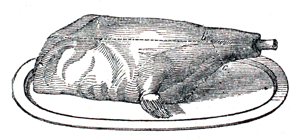 To give venison the flavour and the tenderness so much prized by epicures, it must be well kept; and by taking the necessary precautions, it will hang a considerable time without detriment. Wipe it with soft dry cloths wherever the slightest moisture appears on the surface, and dust it plentifully with freshly-ground pepper or powdered ginger, to preserve it from the flies. The application of the pyroligneous or acetic acid would effectually protect it from these, as well as from the effects of the weather; but the joint must then be, not only well washed, but soaked for some considerable time, and this would be very detrimental.
To prepare the venison for the spit, wash it lightly with tepid water or merely wipe it thoroughly with dam cloths, and dry it afterwards with clean ones; then lay over the fat side a large sheet of thickly-buttered paper, and next a paste of flour and water about three quarters of an inch thick; cover this with two or three sheets of stout paper, secure the whole well with twine, and lay the haunch to a sound clear fire; baste the paper immediately with butter or clarified dripping, and roast the joint from three hours and a half to four and a half, according to its weight and quality. Doe venison will require half an hour less time than buck venison. Twenty minutes before the joint is done remove the paste and paper, baste the meat in every part with butter, and with flour; let it take a pale brown colour, and send it to table as hot as possible with gravy in a tureen, and good current jelly. It is not now customary to serve any other sauces with it; but should the old fashioned sharp or sweet sauce he ordered, the receipt for it will be found at page 100.
3 1/2 to 4 1/2 hours.
Obs.—The kind of gravy appropriate to venison is a matter on which individual taste must decide. When preparations of high savour are preferred to the pure flavour of the game, the Espagnole (or Spanish sauce) of Chapter IV. can be sent to table with it; or either of the rich English gravies which precede it. When a simple unflavoured one is better liked, some mutton cutlets freed entirely from fat, then very slightly broiled over a quick fire, and stewed gently down in a light extract of mutton prepared by Liebeg’s directions, Chapter I., for about an hour, will produce an excellent plain gravy : it should be seasoned with salt and pepper (or fine cayenne) only. When venison abounds, it should be used for the gravy instead of mutton.
TO STEW A SHOULDER OF VENISON.
Bone the joint, by the directions given for a shoulder of veal or mutton (see Chapter XI.); flatten it on a table, season it well with cayenne, salt, and pounded mace, mixed with a very small proportion of allspice; lay over it thin slices of the fat of a loin of well-fed mutton, roll and bind it tightly, lay it into a vessel nearly of its size, and pour to it as much good stock made with equal parts of beef and mutton as will nearly cover it; stew it as slowly as possible from three hours to three and a half or longer, should it be very large, and turn it when it is half done. Dish and serve it with a good Espagnole, made with part of the gravy in which it has been stewed; or thicken this slightly with rice-flour, mixed with a glass or more of claret or of port wine, and as much salt and cayenne as will season the gravy properly.
Some cooks soak the slices of mutton-fat in wine before they are laid upon the joint; but no process of the sort will ever give to any kind of meat the true flavour of the venison, which to most eaters is far finer than that of the wine, and should always be allowed to prevail over all the condiments with which it is dressed. Those, however, who care for it less than for a dish of high artificial savour, can have eschalots, ham, and carrot, lightly browned in good butter, added to the stew when it first begins to boil.
3 1/2 to 4 hours.
TO HASH VENISON.*
For a superior hash of venison, add to three quarters of a pint of strong thickened brown gravy, Christopher North's sauce, in the proportion directed for it in the receipt of page 295.† Cut the venison in small thin slices of equal size, arrange them in a clean saucepan, pour the gravy on them, let them stand for ten minutes or more, then place them near the fire, and bring the whole very slowly to the point of boiling only : serve the hash immediately in a hot-water dish.
For a plain dinner, when no gravy is at hand, break down the bones of the venison small, after the flesh has been cleared from them, and boil them with those of three or four undressed mutton-cutlets, a slice or two of carrot, or a few savoury herbs, and about a pint and a half of water or broth, until the liquid is reduced quite one third. Strain it off let it cool, skim off all the fat, heat the gravy, thicken it when it boils with a dessertspoonful or rather more of arrow-root, or with the brown roux of page 107, mix the same sauce with it, and finish it exactly as the richer hash above. It may be served on sippets of fried bread or not, at choice.
TO ROAST A HARE.
[In season from September to the 1st of March.]
 After the hare has been skinned, or cased, as it is called, wash it very thoroughly in cold water, and afterwards in warm. If in any degree overkept, or musty in the inside, which it will sometimes be when emptied before it is hung up and neglected afterwards, use vinegar, or the pyroligneous acid, well diluted, to render it sweet; then again throw it into abundance of water, that it may retain not taste of the acid. Pierce with the point of a knife any parts in which the blood appears to have settled, and soak them in tepid water that it may be well drawn out. Wipe the hare dry, fill it with the forcemeat No. 1, Chapter VIII., sew it up, truss and spit it firmly, baste it for ten minutes with lukewarm water mixed with a very little salt; throw this away, and put into the pan a quart or more of new milk; keep it constantly laded over the hare until it is nearly dried up, then add a large lump of butter, flour the hare, and continue the basting steadily until it is well browned; for unless this be done, and the roast be kept at a proper distance from the fire, the outside will become so dry and hard as to be quite uneatable. Serve the hare when done, with good brown gravy (of which a little should be poured round it in the dish), and with fine red currant jelly. This is an approved English method of dressing it, but we would recommend in preference, that it should be basted plentifully with butter from the beginning (the strict economist may substitute clarified beef-dripping, or marrow, and finish with a small quantity of butter only); and that the salt and water should be altogether omitted. First-rate cooks merely wipe the hare inside and out, and rub it with its own blood before it is laid to the fire; but there is generally a rankness about it, especially after it has been many days killed, which, we should say, renders the washing indispensable, unless a coarse game-flavour be liked.
1 1/4 to 1 3/4 hour.
ROAST HARE.
(Superior Receipt.)
A hare may be rendered far more plump in appearance, and infinitely easier to carve, by taking out the bones of the back and thighs, or of the former only: in removing this a very sharp knife should be used, and much care will be required to avoid cutting through the skin just over the spine, as it adheres closely to the bone. Nearly double the usual quantity of forcemeat must be prepared: with this restore the legs to their original shape, and fill the body, which should previously be lined with delicate slices of the nicest bacon, of which the rind and the edges have been trimmed away. Sew up the hare, truss it as usual; lard it or not, as is most convenient, keep it basted plentifully with butter while roasting, and serve it with the customary sauce. We have found two tablespoonsful of the finest currant jelly, melted in half a pint of rich brown gravy, an acceptable accompaniment to hare, when the taste has been in favour of a sweet sauce.
To remove the back-bone, clear from it first the flesh in the inside; lay this back to the right and left from the centre of the bone to the tips; then work the knife on the upper side quite to the spine, and when the whole is detached except the skin which adheres to this, separate the bone at the first joint from the neck-bone or ribs (we know not how more correctly to describe it), and pass the knife with caution under the skin down the middle of the back. The directions for boning the thighs of a fowl will answer equally for those of a hare, and we therefore refer the reader to them.
STEWED HARE.
Wash and soak the hare thoroughly, wipe it very dry, cut it down into joints dividing the largest, flour and brown it slightly in butter with some bits of lean ham, pour to them by degrees a pint and a half of gravy, and stew the hare very gently from an hour and a half to two hours : when it is about one third done add the very thin rind of half a large lemon, and ten minutes before it is served stir to it a large dessertspoonful of rice-flour, smoothly mixed with two tablespoonfuls of good mushroom catsup, a quarter of a teaspoonful or more of mace, and something less of cayenne. This is an excellent plain receipt for stewing a hare; but the dish may be enriched with forcemeat (No. 1, Chapter VIII.) rolled into small balls, and simmered for ten minutes in the stew, or fried and added to it after it is dished; a higher seasoning of spice, a couple of glasses of port wine, with a little additional thickening and a tablespoonful of lemon-juice, will all serve to give it a heightened relish.
Hare, 1; lean of ham or bacon, 4 to 6 oz.; butter, 2 oz.; gravy, 1 1/2 pint; lemon-rind: 1 hour and 20 to 50 minutes. Rice-flour, 1 large dessertspoonful ; mushroom catsup, 2 tablespoonsful; mace, 1/2 of teaspoonful ; little cayenne (salt, if needed) : 10 minutes.
TO ROAST A RABBIT.
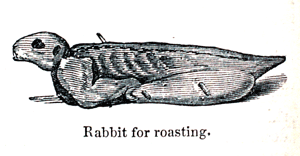 This, like a hare, is much improved by having the back-bone taken out, and the directions we have given will enable the cook, with very little practice, to remove it without difficulty. Line the inside, when this is done, with thin slices of bacon, fill it with force-meat (No. 1, Chapter VIII), sew it up, truss, and roast it at a clear, brisk fire, and baste it constantly with butter. Flour it well soon after it is laid down. Serve it with good brown gravy, and with currant jelly, when this last is liked. For change, the back of the rabbit may be larded, and the bones left in, or not, at pleasure; or it can be plain roasted when more convenient.
3/4 to 1 hour; less, if small.
TO BOIL RABBITS.
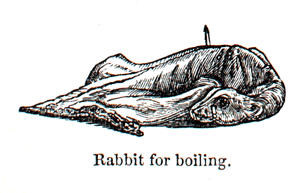 Rabbits that are three parts grown, or, at all events, which are still quite young, should be chosen for this mode of cooking. Wash them well, truss them firmly, with the heads turned and skewered to the sides, drop them into sufficient boiling water to keep them quite covered until they are cooked, and simmer them gently from thirty to forty-five minutes: when very young they will require even less time than this. Cover them with rich white sauce, mixed with the livers parboiled, finely pounded, and well seasoned with cayenne and lemon-juice: or with white onion sauce, or with parsley and butter, made with milk or cream instead of water (the livers, minced, are often added to the last of these), or with good mushroom sauce.
30 to 45 minutes.
FRIED RABBIT.
After the rabbit has been emptied, thoroughly washed and soaked, should it require it to remove any mustiness of smell, blanch it, that is to say, put it into boiling water and let it boil from five to seven minutes; drain it, and when cold or nearly so, cut it into joints, dip them into beaten egg, and then into fine bread-crumbs, seasoned with salt and pepper, and when all are ready, fry them in butter over a moderate fire, from twelve to fifteen minutes. Simmer two or three strips of lemon-rind in a little gravy, until it is well flavoured with it; boil the livers of the rabbit for five minutes, let it cool and then mince it; thicken the gravy with an ounce of butter and a small teaspoonful of flour, add the liver, give the sauce a minute's boil, stir in two tablespoonsful of cream if at hand, and last of all, a small quantity of lemon-juice. Dish the rabbit, pour the sauce under it, and serve it quickly. If preferred, a gravy can be made in the pan as for veal cutlets, and the rabbit may be simply fried.
TO ROAST A PHEASANT.
 [In season from the beginning of October to the end of January. The licensed term of pheasant shooting commences on the 1st of October and terminates on the 2nd of February, but as the birds will remain perfectly good in cold weather for two or three weeks, if from that time hung in a well-ventilated larder, they continue, correctly speaking, in season so long as they can be preserved fit for table after the regular market for them is closed: the same rule applies equally to other varieties of game.]
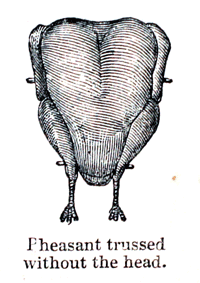
Unless kept to the proper point, a pheasant is one of the most tough, dry, and flavourless birds that is sent to table; but when it has hung as many days as it can without becoming really tainted, and is well roasted and served, it is most excellent eating. Pluck off the feathers carefully, cut a slit in the back of the neck to remove the crop, then draw the bird in the usual way, and either wipe the inside very clean with a damp cloth, or pour water through it; wipe the outside also, but with a dry cloth; cut off the toes, turn the head of the bird under the wing, with the bill laid straight along the breast, skewer the legs, which must not be crossed, flour the pheasant well, lay it to a brisk fire, and baste it constantly and plentifully with well flavoured butter. Send bread-sauce and good brown gravy to table with it. The entire breast of the bird may be larded by the directions of Chapter X. When a brace is served, one is sometimes larded, and the other not; but a much handsomer appearance is given to the dish by larding both. About three quarters of an hour will roast them.
3/4 hour ; a few minutes less, if liked very much underdone; five or ten more for thorough roasting, with a good fire in both cases.
BOUDIN OF PHEASANT A LA RICHLOEU. (ENTRÉE.)
Take, quite clear from the bones, and from all skin and sinew, the flesh of a half-roasted pheasant; mince, and then pound it to the smoothest paste; add an equal bulk of the floury part of some fine roasted potatoes, or of such as have been boiled by Captain Kater's receipt (see Chapter XVII.), and beat them together until they are well blended; next throw into the mortar something less (in volume) of fresh butter than there was of the pheasant-flesh, with a high seasoning of mace, nutmeg, and cayenne, and a half-teaspoonful or more of salt; pound the mixture afresh for ten minutes or a quarter of an hour, keeping it turned from the sides of the mortar into the middle; then add one by one, after merely taking out the germs with the point of a fork, two whole eggs, and a yolk or two without the whites, if these last will not render the mixture too moist. Mould it into the form of a roll, lay it into a stewpan rubbed with butter, pour boiling water on it and poach it gently from ten to fifteen minutes. Let it out with care, drain it on a sieve, and when it is quite cold cover it equally with beaten egg, and then with the finest bread-crumbs, and broil it over a clear fire, or fry it in butter of a clear golden brown. A good gravy should be made of the remains of the bird and sent to table with it; the flavour may be heightened with ham and eschalots, as directed in Chapter IV., page 96, and small mushrooms, sliced sideways, and stewed quite tender in butter, may be mixed with the boudin after it is taken from the mortar; or their flavour may be given more delicately by adding to it only the butter in which they have been simmered, well pressed, from them through a strainer. The mixture, which should be set into a very cool place before it is moulded, may be made into several small rolls, which will require four or five minutes' poaching only. The flesh of partridges will answer quite as well as that of pheasants for this dish.
SALMI OF PHEASANT.
(See page 292.)
PHEASANT CUTLETS.
(See page 275.)
TO ROAST PARTRIDGES.
[In season from the first of September to the second of February, and as long as they can be preserved fit for table from that time.]
 Let the birds hang as long as they can possible be kept without becoming offensive; pick them carefully, draw, and singe them; wipe the insides thoroughly with a clean cloth; truss them with the head turned under the wing and the legs drawn close together, not crossed. Flour them when first laid to the fire, and baste them plentifully with butter. Serve them with bread sauce, and good brown gravy: a little of this last should be poured over them. In some counties they are dished upon fried bread-crumbs, but these are better handed round the table by themselves. When game is plentiful we recommend that the remains of a cold roasted partridge should be well bruised and boiled down with just so much water, or unflavoured broth, as will make gravy for a brace of other birds: this, seasoned with salt, and cayenne only, or flavoured with a few mushrooms, will be found a very superior accompaniment for roast partridges, to the best meat-gravy that can be made. A little eschalot, and a few herbs, can be added to it at pleasure. It should be served also with boiled or with broiled partridges, in preference to any other.
30 to 40 minutes.
Obs.—Rather less time must be allowed when the birds are liked underdressed. In preparing them for the spit, the crop must be removed through a slit cut in the back of the neck, the claws clipped close, and the legs held in boiling water for a minute, that they may be skinned the more easily.
BOILED PARTRIDGES.
This is a delicate mode of dressing young and tender birds. Strip off the feathers clean, and wash them well; cut off the heads, truss the legs like those of boiled fowls, and when ready, drop them into a large pan of boiling water; throw a little salt on them, and in fifteen, or at the utmost, in eighteen minutes they will be ready to serve. Lift them out, dish them quickly, and send them to table with white mushroom sauce, with bread sauce and game gravy (see preceding receipt), or with celery sauce. Our own mode of having them served is usually with a slice of fresh butter, about a tablespoonful of lemon-juice, and a good sprinkling of cayenne placed in a very hot dish, under them.
15 to 18 minutes.
PARTRIDGES WITH MUSHROOMS.
For a brace of young well-kept birds, prepare from half to three quarters of a pint of mushroom-buttons, or very small flaps, as for pickling. Dissolve over a gentle fire an ounce and a half of butter, throw in the mushrooms with a slight sprinkling of salt and cayenne, simmer them from eight to ten minutes, and turn them with the butter on to a plate; when they are quite cold, put the whole into the bodies of the partridges, sew them up, truss them securely, and roast them on a vertical jack with the heads downwards; or would an ordinary spit be used, tie them firmly to it, instead of passing it through them. Roast them the usual time, and serve them with brown mushroom sauce, or with gravy and bread sauce only. The birds may be trussed like boiled fowls, flavoured, and lightly browned in butter, half covered with rich brown gravy and stewed slowly for thirty minutes; then turned, and simmered for another half hour with the addition of some mushrooms to the gravy; or they may be covered with small mushrooms stewed apart, when they are sent to table. They can also be served with their sauce only, simply thickened with a small quantity of fresh butter, smoothly mixed with less than a teaspoonful of arrowroot and flavoured with cayenne and a little catsup, wine, or store sauce.
Partridges, 2; mushrooms, 1/2 to 3/4 pint; butter, 1 1/2 oz.; little mace or cayenne : roasted 30 to 40 minutes, or stewed 1 hour.
Obs.—Nothing can be finer than the game flavour imbibed by the mushrooms with which the birds are filled, in this receipt.
BROILED PARTRIDGE.
(Breakfast Dish.)
"Split a young and well-kept partridge, and wipe it with a soft clean cloth inside and out, but do not wash it; broil it delicately over a very clear fire, sprinkling it with a little salt and cayenne; rub a bit of fresh butter over it the moment it is taken from the fire, and send it quickly to table with a sauce made of a good slice of butter browned with flour, a little water, cayenne, salt, and mushroom-catsup, poured over it." We give this receipt exactly as we received it from a house where we know it to have been greatly approved by various guests who have partaken of it there.
BROILED PARTRIDGE.
(French Receipt.)
After having prepared the bird with great nicety, divided, and flattened it, season it with salt, and pepper, or cayenne, dip it into clarified butter, and then into very fine bread-crumbs, and take care that every part shall be equally covered : if wanted of particularly good appearance dip it a second time into the butter and crumbs. Place it over a very clear fire, and broil it gently from twenty to thirty minutes. Send it to table with brown mushroom sauce, or some Espagnole.
THE FRENCH OR RED-LEGGED PARTRIDGE.
This is dressed precisely like our common partridge, and is excellent eating if it be well kept; otherwise it is tough and devoid of flavour. It done not, we believe, abound commonly in England, its hostility to the gray partridge, which it drives always from its neighbourhood, rendering it an undesirable occupant of a preserve. It was at one time, however, plentiful in Suffolk,* and in one or two of the adjoining counties, but great efforts, we have understood, have been made to exterminate it.
TO ROAST THE LANDRAIL OR CORN-CRAKE.
This delicate and excellent bird is in its full season at the end of August and early in September, when it abounds often in the poulterer's shops. Its plumage resembles that of the partridge, but it is of smaller size and of much more slender shape. Strip off the feathers, draw and prepare the bird as usual for the spit, truss it like a snipe, and roast it quickly at a brisk but not a fierce fire from fifteen to eighteen minutes. Dish it on fried bread-crumbs, or omit these and serve it with gravy round it, and more in a tureen, and with well made bread sauce. Three or even four of the birds will be required for a dish. One makes a nice dinner for an invalid.
TO ROAST BLACK COCK AND GRAY HEN.
In season during the same time as the common grouse, and found like them on the moors, but less abundantly.
These birds, so delicious when well kept and well roasted, are tough and comparatively flavourless when too soon dressed. They should hang therefore till they give unequivocal indication of being ready for the spit. Pick and draw them with exceeding care, as the skin is easily broken; truss them like pheasants, lay them at a moderate distance from a clear brisk fire, baste them plentifully and constantly with butter, and serve them on a thick toast which has been laid under them in the dripping-pan for the last ten minutes of their roasting, and which will have imbibed a high degree of savour: some cooks squeeze a little lemon-juice over it before it is put into the pan. Send rich brown gravy and bread sauce to table with the birds. From three quarters of an hour to a full hour will roast them. Though kept to the point which we have recommended, they will not offend even the most fastidious eater after they are dressed, as, unless they have been too long allowed to hang, the action of the fire will remove all perceptible traces of their previous state. In the earlier part of the season, when warm and close packing have rendered either black game or grouse, in their transit from the North, apparently altogether unfit for table, the chloride of soda, well-diluted may be used with advantage to restore them to a fitting state for it; though the copious washings which must then be resorted to, may diminish something of their fine flavour.
3/4 to 1 hour.
TO ROAST GROUSE.
Handle the birds very lightly in plucking off the feathers; draw them, and wipe the insides with clean damp cloths; or first wash, and then dry them well; though this latter mode would not be approved generally by epicures. Truss the grouse in the same manner as the black game above, and roast them about half an hour at a clear and brisk fire, keeping them basted almost without intermission. Serve them on a buttered toast which has been laid under them in the pan for ten minutes, or with gravy and bread sauce only.
1/2 hour to 35 minutes.
Obs—There are a few occasions, we think, in which the contents of the dripping-pan can be introduced at table with advantage; but in dressing moor game, we would strongly recommend the toast to be laid in it under the birds, as it will afford a superior relish even to the birds themselves.
A SALMI OF MOOR FOWL, PHEASANTS, OR PARTRIDGES. (ENTRÉE.)
This is an excellent mode of serving the remains of roasted game, but when a superlative salmi is desired, the birds must be scarcely more than half roasted for it. In either case carve them very neatly, and strip every particle of skin and fat from the legs, wings, and breasts; bruise the bodies well, and put them with the skin and other trimmings into a very clean stewpan. If for a simple and inexpensive dinner, merely add to them two or three sliced eschalots, a bay leaf, a small blade of mace, and a few peppercorns; then pour in a pint or rather more of good veal gravy or strong broth, and boil it briskly until reduced nearly half; strain the gravy, pressing the bones well to obtain all the flavour, skim off the fat, add a little cayenne and lemon-juice, heat the game very gradually in it, but do not on any account allow it to boil; place sippets of fried bread round the dish, arrange the birds in good form in the centre, give the sauce a boil, and pour it on them. This is but a homely sort of salmi, though of excellent flavour if well made; it may require perhaps the addition of a little thickening, and two or three glasses of dry white wine poured to the bodies of the birds with the broth, would bring it nearer the French salmi in flavour. As the spongy substance in the inside of moor fowl and black game is apt to be extremely bitter when they have been long kept, care should be taken to remove such parts as would endanger the preparation.
FRENCH SALMI, OR HASH OF GAME. (ENTRÉE.)
Prepare underdressed or half-roasted game by the directions we have already given, and after having stripped the skin from the thighs, wings, and breasts, arrange the joints evenly in a clean stewpan, and keep them covered from the air and dust till wanted. Cut down into dice four ounces of the lean of an unboiled ham, and put it, with two ounces of butter, into a thick well-tinned saucepan or stewpan; add three or four minced eschalots (more, should a high flavour of them be liked), two ounces of sliced carrot, four cloves, two bay leaves, a dozen peppercorns, one blade of mace, a small sprig or two of thyme, and part of a root of parsley, or two or three small branches of the leaves. Stew these over a gentle fire, stirring or shaking them often, until the sides of the saucepan appear of a reddish-brown, then mix well with them a dessertspoonful of flour, and let it take a little colour. Next, add by degrees, making the sauce boil as each portion is thrown in, three quarters of a pint of strong veal stock or gravy, and nearly half a pint of sherry or Madeira; put in the well-bruised bodies of the birds, and boil them from an hour to an hour and a half; strain, and clear the sauce quite from fat; pour it on the joints of game, heat them in it slowly; and when they are near the point of boiling, dish them immediately with delicately fried sippets round the dish. When mushrooms can be obtained, throw a dozen or two of small ones, with the other seasonings, into the butter. The wine is sometimes added to the vegetables, and one half reduced before the gravy is poured in; but though a sauce of fine colour is thus produced the flavour of the wine is entirely lost.
TO ROAST WOODCOCKS OR SNIPES.
[In season during the winter months, but not abundant until frost sets in.]
Handle them as little and as lightly as possible, and pluck off the feathers gently; for if this be violently done the skin of the birds will be broken. Do not draw them, but after having wiped them with clean soft cloths, truss them with the head under the wing, and the bill laid close along the breast; pass a slight skewer though the thighs, catch the ends with a bit of twine, and tie it across to keep the legs straight. Suspend the birds with the feet downwards to a bird-spit, flour them well, and baste them with butter, which should be ready dissolved in the pan or ladle. Before the trail begins to drop, which it will as soon as they are well heated, lay a thick round of bread, freed from the crust, toasted a delicate brown, and buttered on both sides, in the pan under them to catch it, as this is considered finer eating even than the flesh of the birds; continue the basting, letting the butter fall from then into the basting-spoon or ladle, as it cannot be collected again from the dripping-pan should it drop there, in consequence of the toast or toasts being in it. There should be one of these for each woodcock, and the trail should be spread equally over it. When the birds are done, which they will be, at a brisk fire, in from twenty to twenty-five minutes, lay the toasts into a very hot dish, dress the birds upon them, pour a little gravy round the bread, and send more to table in a tureen.
Woodcock, 20 to 25 minutes; snipe, 5 minutes less.
TO ROAST THE PINTAIL, OR SEA PHEASANT.
[All wild-fowl is in full season in mid-winter: the more severe the weather, the more abundant are the supplies of it in the markets. It may be had usually from November to March.]
This beautiful bird is by no means rare upon our eastern coast, but we know not whether it be much seen in the markets generally. It is most excellent eating, and should be roasted at a clear quick fire, well flavoured when first laid down, turned briskly, and basted with butter almost without cessation. If drawn from the spit in from twenty-five to thirty minutes, then dished and laid before the fire for two or three more, it will give forth a singularly rich gravy. Score the breast when it is carved, sprinkle on it a little cayenne and fine salt, and let a cut lemon be handed round the table when the bird is served; or omit the scoring, and send round with it brown gravy, and Christopher North's sauce made hot. (For this, see the following page.).
20 to 30 minutes.
TO ROAST WILD DUCKS.
A bit of soft bread soaked in port wine, or in claret, is sometimes put into them, but nothing more. Flour them well, lay them rather near to a very clear and brisk fire, that they may be quickly browned, and yet retain their juices. Baste them plentifully and constantly with butter, and, if it can be so regulated, let the spit turn with them rapidly. From fifteen to twenty minutes will roast them sufficiently for the generality of eaters; but for those who object to them much underdressed, a few additional minutes must be allowed. Something less of time will suffice when they are prepared for persons who like them scarcely more than heated through.
Teal, which is a more delicate kind of wild fowl, is roasted in the same way : in from ten to fifteen minutes it will be enough done for the fashionable mode of serving it, and twenty minutes will dress it well at a good fire.
A SALMI, OR HASH OF WILD FOWL.
Carve the birds very neatly, strip off the skin, and proceed as for the salmi of pheasants (page 292), but mix port or claret, instead of white wine, with the gravy, and give it a rather high seasoning of cayenne. Throw in the juice of half a small lemon before the salmi is served, place fried sippets round the dish, and send it to table as hot as possible.
For a common hash boil the skin and trimmings of the wild-fowl in some good broth, or gravy (with a couple of lightly fried eschalots or not, at choice), until their flavour is imparted to it; then strain, heat, and thicken it slightly, with a little brown roux, or browned flour; add a wineglassful of port wine, some lemon-juice, and cayenne; or sufficient of Christopher North's sauce to flavour it well; warm the birds slowly in it, and serve them as soon as they are thoroughly hot, but without allowing them to boil.
[The following recipe having, from inadvertence, been omitted from the chapter to which it properly belongs—as the reader has already been informed—a place is given to it here.]
CHRISTOPHER NORTH'S OWN SAUCE FOR MANY MEATS.
Throw into a small basin a heaped saltspoonful of good cayenne pepper, in very fine powder and half the quantity of salt; add a small dessertspoonful of well-refined, pounded, and sifted sugar; mix these thoroughly; then pour in a tablespoonful of the strained juice of a fresh lemon, two of Harvey's sauce, a teaspoonful of the very best mushroom catsup (or of cavice), and three tablespoonsful, or a small wineglassful, of port wine. Heat the sauce by placing the basin in a saucepan of boiling water, or turn it into a jar, and place this in the water. Serve it directly it is ready with geese or ducks, tame or wild; roast pork, venison, fawn, a grilled blade-bone, or any other broil. A slight flavour of garlic or eschalot vinegar may be given to it at pleasure. Some persons use it with fish. It is good cold; and, if bottled directly it is made, may be stored for several days. It is the better for being mixed some hours before it is served. The proportion of cayenne may be doubled when a very pungent sauce is desired.
Good cayenne pepper in fine powder, 1 heaped saltspoonful: salt, half as much ; pounded sugar, 1 small dessertspoonful ; strained lemon juice, 1 tablespoonful ; Harvey's sauce, 2 tablespoonsful ; best mushroom catsup (or cavice), 1 teaspoonful ; port wine, 3 tablespoonsful, or small wineglassful. (Little eschalot, or garlic-vinegar at pleasure.)
Obs.—This sauce is exceedingly good when mixed with the brown gravy or of hash or stew, or with that which is served with game or other dishes.
CHAPTER XV.
Game.
Hares and rabbits are stiff when freshly killed, and if young, the ears tear easily, and the claws are smooth and sharp. A hare in cold weather will remain good from ten to fourteen days; care only must be taken to prevent the inside from becoming musty, which it will do if it has been emptied in the field. Pheasants, partridges, and other game may be chosen by nearly the same tests as poultry: by opening the bill, the staleness will be detected easily if they have been too long kept. With few exceptions, game depends almost entirely for the fine flavour and the tenderness of its flesh, on the time which it is allowed to hang before it is cooked, and it is never good when very fresh; but it does not follow that it should be sent to table in a really offensive state, for this is agreeable to few eaters and disgusting to many, and nothing should at any time be served of which the appearance or the odour may destroy the appetite of any person present.
To give venison the flavour and the tenderness so much prized by epicures, it must be well kept; and by taking the necessary precautions, it will hang a considerable time without detriment. Wipe it with soft dry cloths wherever the slightest moisture appears on the surface, and dust it plentifully with freshly-ground pepper or powdered ginger, to preserve it from the flies. The application of the pyroligneous or acetic acid would effectually protect it from these, as well as from the effects of the weather; but the joint must then be, not only well washed, but soaked for some considerable time, and this would be very detrimental.
To prepare the venison for the spit, wash it lightly with tepid water or merely wipe it thoroughly with dam cloths, and dry it afterwards with clean ones; then lay over the fat side a large sheet of thickly-buttered paper, and next a paste of flour and water about three quarters of an inch thick; cover this with two or three sheets of stout paper, secure the whole well with twine, and lay the haunch to a sound clear fire; baste the paper immediately with butter or clarified dripping, and roast the joint from three hours and a half to four and a half, according to its weight and quality. Doe venison will require half an hour less time than buck venison. Twenty minutes before the joint is done remove the paste and paper, baste the meat in every part with butter, and with flour; let it take a pale brown colour, and send it to table as hot as possible with gravy in a tureen, and good current jelly. It is not now customary to serve any other sauces with it; but should the old fashioned sharp or sweet sauce he ordered, the receipt for it will be found at page 100.
3 1/2 to 4 1/2 hours.
Obs.—The kind of gravy appropriate to venison is a matter on which individual taste must decide. When preparations of high savour are preferred to the pure flavour of the game, the Espagnole (or Spanish sauce) of Chapter IV. can be sent to table with it; or either of the rich English gravies which precede it. When a simple unflavoured one is better liked, some mutton cutlets freed entirely from fat, then very slightly broiled over a quick fire, and stewed gently down in a light extract of mutton prepared by Liebeg’s directions, Chapter I., for about an hour, will produce an excellent plain gravy : it should be seasoned with salt and pepper (or fine cayenne) only. When venison abounds, it should be used for the gravy instead of mutton.
Some cooks soak the slices of mutton-fat in wine before they are laid upon the joint; but no process of the sort will ever give to any kind of meat the true flavour of the venison, which to most eaters is far finer than that of the wine, and should always be allowed to prevail over all the condiments with which it is dressed. Those, however, who care for it less than for a dish of high artificial savour, can have eschalots, ham, and carrot, lightly browned in good butter, added to the stew when it first begins to boil.
3 1/2 to 4 hours.
For a plain dinner, when no gravy is at hand, break down the bones of the venison small, after the flesh has been cleared from them, and boil them with those of three or four undressed mutton-cutlets, a slice or two of carrot, or a few savoury herbs, and about a pint and a half of water or broth, until the liquid is reduced quite one third. Strain it off let it cool, skim off all the fat, heat the gravy, thicken it when it boils with a dessertspoonful or rather more of arrow-root, or with the brown roux of page 107, mix the same sauce with it, and finish it exactly as the richer hash above. It may be served on sippets of fried bread or not, at choice.
After the hare has been skinned, or cased, as it is called, wash it very thoroughly in cold water, and afterwards in warm. If in any degree overkept, or musty in the inside, which it will sometimes be when emptied before it is hung up and neglected afterwards, use vinegar, or the pyroligneous acid, well diluted, to render it sweet; then again throw it into abundance of water, that it may retain not taste of the acid. Pierce with the point of a knife any parts in which the blood appears to have settled, and soak them in tepid water that it may be well drawn out. Wipe the hare dry, fill it with the forcemeat No. 1, Chapter VIII., sew it up, truss and spit it firmly, baste it for ten minutes with lukewarm water mixed with a very little salt; throw this away, and put into the pan a quart or more of new milk; keep it constantly laded over the hare until it is nearly dried up, then add a large lump of butter, flour the hare, and continue the basting steadily until it is well browned; for unless this be done, and the roast be kept at a proper distance from the fire, the outside will become so dry and hard as to be quite uneatable. Serve the hare when done, with good brown gravy (of which a little should be poured round it in the dish), and with fine red currant jelly. This is an approved English method of dressing it, but we would recommend in preference, that it should be basted plentifully with butter from the beginning (the strict economist may substitute clarified beef-dripping, or marrow, and finish with a small quantity of butter only); and that the salt and water should be altogether omitted. First-rate cooks merely wipe the hare inside and out, and rub it with its own blood before it is laid to the fire; but there is generally a rankness about it, especially after it has been many days killed, which, we should say, renders the washing indispensable, unless a coarse game-flavour be liked.
1 1/4 to 1 3/4 hour.
(Superior Receipt.)
To remove the back-bone, clear from it first the flesh in the inside; lay this back to the right and left from the centre of the bone to the tips; then work the knife on the upper side quite to the spine, and when the whole is detached except the skin which adheres to this, separate the bone at the first joint from the neck-bone or ribs (we know not how more correctly to describe it), and pass the knife with caution under the skin down the middle of the back. The directions for boning the thighs of a fowl will answer equally for those of a hare, and we therefore refer the reader to them.
Hare, 1; lean of ham or bacon, 4 to 6 oz.; butter, 2 oz.; gravy, 1 1/2 pint; lemon-rind: 1 hour and 20 to 50 minutes. Rice-flour, 1 large dessertspoonful ; mushroom catsup, 2 tablespoonsful; mace, 1/2 of teaspoonful ; little cayenne (salt, if needed) : 10 minutes.
This, like a hare, is much improved by having the back-bone taken out, and the directions we have given will enable the cook, with very little practice, to remove it without difficulty. Line the inside, when this is done, with thin slices of bacon, fill it with force-meat (No. 1, Chapter VIII), sew it up, truss, and roast it at a clear, brisk fire, and baste it constantly with butter. Flour it well soon after it is laid down. Serve it with good brown gravy, and with currant jelly, when this last is liked. For change, the back of the rabbit may be larded, and the bones left in, or not, at pleasure; or it can be plain roasted when more convenient.
3/4 to 1 hour; less, if small.
Rabbits that are three parts grown, or, at all events, which are still quite young, should be chosen for this mode of cooking. Wash them well, truss them firmly, with the heads turned and skewered to the sides, drop them into sufficient boiling water to keep them quite covered until they are cooked, and simmer them gently from thirty to forty-five minutes: when very young they will require even less time than this. Cover them with rich white sauce, mixed with the livers parboiled, finely pounded, and well seasoned with cayenne and lemon-juice: or with white onion sauce, or with parsley and butter, made with milk or cream instead of water (the livers, minced, are often added to the last of these), or with good mushroom sauce.
30 to 45 minutes.
[In season from the beginning of October to the end of January. The licensed term of pheasant shooting commences on the 1st of October and terminates on the 2nd of February, but as the birds will remain perfectly good in cold weather for two or three weeks, if from that time hung in a well-ventilated larder, they continue, correctly speaking, in season so long as they can be preserved fit for table after the regular market for them is closed: the same rule applies equally to other varieties of game.]
Unless kept to the proper point, a pheasant is one of the most tough, dry, and flavourless birds that is sent to table; but when it has hung as many days as it can without becoming really tainted, and is well roasted and served, it is most excellent eating. Pluck off the feathers carefully, cut a slit in the back of the neck to remove the crop, then draw the bird in the usual way, and either wipe the inside very clean with a damp cloth, or pour water through it; wipe the outside also, but with a dry cloth; cut off the toes, turn the head of the bird under the wing, with the bill laid straight along the breast, skewer the legs, which must not be crossed, flour the pheasant well, lay it to a brisk fire, and baste it constantly and plentifully with well flavoured butter. Send bread-sauce and good brown gravy to table with it. The entire breast of the bird may be larded by the directions of Chapter X. When a brace is served, one is sometimes larded, and the other not; but a much handsomer appearance is given to the dish by larding both. About three quarters of an hour will roast them.
3/4 hour ; a few minutes less, if liked very much underdone; five or ten more for thorough roasting, with a good fire in both cases.
(See page 292.)
PHEASANT CUTLETS.
(See page 275.)
Let the birds hang as long as they can possible be kept without becoming offensive; pick them carefully, draw, and singe them; wipe the insides thoroughly with a clean cloth; truss them with the head turned under the wing and the legs drawn close together, not crossed. Flour them when first laid to the fire, and baste them plentifully with butter. Serve them with bread sauce, and good brown gravy: a little of this last should be poured over them. In some counties they are dished upon fried bread-crumbs, but these are better handed round the table by themselves. When game is plentiful we recommend that the remains of a cold roasted partridge should be well bruised and boiled down with just so much water, or unflavoured broth, as will make gravy for a brace of other birds: this, seasoned with salt, and cayenne only, or flavoured with a few mushrooms, will be found a very superior accompaniment for roast partridges, to the best meat-gravy that can be made. A little eschalot, and a few herbs, can be added to it at pleasure. It should be served also with boiled or with broiled partridges, in preference to any other.
30 to 40 minutes.
Obs.—Rather less time must be allowed when the birds are liked underdressed. In preparing them for the spit, the crop must be removed through a slit cut in the back of the neck, the claws clipped close, and the legs held in boiling water for a minute, that they may be skinned the more easily.
15 to 18 minutes.
Partridges, 2; mushrooms, 1/2 to 3/4 pint; butter, 1 1/2 oz.; little mace or cayenne : roasted 30 to 40 minutes, or stewed 1 hour.
Obs.—Nothing can be finer than the game flavour imbibed by the mushrooms with which the birds are filled, in this receipt.
(Breakfast Dish.)
(French Receipt.)
These birds, so delicious when well kept and well roasted, are tough and comparatively flavourless when too soon dressed. They should hang therefore till they give unequivocal indication of being ready for the spit. Pick and draw them with exceeding care, as the skin is easily broken; truss them like pheasants, lay them at a moderate distance from a clear brisk fire, baste them plentifully and constantly with butter, and serve them on a thick toast which has been laid under them in the dripping-pan for the last ten minutes of their roasting, and which will have imbibed a high degree of savour: some cooks squeeze a little lemon-juice over it before it is put into the pan. Send rich brown gravy and bread sauce to table with the birds. From three quarters of an hour to a full hour will roast them. Though kept to the point which we have recommended, they will not offend even the most fastidious eater after they are dressed, as, unless they have been too long allowed to hang, the action of the fire will remove all perceptible traces of their previous state. In the earlier part of the season, when warm and close packing have rendered either black game or grouse, in their transit from the North, apparently altogether unfit for table, the chloride of soda, well-diluted may be used with advantage to restore them to a fitting state for it; though the copious washings which must then be resorted to, may diminish something of their fine flavour.
3/4 to 1 hour.
1/2 hour to 35 minutes.
Obs—There are a few occasions, we think, in which the contents of the dripping-pan can be introduced at table with advantage; but in dressing moor game, we would strongly recommend the toast to be laid in it under the birds, as it will afford a superior relish even to the birds themselves.
Handle them as little and as lightly as possible, and pluck off the feathers gently; for if this be violently done the skin of the birds will be broken. Do not draw them, but after having wiped them with clean soft cloths, truss them with the head under the wing, and the bill laid close along the breast; pass a slight skewer though the thighs, catch the ends with a bit of twine, and tie it across to keep the legs straight. Suspend the birds with the feet downwards to a bird-spit, flour them well, and baste them with butter, which should be ready dissolved in the pan or ladle. Before the trail begins to drop, which it will as soon as they are well heated, lay a thick round of bread, freed from the crust, toasted a delicate brown, and buttered on both sides, in the pan under them to catch it, as this is considered finer eating even than the flesh of the birds; continue the basting, letting the butter fall from then into the basting-spoon or ladle, as it cannot be collected again from the dripping-pan should it drop there, in consequence of the toast or toasts being in it. There should be one of these for each woodcock, and the trail should be spread equally over it. When the birds are done, which they will be, at a brisk fire, in from twenty to twenty-five minutes, lay the toasts into a very hot dish, dress the birds upon them, pour a little gravy round the bread, and send more to table in a tureen.
Woodcock, 20 to 25 minutes; snipe, 5 minutes less.
This beautiful bird is by no means rare upon our eastern coast, but we know not whether it be much seen in the markets generally. It is most excellent eating, and should be roasted at a clear quick fire, well flavoured when first laid down, turned briskly, and basted with butter almost without cessation. If drawn from the spit in from twenty-five to thirty minutes, then dished and laid before the fire for two or three more, it will give forth a singularly rich gravy. Score the breast when it is carved, sprinkle on it a little cayenne and fine salt, and let a cut lemon be handed round the table when the bird is served; or omit the scoring, and send round with it brown gravy, and Christopher North's sauce made hot. (For this, see the following page.).
20 to 30 minutes.
Teal, which is a more delicate kind of wild fowl, is roasted in the same way : in from ten to fifteen minutes it will be enough done for the fashionable mode of serving it, and twenty minutes will dress it well at a good fire.
For a common hash boil the skin and trimmings of the wild-fowl in some good broth, or gravy (with a couple of lightly fried eschalots or not, at choice), until their flavour is imparted to it; then strain, heat, and thicken it slightly, with a little brown roux, or browned flour; add a wineglassful of port wine, some lemon-juice, and cayenne; or sufficient of Christopher North's sauce to flavour it well; warm the birds slowly in it, and serve them as soon as they are thoroughly hot, but without allowing them to boil.
[The following recipe having, from inadvertence, been omitted from the chapter to which it properly belongs—as the reader has already been informed—a place is given to it here.]
Good cayenne pepper in fine powder, 1 heaped saltspoonful: salt, half as much ; pounded sugar, 1 small dessertspoonful ; strained lemon juice, 1 tablespoonful ; Harvey's sauce, 2 tablespoonsful ; best mushroom catsup (or cavice), 1 teaspoonful ; port wine, 3 tablespoonsful, or small wineglassful. (Little eschalot, or garlic-vinegar at pleasure.)
Obs.—This sauce is exceedingly good when mixed with the brown gravy or of hash or stew, or with that which is served with game or other dishes.
Notes:
[*] It must be observed that venison is not in perfection when young: like mutton, it requires to be of a certain age before it is brought to table. The word cleft applies also to the thickest part of the haunch, and it is the depth of the fat on this which decides the quality of the joint.
[*] Minced collops of venison may be prepared exactly like those of beef; and venison-cutlets like those of mutton: the neck may be taken for both of these.
[†] Having been inadvertently omitted from its proper place, this receipt is transferred to the end of the present Chapter.
[*] Brought here by the late Marquis of Hertford, to his Sudbourne estate.