FabulousFusionFood's Miscellaneous Historical Recipe Information and Fruit Guide.
Welcome to Celtnet's Miscellaneous Historical Recipe Information and Fruit Guide Page — As this site has grown, and more and more ancient and historic recipe books are being added, it has become clear that the site is picking up a number of terms and descriptions of fruit meats etc that may not be familiar to everyone. As a result I have decided to create this page of miscellanea. Here you will find a little information about the historical periods used to divide the content of this site. As we get into more historical periods I will define some of the commoner (but unfamiliar) terms used in Middle English and Elizabethan English.
The 20th century has seen a revolution in food production with the industrialization of the entire industry. As such many varieties of foods, particularly root vegetables (think salsify) and fruit that were commonplace and familiar up until the 1920s are only heirloom varieties to us now. Names have also changed (think of the Victorian 'Windsor Bean' which we now call the 'broad bean' or 'fava bean').
This page therefore starts with historical periods and gives links to the various books and recipe pages associated with that period. Below these you will find listings of cookery therms and below that listings of fruit and vegetables.
British Historical Periods
Though the recipes on this site come from every country on earth, the historical recipes are, in the main, British. As a result I have limited the timeline here to Britain.
British Historical Periods- Ancient Period (10 000 BCE to 43 BCE)
-
- Mesolithic (10 000 BCE to 6500 BCE) The Middle Stone Age. Re-population of Britain after the Ice Age.
- Neolithic (6500 BCE to 3500 BCE) The New Stone Age; coincides with the loss of the land bridge between Britain and Europe and the beginnings of farming
- Bronze Age (3500 BCE to 800 BCE). Bronze used as a metal. Beginnings of kingdoms and literature.
- The Iron Age/Celtic Age (800 BCE to 43 CE) This corresponds to the arrival of the Celts in Britain and the use of iron as the chief metal.
- For recipes from this period, please see the Reconstructed Ancient Recipes collection
- The Romano-Celtic period (43 CE to 410 CE). This period represents the time from the Roman invasion to the end of the Roman occupation.
- For classical Roman recipes, see the Ancient Roman Recipes collection
- This period also sees our first cookery book, Apicius' De Re Coquinaria (on cooking)
- Dark Ages (410 CE to 1066)
- Anglo-Saxon Period (410 CE to 1066). This period begins with the migration of Anglo-Saxons into Britain
- This is not truly a 'British' period as there was no Britain, the origins of modern England, Wales and Scotland start here.
- Viking Period (793 to 1066) this period starts in 793 with the first Viking raids and culminates in the establishment of the Danelaw of Eastern England it culminates in 1016 when king Canute of Denmark captures the English crown.
- Middle Ages (1066 to 1485)
- Norman Period (1066 to 1154) this begins with William the Conqueror's Invasion in 1066)
- Plantagenet Period (1154 to 1485)
- Here we have the first cookery book written in English, the Forme of Cury, 1390
- The Tudor Period (1485 to 1603)
- This is the period of the Anglo-Cambro Tudor family (Henry VII, Henry VIII, Mary and Elizabeth I) and begins the Early-modern period
- This site has a large collection of Elizabethan/Tudor recipes. Including the following cookbooks:
- The Boke of cokery (c 1510)
- The Proper Newe Booke of Cookerye (1545)
- Hugh Plat's Delightes for Ladies (1602)
- Closet for Ladies (submitted 1602, published 1608)
- Stuart Period (1603 to 1714)
- The crowns of England and Scotland are united under James 1st (of England) we also have the following periods:
- Jacobean (1603 to 1625)
- Caroline era (1625 to 1649) the reign of Charles Ist
- Interregnum (1649 ti 1660) Cromwell's Commonwealth, following the execution of Charles Ist
- W.M.'s The Compleat Cook (1658)
- Restoration (1660 to 1800)
- Robert May's Accomplisht Cook (1660)
- Hannah Woolley's Queen-like Closet (1670)
- Georgian Period (1714 to 1837) [the reigns of George Ist to George IVth, inclusive]
- This site has a growing number of Georgian recipes, including the full text of:
- Hannah Glasse's The Art of Cookery Made Plain and Easy (1747)
- Victorian Era (1837 to 1901)
- This site has a large collection of Victorian recipes. Including the following cookbooks:
- Eliza Acton's Modern Cookery (1845)
- Alexis Bénoit Soyer's The Modern Housewife or Ménagère (1849)
- Charles Elmé Francatelli's The Cook's Guide (1851)
- Alexis Bénoit Soyer's Shilling Cookery for the People (1854)
- Eliza Acton's English Bread Book (1857)
- Mrs Beeton's Book of Household Management (1861)
The Elizabethan and Jacobean periods are sometimes linked together as the Jacobethan era (1558 to 1625). Most of the recipes and texts on this site labelled as 'Elizabethan' are would more correctly be termed 'Tudorbean' (covering the Tudor period and the Jacobean)
The dates of publication of a book may be hard and fast, but putting things like cookery books into context is more difficult. After all, a book might be published in 1640, say... but it might have been published posthumously after the author's death or could have been written many years earlier. As a result the date might fit in with one historical period, but the actual recipes belong to another.
Historically Accurate Fonts
Because I like to show the texts of these books as close to the original orthography and appearance as possible, I have been busy creating and modifying fonts to display all the characters and nuances of the original. Before the the development of Johannes Gensfleisch zur Laden zum Gutenberg's moveabley press around 1439 all books were hand written and hand-illuminated. For these texts I have my own Medieval font based on the writings of the scribes of the Medieval Welsh text, the Red Book of Hergest, this font being Mabinogi Celtic. Tudor texts (from the reign of Henry VIIIth to Elizabeth Ist are represented in a Gothic-style typeface, Old London, adapted from an existing typeface specifically for this site. Texts from 1620 to 1720 (essentially the Stuart period) are represented in another font face, Fell Roman, specifically deisgned for this site and based on the fonts of Dr John Fell, Bishop of Oxford during the seventeenth century who donated his fonts to the University of Oxford.
Eighteenth century texts are presented in another new font face for this site, Wyld-18c. This is a Caslon style font that was used to typeset The Practical Surveyor, by Samuel Wyld, published in London in 1725. It should be noted that all American and English printing from 1735 to 1800 was done using the Caslon font, created by William Caslon (1692-1766), sometime around 1722. Another font appropriate for this era would be Baskerville Old Face which was introduced by Issaac Moore in 1768, based on the fonts of John Baskerville.
Personally I think that Victorian-era fonts are rather ugly and I am still working on a font from that period that will keep the 'look and feel' of the original published works but being a little kinder to the eyes of modern readers.
Historical Cookery Terms
Balneo ߞ (also Balneum). The word derives from the Latin Balneum (bath). It was typically used as to describe a vessel filled with either water or sand which was set on the heat and in which another vessel would sit (the same as a modern bain-marie or double-boiler). Typically it was used in alchemy or distillation but could be used in cookery.

Neats — This is a word in use from Tudor to Georgian times that describes any cattle of the genus Bos (includes mature and immature, so the steer, heifer and calf would all be called a neat). Typically used In the sense of a 'neat's tongue' or 'neat's foot' — that body part belonging to a cow, ox or calf. Used from medieval to late Georgian times, but died out in Victorian culinary usage. |
Pottle ߞ This is an Elizabethan customary unit of volume that is equivalent to half a gallon (2.27l).
Pints — As the books was written in 1747 and 1845, respectively, Hanna Glasse's Art or Cookery and Eliza Acton's Modern Cookery this means that the 'pint' referred to in both books is a pint of 16 fluid ounces (454ml, the same as the modern American pint) rather than the Imperial pint of 20 fluid ounces (568ml). Essentially for these books a pint of water weighs a pound.
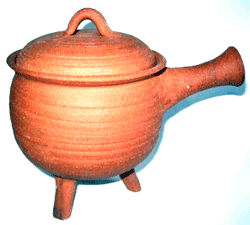
Pipkin — A pipkin is an earthenware cooking pot used for cooking over direct heat from coals or a wood fire. It has a handle and three feet. Late medieval and post-medieval pipkins had a hollow handle in order to insert a stick in it for manipulation.
Cooking Times — Ovens used in historical cookery books up to the 1850s (and sometimes later) were either communal bread ovens or metal constructions put before the fire. As a result they would have been much cooler than modern electric ovens. Below are some basic conversions. It is only from the 1850s that ranges start to become more commonplace and cooking times start to become more similar to modern ones. However, ranges still had hotplates that allowed for very slow cooking that is just not possible with modern ovens (a slow cooker [crockpot] would be the closest modern equivalent).
| Description | Gas Mark | Conventional Oven | Fan Oven |
| Cool | 1 | 140°C | 120°C |
| Low | 2 | 150°C | 130°C |
| Moderately Low | 3 | 160°C | 140°C |
| Moderate | 4 | 180°C | 160°C |
| Moderately Hot | 5 | 190°C | 170°C |
| Hot | 6 | 200°C | 180°C |
| Hot | 7 | 220°C | 200°C |
| Very Hot | 8 | 230°C | 210°C |
Both women were also essentially cooking on open fires. As a result the heat transferred to cooking pots was much lower that even the lowest settings on modern hobs. To use either Eliza Acton or Hannah Glasse's recipes as the basis for modern recipes, any boiling times must be dramatically decreased.
From the time of Mrs Beeton and Francatelli, ranges were becoming more commonplace, so oven times and boiling times are becoming more comparable.
Victorian and earlier recipes often refer to a whole range of fruit (plums and apples predominantly) that may not be readily available today, or which could be classed as 'heirloom' varieties. I have given a pictorial guide to as many of these as possible below.
Historical Vegetables
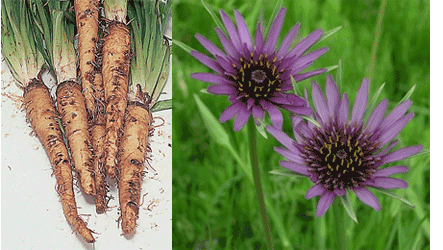
Salsify — Tragopogon porrifolius is a member of the Asteraceae (Daisy) family of flowering plant that is grown for it's ornamental flower, edible root and herbal properties. It is a biennial wildflower, native to the Mediterranean region of Europe. It is known from ancient times and was brought into cultivation in Europe in France and Italy during the 16th century. It was introduced into Britain at this time because of its flower, but became a mildly-popular vegetable in the 18th century, though subsequently it fell into disuse (Eliza Acton decries this). It is still grown and consumed in France, Germany, Italy and Russia. However, in modern times true salsify tends to be replaced by Spanish salsify (Scorzonera hispanica) which has larger roots that are not as troublesome to extract from the ground. Salsify root discolours readily if the root is damaged, tough its notable for tasting like oysters. The flowering shoots can be used like asparagus (either raw or cooked), the flowers can be added to salads and the sprouting seeds can be used in salads and garnishes. It is an occasional escapee into the wild, particularly in the southern counties of England. |
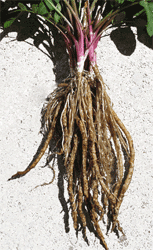
Skirrets — (also skyrrwhits) Sium sisarum is a perennial plant belonging to the Apiciae (carrot) family of flowering plants. It was extensively cultivated in the Middle Ages (in the same way that carrot is today) for its sweet, bright-white roots. These are similar in taste and appearance to sweet potatoes (but longer). Like carrots, skirrets can be boiled, stewed or roasted. They have woody cores like parsnips, and these should be removed and discarded prior to cooking.
The plant is of Chinese origin, but seems to have arrived in Europe in ancient times. Pliny the Elder mentions it as a favourite of Emperor Tiberius and it also seems to have been grown in Celtic Britain. The plant is robust, resistant to cold and can grow up to 1m tall. Typically it is propagated from seed, but can also be grown by root division. It requires plenty of water during the growing season, or the roots tend to become fibrous. To cook, skirrets are washed, boiled in their skins and then peeled before serving. |
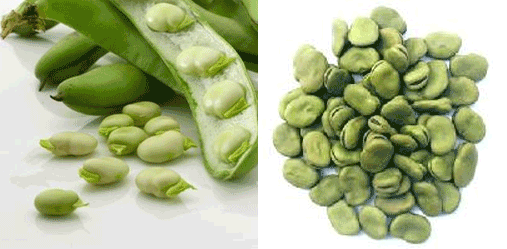
Windsor Beans — This is the Victorian name of what we would call today the 'Broad Bean' or 'Fava Bean'. Brown Windsor Soup obtained its name as one of the original and traditional ingredients was the Windsor Bean. |
Historical Fruit
Apple Varieties
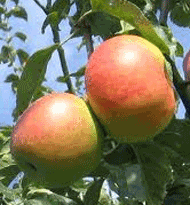
Blenheim Orange. — This cultivar was described about 1740 and the comes from Woodstock, Oxfordshire (near the Blenheim estate), England. It is said that a local tailor, George Kempster planted the original apple, which became known locally as Kempster's Pippin, however it was not until 1818 that the fruit came to note. The apple itself has a greenish-yellow to orange skin streaked with red. It has a distinctive nutty taste that makes it both a good eating as well as an excellent cooking apple, particularly for pies. As such, it is a dual-purpose apple. |
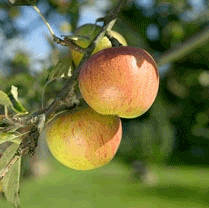
Cox's Orange Pippin — Perhaps one of the most well known of the British eating apples today. The Cox's pippin was first grown in 1825 at Colnbrook in Buckinghamshire, England, by the retired brewer and horticulturist Richard Cox. The variety was introduced for sale by the 1850s by Mr. Charles Turner, and grown commercially from the 1860s, particularly in the Vale of Evesham in Worcestershire, and later in Kent. It is a very attractive in appearance, being orange-red in colour deepening to bright red and mottled with carmine over a deep yellow background. The flesh is firm, yellow-white in colour, fine grained, crisp and very juice. It is also very fragrant with hints of cherry and anise. It is sometimes added to cider to give a floral note. It does not cook however, and breaks down quickly to a forth when heated. |
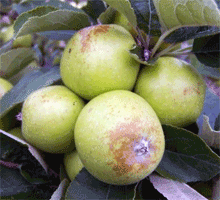
Golden Pippin — This is a classic British all-purpose apple, first described in 1629 by Parkinson (he names it the Golding Pippin though there is some debate as to whether the two apple varieties are exactly identical). Whatever the truth, it was a well-known and frequently planted variety by the 1640s The fruit is gold in colour with russet dots. The flesh has a rich taste with a distinctive lemony tang. Though small it cooks well, and is the classic apple for making pippin jelly. The origin of the apple is so old that it is uncertain, but it is claimed to have arisen at Parham Park, near Arundel, Sussex. It is also known that George Washington ordered the variety for his garden at Mount Vernon, Virginia, but it failed to flourish in the USA. It was widely grown both commercially and in domestic orchards until the late 18th century, and Hannah Glasse refers to it often in her book. During the 17th century, it seems to have primarily been cultured for cider making, which is why the apple became so commonplace in the first instance. But it proved to be such a good general-purpose fruit that it soon came to prominence in the fruit markets. |

Keswick Codling — Developed in Ulverton, Lancashire in the late 18th century (circa 1790) which was purportedly found growing on a rubbish heap at Gleaston Castle. It has a tidy habit, produces profuse early blossoms and is s good cropper. The apples are green with white flesh that have a refreshing taste (but low acidity). This apple contains plenty of pectin and makes good jelly. It was a favourite Victorian apple for making purees and sauces. It matures early and can be eaten from the beginning of September. Typically it's classed as a cooking apple, but its low acidity also makes it a decent eating apple. |
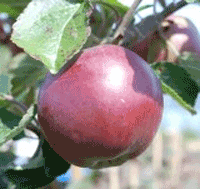
Norfolk Biffin — This is a classic cooking apple (also known as Norfolk Beefing) that is round but slightly flattened on the top and bottom (about 7cm in diameter and 6mc tall) that has a yellow-green skin with brown-purple and dark red steaks. The flesh has a greenish tint, is crisp and has a slight note of cinnamon. The apples store well and also dry very well. They get sweeter the longer they are stored. They were a favourite of Victorian bakers and were also used in cider making. They are known from at least 1698 (they are mentioned by Robert Walpole) and by the 1840s had been planted in the Americas. |
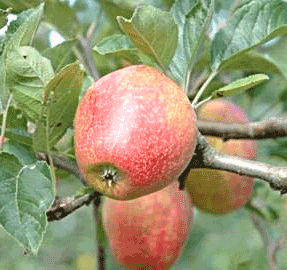
Norfolk Pippin — (also known as an 'Adams Pearmain' or 'Hanging Pearmain') is a dessert apple first developed in 1826 that is similar in flavour to the Russet. The fruit is strongly red-flushed and has a nutty and aromatic flavour. The fruit is distinctively shaped, rather like a conic section with a wide top and a narrow base. |
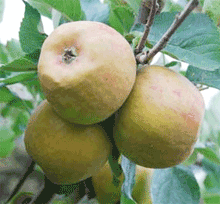
Pearmain — The term 'pearmain' refers to any variety of apples that has the appearance of a pear. The Norfolk Pippin (also known as Adam's Pearmain) [See Above] being a classic example. Another example being the Claygate Pearmain (See image) which was found at Claygate, Surrey in England in about 1822. This is a medium-sized that is brown-russeted with a crimson patch on the sun-facing side. There is pink-silver tinge to the russet scale. It has a nutty aromatic flavour and a strong sweet-sharp taste. It also posesses good keeping qualities, being both disease and scab resistant. |
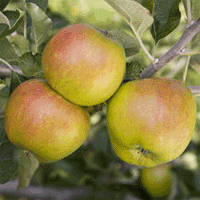
Ribston Pippin — (also known as Essex Pippin, Beautiful Pippin, Formosa, Glory of York, Ribstone pippin, Rockhill's Russet and Travers), is a classic Georgian eating apple that also makes a good dessert apple (it has a faint taste of pear). The apple was grown in 1708 from one of three apple pips sent from Normandy to Sir Henry Goodricke of Ribston Hall at Knaresborough, Yorkshire. The apple has a yellow skin that is flushed with orange and streaked russet at the base and apex. The flesh is firm, fie grained, is sweet in taste and has a pear note. Typically it is round to conical in form, with a flattened base but can be irregular and lopsided. The Ribston is one of the possible parents of the Cox's Orange Pippin. |
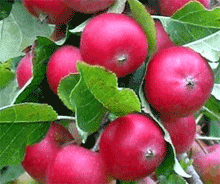
Siberian Crabs — The Siberian Crabapple (also known as 'Siberian Crabs', Manchurian crab apple and Chinese crab apple), Malus baccata is a form of wild apple native to much of Asia (but which is grown elsewhere as an ornamental tree and also a rootstock). It bears plentiful fragrant white flowers that develop to red and yellow fruit of about 1cm in diameter. These are edible and nowhere near as tart as European crabapples. The fruit form dense clusters and may resembles cherries from a distance. In the red-skinned varieties the white flesh of the apples is also veined with red. These apples also dry well and they were commonly used for preserves in Victorian times. |
Nonsuches
These are a group of apples that were considered 'boiling apples' in Victorian terms ie apples that can be used for cooking with firm flesh and a subtle flavour that will also keep well over winter. There are early-ripening varieties and late ripening varieties. As a result Nonsuches are typically in season from late August. The varieties seem to have started in Elizabethan times (hence the name, which is a variant spelling of nonesuch which literally means 'a model of excellence' or 'beyond compare') Below are some classic examples of Nonsuches:
Langton Nonsuch. This is one of the oldest varieties, being first described in 1668 at Hanbury, Leicestershire. It is further described in described in the A Guide to the Orchard and Fruit Garden, George Lindley, John Lindley, Longman, Rees; 1831. The fruit is described as being medium-sized (about 6cm wide and 5.5cm high) being roundish-oblate and regularly shaped. The skin is smooth, pale yellow, mottled with thin pale red on the shaded side, and striped with broad broken stripes of red next the sun. It is an excellent culinary apple, ripe in September, and continues during October. The tree is an abundant and early bearer. The flesh is white, soft, and tender. Juice plentiful, a little saccharine, and slightly perfumed.
Peasgood Nonsuch. This is another classic Leicestershire apple variety. This is an excellent apple variety, being dual-purpose. It is good for both eating and cooking. The fruit are large, pale yellow-green in colour, covered with pinky flush that quickly deepens to orange-yellow with short stripes of bright red and some russet patches. The flesh is crisp and yellow when ripe, white green earlier and has a good acid-sweet flavour, and cooks down to a froth.
The variety was developed in 1858, raised by by Mr Peasgood from a ‘pip sown in a pot by his wife’. Said to be from Catshead Codling and sown in 1858. Large to very large. Round/conical to round, slightly flattened. Regular, flattened at base and apex. No ribs.
The Peasgood Nonsuch is most well known for it's size. A large apple can weight up to 600g (typical apples are about 120g in weight) and a single apple can be enough for a whole apple pie.
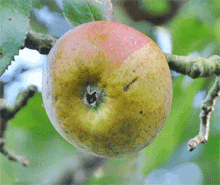
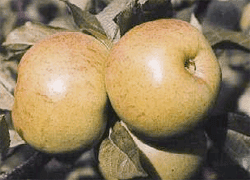
Norman Apples — This is actually a collective term rather than the name of a variety and refers to two traditional cooking apple varieties introduced to Britain by the Normans. These being the Old English Pearmain (image, left) and the Costard (image, right). The Old English Pearmain is first mentioned in the taxes of 1204, as the manor of Runham (Norfolk) had to pay to the Exchequer each year for 200 Pearmains and 4 hogsheads of cider made from Pearmains. The Costard was first recorded in 1296 when 100 fruit were sold for 1 shilling. In 1325 29 Costard apple trees were recorded as having been sold for 3 shillings. The costard apple became so commonplace that the word costermonger was derived for a person who sold these apples.
Both apple varieties are cooking apples, though costards were also used in Cider making. Right up until the end of the 18th century, these were the main cooking apples sold and used in Britain. If you are looking for apples to give an authentic flavour to medieval, Tudor, Stewart or even Georgian apple dishes then these are the varieties you want.
The costard is a large, ribbed, apple that quite round and classically has a green skin that turns yellow when ripe (though more modern cultivars tend to be green and red). The Old English Pearmain is larger and more elongated with a more pronounced reddish blush.
Normandy Pippin — Though mentioned by Eliza Acton and a number of other Victorian writers, it has been difficult to track down this particular apple variety. There is a pippin tree still extant in Normandy that produces a medium sized, yellow skinned apple with slightly yellowish coarse flesh. Then I stumbled across an 1831 Catalogue of the Fruits Cultivated in the Garden by the Royal Horticultural Society which gives the Normanton Wonder as a synonym of the Normandy Pippin. This apple (also known as Dumelow’s Seedling, Dumeller’s Seedling, Dumelow’s Crab, Normanton Wonder and Wellington) was one of the most widely grown culinary apples of the Victorian period and was particularly renowned for its flavour and keeping quality.
The apple is medium sized, has a yellowish flesh that blushes red on the side exposed to the sun. The flavour of the flesh is very acid, but it cooks down to a rich purée. The tree is very hardy and frost-resistant which makes this apple variety and excellent cooker for planting in frost-prone regions.
According to Robert Hogg's British Pomology: "This excellent apple was raised by a person of the name of Dumeller, (pronounced Dumelow), a farmer at Shakerstone, a village in Leicestershire, six miles from Ashby-de-la-Zouch, and is extensively cultivated in that, and the adjoining counties under the names of Dumelow's Crab. It was first introduced to the neighbourhood of London, by Mr. Richard Williams, of the Turnham Green nursery, who received it from Gopsal Hall, the seat of Earl Howe, and presented specimens of the fruit to the Horticultural Society in 1820. It was with him that the name of Wellington Apple originated, and by which only it is now known in the London markets."


Plum Varieties
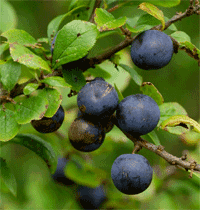
Bullaces — The bullace is a variety of plum. It bears edible fruit similar to those of the damson, and like the damson is considered to be a strain of the insititia subspecies of Prunus domestica. Although the term has regionally been applied to several different kinds of "wild plum" found in the United Kingdom, it is usually taken to refer to varieties with a round shape, as opposed to the oval damsons. It should also be noted that damsons are always black but bullaces can be either black (blue or purple) or white (yellow or green) in colour. The name itself originates from the Old French beloce (sloe) by way of Middle English bolas. There is still some debate as to whether the bullace is a species in its own right or a hybrid and many believe tht the bullace is truly native to the United Kingdom. They were once cultivated, but fell out of favour in the 18th Century as larger varieties and cultivars became available. Now they are mostly seen as a semi-wild hedgerow variety. |
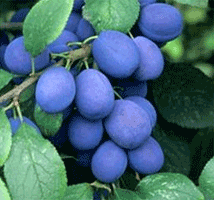
Damsons — The damson, like the bullace is a species of plum Prunus domestica subsp. insititia that is also known as the Damask plum. It has a rich plummy flavour and an acid base and is frequently used to make jams and jellies. The name damson derives from the Latin prunum damascenum, "plum of Damascus". Damsons were first cultivated in antiquity in the area around the ancient city of Damascus, capital of modern-day Syria, and were introduced into Britain by the Romans.Damson fruit are oval in shape (not round like bullaces) and are always 'black' (black or purple) in colour. The damson (fruit) is identified by its oval shape (though slightly pointed at one end), smooth-textured yellow-green flesh, and skin from dark blue to indigo. |
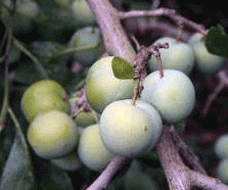
Green Gages — The Greenegage (also known as Reine Claude), Prunus domestica ssp . italica var. claudiana is a green-skinned plum originally bred in Moissac, France from a green-fruited wild plum (Canerik) originally from Asia Minor. This led to the development of the Reine Claude Verte (which is still grown). The fruit trees were imported into England from france in 1724 by Sir William Gage of Bury St Edmunds. It is said that the original labels identifying the French tree varieties were lost in transit and hence the tree became known locally as the 'Green Gage'. Greegages have a bright green skin and when ripe have a tender, melting and very juicy flesh that is rich, sugary and highly flavoured. Indeed, the gages are often considered to be the most flavourful of all plum varieties. This makes the greengage both a good dessert plum and a good cooking plum. They preserve well and their high sugar content mean that they also make excellent plum marmalades. |
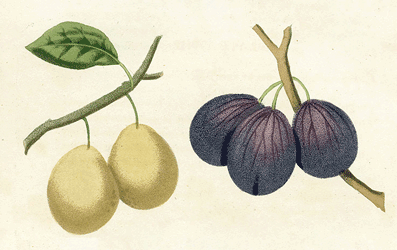
Imperatrice — These are small late-season dessert plums that can be either 'white' (green or yellow) or blue in colour. These plums are self-fertile and the taste is sweet. The stones of Imperatrice plums separate easily from the fruit and the flesh is juicy, firm and sweet and is a little more transparent than other plum varieties. Imperatrices ripen from September to October and though the fruit does not keep well, if left on the tree it will shrivel and become very sweet. At which point it is very good for preserving. The images shown here of the White Imperatrice and Blue Imperatrice plums come from George Brookshaw’s Pomona Britannica (1804). |

Magnum Bonum/Mogul Plums — The Magnum Bonum is a large culinary plum that can be either 'white' (yellow or green), red or black in colour. They were originally called 'Dutch' plums, suggesting that the original cultivars came from the Netherlands (they were introduced prior to 1630 and were well established in Britain by the early 19th century). The flesh of all cultivars is firm and coarse-grained with a subacid flavour with the flesh adhering to the stone. It was very highly esteemed for preserving in Victorian times and was also commonly known as the 'Mogul Plum'. The image given shows both white and red varieties of Magnum Bonum. The red magnum bonum was originally known as the 'Red Imperial' plum. |
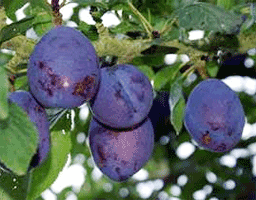
Mussel Plums — The Mussel Plum (also known as the Quetsch or Ketsch) is a is a small purple-skinned plum with a yellow flesh that ripens in late summer. It is typical of the Alsace region of France, though they originate from Central Europe where they are frequently dried into prunes. The first trees appear to have come to Britain in the late 1790s and they were very popular plum varieties in Victorian times, particularly for baking pies, tarts, boiled puddings and preserves. This is still a much loved plum in Alsatian and Luxembourger cuisine, though sadly they have all but disappeared from British orchards. |
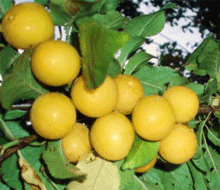
Orange Plums — The Orange Plum (also known as the Stonewood Plum), Prunus x domestica var syriaca was the Victorian name for what we now know as the Mirabelle plum, a tart bright-orange fruit that is excellent for making jams and preserves. Today, it is hardly seen in Britain and is mostly grown in the region surrounding Nancy in France (Lorraine) where it is used as a dessert plum and for making jam, pies and tarts, as well as being fermented for plum wine and distilled for plum brandy. The mirabelle is identified by its small, oval shape, smooth-textured flesh, and especially by its dark yellow colour which becomes flecked in appearance. The flesh, when ripe is sweet and full of flavour. Mirabelle plums ripen early in the season (from July to mid September). In Romania they are typically eaten when green and not ripe, and Eliza Acton in her cookery book suggests that they are tastier when green (though this is debatable). The origin of the plum is quite ancient and it is believed that it was domesticated from a wild fruit native to Asia Minor. |

Pear Plums — These are referred to in manuscripts from the 1520s right through to the 1830s. From the historical sources, there appear to have been two types, the white pear plum (an early ripening variety) and the black pear plum. An image from Bodleian Library MS Ashmole 1461 from 1620 (follow his link for the manuscript) shows the blacke peare plum as a small damson-like plum with a per-like shape and black skin that ripens in early Spetember. An image from the same manuscript shows the early whight pere plum as a yellow, rather elongated, pear-shaped plum that ripened in early July. (I have sketched copies of the fruit images, based on the originals, to present here.) Hannah Glasse (and may other Georgian writers) had many recipes for the use and cookery of pear plums (both black and white). |
Pears and Quinces
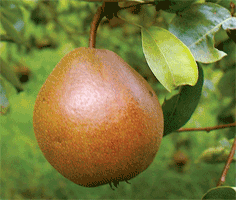
Warden Pear — The warden pear (wardenys) is referred to from the first Medieval recipe books (there are several recipes for Wardenys in The Forme of Cury). They are referred to thought the Tudor and Georgian periods then they disappear altogether. Partly this is because of the nature of the pear itself. Even when ripe the interior is rock-hard and has to be cooked to become edible. This makes it a good keeping pear, but it is inedible unless cooked. Of course, it is excellent poached in wine (the selfsame method of preparing as used by Medieval cooks). Another reason that the pear seems to have disappeared is that it is now known as the 'Black Worcester', though the original name survives in the alternate name of 'Parkinson's Warden'. In Elizabethan times there were both poached to cook, as earlier and were also baked as 'Warden Pies'. |
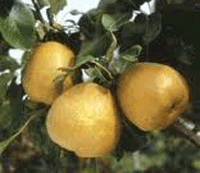
Bon Chrétien Pear — The Bon Chrétien pear (now more commonly known as the Williams pear or the Bartlett pear [in North America]) is a cultivar of the European pear Pyrus communis with a bell-shaped fruit whose skin starts out green but turns yellow upon later ripening (though red-skinned varieties also exist). It is a dual purpose pear, as it can be eaten raw, but also holds its shape well when cooked (it is the most common pear used in canning and preserving). The williams pear is believed to date from around 1765 to 1770, originating in the yard of a schoolmaster named Mr. Stair or Mr. Wheeler of Aldermaston, England (hence the alternate names of Aldermaston pear and Stairs pear). However, it was a nurseryman known as Williams who introduced the pear to the remainder of Britain and as such it became known as the Williams Bon Chrétien (good Christian) pear. The fruit presents the classic pear shape, with a rounded bell on the bottom half of the fruit, and then a definitive shoulder with a smaller neck or stem end. They are an aromatic fruit and have the distinctive floral tang of the classic pear. The pear should typically be picked when still green (it will ripen in from 7 to 10 days if kept in dry, shady, areas). The unripe pear is green, but as it ripens it will slowly change to a soft yellow and the initially hard flesh becomes soft. |
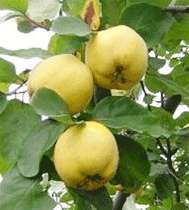
Quinces — The quince is the fruit of Cydonia oblonga native to southwest Asia in the Caucasus region that is related to apples and pears. The quince plant is a small deciduous tree growing some 5–8m tall and 4–6m wide in diameter. The modern English 'quince' originated in the 14th century as a plural of quoyn, via Old French cooin from Latin cotoneum malum/cydonium malum, ultimately from Greek κυδώνιον μῆλον, kydonion melon 'Kydonian apple. Indeed, it may well be that quinces were domesticated before apples and that many ancient references that are translated as 'apple' actually refer to quinces. The quince tree is frost tolerant and actually requires a prolonged period of cold below 7°C for proper flowering. As a result it will grow and thrive even in Northern Europe. In his botanical edicts, Charlemagne directed that quinces be planted in well-stocked orchards. Quinces first came to Britain in 1275 when Edward I had some planted at the Tower of London. Frequently quinces were not grown in large amounts. With only one or two trees being planted in the corners of large orchards. This is why quince trees rapidly became uncommon with the elimination of orchards. The immature fruit is green with dense grey-white pubescence, most of which rubs off before maturity in late autumn when the fruit changes colour to yellow with hard, strongly perfumed flesh. However, the fruit requires long, hot, summers to become fully ripe. As a result, in Northern Europe the fruit seldom become ripe by themselves. As a result they are frequently too hard, astringent and sour to be eaten from the tree unless 'bletted' (softened by frost and subsequent decay). However, quinces are very high in pectin and are useful in helping to set other fruit preserves. Indeed, when sugar became common in Europe during the Elizabethan period, quinces were some of the first fruit to be turned into sugar-based preserves. Indeed, the modern English word 'marmalade', originally meaning a preserve boiled until the sugar caramelizes and becomes dark, is derived from the Portuguese name for quince, marmelo indicating that quince was the first fruit to be preserved by this new method. It should be noted, however, that there are now varieties of quince (Kuganskaya for example) that ripen even in northern Europe and do not require cooking to be edible (they can be eaten raw like apples or pears). |
Other Fruit

Barberry — The common barberry Barberis vulgaris used to be a common fruit in orchards, gardens and hedgerows. Recipes for making preserves and pies with this fruit are seen in cookery books from Elizabethan times up to late Victorian times. The plant decreased in popularity when it was discovered that it could act as a host for wheat rust. The fruit develop in summer and are initially lemony in colour eventually turning bright red by early September, when they are ripe. The fruit of the common barberry looks superficially like that of the dog rose (and is about the same size), except that rather than being ovate they are shaped more like an inverted pear. The fruit are quite tart, even when ripe, but they make excellent preserves, jams and jellies. For more information on the common barberry, see this site's wild food entry page for common barberry (this page has links to a range of barberry-based recipes). |
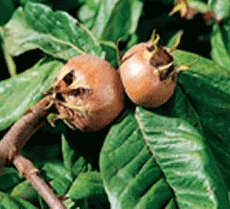
Medlar — The Medlar Mespilus germaica represents a species of flowering plants in the genus Mespilus of the family Rosaceae that is a long-known native of southwest Asia and possibly also southeastern Europe (Black Sea coast of Bulgaria and modern Turkey). It bears an unusual apple-like fruit that requires bletting [partial rotting and/or softening by frost] to eat. Mespilus germaica is deciduous shrub or small tree growing up to 8m tall. The leaves are dark green and elliptic, 6–15 centimetres long and 3–4 centimetres wide. The leaves turn red in autumn before falling. The five-petaled white flowers, produced in late spring, are hermaphrodite and pollinated by bees. The fruit is a pome, 2–3 centimetres in diameter, with wide-spreading persistent sepals giving a "hollow" appearance to the fruit that is matte brown in colour. The trees have and ancient history of cultivation and were known by the Ancient Romans and Greeks. They seem to have been introduced to Britain at least by the late middle ages and are named in Tudor and later cookery texts. They were were particularly popular in the Victorian era and are named by Eliza Acton, Mrs Beeton and others. Typically they were used rather like quinces to make jellies and preserves (this is why they are increasingly named from the Elizabethan period onwards, where sugar became more common and making jams and preserves was popular). Though not commonly seen in orchards and gardens today, medlars are still available from specialist nurseries, with the two commonest cultivars being the varieties 'Nottingham' and 'Royal'. |
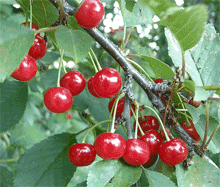
Kentish cherry — The Kentish cherry Prunus domestica is an ancient, small, red cherry with a tart and tangy flesh that was the first cherry variety introduced by the North American colonists (who knew it as 'Kentish Red'). It was much in demand in Victorian times as a cooking cherry, but it is also the classic cooking cherry used in Tudor, Elizabethan and later recipes. The trees are large, growing up to 30m tall and used to be a feature of the Kentish landscape, though they are becoming increasingly rare these days. |
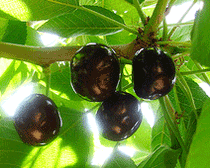
Black Heart Cherry — (also known as Blackheart Cherry) Prunus domestica is an ancient, sweet, dark-skinned (and dark-fleshed) cherry variety. They were first described by John Rea in 1676 but almost certainly trace their lineage further back. Indeed, this may be the cherry mentioned by Robert Dodonee, a naturalist of Malines, Belgium,in 1552. If seems to have been introduced to Britain about the 1580s. The tree is very large (up to 30m) and bears abundant fruit. Indeed, during the Victorian period in both Britain and North America this was by far the commonest cherry type consumed and the commonest cherry tree in the landscape. It fails for modern commercial purposes as the fruit do not travel well and it is very susceptible to brown rot. Being a large tree it is not suited to small gardens. This is a sweet (dessert) cherry that is a very tasty eating cherry but which also makes excellent cherry juice, jams and preserves. They also lend themselves for pickling. |
|
Melocoton — (also known as Mirabolans, Malacadonians, Mellacattons, Melum cotoneum, Cydonian apples) is an ancient and rather unusal fruit. They were one of the first graftings and represent a peach grafted onto a quince rootstock. The fruit was thickly downed and late ripening. Often they would be picked green for preserving. The name derives from the Spanish melocotón, which itself is derived from the Medieval Latin melum cotonium. Unless you produce your own grafting this is not a fruit you will find today and the best substitute would be an unripe peach. |