FabulousFusionFood's Spice Guide for Rose Petals Home Page
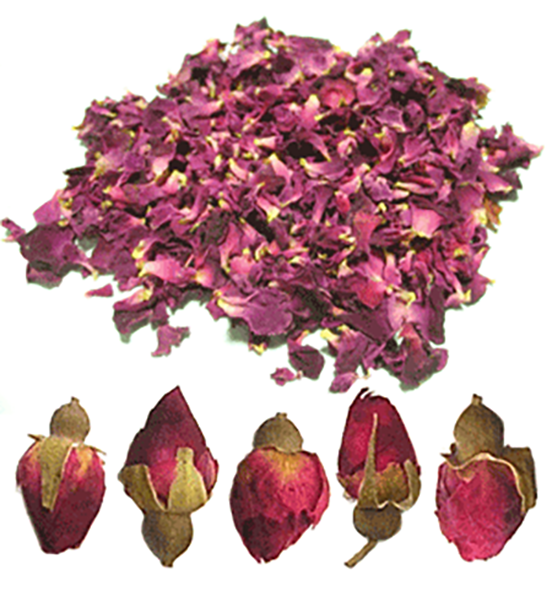 Dried aromatic rose
petals and rose
flower buds from
Rosa
gallica x
Rosa
Dried aromatic rose
petals and rose
flower buds from
Rosa
gallica x
Rosamoschata.
Welcome to the summary page for FabulousFusionFood's Spice guide to Rose Petals along with all the Rose Petals containing recipes presented on this site, with 42 recipes in total.
This is a continuation of an entire series of pages that will, I hope, allow my visitors to better navigate this site. As well as displaying recipes by name, country and region of origin I am now planning a whole series of pages where recipes can be located by meal type and main ingredient. This page gives a listing of all the spice-based recipes added to this site.
These recipes, all contain Rose Petals as a major flavouring.
Rose petals (or dried rose buds) are a classic Middle Eastern spice. They represent the aromatic dried petals (or dried flower buds) of the Damasc Rose, Rosa damascena a member of the Rosaceae (rose) family. The Damasc rose is a hybrid between Rosa gallica and Rosa moschata which grows to 2.2 m tall and is considered an Old Rose type (a rose variety in existence before 1867 when the first tea rose hybrids were introduced) which bears flowers renowned for their fine fragrance. Indeed, the flowers are commercially harvested to make rose oil for perfumery and rose water for culinary uses. Though not much used in the West, rose petals are particularly popular as a spice in the Middle East and are used to make rose petal jam and are incorporated into the spice blend Ras el hanout. They can be added as a flavouring to rice or can be made into ice creams and sorbets. In Arabic, dried rose buds are known as chouch el-ouard and are still commonly used as a spice.
More commonly, however, rose water (a distillate of rose petals) is used as a flavouring. One of the main fragrance compounds of rose petals 2-phenyl ethanol, evaporates during steam distillation and is collected in the distillate (this is why rose water smells strongly of rose). It is known that roses have been used in cooking since Roman times (and Apicius has a few rose-based recipes). Indeed, Damasc rose, itself is known since antiquity.
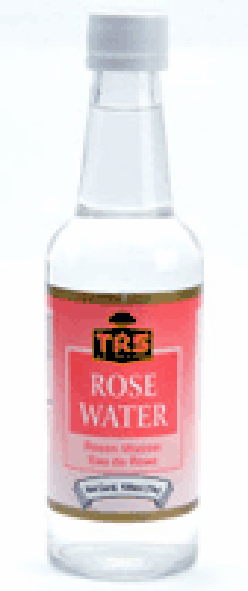
Rose water (ma al-ward [ماء الورد] in Arabic) is a common ingredient in many Arabic dishes, particularly rice dishes and desserts and imparts a light, floral, fragrance. It is also added to the milk-based drinks and desserts of Northern India.
Rose water came to note in Europe during the crusades, after exposure to the cuisines of the Levant and during the Middle Ages and into the Elizabethan era rose water was a popular flavouring and many recipes from the period employ rose water. Though it is still used in marzipan and in French madeleines. It also makes an interesting addition to many biscuit recipes.
Rose water itself can easily be made at home. Collect a large quantity of aromatic rose petals. Get a large pot (a pasta pot with a curved lid is good). Place half a brick standing upright in the middle of the pot. Set a bowl on top of this so that the top of the bowl sits beneath the lip of the pot itself. Pack rose petals in the pot just to to the top of the brick and cover with water. Invert the lid and place on top. Bring the water to the boil and place a load of ice on top of the lid. You have just produced a fermenter and the rose water will condense on the lid and drip into the bowl. Every twenty minutes or so spoon the rose water from the bowl and continue heating until almost dry. This should give you a decent bottle of your very own rose water.
This is a continuation of an entire series of pages that will, I hope, allow my visitors to better navigate this site. As well as displaying recipes by name, country and region of origin I am now planning a whole series of pages where recipes can be located by meal type and main ingredient. This page gives a listing of all the spice-based recipes added to this site.
These recipes, all contain Rose Petals as a major flavouring.
Rose petals (or dried rose buds) are a classic Middle Eastern spice. They represent the aromatic dried petals (or dried flower buds) of the Damasc Rose, Rosa damascena a member of the Rosaceae (rose) family. The Damasc rose is a hybrid between Rosa gallica and Rosa moschata which grows to 2.2 m tall and is considered an Old Rose type (a rose variety in existence before 1867 when the first tea rose hybrids were introduced) which bears flowers renowned for their fine fragrance. Indeed, the flowers are commercially harvested to make rose oil for perfumery and rose water for culinary uses. Though not much used in the West, rose petals are particularly popular as a spice in the Middle East and are used to make rose petal jam and are incorporated into the spice blend Ras el hanout. They can be added as a flavouring to rice or can be made into ice creams and sorbets. In Arabic, dried rose buds are known as chouch el-ouard and are still commonly used as a spice.
More commonly, however, rose water (a distillate of rose petals) is used as a flavouring. One of the main fragrance compounds of rose petals 2-phenyl ethanol, evaporates during steam distillation and is collected in the distillate (this is why rose water smells strongly of rose). It is known that roses have been used in cooking since Roman times (and Apicius has a few rose-based recipes). Indeed, Damasc rose, itself is known since antiquity.
Rose water (ma al-ward [ماء الورد] in Arabic) is a common ingredient in many Arabic dishes, particularly rice dishes and desserts and imparts a light, floral, fragrance. It is also added to the milk-based drinks and desserts of Northern India.
Rose water came to note in Europe during the crusades, after exposure to the cuisines of the Levant and during the Middle Ages and into the Elizabethan era rose water was a popular flavouring and many recipes from the period employ rose water. Though it is still used in marzipan and in French madeleines. It also makes an interesting addition to many biscuit recipes.
Rose water itself can easily be made at home. Collect a large quantity of aromatic rose petals. Get a large pot (a pasta pot with a curved lid is good). Place half a brick standing upright in the middle of the pot. Set a bowl on top of this so that the top of the bowl sits beneath the lip of the pot itself. Pack rose petals in the pot just to to the top of the brick and cover with water. Invert the lid and place on top. Bring the water to the boil and place a load of ice on top of the lid. You have just produced a fermenter and the rose water will condense on the lid and drip into the bowl. Every twenty minutes or so spoon the rose water from the bowl and continue heating until almost dry. This should give you a decent bottle of your very own rose water.
The alphabetical list of all Rose Petals recipes on this site follows, (limited to 100 recipes per page). There are 42 recipes in total:
Page 1 of 1
| Advieh (Iranian Spice Mix) Origin: Iran | Gül Şurubu (Rose Syrup) Origin: Turkey | Rose Petal and Marigold Ice Cream Origin: Britain |
| Advieh Khoresh (Persian Stew Blend) Origin: Iran | Gulab Jamun Cheesecake Origin: India | Rose Petal Drop Scones Origin: Britain |
| Advieh Polow (Persian Rice Spice Blend) Origin: Iran | Hebridean Carrageen Pudding with Rose Water and Cardamom Origin: Scotland | Rose Petal Ice Cream Origin: Britain |
| Arabic Pasta with Beef and Yogurt Sauce Origin: Fusion | Iraqi Dolma Origin: Iraq | Rose Petal Jelly Origin: Britain |
| Balti Garam Masala Origin: India | Lebanese-style Braaied Fruit Salad Origin: South Africa | Rosee (Rose Pudding) Origin: England |
| Boharat Origin: Middle East | Malpua with Rabri (Indian Pancakes with Saffron and Rosewater Cream) Origin: India | Rozha z Tsukrom (Ukrainian Rose Preserve) Origin: Ukraine |
| Cacen Ffenestr Rhosyn a Phistasio (Rose and Pistachio Battenberg) Origin: Welsh | Nyponsoppa (Wild Rosehip Soup) Origin: Sweden | Saffron Black Cardamom Fudge Origin: Pakistan |
| Carrot Halwa Origin: Fusion | Penne with Edible Flowers Origin: Britain | Sharbat Gulab (Rose Petal Sharbat) Origin: India |
| Courgette Halwa Origin: Fusion | Pickled Evening Primrose Buds and Flowers Origin: Britain | Sholeh Zard (Persian Yellow Rice Pudding) Origin: Iran |
| Crystallized Rose Petals Origin: Britain | Podnosił się Zachowują (Polish Rose Preserve) Origin: Poland | Shrikhand (Sweet Yoghurt with Saffron) Origin: India |
| Early Spring Salad Origin: Britain | Rhubarb and Elderflower Cake Origin: Britain | Slow-roasted Lamb with Advieh Origin: Fusion |
| Edible Flower Pancakes Origin: American | Rooh Afza (Rose Water Tonic) Origin: India | Sugared Flower Shortbreads Origin: Britain |
| Floral Mayonnaise Origin: American | Rosatum et Violacium (Rose Wine and Violet Wine) Origin: Roman | To Candy Flowers for Sallets, as Violets, Cowslips, Clove-gilliflowers, Roses, Primroses, Borrage, Bugloss, &c. Origin: Britain |
| Flowers and Greens Salad Origin: Britain | Rose and Pistachio Tres Leches Origin: Fusion | Vermouth di Torino (Turin Vermouth) Origin: Italy |
Page 1 of 1