FabulousFusionFood's Spice Guide for Canelo Home Page
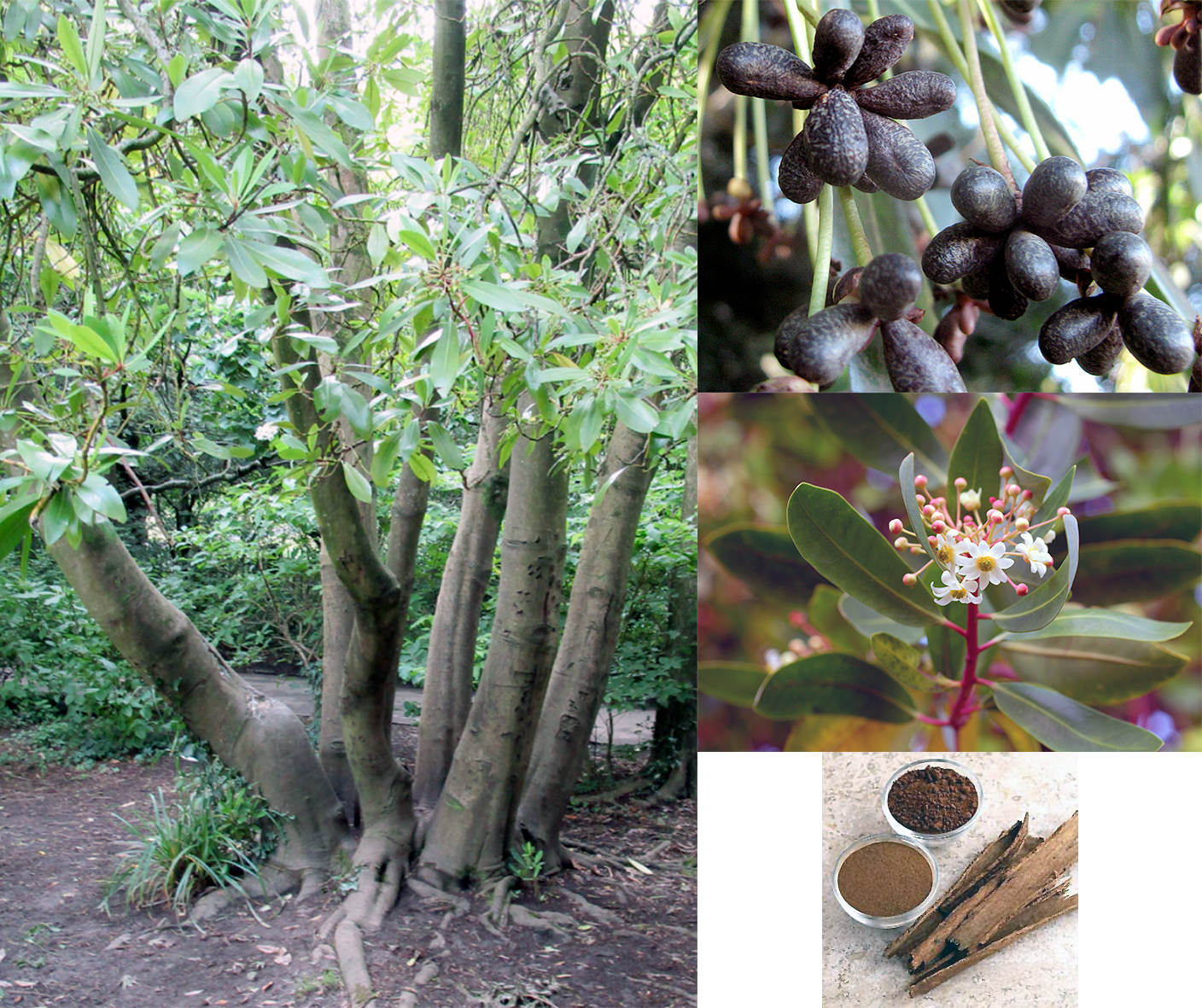 Mature canelo tree
(left) shown with
the fruit (top
right) a branch in
flower
Mature canelo tree
(left) shown with
the fruit (top
right) a branch in
flower(centre) and the dried and ground bark (bottom)
Welcome to the summary page for FabulousFusionFood's Spice guide to Canelo along with all the Canelo containing recipes presented on this site, with 1 recipes in total.
This is a continuation of an entire series of pages that will, I hope, allow my visitors to better navigate this site. As well as displaying recipes by name, country and region of origin I am now planning a whole series of pages where recipes can be located by meal type and main ingredient. This page gives a listing of all the spice-based recipes added to this site.
These recipes, all contain Canelo as a major flavouring.
Canelo is the bark of Drimys winteri (known as Winter's bark or Magellan's Cinnamon in English and as Foy or Foike in Spanish) is a peppery spice made from the grey, thick and soft bark of the tree that is ground and used as a pepper replacement in Argentina and Chile. The peppery compound in canelo is polygodial. In Patagonia, the dried berries of the tree are also sold as a peppery spice. Their flavor is initially sweet and fruity, recalling cinnamon, before a piquancy emerges and gently numbs the tongue. The canelo berries, dried and finely chopped to best preserve their aroma, are used to prepare both sweet and savory recipes. Their sensory qualities mean they pair well with red meat and game, but they can also enhance fruit and chocolate desserts thanks to their sweet, fruity notes. Locally the fruit are known as 'pepe canelo'.
Canelo is related to Tasmanian Pepperberry (Tasmannia lanceolata) and shares a similar flavour and usage profile. The soft grey bark, which is aromatic and pungent, is harvested in the autumn and winter and is dried for later use. In Brazil, Chile and Argentina it is powdered and used as a pepper substitute.
Drimys winteri is a slender tree in the family Winteraceae, growing up to 20m tall. It is native to the Magellanic and Valdivian temperate forests of Chile and Argentina, where it is a dominant tree in the coastal evergreen forests. It is found below 1,200m between latitude 32° south and Cape Horn at latitude 56°. In its southernmost natural range it can tolerate temperatures down to −20°C. The plant is renowned for its phenotypic plasticity being able to grow in different sites from 'extreme arid zones to wetlands along Chile'. The tree does also grow in places with various types and degrees of competition from other plants.
When Sir Francis Drake sailed round the world in 1577-80, of the four ships accompanying the Golden Hind at the outset, the only ship that successfully reached the entrance to the Strait of Magellan was the Elizabeth, captained by William (also known as John) Wynter. Before entering the Strait, in July 1578, Drake sent Wynter ashore where he learned indigenous people ate the astringent bark. The Elizabeth transversed the Strait. A week later the two ships were separated in a storm and Wynter turned back. Wynter returned in 1579 with a supply of Drimys bark, and for centuries before vitamin C was isolated, "Winter's Bark" was esteemed as a preventive and remedy for scurvy.
Other reports state the the crew ate the fruit of the tree cooked in honey. Parkinson (1640) writes how Winter's crew ate the berries: '... the berries grow in clusters like the Hawthorne with divers seedes in each of them'.
The bark was brought back to England by Winter in 1579 and came to be known as Winter’s Bark. Vitamin C used to be synthesised from it. The species epithet of Drimys winteri is named after John Wynter.
This is a continuation of an entire series of pages that will, I hope, allow my visitors to better navigate this site. As well as displaying recipes by name, country and region of origin I am now planning a whole series of pages where recipes can be located by meal type and main ingredient. This page gives a listing of all the spice-based recipes added to this site.
These recipes, all contain Canelo as a major flavouring.
Canelo is the bark of Drimys winteri (known as Winter's bark or Magellan's Cinnamon in English and as Foy or Foike in Spanish) is a peppery spice made from the grey, thick and soft bark of the tree that is ground and used as a pepper replacement in Argentina and Chile. The peppery compound in canelo is polygodial. In Patagonia, the dried berries of the tree are also sold as a peppery spice. Their flavor is initially sweet and fruity, recalling cinnamon, before a piquancy emerges and gently numbs the tongue. The canelo berries, dried and finely chopped to best preserve their aroma, are used to prepare both sweet and savory recipes. Their sensory qualities mean they pair well with red meat and game, but they can also enhance fruit and chocolate desserts thanks to their sweet, fruity notes. Locally the fruit are known as 'pepe canelo'.
Canelo is related to Tasmanian Pepperberry (Tasmannia lanceolata) and shares a similar flavour and usage profile. The soft grey bark, which is aromatic and pungent, is harvested in the autumn and winter and is dried for later use. In Brazil, Chile and Argentina it is powdered and used as a pepper substitute.
Drimys winteri is a slender tree in the family Winteraceae, growing up to 20m tall. It is native to the Magellanic and Valdivian temperate forests of Chile and Argentina, where it is a dominant tree in the coastal evergreen forests. It is found below 1,200m between latitude 32° south and Cape Horn at latitude 56°. In its southernmost natural range it can tolerate temperatures down to −20°C. The plant is renowned for its phenotypic plasticity being able to grow in different sites from 'extreme arid zones to wetlands along Chile'. The tree does also grow in places with various types and degrees of competition from other plants.
When Sir Francis Drake sailed round the world in 1577-80, of the four ships accompanying the Golden Hind at the outset, the only ship that successfully reached the entrance to the Strait of Magellan was the Elizabeth, captained by William (also known as John) Wynter. Before entering the Strait, in July 1578, Drake sent Wynter ashore where he learned indigenous people ate the astringent bark. The Elizabeth transversed the Strait. A week later the two ships were separated in a storm and Wynter turned back. Wynter returned in 1579 with a supply of Drimys bark, and for centuries before vitamin C was isolated, "Winter's Bark" was esteemed as a preventive and remedy for scurvy.
Other reports state the the crew ate the fruit of the tree cooked in honey. Parkinson (1640) writes how Winter's crew ate the berries: '... the berries grow in clusters like the Hawthorne with divers seedes in each of them'.
The bark was brought back to England by Winter in 1579 and came to be known as Winter’s Bark. Vitamin C used to be synthesised from it. The species epithet of Drimys winteri is named after John Wynter.
The alphabetical list of all Canelo recipes on this site follows, (limited to 100 recipes per page). There are 1 recipes in total:
Page 1 of 1
| Pebre (Chilean Chilli Salsa) Origin: Chile |
Page 1 of 1