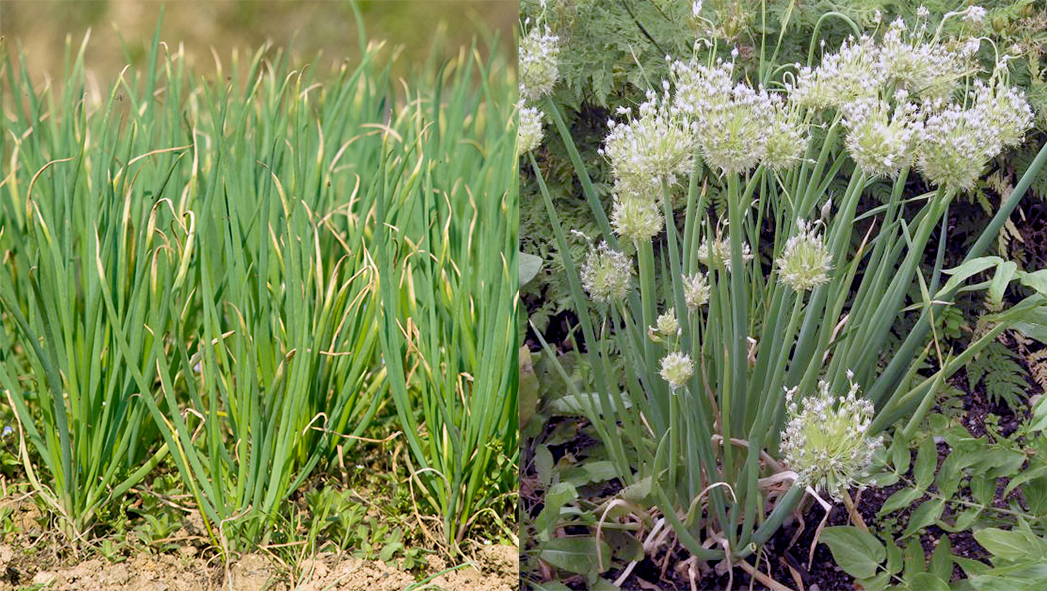
 Branching onions
Allium
fistulosum in
cultivation in China
and in flower in a
Japanese garden.
Branching onions
Allium
fistulosum in
cultivation in China
and in flower in a
Japanese garden.
Welcome to the summary page for FabulousFusionFood's Herb guide to Branching Onion along with all the Branching Onion containing recipes presented on this site, with 26 recipes in total.
This is a continuation of an entire series of pages that will, I hope, allow my visitors to better navigate this site. As well as displaying recipes by name, country and region of origin I am now planning a whole series of pages where recipes can be located by meal type and main ingredient. This page gives information about Branching Onion and a listing of all the Branching Onion-based recipes added to this site.
These recipes, all contain Branching Onion as a major herb flavouring.
Branching onions, Allium fistulosum (also known as Welsh onion, bunching onion, long green onion, Japanese bunching onion, bunching shallot, cibol, cives and spring onion) is a species of perennial plant, often considered to be a kind of scallion It is a member of the Amaryllidaceae (Amaryllis) family).
The species is very similar in taste and odour to the related common onion, Allium cepa, and hybrids between the two (tree onions) exist. A. fistulosum, however, does not develop bulbs, and its leaves and scapes are hollow (fistulosum means "hollow"). Larger varieties of A. fistulosum, such as the Japanese negi, resemble the leek, whilst smaller varieties resemble chives. A. fistulosum can multiply by forming perennial evergreen clumps. It is also grown in a bunch as an ornamental plant.
It is native to China, though cultivated in Eurasia and North America (particularly the Caribbean). The epithet 'Welsh' comes from the Anglo-Saxon root wealh- meaning foreign or non native (cf Welsh or Walloon) and survived in Botanical nomenclature to mean the same. A. fistulosum is an ingredient in Asian cuisine, especially in East Asia and Southeast Asia. It is particularly important in China, Japan, and Korea, hence one of the English names for this plant, Japanese bunching onion. It is also a key flavouring in French Antillean cuisine where it is known as cive (often mis-translated as 'chives'). In the West, A. fistulosum is primarily used as a scallion or salad onion, but is more widely used in other parts of the world, particularly East Asia. Known as escallion it is an ingredient in Jamaican cuisine and is often added to dry spice mixtures.
This is a continuation of an entire series of pages that will, I hope, allow my visitors to better navigate this site. As well as displaying recipes by name, country and region of origin I am now planning a whole series of pages where recipes can be located by meal type and main ingredient. This page gives information about Branching Onion and a listing of all the Branching Onion-based recipes added to this site.
These recipes, all contain Branching Onion as a major herb flavouring.
Branching onions, Allium fistulosum (also known as Welsh onion, bunching onion, long green onion, Japanese bunching onion, bunching shallot, cibol, cives and spring onion) is a species of perennial plant, often considered to be a kind of scallion It is a member of the Amaryllidaceae (Amaryllis) family).
The species is very similar in taste and odour to the related common onion, Allium cepa, and hybrids between the two (tree onions) exist. A. fistulosum, however, does not develop bulbs, and its leaves and scapes are hollow (fistulosum means "hollow"). Larger varieties of A. fistulosum, such as the Japanese negi, resemble the leek, whilst smaller varieties resemble chives. A. fistulosum can multiply by forming perennial evergreen clumps. It is also grown in a bunch as an ornamental plant.
It is native to China, though cultivated in Eurasia and North America (particularly the Caribbean). The epithet 'Welsh' comes from the Anglo-Saxon root wealh- meaning foreign or non native (cf Welsh or Walloon) and survived in Botanical nomenclature to mean the same. A. fistulosum is an ingredient in Asian cuisine, especially in East Asia and Southeast Asia. It is particularly important in China, Japan, and Korea, hence one of the English names for this plant, Japanese bunching onion. It is also a key flavouring in French Antillean cuisine where it is known as cive (often mis-translated as 'chives'). In the West, A. fistulosum is primarily used as a scallion or salad onion, but is more widely used in other parts of the world, particularly East Asia. Known as escallion it is an ingredient in Jamaican cuisine and is often added to dry spice mixtures.
The alphabetical list of all Branching Onion recipes on this site follows, (limited to 100 recipes per page). There are 26 recipes in total:
Page 1 of 1
| Bébélé (Tripe and Plantain Stew) Origin: Guadeloupe | Dombrés haricots rouges (Red Bean Dombrés) Origin: Guadeloupe | Ouassous dans la nage (Ouassous in the swim) Origin: Guadeloupe |
| Blaff de poisson (Fish Blaff) Origin: Guadeloupe | Dombrés Poulet (Chicken Dombres) Origin: Martinique | Poulet Boucané (Buccaneer/Smoked Chicken) Origin: Martinique |
| Blaff de poisson (Fish Blaff) Origin: French Guiana | Dongouésde bananes plantain à la morue et lait de coco (Plantain Dongoués with Salt Cod and Coconut Milk) Origin: Martinique | Ragoût de cabri créole (Creole Goat Stew) Origin: Guadeloupe |
| Boudin Créole (Creole Black Pudding) Origin: French Guiana | Fermented Krill Sauce Origin: Japan | Ragoût de chatrou créole (Creole Chatrou Stew) Origin: Guadeloupe |
| Boudin Créole Rouge (Creole Black Pudding) Origin: Guadeloupe | Fricassée de Lambi (Queen Conch Fricassee) Origin: Martinique | Saba Pigeon Pea Stew Origin: Saba |
| Chaudage (Pork and Beef Stew) Origin: Guadeloupe | Krill Sweet Potato Cakes Origin: Fusion | Tteokguk (Korean Rice Cake Soup) Origin: Korea |
| Chiquetaille de morue (Cod Chiquetaille) Origin: Guadeloupe | Mines Frites Origin: Mauritius | Xuyi Shisanxiang Longxia (Jiangsu Crayfish Cooked with Thirteen-Spice Powder) Origin: China |
| Court-bouillon de Poisson à la Créole (Creole-style Fish Court-bouillon) Origin: Guadeloupe | Montserratian Goat Water Origin: Montserrat | Z'habitants (Martinique Callaloo) Origin: Martinique |
| Dombrés de Morue Salé (Salt Cod Dombres) Origin: Martinique | Mousseline de fruit à pain (Breadfruit mousseline) Origin: Martinique |
Page 1 of 1