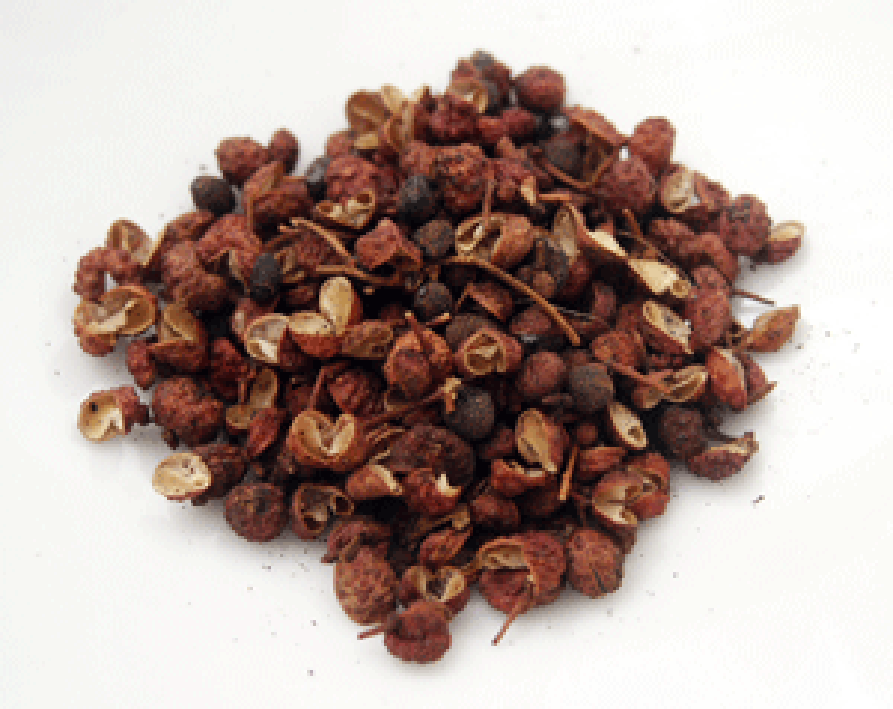
 Pile of Sichuan pepper, the dried fruit of Zanthoxylum.
Welcome to the summary page for FabulousFusionFood's Cook's Guide entry for Sichuan Pepper along with all the recipes employing Sichuan Pepper presented on this site, with 49 recipes in total.
This is a continuation of an entire series of pages that will, I hope, allow my visitors to better navigate this site. As well as displaying recipes by name, country and region of origin I am now planning a whole series of pages where recipes can be located by meal type and main ingredient. This page gives a listing of all the Sichuan Pepper recipes added to this site.
These recipes, all contain Sichuan Pepper as a major wild food ingredient.
Sichuan Pepper (also called Szechuan Pepper, Szechwan pepper, Chinese pepper, Japanese pepper, Aniseed pepper, Sprice pepper, Chinese prickly ash, Fagara, Sansho, Nepal pepper, Indonesian lemon pepper) is the outer pod of the fruit of a number of species in the genus Zanthoxylum (most commonly Zanthoxylum piperitum but also Zanthoxylum simulans, and Zanthoxylum sancho), widely grown and consumed in Asia as a spice. These are not true peppers, as the Zanthoxylum trees are actually members of the Rutaceae (citrus) family.
The spice itself is formed from the pericarp (shell) of the fruit and the seeds are generally omitted (they are bitter in flavour and yield a gritty texture to the ground spice). The dried fruits of sichuan pepper and its relatives have an aromatic odour that, for most species, can be described as lemon-like, with more or less pronounced warm and woodsy overtones. Some of the species have deviating flavour, e.g., Z. alatum (spicy) and Z. avicennae and Z. schinifolium both of which have an anise aroma. It is best to buy the spice whole and then grind yourself. Many commercial preparations, however, have significant stems attached which are woody and best removed by grinding (which can be done either with a pestle and mortar or with a coffee grinder).
It is widely used in the cuisine of Sichuan, China, from which it takes its name, as well as Tibetan, Bhutani, and Japanese cuisines. Ground with nutmeg, black pepper, cinnamon, anise and allspice and mixed with flour it makes a flavoursome coating for fish before frying.
This is a continuation of an entire series of pages that will, I hope, allow my visitors to better navigate this site. As well as displaying recipes by name, country and region of origin I am now planning a whole series of pages where recipes can be located by meal type and main ingredient. This page gives a listing of all the Sichuan Pepper recipes added to this site.
These recipes, all contain Sichuan Pepper as a major wild food ingredient.
Sichuan Pepper (also called Szechuan Pepper, Szechwan pepper, Chinese pepper, Japanese pepper, Aniseed pepper, Sprice pepper, Chinese prickly ash, Fagara, Sansho, Nepal pepper, Indonesian lemon pepper) is the outer pod of the fruit of a number of species in the genus Zanthoxylum (most commonly Zanthoxylum piperitum but also Zanthoxylum simulans, and Zanthoxylum sancho), widely grown and consumed in Asia as a spice. These are not true peppers, as the Zanthoxylum trees are actually members of the Rutaceae (citrus) family.
The spice itself is formed from the pericarp (shell) of the fruit and the seeds are generally omitted (they are bitter in flavour and yield a gritty texture to the ground spice). The dried fruits of sichuan pepper and its relatives have an aromatic odour that, for most species, can be described as lemon-like, with more or less pronounced warm and woodsy overtones. Some of the species have deviating flavour, e.g., Z. alatum (spicy) and Z. avicennae and Z. schinifolium both of which have an anise aroma. It is best to buy the spice whole and then grind yourself. Many commercial preparations, however, have significant stems attached which are woody and best removed by grinding (which can be done either with a pestle and mortar or with a coffee grinder).
It is widely used in the cuisine of Sichuan, China, from which it takes its name, as well as Tibetan, Bhutani, and Japanese cuisines. Ground with nutmeg, black pepper, cinnamon, anise and allspice and mixed with flour it makes a flavoursome coating for fish before frying.
The alphabetical list of all Sichuan Pepper recipes on this site follows, (limited to 100 recipes per page). There are 49 recipes in total:
Page 1 of 1
| Air Fryer Crispy Sichuan Duck Origin: Britain | Henan Hu La Tang (Hot Pepper Soup) Origin: China | Salt and Pepper Squid Rings Origin: South Africa |
| Bottle Masala Origin: India | Home-made Chilli Oil Origin: China | Shi San Xiang Fen (Thirteen Spice Powder) Origin: China |
| Chilli Crisp Origin: Korea | Home-made Sichuan Garlic Chilli Oil Origin: China | Shichimi Togarashi (Japanese Seven-spice Powder) Origin: Japan |
| Chinese Five Spice Origin: China | Hong Shao Rou (Red-cooked Pork Belly) Origin: China | Shuizhu niurou (Spicy Water-boiled Beef) Origin: China |
| Chinese Hot Pot Origin: China | Hong Shao Rou (Red-braised pork belly) Origin: Britain | Sichuan Beef Stir-fry Origin: China |
| Chinese Pickled Cabbage Origin: China | Hot Water Dough Dumplings Origin: China | Sichuan Hot Pot Soup Base Origin: China |
| Chinese Steamed Whole Fish Origin: China | Insanity Chilli Paste Origin: Fusion | Sichuan-style Chicken with Chilli Bean Sauce Origin: China |
| Curry de Lotte Bretonne (Breton Monkfish Curry) Origin: France | Laj Ntses (Fish Larb) Origin: Laos | Spiced Lima Beans with Garlic and Coconut Origin: Nepal |
| Dan Dan Noodles Origin: America | Lo Sui (Chinese Master Sauce) Origin: China | Steamed Cantonese-style fish with spicy noodles Origin: China |
| Dan Dan Noodles II Origin: Fusion | Lu Rou Fan (Taiwanese Braised Pork Rice Bowl) Origin: Taiwan | Taiwan Pickled Cabbage Origin: Taiwan |
| Duck Sukuti Origin: Nepal | Mala Long Xia (Chinese Spicy Crayfish) Origin: China | Taiwanese Beef Noodle Soup Origin: Taiwan |
| Eight-day Spiced Beef Origin: Britain | Mala Long Xia (Chinese Spicy Crayfish) Origin: China | Taiwanese Hot Pot Origin: Taiwan |
| Ezay (Bhutanese Chilli Condiment) Origin: Bhutan | Málàjiàng (Mala Hotpot Paste) Origin: China | Tharoi Thongba (Water Snail Curry) Origin: India |
| Golbeda Achar (Nepali Tomato Achar) Origin: Nepal | Momos Chutney Origin: India | Xiao Long Xia (Garlic-braised Crayfish) Origin: China |
| Gong Bao Chicken Origin: China | Mongolian Spice Origin: Mongolia | Xinjiang Lamb Skewers Origin: Fusion |
| Guai wei ji si (Bang-bang Chicken) Origin: China | Nepalese Meat Masala Origin: Nepal | |
| Hakka Salt-baked Chicken Origin: China |
Page 1 of 1