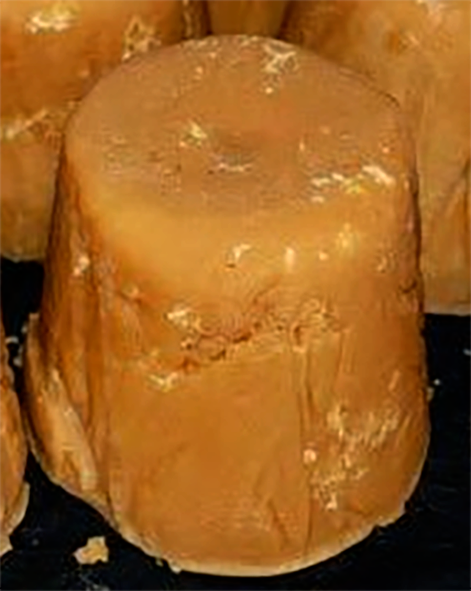
 Lump jaggery.
Welcome to the summary page for FabulousFusionFood's Cook's Guide entry for Jaggery along with all the recipes employing Jaggery presented on this site, with 55 recipes in total.
This is a continuation of an entire series of pages that will, I hope, allow my visitors to better navigate this site. As well as displaying recipes by name, country and region of origin I am now planning a whole series of pages where recipes can be located by meal type and main ingredient. This page gives a listing of all the Jaggery recipes added to this site.
These recipes, all contain Jaggery as a major wild food ingredient.
Jaggery is the traditional, unrefined, sugar used throughout Sout hand South East Asia. The term is used to refer to both the products of sugar candy and the date palm tree though, technically, the term jaggery refers solely to sugarcane sugar. The sugar made from the sap of the date palm is both more prized and less available outside of the districts where it is made. Hence, outside of these areas, sugarcane jaggery is sometimes called "gur" to increase its market value. The sago palm and coconut palm are also now tapped for producing jaggery in southern India. In Mexico and South America, similar sugarcane products are known as "panela" or "piloncillo". These sugars are sold as blocks made from concentrated sugar syrup that's heated to 200°C Traditionally, the syrup is made by boiling raw sugarcane juice or palm sap in a large shallow round-bottom vessel. Jaggery is considered by some to be a particularly wholesome sugar and, unlike refined sugar, it retains more mineral salts. Moreover, the process does not involve chemical agents. Indian Ayurvedic medicine considers jaggery to be beneficial in treating throat and lung infections.
Traditionally, jaggery is used as an ingredient in both the sweet and savory dishes of India and Sri Lanka. For example, a pinch of jaggery is sometimes added to sambar, rasam and other gravies which are staples in India. Jaggery is also added to lentil soups (dal) to add sweetness to balance the spicy, salty and sour components, particularly in Gujarati cooking. As well as the traditional blocks jaggery is also sold in cubes and can be found in many Indian, Chinese and South-east Asian stores.
This is a continuation of an entire series of pages that will, I hope, allow my visitors to better navigate this site. As well as displaying recipes by name, country and region of origin I am now planning a whole series of pages where recipes can be located by meal type and main ingredient. This page gives a listing of all the Jaggery recipes added to this site.
These recipes, all contain Jaggery as a major wild food ingredient.
Jaggery is the traditional, unrefined, sugar used throughout Sout hand South East Asia. The term is used to refer to both the products of sugar candy and the date palm tree though, technically, the term jaggery refers solely to sugarcane sugar. The sugar made from the sap of the date palm is both more prized and less available outside of the districts where it is made. Hence, outside of these areas, sugarcane jaggery is sometimes called "gur" to increase its market value. The sago palm and coconut palm are also now tapped for producing jaggery in southern India. In Mexico and South America, similar sugarcane products are known as "panela" or "piloncillo". These sugars are sold as blocks made from concentrated sugar syrup that's heated to 200°C Traditionally, the syrup is made by boiling raw sugarcane juice or palm sap in a large shallow round-bottom vessel. Jaggery is considered by some to be a particularly wholesome sugar and, unlike refined sugar, it retains more mineral salts. Moreover, the process does not involve chemical agents. Indian Ayurvedic medicine considers jaggery to be beneficial in treating throat and lung infections.
Traditionally, jaggery is used as an ingredient in both the sweet and savory dishes of India and Sri Lanka. For example, a pinch of jaggery is sometimes added to sambar, rasam and other gravies which are staples in India. Jaggery is also added to lentil soups (dal) to add sweetness to balance the spicy, salty and sour components, particularly in Gujarati cooking. As well as the traditional blocks jaggery is also sold in cubes and can be found in many Indian, Chinese and South-east Asian stores.
The alphabetical list of all Jaggery recipes on this site follows, (limited to 100 recipes per page). There are 55 recipes in total:
Page 1 of 1
| Aam Ka Meetha Achaar (Sweet Mango Chutney) Origin: India | French Coconut Fish Curry Origin: France | Rangood na Vaal (Gujarati Butter Bean Curry) Origin: India |
| Arrowroot Halwa Origin: India | Japanese Knotweed and Pineapple Marmalade Origin: Britain | Red Rice Rava Kheer Origin: India |
| Ash Gourd Coconut Curry Origin: India | Kasundi Origin: Bangladesh | Saffron Chicken Korma with Wholemeal Paratha Origin: India |
| Aurangabadi Special Naan Bread Origin: India | Khatmitthi Raani (Tamarind Chutney) Origin: India | Sarson ka Saag (Mustard Greens and Spinach Curry) Origin: India |
| Bael Sherbet Origin: Anglo-Indian | Khatta Meetha (Cabbage Curry) Origin: India | Simba Mbili (Swahili Curry Powder) Origin: Kenya |
| Batak Raichat (Duck Raichat) Origin: India | Kiribati Poi Origin: Kiribati | Simba Mbili (Swahili Curry Powder) Origin: Comoros |
| Bibimap (Korean Mixed Rice with Meat and Assorted Vegetables) Origin: Korea | Kusabi Chutney (Safflower Seed and Tamarind Chutney) Origin: India | Simba Mbili (Swahili Curry Powder) Origin: Tanzania |
| BIR Chicken Chettinad Origin: Britain | Leftover Ham Vindhalo Origin: Britain | Spicy Sambar Curry Origin: Britain |
| BIR Kashmiri Curry Origin: Britain | Mandas Origin: India | Sri Lankan-style Mango Curry Origin: Sri Lanka |
| BIR Lamb Chettinad Origin: Britain | Mandas of Cucumber Origin: India | Sweet and Sour Fish Patia Origin: India |
| Bottle Masala Chicken Curry Origin: Britain | Mandas of Red Pumpkin Origin: India | Ukkarai Origin: India |
| Breadfruit Curry Origin: India | Mani (Rice Sweet Dish) Origin: India | Vaihalo Tokelau (Green Coconut Porridge) Origin: Tokelau |
| Candied Catkins, Catkin Flour and Catkin Syrup Origin: Britain | Pasanda Sauce Origin: Britain | Veihalo Tonga (Green Coconut Porridge) Origin: Tonga |
| Chicken Dhansak Origin: Britain | Pineapple Pulissery Origin: India | Victorian Mallie Malai Origin: Anglo-Indian |
| Chicken Ghee Roast Origin: India | Pork Balchão Origin: India | Victorian Mango Fool Origin: Anglo-Indian |
| Coconut Pitha Origin: Anglo-Indian | Pork Vindhalo Origin: India | Vietnamese Fried Red Rice Origin: Fusion |
| Cyri Cocos a Dail Gwyrdd (Cockle and Greens Curry) Origin: Welsh | Pumpkin Skin Chutney Origin: Anglo-Indian | Wild Mustard and Spinach Curry with Oak Moss Tempering Origin: India |
| Dhal Dhokla Origin: India | Puran Poli Origin: India | |
| Diwali Coconut Chammanthi Origin: India |
Page 1 of 1