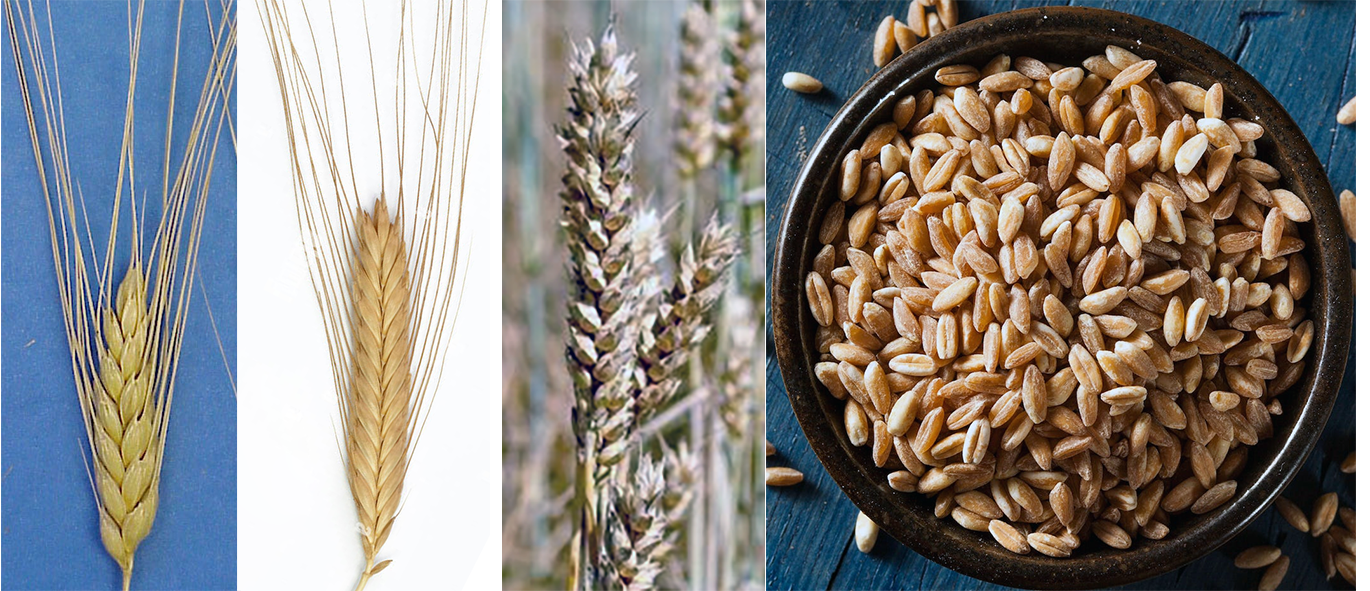
 Ripe ears of emmer, einkorn and spelt with a bowl of farro grains
(right).
Welcome to the summary page for FabulousFusionFood's Cook's Guide entry for Farro along with all the recipes employing Farro presented on this site, with 31 recipes in total.
This is a continuation of an entire series of pages that will, I hope, allow my visitors to better navigate this site. As well as displaying recipes by name, country and region of origin I am now planning a whole series of pages where recipes can be located by meal type and main ingredient. This page gives a listing of all the Farro recipes added to this site.
These recipes, all contain Farro as a major wild food ingredient.
Farro is a grain of any of three species of hulled wheat, namely einkorn, emmer, or spelt, sold dried and cooked in water until soft. It is used as a side dish and added to salads, soups and stews. The English word is borrowed directly from Italian farro, first documented in English in 1828 when the botanist Samuel Frederick Gray mentioned it. It derives from Latin far, farris (spelt, grain).
Farro is made from any of three species of hulled wheat (those that retain their husks tightly and cannot be threshed): spelt (Triticum spelta), emmer (Triticum dicoccum), and einkorn (Triticum monococcum). In Italian cuisine, the three species are sometimes distinguished as farro grande, farro medio, and farro piccolo (large, medium, and small farro, respectively).
Emmer is the most common variety of farro grown in Italy, specifically in certain mountain regions of Tuscany and Abruzzo. It is considered to be of higher quality for cooking than the other two grains and thus is sometimes called 'true' farro.
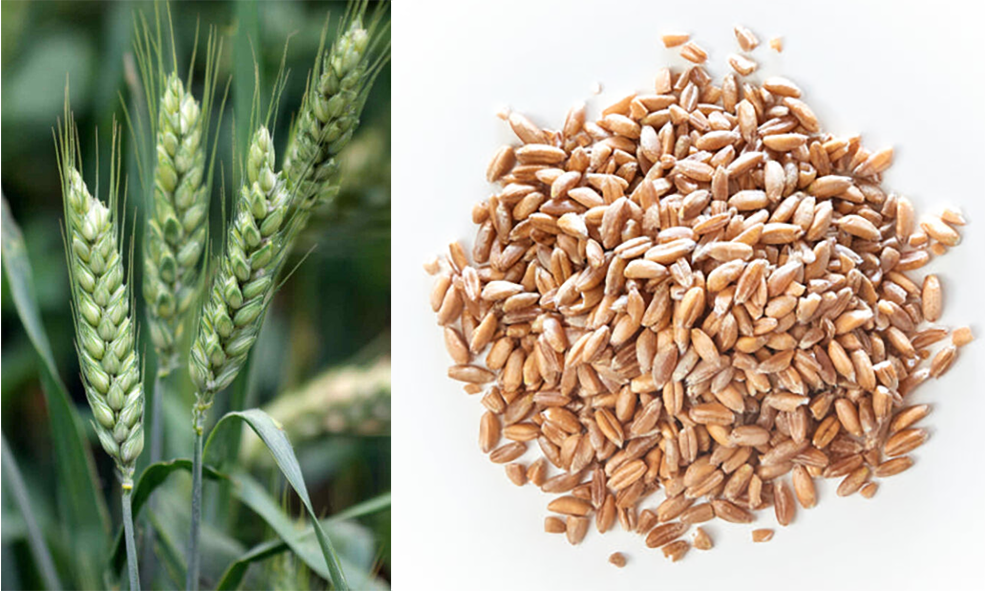
Triticum turgidum subsp. dicoccum and Triticum turgidum subsp. durum also known as Emmer wheat is a hybrid species of wheat. Along with einkorn (see below), it was one of the first crops domesticated in the Near East. It was widely cultivated in the ancient world, but is now a relict crop in mountainous regions of Europe and Asia. Emmer is one of the three grains called farro in Italy.
The edible seeds have been used as food since ancient times. The domesticated types are Triticum turgidum subsp. dicoccum and Triticum turgidum subsp. durum. The wild plant is called Triticum dicoccoides. The seeds have an awned covering, the sharp spikes helping the seeds to become buried in the ground. The principal difference between the wild and the domestic forms is that the ripened seed head of the wild plant shatters and scatters the seed onto the ground, while in the domesticated emmer, the seed head remains intact, thus making it easier to harvest the grain.
Like einkorn (T. monococcum) and spelt (T. spelta), emmer is a hulled wheat, meaning it has strong glumes (husks) that enclose the grains, and a semibrittle rachis. On threshing, a hulled wheat spike breaks up into spikelets that require milling or pounding to release the grains from the glumes. Wild emmer spikelets effectively self-cultivate by propelling themselves mechanically into soils with their awns. During a period of increased humidity during the night, the awns of the spikelet become erect and draw together, and in the process push the grain into the soil. During the daytime, the humidity drops and the awns slacken back again; however, fine silica hairs on the awns act as hooks in the soil and prevent the spikelets from backing out. During the course of alternating stages of daytime drying and nighttime humidity, the awns' pumping movements, which resemble a swimming frog kick, will drill the spikelet 25mm or more into the soil.
Strong similarities in morphology and genetics show that wild emmer (T. dicoccoides Koern.) is the wild ancestor and a crop wild relative of domesticated emmer. Wild emmer still grows wild in the Near East. It is a tetraploid wheat formed by the hybridization of two diploid wild grasses, wild red einkorn (Triticum urartu), and the goatgrass Aegilops speltoides.
Wild emmer is native to the Fertile Crescent of the Middle East, growing in the grass and woodland of hill country from modern-day Israel to Iran. The origin of wild emmer has been suggested, without universal agreement among scholars, to be the Karaca Dağ mountain region of southeastern Turkey. In 1906, Aaron Aaronsohn's discovery of wild emmer wheat growing in Rosh Pinna (Israel) created a stir in the botanical world. Emmer wheat has been found in archaeological excavations and ancient tombs. Emmer was collected from the wild and eaten by hunter gatherers for thousands of years before its domestication. Grains of wild emmer discovered at Ohalo II had a radiocarbon dating of 17,000 BC and at the Pre-Pottery Neolithic A (PPNA) site of Netiv Hagdud are 10,000–9,400 years old.
Today emmer is primarily a relict crop in mountainous areas. Its value lies in its ability to give good yields on poor soils, and its resistance to fungal diseases such as stem rust that are prevalent in wet areas. Emmer is grown in Armenia, Morocco, Spain (Asturias), the Carpathian mountains on the border of Czechia and Slovakia, Albania, Turkey, Switzerland, Germany, Greece and Italy. It is grown in the U.S. as a specialty product. In Ethiopia, the grain is traditional.
Emmer's main use is as food, though it is also used as fodder. Ethnographic evidence from Turkey and other emmer-growing areas suggests that emmer makes good bread (judged by the taste and texture standards of traditional bread); it was widely eaten as bread in ancient Egypt. In Armenian cuisine, emmer pilaf is cooked in sunflower oil. The pre-cooked emmer is fried in oil and then sautéed onions are added. In the second version, boiled water and emmer are added to the sautéed onion and then cooked until tender. In Armenia, emmer porridge with lamb called "kashovi" is widespread in the Shirak region, while lean kashovi is known in all regions of Armenia. Chopped lamb is added to cold water then boiled for 10 minutes, emmer and sautéed onion are added and cooked over a low heat until tender. Emmer is the most common variety of farro grown in Italy, specifically in certain mountain regions of Tuscany and Abruzzo, and can be found in most supermarkets and groceries. It is considered to be of higher quality for cooking than the other two grains and thus is sometimes called 'true' farro. The whole grains can be cooked in water until soft and used as a side dish, or added into salads, soups and desserts. Emmer bread (pane di farro) can be found in bakeries in some areas.
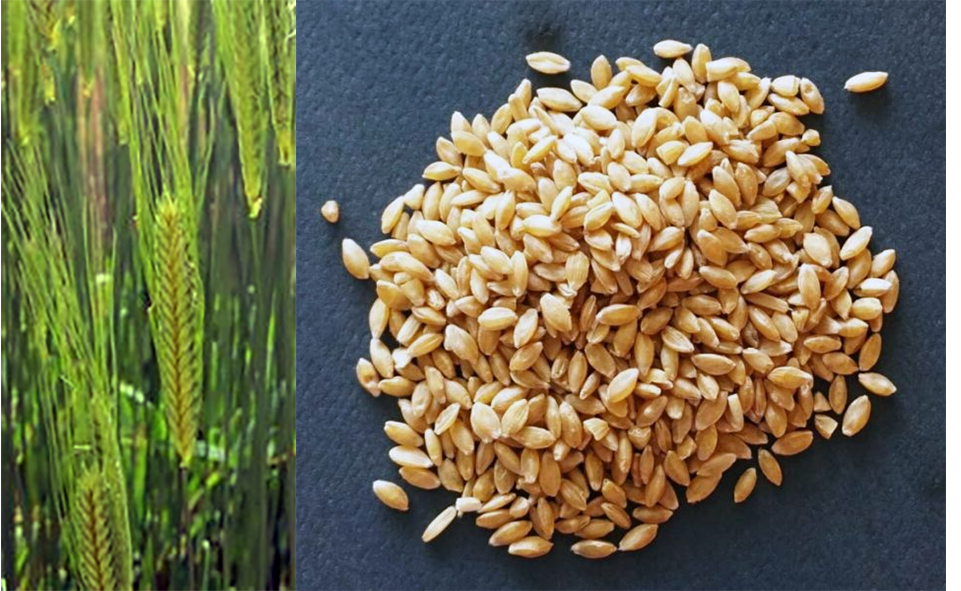
Einkorn (from German Einkorn, literally 'single grain') can refer to either a wild species of wheat (Triticum) or a domesticated form of wheat. The wild form is T. boeoticum (syn. T. m. subsp. boeoticum), and the domesticated form is T. monococcum (syn. T. m. subsp. monococcum). Einkorn is a diploid species (2n = 14 chromosomes) of hulled wheat, with tough glumes (husks) that tightly enclose the grains. The cultivated form is similar to the wild, except that the ear stays intact when ripe and the seeds are larger. The domestic form is known as petit épeautre in French, Einkorn in German, 'einkorn' or 'littlespelt' in English, piccolo farro in Italian and escanda menor in Spanish. The name refers to the fact that each spikelet contains only one grain. Einkorn was one of the first forms of wheat to be cultivated.
Einkorn is a short variety of wild wheat, usually less than 70cm tall, and is not very productive of edible seeds. The principal difference between wild einkorn and cultivated einkorn is the method of seed dispersal. In the wild variety, the seed head usually shatters and drops the kernels (seeds) of wheat onto the ground. This facilitates a new crop of wheat. In the domestic variety, the seed head remains intact. While such a mutation may occasionally occur in the wild, it is not viable there in the long term: the intact seed head will only drop to the ground when the stalk rots, and the kernels will not scatter but form a tight clump which inhibits germination and makes the mutant seedlings susceptible to disease. Harvesting einkorn with intact seed heads was easier for early human harvesters, who could then manually break apart the seed heads and scatter any kernels not eaten. Over time and through selection, conscious or unconscious, the human preference for intact seed heads created the domestic variety, which has slightly larger kernels than wild einkorn. Domesticated einkorn thus requires human planting and harvesting for its continuing existence. This process of domestication may have taken only 20 to 200 years, resulting in a wheat that was easier to harvest.
Cultivated Einkorn was described as a taxon, Triticum monococcum, by Carl Linnaeus in 1753. Later descriptions by other taxonomists, now treated as synonyms, include Triticum pubescens by von Bieberstein in 1800; Triticum hornemanii by Clementi in 1818; Nivieria monococcum in 1841; Triticum vulgare monococcum by Alefeld in 1866; Triticum monococcum subsp. cereale by Albert Thellung in 1918. Wild Einkorn is known either as Triticum monococcum subsp. aegilopoides or as Triticum boeoticum.
Einkorn wheat is one of the earliest cultivated forms of wheat, alongside emmer wheat (T. dicoccum). Hunter gatherers in the Fertile Crescent may have started harvesting einkorn as early as 30,000 years ago, according to archaeological evidence from Syria. Although gathered from the wild for thousands of years, einkorn wheat was first domesticated approximately 10,000 years BP in the Pre-Pottery Neolithic A (PPNA) or B (PPNB) periods. Evidence from DNA fingerprinting suggests einkorn was first domesticated near Karaca Dağ in southeast Turkey, an area in which a number of PPNB farming villages have been found. Yuval Noah Harari suggests that the domestication of einkorn was linked to intensive agriculture to support the nearby Göbekli Tepe site.
Einkorn wheat is low-yielding, but can survive on poor, dry, marginal soils where other varieties of wheat will not. As with other ancient varieties of wheat such as emmer, Einkorn is a "covered wheat", as its kernels do not break free from its seed coat (glume) with threshing. This makes it difficult to separate the husk from the seed. Einkorn is a common food in northern Provence, France. It is used for bulgur or as animal feed in mountainous areas of countries including France, India, Italy, Morocco, the former Yugoslavia, and Turkey. It contains gluten (so is not suitable for people with gluten-related disorders) and has a higher percentage of protein than modern red wheats. It is considered more nutritious because it has higher levels of fat, phosphorus, potassium, pyridoxine, and beta-carotene.
Historically, einkorn was not used in bread making, having primarily been eaten boiled in whole grains or in porridge, meaning that cultivars were not selected for their bread making potential. Until recently, einkorn was not thought to be suitable for baking, as its dough is sticky, inelastic and difficult to handle. Testing during the 1990s demonstrated that some einkorn varieties could perform favourably in comparison to bread wheats, and, while only some genotypes proved suitable for bread making, a wide variety were suitable for use in other baked goods. Einkorn dough has a bright yellow colour due to high levels of carotenoids, and due to low gas retention yields loaves with a dense structure.
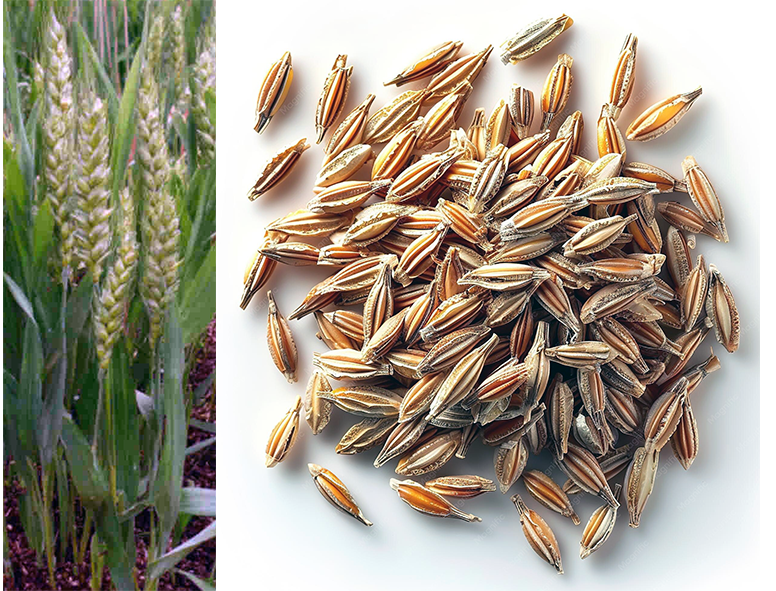
Spelt (Triticum spelta), also known as dinkel wheat, is a species of wheat. It is a relict crop, eaten in Central Europe and northern Spain. It is high in protein. In Australia it is marketed as a health food.
Spelt was cultivated from the Neolithic period onward. It was a staple food in parts of Europe from the Bronze Age to the Middle Ages. It is used in baking, and is made into bread, pasta, and beer. It is sometimes considered a subspecies of the closely related common wheat (T. aestivum), with the botanical name Triticum aestivum subsp. spelta. It is a hexaploid, most likely a hybrid of wheat and emmer.
Spelt is a species of Triticum, a large stout grass similar to bread wheat. Its flowering spike is slenderer than that of bread wheat; when ripe, it bends somewhat from the vertical. The spike is roughly four-edged. The axis of the spike is brittle and divided into segments; it shatters into separate segments when fully ripe. Spelt differs from bread wheat in that each seed (a caryopsis, botanically a fruit with its wall fused to the single seed inside) stays fully encapsulated by its husk.
Like common wheat, spelt is a hexaploid wheat species, which means it has six sets of chromosomes. It is derived from a hybridisation event between a domesticated tetraploid wheat such as durum wheat and another wheat species, increasing the number of sets of chromosomes.[10] Genetic evidence indicates an initial hybridisation of a domesticated tetraploid wheat and the diploid wild goat-grass Aegilops tauschii. It further shows that spelt could have arisen as the result of a second hybridisation, this time of bread wheat and emmer, giving rise to European spelt. The spelt genome continues to influence the breeding of modern hexaploid bread wheat through recent hybridisation.
Spelt has been cultivated since approximately 5000 BCE. In the fifth millennium BCE, there are archaeological remains in the north of Iraq and in Transcaucasia, north-east of the Black Sea. Much more evidence comes from Europe. Remains of spelt have been found in Denmark, Germany, and Poland from the later Neolithic (dating from 2500–1700 BCE). Evidence of spelt has been found from across central Europe from the Bronze Age. In the south of Germany and Switzerland in the Iron Age (750–15 BCE), it was a major type of wheat, while by 500 BCE, it had in addition become widespread in the south of Britain. There is evidence that spelt cultivation increased in Iron Age Britain as damp regions of the country with heavy soils tolerated by spelt were being settled.
A 100g reference serving of uncooked spelt provides 1,400 kilojoules (340 kilocalories) of food energy and is a rich source (20% or more of the Daily Value) of protein, dietary fibre, several B vitamins, and numerous dietary minerals (table). Highest nutrient contents include manganese (143% DV), phosphorus (57% DV), and niacin (46% DV). Spelt contains about 70% total carbohydrates, including 11% as dietary fibre, and is low in fat
In Germany and Austria, spelt loaves and rolls (Dinkelbrot) are widely available in bakeries. The unripe spelt grains are dried and eaten as Grünkern ('green grain'). In Australia it is grown organically for the health food market. Dutch jenever makers sometimes distil with spelt,while beer brewed from spelt exists in Bavaria and Belgium.
This is a continuation of an entire series of pages that will, I hope, allow my visitors to better navigate this site. As well as displaying recipes by name, country and region of origin I am now planning a whole series of pages where recipes can be located by meal type and main ingredient. This page gives a listing of all the Farro recipes added to this site.
These recipes, all contain Farro as a major wild food ingredient.
Farro is a grain of any of three species of hulled wheat, namely einkorn, emmer, or spelt, sold dried and cooked in water until soft. It is used as a side dish and added to salads, soups and stews. The English word is borrowed directly from Italian farro, first documented in English in 1828 when the botanist Samuel Frederick Gray mentioned it. It derives from Latin far, farris (spelt, grain).
Farro is made from any of three species of hulled wheat (those that retain their husks tightly and cannot be threshed): spelt (Triticum spelta), emmer (Triticum dicoccum), and einkorn (Triticum monococcum). In Italian cuisine, the three species are sometimes distinguished as farro grande, farro medio, and farro piccolo (large, medium, and small farro, respectively).
Emmer is the most common variety of farro grown in Italy, specifically in certain mountain regions of Tuscany and Abruzzo. It is considered to be of higher quality for cooking than the other two grains and thus is sometimes called 'true' farro.
Triticum turgidum subsp. dicoccum and Triticum turgidum subsp. durum also known as Emmer wheat is a hybrid species of wheat. Along with einkorn (see below), it was one of the first crops domesticated in the Near East. It was widely cultivated in the ancient world, but is now a relict crop in mountainous regions of Europe and Asia. Emmer is one of the three grains called farro in Italy.
The edible seeds have been used as food since ancient times. The domesticated types are Triticum turgidum subsp. dicoccum and Triticum turgidum subsp. durum. The wild plant is called Triticum dicoccoides. The seeds have an awned covering, the sharp spikes helping the seeds to become buried in the ground. The principal difference between the wild and the domestic forms is that the ripened seed head of the wild plant shatters and scatters the seed onto the ground, while in the domesticated emmer, the seed head remains intact, thus making it easier to harvest the grain.
Like einkorn (T. monococcum) and spelt (T. spelta), emmer is a hulled wheat, meaning it has strong glumes (husks) that enclose the grains, and a semibrittle rachis. On threshing, a hulled wheat spike breaks up into spikelets that require milling or pounding to release the grains from the glumes. Wild emmer spikelets effectively self-cultivate by propelling themselves mechanically into soils with their awns. During a period of increased humidity during the night, the awns of the spikelet become erect and draw together, and in the process push the grain into the soil. During the daytime, the humidity drops and the awns slacken back again; however, fine silica hairs on the awns act as hooks in the soil and prevent the spikelets from backing out. During the course of alternating stages of daytime drying and nighttime humidity, the awns' pumping movements, which resemble a swimming frog kick, will drill the spikelet 25mm or more into the soil.
Strong similarities in morphology and genetics show that wild emmer (T. dicoccoides Koern.) is the wild ancestor and a crop wild relative of domesticated emmer. Wild emmer still grows wild in the Near East. It is a tetraploid wheat formed by the hybridization of two diploid wild grasses, wild red einkorn (Triticum urartu), and the goatgrass Aegilops speltoides.
Wild emmer is native to the Fertile Crescent of the Middle East, growing in the grass and woodland of hill country from modern-day Israel to Iran. The origin of wild emmer has been suggested, without universal agreement among scholars, to be the Karaca Dağ mountain region of southeastern Turkey. In 1906, Aaron Aaronsohn's discovery of wild emmer wheat growing in Rosh Pinna (Israel) created a stir in the botanical world. Emmer wheat has been found in archaeological excavations and ancient tombs. Emmer was collected from the wild and eaten by hunter gatherers for thousands of years before its domestication. Grains of wild emmer discovered at Ohalo II had a radiocarbon dating of 17,000 BC and at the Pre-Pottery Neolithic A (PPNA) site of Netiv Hagdud are 10,000–9,400 years old.
Today emmer is primarily a relict crop in mountainous areas. Its value lies in its ability to give good yields on poor soils, and its resistance to fungal diseases such as stem rust that are prevalent in wet areas. Emmer is grown in Armenia, Morocco, Spain (Asturias), the Carpathian mountains on the border of Czechia and Slovakia, Albania, Turkey, Switzerland, Germany, Greece and Italy. It is grown in the U.S. as a specialty product. In Ethiopia, the grain is traditional.
Emmer's main use is as food, though it is also used as fodder. Ethnographic evidence from Turkey and other emmer-growing areas suggests that emmer makes good bread (judged by the taste and texture standards of traditional bread); it was widely eaten as bread in ancient Egypt. In Armenian cuisine, emmer pilaf is cooked in sunflower oil. The pre-cooked emmer is fried in oil and then sautéed onions are added. In the second version, boiled water and emmer are added to the sautéed onion and then cooked until tender. In Armenia, emmer porridge with lamb called "kashovi" is widespread in the Shirak region, while lean kashovi is known in all regions of Armenia. Chopped lamb is added to cold water then boiled for 10 minutes, emmer and sautéed onion are added and cooked over a low heat until tender. Emmer is the most common variety of farro grown in Italy, specifically in certain mountain regions of Tuscany and Abruzzo, and can be found in most supermarkets and groceries. It is considered to be of higher quality for cooking than the other two grains and thus is sometimes called 'true' farro. The whole grains can be cooked in water until soft and used as a side dish, or added into salads, soups and desserts. Emmer bread (pane di farro) can be found in bakeries in some areas.
Einkorn (from German Einkorn, literally 'single grain') can refer to either a wild species of wheat (Triticum) or a domesticated form of wheat. The wild form is T. boeoticum (syn. T. m. subsp. boeoticum), and the domesticated form is T. monococcum (syn. T. m. subsp. monococcum). Einkorn is a diploid species (2n = 14 chromosomes) of hulled wheat, with tough glumes (husks) that tightly enclose the grains. The cultivated form is similar to the wild, except that the ear stays intact when ripe and the seeds are larger. The domestic form is known as petit épeautre in French, Einkorn in German, 'einkorn' or 'littlespelt' in English, piccolo farro in Italian and escanda menor in Spanish. The name refers to the fact that each spikelet contains only one grain. Einkorn was one of the first forms of wheat to be cultivated.
Einkorn is a short variety of wild wheat, usually less than 70cm tall, and is not very productive of edible seeds. The principal difference between wild einkorn and cultivated einkorn is the method of seed dispersal. In the wild variety, the seed head usually shatters and drops the kernels (seeds) of wheat onto the ground. This facilitates a new crop of wheat. In the domestic variety, the seed head remains intact. While such a mutation may occasionally occur in the wild, it is not viable there in the long term: the intact seed head will only drop to the ground when the stalk rots, and the kernels will not scatter but form a tight clump which inhibits germination and makes the mutant seedlings susceptible to disease. Harvesting einkorn with intact seed heads was easier for early human harvesters, who could then manually break apart the seed heads and scatter any kernels not eaten. Over time and through selection, conscious or unconscious, the human preference for intact seed heads created the domestic variety, which has slightly larger kernels than wild einkorn. Domesticated einkorn thus requires human planting and harvesting for its continuing existence. This process of domestication may have taken only 20 to 200 years, resulting in a wheat that was easier to harvest.
Cultivated Einkorn was described as a taxon, Triticum monococcum, by Carl Linnaeus in 1753. Later descriptions by other taxonomists, now treated as synonyms, include Triticum pubescens by von Bieberstein in 1800; Triticum hornemanii by Clementi in 1818; Nivieria monococcum in 1841; Triticum vulgare monococcum by Alefeld in 1866; Triticum monococcum subsp. cereale by Albert Thellung in 1918. Wild Einkorn is known either as Triticum monococcum subsp. aegilopoides or as Triticum boeoticum.
Einkorn wheat is one of the earliest cultivated forms of wheat, alongside emmer wheat (T. dicoccum). Hunter gatherers in the Fertile Crescent may have started harvesting einkorn as early as 30,000 years ago, according to archaeological evidence from Syria. Although gathered from the wild for thousands of years, einkorn wheat was first domesticated approximately 10,000 years BP in the Pre-Pottery Neolithic A (PPNA) or B (PPNB) periods. Evidence from DNA fingerprinting suggests einkorn was first domesticated near Karaca Dağ in southeast Turkey, an area in which a number of PPNB farming villages have been found. Yuval Noah Harari suggests that the domestication of einkorn was linked to intensive agriculture to support the nearby Göbekli Tepe site.
Einkorn wheat is low-yielding, but can survive on poor, dry, marginal soils where other varieties of wheat will not. As with other ancient varieties of wheat such as emmer, Einkorn is a "covered wheat", as its kernels do not break free from its seed coat (glume) with threshing. This makes it difficult to separate the husk from the seed. Einkorn is a common food in northern Provence, France. It is used for bulgur or as animal feed in mountainous areas of countries including France, India, Italy, Morocco, the former Yugoslavia, and Turkey. It contains gluten (so is not suitable for people with gluten-related disorders) and has a higher percentage of protein than modern red wheats. It is considered more nutritious because it has higher levels of fat, phosphorus, potassium, pyridoxine, and beta-carotene.
Historically, einkorn was not used in bread making, having primarily been eaten boiled in whole grains or in porridge, meaning that cultivars were not selected for their bread making potential. Until recently, einkorn was not thought to be suitable for baking, as its dough is sticky, inelastic and difficult to handle. Testing during the 1990s demonstrated that some einkorn varieties could perform favourably in comparison to bread wheats, and, while only some genotypes proved suitable for bread making, a wide variety were suitable for use in other baked goods. Einkorn dough has a bright yellow colour due to high levels of carotenoids, and due to low gas retention yields loaves with a dense structure.
Spelt (Triticum spelta), also known as dinkel wheat, is a species of wheat. It is a relict crop, eaten in Central Europe and northern Spain. It is high in protein. In Australia it is marketed as a health food.
Spelt was cultivated from the Neolithic period onward. It was a staple food in parts of Europe from the Bronze Age to the Middle Ages. It is used in baking, and is made into bread, pasta, and beer. It is sometimes considered a subspecies of the closely related common wheat (T. aestivum), with the botanical name Triticum aestivum subsp. spelta. It is a hexaploid, most likely a hybrid of wheat and emmer.
Spelt is a species of Triticum, a large stout grass similar to bread wheat. Its flowering spike is slenderer than that of bread wheat; when ripe, it bends somewhat from the vertical. The spike is roughly four-edged. The axis of the spike is brittle and divided into segments; it shatters into separate segments when fully ripe. Spelt differs from bread wheat in that each seed (a caryopsis, botanically a fruit with its wall fused to the single seed inside) stays fully encapsulated by its husk.
Like common wheat, spelt is a hexaploid wheat species, which means it has six sets of chromosomes. It is derived from a hybridisation event between a domesticated tetraploid wheat such as durum wheat and another wheat species, increasing the number of sets of chromosomes.[10] Genetic evidence indicates an initial hybridisation of a domesticated tetraploid wheat and the diploid wild goat-grass Aegilops tauschii. It further shows that spelt could have arisen as the result of a second hybridisation, this time of bread wheat and emmer, giving rise to European spelt. The spelt genome continues to influence the breeding of modern hexaploid bread wheat through recent hybridisation.
Spelt has been cultivated since approximately 5000 BCE. In the fifth millennium BCE, there are archaeological remains in the north of Iraq and in Transcaucasia, north-east of the Black Sea. Much more evidence comes from Europe. Remains of spelt have been found in Denmark, Germany, and Poland from the later Neolithic (dating from 2500–1700 BCE). Evidence of spelt has been found from across central Europe from the Bronze Age. In the south of Germany and Switzerland in the Iron Age (750–15 BCE), it was a major type of wheat, while by 500 BCE, it had in addition become widespread in the south of Britain. There is evidence that spelt cultivation increased in Iron Age Britain as damp regions of the country with heavy soils tolerated by spelt were being settled.
A 100g reference serving of uncooked spelt provides 1,400 kilojoules (340 kilocalories) of food energy and is a rich source (20% or more of the Daily Value) of protein, dietary fibre, several B vitamins, and numerous dietary minerals (table). Highest nutrient contents include manganese (143% DV), phosphorus (57% DV), and niacin (46% DV). Spelt contains about 70% total carbohydrates, including 11% as dietary fibre, and is low in fat
In Germany and Austria, spelt loaves and rolls (Dinkelbrot) are widely available in bakeries. The unripe spelt grains are dried and eaten as Grünkern ('green grain'). In Australia it is grown organically for the health food market. Dutch jenever makers sometimes distil with spelt,while beer brewed from spelt exists in Bavaria and Belgium.
The alphabetical list of all Farro recipes on this site follows, (limited to 100 recipes per page). There are 31 recipes in total:
Page 1 of 1
| Alicam vel sucum tisanae (Spelt or Barley Gruel) Origin: Roman | Catillus Ornatus (Seasoned Fritters) Origin: Roman | Puls Fabata (Broad Bean Porridge) Origin: Roman |
| Aliter Coliclos V (Stalks, Another Way, V) Origin: Roman | Crempog Gri (Welsh Currant Pancake) Origin: Welsh | Pultes (Meat Pottage) Origin: Roman |
| Aliter Isicia (Another Sausage) Origin: Roman | Dulse Muffins Origin: Britain | Pumpkin, Goat's Cheese and Kale Tart with Three-cornered Leeks Origin: Britain |
| Aliter Isicia II (Another Sausage II) Origin: Roman | Farro Breakfast Pudding Origin: Fusion | Pumpkin, Goat's Cheese and Kale Tart Origin: Britain |
| Aliter Sphondylos VI (Parsnips, Another Way VI) Origin: Roman | Hadrians Spelt Bread Origin: Britain | Rainkohl und Grünkern-Suppe (Nipplewort and Green Spelt Soup) Origin: Germany |
| Apothermum (Sweet Wine and Raisin Sauce) Origin: Roman | Harisa (Chicken and Wheat Porridge) Origin: Armenia | Risotto al Farro con Funghi (Farro Risotto with Mushrooms and Herbs) Origin: Italy |
| Artolaganon (Fried Savoury Pasta) Origin: Roman | Iron Age Flatbread Origin: Ancient | Savoury Farro Breakfast Porridge Origin: Fusion |
| Artolaganon II (Leavened Flatbread) Origin: Roman | Keşkek (Slow-cooked Lamb and Farro Stew) Origin: Turkey | Spelt, Fig and Pomegranate Salad Origin: Britain |
| Bisgedi Ceirch a Sbelt (Oat and Spelt Biscuits) Origin: Welsh | Minestra di farro (Tuscan Farro Soup with White Beans and Vegetables) Origin: Italy | Tyttebœr Brød (Lingonberry Bread) Origin: Denmark |
| Bisort Bolognese Origin: Fusion | Olusatra (Alexanders with Raisin Sauce) Origin: Roman | |
| Buccellatum (Roman Hardtack) Origin: Roman |
Page 1 of 1