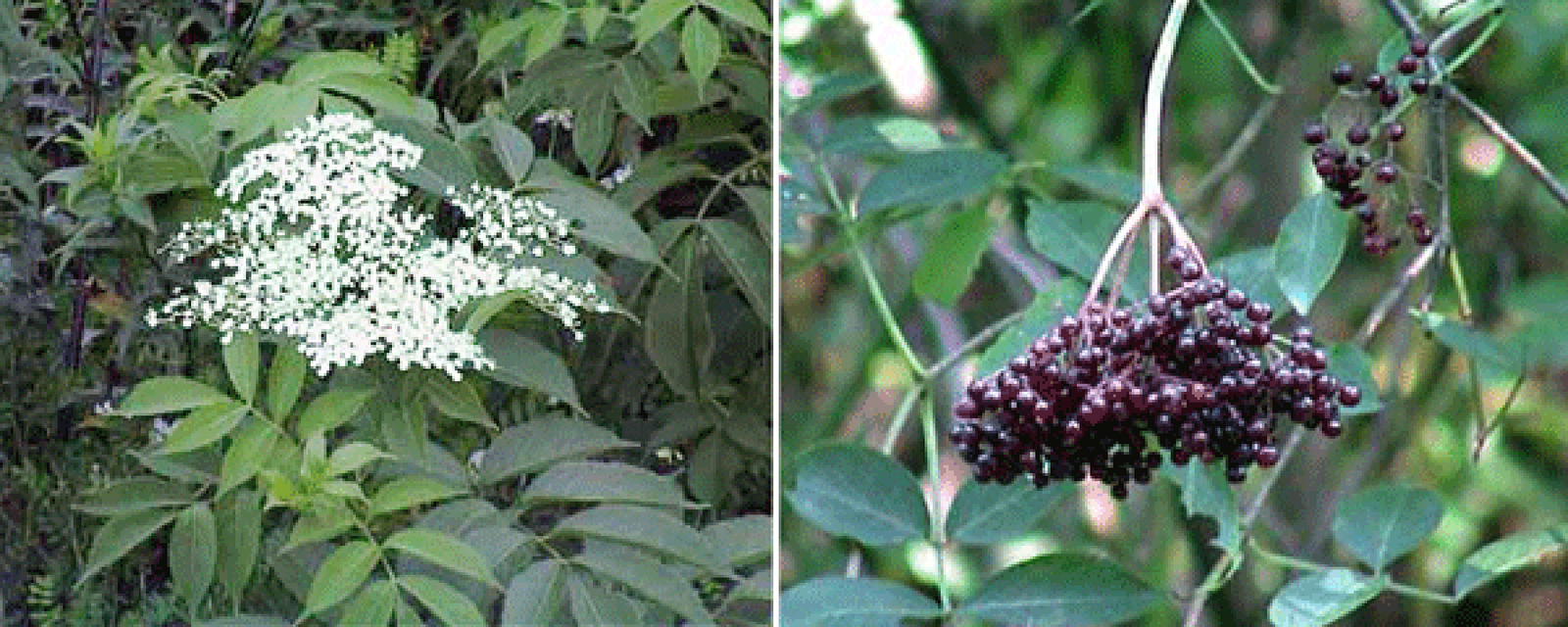
 Elder trees Sambucus nigra showing elder flowers (left)
and elderberries (right).
Welcome to the summary page for FabulousFusionFood's Cook's Guide entry for Elder along with all the recipes employing Elder presented on this site, with 18 recipes in total.
This is a continuation of an entire series of pages that will, I hope, allow my visitors to better navigate this site. As well as displaying recipes by name, country and region of origin I am now planning a whole series of pages where recipes can be located by meal type and main ingredient. This page gives a listing of all the Elder recipes added to this site.
These recipes, all contain Elder as a major wild food ingredient.
The elder (also known as elderberry) represent the flowers and the fruit of the black (or common) elder Sambucus nigra, native to Europe and western Asia. These are small trees which are classed as part of the Caprifoliaceae (honeysuckle) family, but which recent genetic evidence has shown to be part of the Adoxaceae (viburnum) family. This can grow to a tree reaching 15m tall, though more generally it grows as a large shrub (some 5–8m tall). Both the flowers and the berries are edible.
Elder flowers can either be used to create an infusion (elderflower cordial or wine) or they can actually be eaten themselves (elderflower fritters). It is best to pick the flowering heads when the flowers are open and full of pollen (it's the pollen that actually produces the flavour). If the flowers have begun to turn brown then they are past their best and have shed their pollen. These kinds of flowers should be discarded. The ripe fruit of the elder is also edible (although it is somewhat bitter, but a pinch of salt cures that problem) and can be made into wines or even baked into pies. You can also collect elderflower buds for pickling in vinegar and they make a decent substitute for capers.
This is a continuation of an entire series of pages that will, I hope, allow my visitors to better navigate this site. As well as displaying recipes by name, country and region of origin I am now planning a whole series of pages where recipes can be located by meal type and main ingredient. This page gives a listing of all the Elder recipes added to this site.
These recipes, all contain Elder as a major wild food ingredient.
The elder (also known as elderberry) represent the flowers and the fruit of the black (or common) elder Sambucus nigra, native to Europe and western Asia. These are small trees which are classed as part of the Caprifoliaceae (honeysuckle) family, but which recent genetic evidence has shown to be part of the Adoxaceae (viburnum) family. This can grow to a tree reaching 15m tall, though more generally it grows as a large shrub (some 5–8m tall). Both the flowers and the berries are edible.
Elder flowers can either be used to create an infusion (elderflower cordial or wine) or they can actually be eaten themselves (elderflower fritters). It is best to pick the flowering heads when the flowers are open and full of pollen (it's the pollen that actually produces the flavour). If the flowers have begun to turn brown then they are past their best and have shed their pollen. These kinds of flowers should be discarded. The ripe fruit of the elder is also edible (although it is somewhat bitter, but a pinch of salt cures that problem) and can be made into wines or even baked into pies. You can also collect elderflower buds for pickling in vinegar and they make a decent substitute for capers.
The alphabetical list of all Elder recipes on this site follows, (limited to 100 recipes per page). There are 18 recipes in total:
Page 1 of 1
| Blackberry and Elderberry Jam Origin: British | Elderberry Soup Origin: Britain | Patina de Sabuco (Elderberry Souflée) Origin: Roman |
| Câpres de sureau verte (Green Elderberry Capers) Origin: France | Elderberry Syrup Bavarois Origin: Britain | Petits Gâteaux au Sureau (Elderberry Muffins) Origin: Switzerland |
| Chilled Elderberry Soup Origin: Britain | Elderberry Syrup II Origin: Britain | Pontac Catsup for Fish Origin: Britain |
| Elderberry and Chocolate Muffins Origin: Britain | Fruit Dumplings Origin: Ancient | Pontack Sauce Origin: Britain |
| Elderberry Sauce Origin: Britain | Hedgerow Jam Origin: British | Roast Venison with Elderberries and Lavender Vinegar Origin: Britain |
| Elderberry Sauce Origin: Britain | Holdermus (Elderberry Mush) Origin: Germany | Wildberry Crisp Origin: Britain |
Page 1 of 1