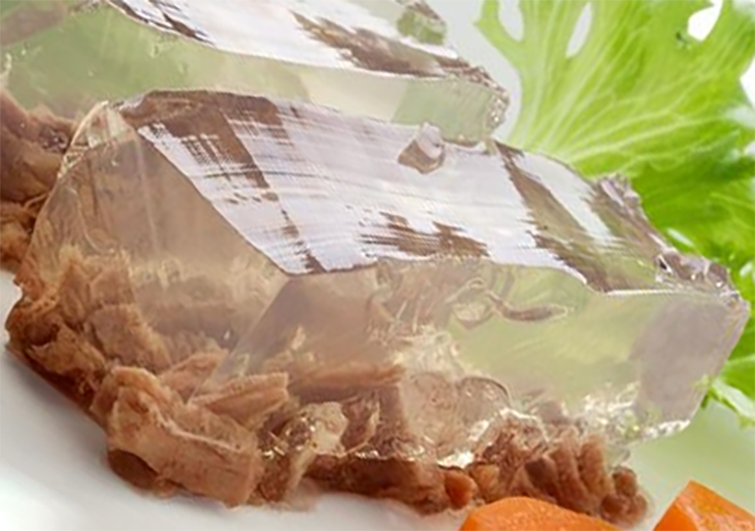
 Seafood suspended in a block of aspic.
Welcome to the summary page for FabulousFusionFood's Cook's Guide entry for Aspic along with all the recipes employing Aspic presented on this site, with 12 recipes in total.
This is a continuation of an entire series of pages that will, I hope, allow my visitors to better navigate this site. As well as displaying recipes by name, country and region of origin I am now planning a whole series of pages where recipes can be located by meal type and main ingredient. This page gives a listing of all the Aspic recipes added to this site.
These recipes, all contain Aspic as a major wild food ingredient.
Aspic is a clear transparent jelly in which cold fish, poultry and meat are sometimes served. It's used as a garnish to glaze and protect fish and other food from drying out (the clear aspic allows any decoration to be seen), and to set savoury foods in a mould. It was a staple of Edwardian cookery and is made from reduced meat stock and gelatine (though if you are using veal bones you may not need the gelatine). These days aspic can also be purchased in powder form.
Traditional aspics are made by boiling down animal parts with high gelatine content (calf's feet or pig's trotters, typically) to make a meat stock jelly. However, with the availability of purified gelatines aspic can also be made with gelatine powder or gelatine leaves. Vegetarian aspic can be made from agar-agar or from boiling Irish moss (carragheen) seaweed. In the past aspics were also made form isinglass (fish swim bladders).
In her 'Book of Household Management', Mrs Beeton defines and Aspic as an Ornamental or Savoury Jelly. They have been a part of British cuisines since Elizabethan times, but their heyday was in the Stuart period (1660s to 1700s) where they were served with the sweetmeats at the end of the evening meal.
This is a continuation of an entire series of pages that will, I hope, allow my visitors to better navigate this site. As well as displaying recipes by name, country and region of origin I am now planning a whole series of pages where recipes can be located by meal type and main ingredient. This page gives a listing of all the Aspic recipes added to this site.
These recipes, all contain Aspic as a major wild food ingredient.
Aspic is a clear transparent jelly in which cold fish, poultry and meat are sometimes served. It's used as a garnish to glaze and protect fish and other food from drying out (the clear aspic allows any decoration to be seen), and to set savoury foods in a mould. It was a staple of Edwardian cookery and is made from reduced meat stock and gelatine (though if you are using veal bones you may not need the gelatine). These days aspic can also be purchased in powder form.
Traditional aspics are made by boiling down animal parts with high gelatine content (calf's feet or pig's trotters, typically) to make a meat stock jelly. However, with the availability of purified gelatines aspic can also be made with gelatine powder or gelatine leaves. Vegetarian aspic can be made from agar-agar or from boiling Irish moss (carragheen) seaweed. In the past aspics were also made form isinglass (fish swim bladders).
In her 'Book of Household Management', Mrs Beeton defines and Aspic as an Ornamental or Savoury Jelly. They have been a part of British cuisines since Elizabethan times, but their heyday was in the Stuart period (1660s to 1700s) where they were served with the sweetmeats at the end of the evening meal.
The alphabetical list of all Aspic recipes on this site follows, (limited to 100 recipes per page). There are 12 recipes in total:
Page 1 of 1
| Aspic Jelly Origin: Britain | Elderflower Seaweed Pudding Origin: Ireland | Rieslingspaschtèit (Riesling Wine and Meat Pie) Origin: Luxembourg |
| Brown Chaudfroid Sauce Origin: France | Fierkelsjhelli (Suckling Pig in Aspic) Origin: Luxembourg | Smoked Mackerel Pâté II Origin: Britain |
| Clear Tarragon Sauce Origin: Britain | Mayonnaise Collée Origin: France | Ube Halaya (Purple Yam Dessert) Origin: Philippines |
| Economical Aspic Jelly Origin: Britain | Morels in Aspic Origin: Britain | White Aspic Jelly Origin: Britain |
Page 1 of 1