FabulousFusionFood's Biscuit, Cookie and Cracker Recipes 4th Page
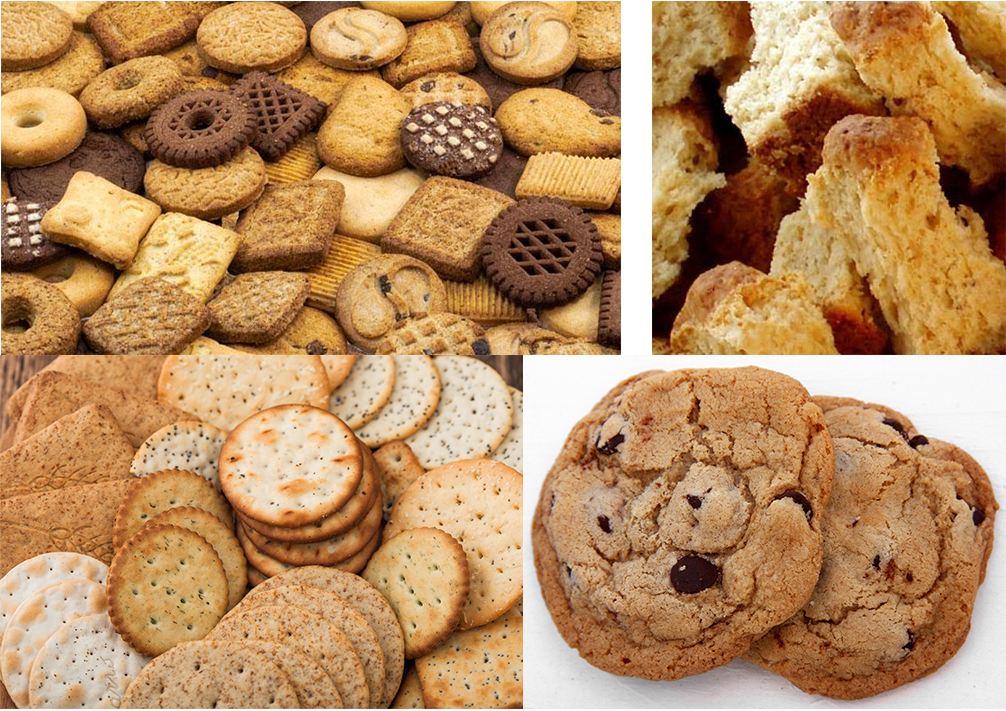 Examples of, clockwise from top left: biscuits, rusks, cookies and crackers.
Welcome to FabulousFusionFood's Biscuit, Cookie and Cracker Recipes Page — This page gives a listing of all the biscuit/cookie recipes added to this site. In British English they are called 'biscuits' a name ultimately derived from the Latin bis ('twice') and coquere, coctus ('to cook', 'cooked') via the French bescuit and literally means 'cooked twice'. This is because biscuits were originally cooked in a twofold process: first baked, and then dried out in a slow oven, a process that is still employed for rusks.
It can be argued that the development of biscuits, as a dry form of flour dough began with the need for travelling bread, particularly for travelling. The introduction of the baking of processed cereals, including the creation of flour, provided a more reliable source of food. Egyptian sailors carried a flat, brittle loaf of millet bread called dhourra cake while the Romans had a biscuit called buccellatum. Roman cookbook Apicius describes: 'a thick paste of fine wheat flour was boiled and spread out on a plate. When it had dried and hardened, it was cut up and then fried until crisp, then served with honey and pepper'.
Hard biscuits soften as they age. To solve this problem, early bakers attempted to create the hardest biscuit possible. Because it is so hard and dry, if properly stored and transported, navies' hardtack will survive rough handling and high temperature. Baked hard, it can be kept without spoiling for years as long as it is kept dry. For long voyages, hardtack was baked four times, rather than the more common two. To soften hardtack for eating, it was often dunked in brine, coffee, or some other liquid or broken into pieces and cooked into a skillet meal.
Early biscuits were hard, dry, and unsweetened. They were most often cooked after bread, in a cooling bakers' oven; they were a cheap form of sustenance for the poor.
By the 7th century AD, cooks of the Persian empire had learnt from their forebears the techniques of lightening and enriching bread-based mixtures with eggs, butter, and cream, and sweetening them with fruit and honey. One of the earliest spiced biscuits was gingerbread, in French, pain d'épices, meaning "spice bread", brought to Europe in 992 by the Armenian monk Grégoire de Nicopolis. He left Nicopolis Pompeii, of Lesser Armenia to live in Bondaroy, France, near the town of Pithiviers. He stayed there for seven years and taught French priests and Christians how to cook gingerbread. This was originally a dense, treacly (molasses-based) spice cake or bread. As it was so expensive to make, early ginger biscuits were a cheap form of using up the leftover bread mix.
With the combination of knowledge spreading from Al-Andalus, and then the Crusades and subsequent spread of the spice trade to Europe, the cooking techniques and ingredients of Arabia spread into Northern Europe.[4] By mediaeval times, biscuits were made from a sweetened, spiced paste of breadcrumbs and then baked (e.g., gingerbread), or from cooked bread enriched with sugar and spices and then baked again.[19] King Richard I of England (aka Richard the Lionheart) left for the Third Crusade (1189–92) with "biskit of muslin", which was a mixed corn compound of barley, rye, and bean flour.
The milk chocolate coated side of a McVitie's chocolate digestive. It is routinely ranked the UK's favourite snack. As the making and quality of bread had been controlled to this point, so were the skills of biscuit-making through the craft guilds. As the supply of sugar began, and the refinement and supply of flour increased, so did the ability to sample more leisurely foodstuffs, including sweet biscuits. Early references from the Vadstena monastery show how the Swedish nuns were baking gingerbread to ease digestion in 1444. The first documented trade of gingerbread biscuits dates to the 16th century, where they were sold in monastery pharmacies and town square farmers markets. Gingerbread became widely available in the 18th century. The Industrial Revolution in Britain sparked the formation of businesses in various industries, and the British biscuit firms of McVitie's, Carr's, Huntley & Palmers, and Crawfords were all established by 1850.
Most modern biscuits can trace their origins back to either the hardtack ship's biscuit or the creative art of the baker:
Ship's biscuit derived: digestive, rich tea, hobnobs, Garibaldi.
Baker's art: biscuit rose de Reims.
Biscuits today can be savoury (crackers) or sweet. Most are small, at around 5 cm (2.0 in) in diameter, and flat. Sandwich-style biscuits consist of two biscuits sandwiching a layer of "creme" or icing, such as the custard cream, or a layer of jam (as in the biscuits that are known as "Jammie Dodgers" in the United Kingdom).
Sweet biscuits are commonly eaten as a snack food, and are, in general, made with wheat flour or oats, and sweetened with sugar or honey. Varieties may contain chocolate, fruit, jam, nuts, ginger, or even be used to sandwich other fillings.
Savoury biscuits or crackers (such as cream crackers, water biscuits, oatcakes, or crisp breads) are usually plainer and commonly eaten with cheese following a meal. Many savoury biscuits also contain additional ingredients for flavour or texture, such as poppy seeds, onion or onion seeds, cheese (such as cheese melts), and olives. Savoury biscuits also usually have a dedicated section in most European supermarkets, often in the same aisle as sweet biscuits. The exception to savoury biscuits is the sweetmeal digestive known as the 'Hovis biscuit', which, although slightly sweet, is still classified as a cheese biscuit.[32] Savoury biscuits sold in supermarkets are sometimes associated with a certain geographical area, such as Scottish oatcakes or Cornish wafer biscuits.
The alphabetical list of all the biscuit, cookie and cracker recipes on this site follows, (limited to 100 recipes per page). There are 471 recipes in total:
Page 4 of 5
| Mincemat, Macadamia and Cranberry Biscotti Origin: Fusion | Orange Chesecake Origin: Britain | Pumpkin Spice Cookies Origin: American |
| Mincemeat Blondies Origin: Fusion | Orašnice (Walnut Biscuits) Origin: Bosnia | Queki Biscuits Origin: Panama |
| Mini Milk Cookies Origin: America | Orašnice (Walnut Biscuits) Origin: Serbia | Raivas (Portuguese Cinnamon Butter Biscuits) Origin: Guinea-Bissau |
| Mini Pots of Gold Origin: Ireland | Orašnice (Walnut Biscuits) Origin: Croatia | Raspberry Drops Origin: New Zealand |
| Mint Shortbread Biscuits Origin: Ireland | Orašnice (Walnut Biscuits) Origin: Macedonia | Raspberry Jam Shortbreads Origin: Britain |
| Mixed Nut Butter Cookies Origin: American | Ostkaka (Swedish Cheesecake) Origin: Sweden | Ratafia Biscuits Origin: Scotland |
| Montserratian Johnny Cakes Origin: Montserrat | Palets Breton (Breton Pucks) Origin: France | Red Chilli Biscuits Origin: America |
| Mtedza (Peanut Puffs) Origin: Malawi | Palets bretons au caramel salé (Breton Pucks with Salted Caramel) Origin: France | Red Clover and Almond Biscuits Origin: Britain |
| Mtedza Puffs Origin: Malawi | Panlevi (Sponge Biscuits) Origin: Aruba | Red Lobster's Cheesecake Origin: American |
| Mulled Wine Cheesecake Origin: Britain | Party crispies Origin: Andorra | Redcurrant and Oat Biscuits Origin: Britain |
| Mulled Wine Cheesecake II Origin: Britain | Peanut Butter Cheesecake Origin: Britain | Rhubarb and Ginger Cheesecake Origin: Britain |
| Naples Biscuits Origin: American | Peanut Clusters Origin: Britain | Ricciarelli (Sienese Christmas Biscuits) Origin: Italy |
| Naples Bisket Origin: Britain | Peanut Cookies Origin: Britain | Roof Tile Crackers Origin: Britain |
| Navettes Bretonnes aux fruits rouges (Breton Navettes with Red Fruit) Origin: France | Peanut Macaroons Origin: Sudan-a | Rusks with Chickpea Leaven Origin: Cyprus |
| Nederlander Bloemen Sprits (Chocolate And Cinnamon Sprits Biscuits) Origin: Netherlands | Pesto Pastry Stars Origin: Britain | Sablés Bretons (Breton Biscuits) Origin: France |
| New York Cheesecake II Origin: America | Petits Beurres Origin: France | Saboera Biscuits Origin: South Africa |
| No Bake Cheesecake Origin: Britain | Peynirli Bisküvi (Cheese Biscuits) Origin: Turkey | Sagu Keju (Indonesian Cheese Biscuits) Origin: Indonesia |
| No-bake Cheesecake 3 Origin: Scotland | Pineapple Pudding Origin: India | Salted Caramel Cheesecake Origin: Britain |
| No-bake Cheesecake II Origin: American | Pineappleweed Biscuits Origin: Britain | Sauerbraten Origin: Germany |
| No-bake Lemon Cheesecake Origin: American | Pineappleweed Posset Pots Origin: Britain | Savoiardi Biscuits Origin: Italy |
| No-bake Peanut Butter Flapjack Origin: Britain | Pineappleweed Skolebrød Origin: Scotland | Schokoladenpretzel (Chocolate Pretzels) Origin: Germany |
| Oat and Barley Milk Cakes Origin: Ancient | Piparkökur (Icelandic Pepper Biscuits) Origin: Iceland | Scotch Cake Biscuits Origin: Scotland |
| Oat and Currant Biscuits Origin: Britain | Pistachio Pudding Cookies Origin: American | Scottish Lace Biscuits Origin: Scotland |
| Oat Biscuits Origin: Britain | Pitcaithly Bannocks Origin: Scotland | Scottish Oatcakes Origin: Scotland |
| Oat, Raisin and Himalayan Balsam Seed Biscuits (Oat and Raisin and Himalayan Balsam Seed Biscuits) Origin: British | Plantain Seed Crackers Origin: Britain | Scottish Parkin Biscuits Origin: Scotland |
| Oatcakes Origin: Ancient | Polvorones de Canela (Cinnamon Shortbread) Origin: Spain | Scottish Parliament Cakes Origin: Scotland |
| Oatmeal Cakes Origin: Scotland | Polvorones puertorriqueños (Guava Thumbprint Biscuits) Origin: Puerto Rico | Scottish Shortbread Origin: Scotland |
| Oaty Crumbles Origin: Scotland | Pratie Oaten Origin: Northern Ireland | Sea-buckthorn Cheesecake Origin: Britain |
| Obuoliniai Sausainiai (Lithuanian Apple Biscuits) Origin: Lithuania | Prince Bisket Origin: Britain | Seaweed Flour Biscuits Origin: Britain |
| Oil-based Flapjacks Origin: Britain | Puerto Rican Dulce de Leche Origin: Puerto Rico | Shaker Ghurek Origin: Azerbaijan |
| Old-fashioned Lemon Sugar Cookies Origin: American | Pumpkin Cheesecake Origin: Britain | Shamrock Sugar Biscuits Origin: Ireland |
| Oliebollen (Dutch New Year Doughnuts) Origin: Netherlands | Pumpkin Oatmeal Chocolate Chip Cookies Origin: American | Sheqerpare (Biscuits in Syrup) Origin: Albania |
| Omled Sloj (Onion Greens Omelette) Origin: Welsh | Pumpkin Pie Bars Origin: American | |
| Orange Cheesecake 2 Origin: Britain | Pumpkin Pie with Gingersnap Crust Origin: American |
Page 4 of 5