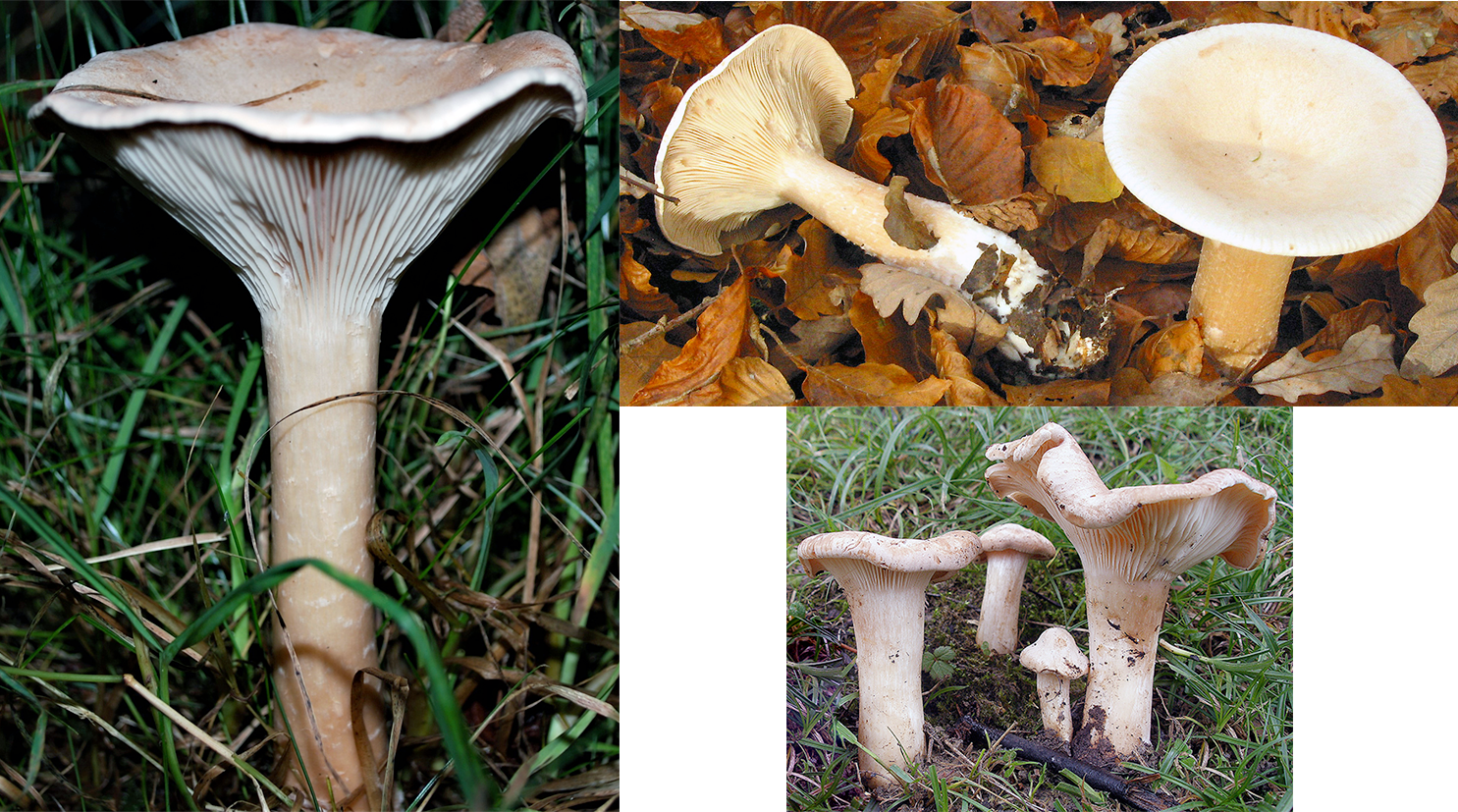
 The image, above, shows various views of the Trooping Funnel
Infundibulicybe geotropa, showing a mature specimen,
specimens at different growth stages and a mature specimen in
leaf litter, one upright and one on its side showing the stipe
and gills..
| Common Name: Trooping Funnel Scientific Name: Infundibulicybe geotropa |
| Other Names: Monk's Head, Rickstone Funnel Cap, Twmffat/Twndish Cylchol (CY) |
Physical Characteristics Clitocybe odora is a mycorrhizal saprophytic fungus, growing to 20cm in diameter by 20cm tall. It is typically found in mixed woodlands, especially grassy clearings, in autumn. Often gregarious, it can form fairy rings, and has a complex mycelium.
|
| Family: Omphalinaceae |
|
Edible Parts: Caps |
 Spore Print: White Spore Print: White |
 Cap: depressed Cap: depressed
|
 Hymenium: Decurrent Hymenium: Decurrent
|
 Gills: Gills on hymenium Gills: Gills on hymenium
|
 Stipe: Bare Stipe: Bare
|
 Edibility Rating: 4 Edibility Rating: 4 
|
 Known Hazards: None known Known Hazards: None known
|
Monthly Availability:
|
Welcome to the summary page for FabulousFusionFood's Wild Food guide to Trooping Funnel along with all the Trooping Funnel containing recipes presented on this site, with 10 recipes in total.
These recipes, all contain Trooping Funnel as a major wild food ingredient.
The Trooping Funnel, Infundibulicybe geotropa (formerly Clitocybe geotropa) (also known as the Monk's Head) is an choice edible species of mycorrhizal fungus (has a symbiotic relationship with tree roots) and is a member of the Omphalinaceae family of the Agaricales order. The trooping funnel is a cream- or buff-coloured mushroom, the cap may reach 20cm in diameter. It has a prominent boss and looks small in relation to the large stem in young specimens. As the mushroom ages, the cap changes from convex with inrolled margins to more funnel shaped. The decurrent gills are the same colour as the cap. The stipe is bulbous, larger at the base and 10–20 cm tall. The spore print is white. There is a sweet smell, which has been likened to the odour of bitter almonds. The white flesh is firm in young specimens.
Trooping funnel is found in mixed woodlands, especially grassy clearings, in autumn. Often gregarious, it can form fairy rings, and has a complex mycelium. It is abundant and widespread in Europe (August to November), and less common in North America.
The cap grows maximally to 15–20cm in diameter. It is typically convex with in-turned edge and obvious umbo becoming flattened then funnel-shaped but keeping an in-turned edge. Buff/yellow to having a salmon pink tinge. The gills are crowded and pale buff/yellow sometimes with a salmon pink tinge. Running down the stem (decurrent). The stem is maximally 16-20 cm long, 2-3 cm diameter. Swollen and a bit woolly at the base. Pale buff/yellow sometimes with a tinge of salmon pink. The stem is very tough and fibrous and usually requires a knife to harvest them. When cooking the stem cut it into discs. The flesh is white and firm
Only young mushrooms are recommended for eating, as older ones lose their pleasant taste,[4] and the flesh becomes leathery in consistency. The stipes of all aged specimens are generally discarded.[5] The fungus is popular in northern Italy, where it is roasted or cooked in stews and frittatas, or preserved in oil.
It might be confused with the potentially deadly Clitocybe rivulosa and Clitocybe dealbatta, is similar, although these mushrooms do not get any where near as big as the Trouping Funnel, so when identifying these mushrooms size matters... The livid pinkgill (Entoloma sinuatum) is slightly similar, but has notched gills and a mealy smell. Melanoleuca grammopodia is again similar but with a pale brown cap and musty smell. If you stick to large specimens, with some being 20cm or more, it would be difficult to confuse this mushroom with any other.
For other edible mushrooms, see the guide to edible mushrooms
[2]. Huxley, A. The New RHS Dictionary of Gardening. 1999
[3]. Tanaka, T. Tanaka's Cyclopaedia of Edible Plants of the World.
[4]. Lim T.K. Edible Medicinal And Non-Medicinal Plants, Vols 1–12.
[5]. Thomas, G. S. Perennial Garden Plants, 2004
[6]. Milner, E. Trees of Britain and Ireland, 2011
[7]. Rose, F. & O'Reilly, C. The Wild Flower Key (Revised Edition) — How to identify wild plants, trees and shrubs in Britain and Ireland, 2006
[8]. Streeter, D. & Garrard, I. The Wild Flowers of the British Isles, 1983
[9]. Clapham, A.R.; Tutin, T.G. & Moore, D.M. Flora of the British Isles, 1987
[10]. Phillips, R. Mushrooms, 2006
[11]. Jordan, P. & Wheeler, S. The Complete Book of Mushrooms: An Illustrated Encyclopedia of Edible Mushrooms, 2011
[12]. Bunker, F. Seaweeds of Britain and Ireland, Second Edition, 2017
[13]. Facciola, S. Cornucopia II — A Source Book of Edible Plants, 1998
[14]. Hartford, R. Edible and Medicinal Wild Plants of Britain and Ireland: A Foraging and Photographic Identification Guide
(Note that the above book links are Amazon Affiliate links)
These recipes, all contain Trooping Funnel as a major wild food ingredient.
The Trooping Funnel, Infundibulicybe geotropa (formerly Clitocybe geotropa) (also known as the Monk's Head) is an choice edible species of mycorrhizal fungus (has a symbiotic relationship with tree roots) and is a member of the Omphalinaceae family of the Agaricales order. The trooping funnel is a cream- or buff-coloured mushroom, the cap may reach 20cm in diameter. It has a prominent boss and looks small in relation to the large stem in young specimens. As the mushroom ages, the cap changes from convex with inrolled margins to more funnel shaped. The decurrent gills are the same colour as the cap. The stipe is bulbous, larger at the base and 10–20 cm tall. The spore print is white. There is a sweet smell, which has been likened to the odour of bitter almonds. The white flesh is firm in young specimens.
Trooping funnel is found in mixed woodlands, especially grassy clearings, in autumn. Often gregarious, it can form fairy rings, and has a complex mycelium. It is abundant and widespread in Europe (August to November), and less common in North America.
The cap grows maximally to 15–20cm in diameter. It is typically convex with in-turned edge and obvious umbo becoming flattened then funnel-shaped but keeping an in-turned edge. Buff/yellow to having a salmon pink tinge. The gills are crowded and pale buff/yellow sometimes with a salmon pink tinge. Running down the stem (decurrent). The stem is maximally 16-20 cm long, 2-3 cm diameter. Swollen and a bit woolly at the base. Pale buff/yellow sometimes with a tinge of salmon pink. The stem is very tough and fibrous and usually requires a knife to harvest them. When cooking the stem cut it into discs. The flesh is white and firm
Only young mushrooms are recommended for eating, as older ones lose their pleasant taste,[4] and the flesh becomes leathery in consistency. The stipes of all aged specimens are generally discarded.[5] The fungus is popular in northern Italy, where it is roasted or cooked in stews and frittatas, or preserved in oil.
For other edible mushrooms, see the guide to edible mushrooms
References:
[1]. David Evans Notes from field observations, tastings and cookery experiments.[2]. Huxley, A. The New RHS Dictionary of Gardening. 1999
[3]. Tanaka, T. Tanaka's Cyclopaedia of Edible Plants of the World.
[4]. Lim T.K. Edible Medicinal And Non-Medicinal Plants, Vols 1–12.
[5]. Thomas, G. S. Perennial Garden Plants, 2004
[6]. Milner, E. Trees of Britain and Ireland, 2011
[7]. Rose, F. & O'Reilly, C. The Wild Flower Key (Revised Edition) — How to identify wild plants, trees and shrubs in Britain and Ireland, 2006
[8]. Streeter, D. & Garrard, I. The Wild Flowers of the British Isles, 1983
[9]. Clapham, A.R.; Tutin, T.G. & Moore, D.M. Flora of the British Isles, 1987
[10]. Phillips, R. Mushrooms, 2006
[11]. Jordan, P. & Wheeler, S. The Complete Book of Mushrooms: An Illustrated Encyclopedia of Edible Mushrooms, 2011
[12]. Bunker, F. Seaweeds of Britain and Ireland, Second Edition, 2017
[13]. Facciola, S. Cornucopia II — A Source Book of Edible Plants, 1998
[14]. Hartford, R. Edible and Medicinal Wild Plants of Britain and Ireland: A Foraging and Photographic Identification Guide
(Note that the above book links are Amazon Affiliate links)
The alphabetical list of all Trooping Funnel recipes on this site follows, (limited to 100 recipes per page). There are 10 recipes in total:
Page 1 of 1
| Brine-pickled Mushrooms with Herbs Origin: Britain | Torta di patate e Funghi selvatici (Wild Mushroom and Potato Cake) Origin: Italy | Wild Mushroom Soup Origin: Britain |
| Fried Morels Origin: Britain | Trooping Funnel with Cannellini Beans Origin: Britain | Wild Mushroom Stuffed Potato Cakes Origin: Britain |
| Mazze de Tamburo (Fried Shaggy Parasols) Origin: Italy | Wild Mushroom Compote Origin: Britain | |
| Stuffed Shaggy Parasols Origin: America | Wild Mushroom Omelette Origin: Britain |
Page 1 of 1