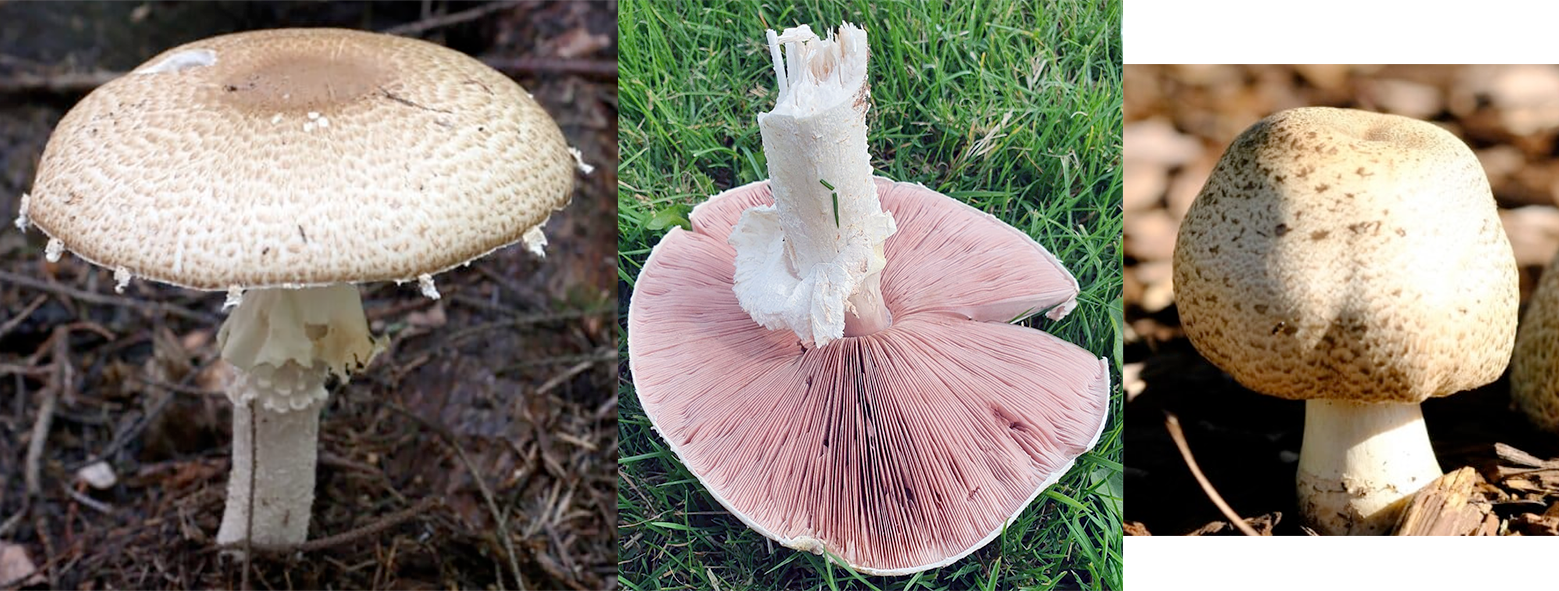
 The image, above, shows The Prince, Agaricus augustus in
various views (left to right), including the mature specimen, a
mature specimen inverted to show pink gills and an immature
'button' form..
| Common Name: Field Mushrooms |
| Scientific Name: Agaricus campestris |
| Other Names: |
| Family: Agaricaceae |
| Range: Europe, North Africa, Asia, and North America |
Physical Characteristics Agaricus augustus is a basidiomycete saprophytic (ie acquires nutrients from decaying dead organic matter) fungus of the genus Agaricus that can grow 30cm in diameter. It is found in deciduous and coniferous woods and in gardens and by roadside verges.
|
| Edible Parts: Caps, Stipes |
 Spore Print: Dark Brown Spore Print: Dark Brown
|
 Cap: Convex Cap: Convex
|
 Hymenium: Free Hymenium: Free
|
 Gills: Gills on hymenium Gills: Gills on hymenium
|
 Stipe: Bears a Ring Stipe: Bears a Ring
|
 Edibility Rating: 4 Edibility Rating: 4 
|
 Known Hazards: None known. However, it has been found to bioacumulate the metal cadmium in some locales and could be toxic because of this). Known Hazards: None known. However, it has been found to bioacumulate the metal cadmium in some locales and could be toxic because of this).
|
Monthly Availability:
|
Welcome to the summary page for FabulousFusionFood's Wild Food guide to The Prince along with all the The Prince containing recipes presented on this site, with 74 recipes in total.
These recipes, all contain The Prince as a major wild food ingredient.
The Prince, Agaricus augustus, is a saprophytic basidiomycete fungus (filamentous fungi composed of hyphae that reproduce sexually) and is a member of the Agaricaceae (Agaricus) family of fungi. Its species name augustus is derived from the Latin august> (meaning 'noble' and is the same epithet as used by the Augustus Roman Emperors (who gave their name to the month August) and the Augustinian Friars.
The prince grows under or around conifer and deciduous trees, but it rarely is found in the forest. It emerges on the forest edge, along roads, in parks, and places with conifers and plentiful sun. The fruiting princes grow in scattered clusters, usually individually or in pairs. Sometimes, they grow in dense groupings.
Agaricus augustus forms large and distinctive agarics. The cap shape is hemispherical during the so-called button stage, and then expands, becoming convex and finally flat, with a diameter from 8–30 cm. The cap cuticle is dry, and densely covered with concentrically arranged, brown-coloured scales on a white to yellow background.
The flesh is thick, firm and white and may discolour yellow when bruised. The gills are crowded and pallid at first, and turn pink then dark brown with maturity. The gills are not attached to the stem; they are free. Immature specimens bear a delicate white partial veil with darker-coloured warts, extending from the stem to the cap periphery.
The stem is clavate and 7–30 cm (3–12 in) tall, and 2–6 cm thick. In mature specimens, the partial veil is torn and left behind as a pendulous ring adorning the stem. Above the ring, the stem is white to yellow and smooth. Below, it is covered with numerous small scales. Its flesh is thick, white and sometimes has a narrow central hollow. The stem base extends deeply into the substrate.
The mushroom's odour is strong and sweet, similar to almond extract, marzipan or maraschino cherry, due to the presence of benzaldehyde and benzyl alcohol. Its taste has been described as not distinctive. It shows a red positive Schaeffer's test reaction. The cap cuticle turns yellow when a 10% potassium hydroxide (KOH) solution is applied.
Under a microscope, the ellipsoid-shaped spores are seen characteristically large at 7–10 by 4.5–6.5 μm. The basidia are 4-spored. The spore mass is coloured chocolate-brown.
The Prince is considered a choice edible mushroom.
For other edible mushrooms, see the guide to edible mushrooms
Possible Confusion:
The toxic Yellow Stainer (Agaricus xanthodermus), but this mushroom stains chrome yellow when bruised or cut and smells of Indian ink, hospitals or iodine.
[2]. Huxley, A. The New RHS Dictionary of Gardening. 1999
[3]. Tanaka, T. Tanaka's Cyclopaedia of Edible Plants of the World.
[4]. Lim T.K. Edible Medicinal And Non-Medicinal Plants, Vols 1–12.
[5]. Thomas, G. S. Perennial Garden Plants, 2004
[6]. Milner, E. Trees of Britain and Ireland, 2011
[7]. Rose, F. & O'Reilly, C. The Wild Flower Key (Revised Edition) — How to identify wild plants, trees and shrubs in Britain and Ireland, 2006
[8]. Streeter, D. & Garrard, I. The Wild Flowers of the British Isles, 1983
[9]. Clapham, A.R.; Tutin, T.G. & Moore, D.M. Flora of the British Isles, 1987
[10]. Phillips, R. Mushrooms, 2006
[11]. Jordan, P. & Wheeler, S. The Complete Book of Mushrooms: An Illustrated Encyclopedia of Edible Mushrooms, 2011
[12]. Bunker, F. Seaweeds of Britain and Ireland, Second Edition, 2017
[13]. Facciola, S. Cornucopia II — A Source Book of Edible Plants, 1998
[14]. Hartford, R. Edible and Medicinal Wild Plants of Britain and Ireland: A Foraging and Photographic Identification Guide
(Note that the above book links are Amazon Affiliate links)
These recipes, all contain The Prince as a major wild food ingredient.
The Prince, Agaricus augustus, is a saprophytic basidiomycete fungus (filamentous fungi composed of hyphae that reproduce sexually) and is a member of the Agaricaceae (Agaricus) family of fungi. Its species name augustus is derived from the Latin august> (meaning 'noble' and is the same epithet as used by the Augustus Roman Emperors (who gave their name to the month August) and the Augustinian Friars.
The prince grows under or around conifer and deciduous trees, but it rarely is found in the forest. It emerges on the forest edge, along roads, in parks, and places with conifers and plentiful sun. The fruiting princes grow in scattered clusters, usually individually or in pairs. Sometimes, they grow in dense groupings.
Agaricus augustus forms large and distinctive agarics. The cap shape is hemispherical during the so-called button stage, and then expands, becoming convex and finally flat, with a diameter from 8–30 cm. The cap cuticle is dry, and densely covered with concentrically arranged, brown-coloured scales on a white to yellow background.
The flesh is thick, firm and white and may discolour yellow when bruised. The gills are crowded and pallid at first, and turn pink then dark brown with maturity. The gills are not attached to the stem; they are free. Immature specimens bear a delicate white partial veil with darker-coloured warts, extending from the stem to the cap periphery.
The stem is clavate and 7–30 cm (3–12 in) tall, and 2–6 cm thick. In mature specimens, the partial veil is torn and left behind as a pendulous ring adorning the stem. Above the ring, the stem is white to yellow and smooth. Below, it is covered with numerous small scales. Its flesh is thick, white and sometimes has a narrow central hollow. The stem base extends deeply into the substrate.
The mushroom's odour is strong and sweet, similar to almond extract, marzipan or maraschino cherry, due to the presence of benzaldehyde and benzyl alcohol. Its taste has been described as not distinctive. It shows a red positive Schaeffer's test reaction. The cap cuticle turns yellow when a 10% potassium hydroxide (KOH) solution is applied.
Under a microscope, the ellipsoid-shaped spores are seen characteristically large at 7–10 by 4.5–6.5 μm. The basidia are 4-spored. The spore mass is coloured chocolate-brown.
The Prince is considered a choice edible mushroom.
For other edible mushrooms, see the guide to edible mushrooms
Possible Confusion:
The toxic Yellow Stainer (Agaricus xanthodermus), but this mushroom stains chrome yellow when bruised or cut and smells of Indian ink, hospitals or iodine.
References:
[1]. David Evans Notes from field observations, tastings and cookery experiments.[2]. Huxley, A. The New RHS Dictionary of Gardening. 1999
[3]. Tanaka, T. Tanaka's Cyclopaedia of Edible Plants of the World.
[4]. Lim T.K. Edible Medicinal And Non-Medicinal Plants, Vols 1–12.
[5]. Thomas, G. S. Perennial Garden Plants, 2004
[6]. Milner, E. Trees of Britain and Ireland, 2011
[7]. Rose, F. & O'Reilly, C. The Wild Flower Key (Revised Edition) — How to identify wild plants, trees and shrubs in Britain and Ireland, 2006
[8]. Streeter, D. & Garrard, I. The Wild Flowers of the British Isles, 1983
[9]. Clapham, A.R.; Tutin, T.G. & Moore, D.M. Flora of the British Isles, 1987
[10]. Phillips, R. Mushrooms, 2006
[11]. Jordan, P. & Wheeler, S. The Complete Book of Mushrooms: An Illustrated Encyclopedia of Edible Mushrooms, 2011
[12]. Bunker, F. Seaweeds of Britain and Ireland, Second Edition, 2017
[13]. Facciola, S. Cornucopia II — A Source Book of Edible Plants, 1998
[14]. Hartford, R. Edible and Medicinal Wild Plants of Britain and Ireland: A Foraging and Photographic Identification Guide
(Note that the above book links are Amazon Affiliate links)
The alphabetical list of all The Prince recipes on this site follows, (limited to 100 recipes per page). There are 74 recipes in total:
Page 1 of 1
Page 1 of 1