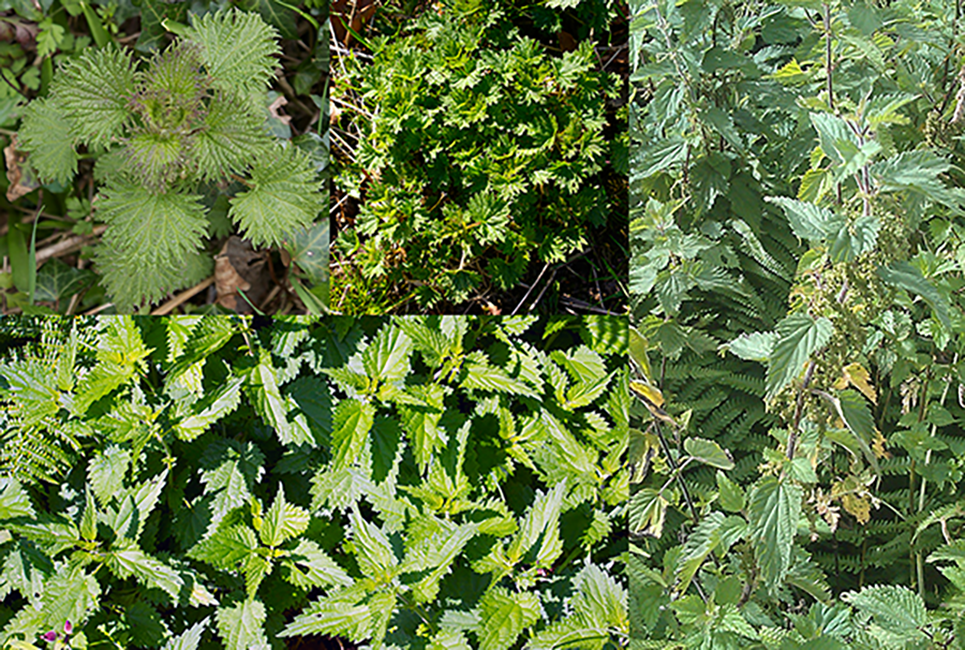
 The image, above, shows the full stinging nettle plant
(Urtica dioica), which is in flower, right. The other
panels show young plants with edible leaves. A single young plant
is shown top, left, a cluster of young plant,s centre, top and a
group of young plants, bottom left..
| Common Name: Stinging Nettles |
| Scientific Name: Urtica dioica |
| Other Names: Common Nettle |
| Family: Urticaceae |
| Range: Temperate regions throughout the world, including Britain. The plant has become naturalized at higher elevations in the Tropics. |
Physical Characteristics Urtica dioica is a hardy Perennial plant, growing to 1.2m (4ft) by 1m (3 ft 3 in) in size. It is hardy to zone 3 and is not frost tender. The plant flowers from May to October and seeds ripen from June to October. The flowers are dioecious (individual flowers are either male or female) but only one sex is found on any given plant. The flowers and are wind pollinated.
|
| Edible Parts: Young Leaves, Shoots, Oil, Seeds |
 Edibility Rating: 5 Edibility Rating: 5 
|
 Known Hazards: The leaves of the plants have stinging hairs, causing irritation to the skin. This action is neutralized by heat or by thorough drying, rendering the cooked leaves are perfectly safe and nutritious). However, only young leaves should be used because older leaves develop gritty particles called cystoliths which act as a kidney irritant. There may be possible interference with allopathic drugs for diabetes mellitus and hypertension. Depressive drugs, acting on the central nervous system (eg morphine, alcohol) may also interact with nettle. Avoid during pregnancy. Known Hazards: The leaves of the plants have stinging hairs, causing irritation to the skin. This action is neutralized by heat or by thorough drying, rendering the cooked leaves are perfectly safe and nutritious). However, only young leaves should be used because older leaves develop gritty particles called cystoliths which act as a kidney irritant. There may be possible interference with allopathic drugs for diabetes mellitus and hypertension. Depressive drugs, acting on the central nervous system (eg morphine, alcohol) may also interact with nettle. Avoid during pregnancy.
|
Monthly Availability: Nettles are another plant affected by verge trimming. This means that young nettle leaves can now be collected almost all spring and summer and into autumn.
|
Welcome to the summary page for FabulousFusionFood's Wild Food guide to Stinging Nettles along with all the Stinging Nettles containing recipes presented on this site, with 75 recipes in total.
These recipes, all contain Stinging Nettles as a major wild food ingredient.
Stinging Nettles, Urtica dioica is an herbaceous flowering plant in the Urticaceae (nettle) family. they grow to some 1.5m tall in summer, when they flower, before dying down to ground-cover in winter. Their soft green leaves are broadly spear-shaped and have a strongly-serrated margin. The male and female flowers are borne on separate plants. It is the young leaves of the common nettle, Urtica dioica that are the most palatable.
Everyone recognises the stinging nettle (generally referred to just as 'nettles') and many of us have been stung by this plant. Nettles are covered with tiny, nearly invisible stinging hairs that contain histamine and formic acid that produce an intense, stinging pain, followed by redness and skin irritation. The generic name (Urtica) comes from the Latin word, uro which means 'I burn'. Bizarrely, whilst the stinging nettle is normally very painful to the touch, when it comes into contact with an area of the body that is already in pain, the chemicals can actually decrease the original pain. This is why the stinging nettle is also termed a counterirritant. Indeed, Applying juice from the stinging nettle to the skin can actually relieve painful nettle stings or insect bites.
In ancient times, the nettle was an extremely versatile plant. It was used as an analgesic, the fibres from the stems were woven into string, ropes and cloth. Mature nettle leaves were used to wrap fish, meat and cheeses. Indeed, it was the Romans who brought a second species of nettle, Urtica pilulifera (the Roman Nettle) to Britain. This is very similar to the common nettle, Urtica dioicia, but is said to have a stronger sting. Most importantly, the young leaves of nettles do not sting and can be used in salads, to make soups, to make puddings. Even the slightly older leaves of nettles, once boiled, do not sting and can be used in a variety of dishes.
It should be noted that truly old nettle plants should never be eaten, as they develop gritty particles called cystoliths which act as a kidney irritant and which can produce kidney damage, yielding the symptoms of poisoning. Nettle leaves are rich in vitamins, plant proteins and minerals and, because of this, some farmers encourage the growth of nettles in some regions of their fields for inclusion in hay and silage.
Nettle seeds are also edible and can be used as a direct replacement in any recipe that call for sesame seeds. Nettle seed flour can also be used as an adulterant to any wheat flour recipe (replace 10% of the wheat flour with ground nettle seeds). Nettle seeds also have a distinctly salty taste so they can also be used as a condiment.
As well as being cooked as a potherb, young nettle leaves can also be dried for winter (they are excellent when making pasta). The young shoots, harvested in the spring when 15–20cm long, complete with the underground stem, can be cooked like asparagus and are very tasty as a vegetable. The plants are harvested commercially for extraction of the chlorophyll, which is used as a green colouring agent (E140) in foods and medicines. A tea can be prepared from the dried leaves, which is warming on a winter's day. The juice of the leaves, or a decoction of the herb, can be used as a rennet substitute in curdling milk.
[2]. Huxley, A. The New RHS Dictionary of Gardening. 1999
[3]. Tanaka, T. Tanaka's Cyclopaedia of Edible Plants of the World.
[4]. Lim T.K. Edible Medicinal And Non-Medicinal Plants, Vols 1–12.
[5]. Thomas, G. S. Perennial Garden Plants, 2004
[6]. Milner, E. Trees of Britain and Ireland, 2011
[7]. Rose, F. & O'Reilly, C. The Wild Flower Key (Revised Edition) — How to identify wild plants, trees and shrubs in Britain and Ireland, 2006
[8]. Streeter, D. & Garrard, I. The Wild Flowers of the British Isles, 1983
[9]. Clapham, A.R.; Tutin, T.G. & Moore, D.M. Flora of the British Isles, 1987
[10]. Phillips, R. Mushrooms, 2006
[11]. Jordan, P. & Wheeler, S. The Complete Book of Mushrooms: An Illustrated Encyclopedia of Edible Mushrooms, 2011
[12]. Bunker, F. Seaweeds of Britain and Ireland, Second Edition, 2017
[13]. Facciola, S. Cornucopia II — A Source Book of Edible Plants, 1998
[14]. Hartford, R. Edible and Medicinal Wild Plants of Britain and Ireland: A Foraging and Photographic Identification Guide
(Note that the above book links are Amazon Affiliate links)
These recipes, all contain Stinging Nettles as a major wild food ingredient.
Stinging Nettles, Urtica dioica is an herbaceous flowering plant in the Urticaceae (nettle) family. they grow to some 1.5m tall in summer, when they flower, before dying down to ground-cover in winter. Their soft green leaves are broadly spear-shaped and have a strongly-serrated margin. The male and female flowers are borne on separate plants. It is the young leaves of the common nettle, Urtica dioica that are the most palatable.
Everyone recognises the stinging nettle (generally referred to just as 'nettles') and many of us have been stung by this plant. Nettles are covered with tiny, nearly invisible stinging hairs that contain histamine and formic acid that produce an intense, stinging pain, followed by redness and skin irritation. The generic name (Urtica) comes from the Latin word, uro which means 'I burn'. Bizarrely, whilst the stinging nettle is normally very painful to the touch, when it comes into contact with an area of the body that is already in pain, the chemicals can actually decrease the original pain. This is why the stinging nettle is also termed a counterirritant. Indeed, Applying juice from the stinging nettle to the skin can actually relieve painful nettle stings or insect bites.
In ancient times, the nettle was an extremely versatile plant. It was used as an analgesic, the fibres from the stems were woven into string, ropes and cloth. Mature nettle leaves were used to wrap fish, meat and cheeses. Indeed, it was the Romans who brought a second species of nettle, Urtica pilulifera (the Roman Nettle) to Britain. This is very similar to the common nettle, Urtica dioicia, but is said to have a stronger sting. Most importantly, the young leaves of nettles do not sting and can be used in salads, to make soups, to make puddings. Even the slightly older leaves of nettles, once boiled, do not sting and can be used in a variety of dishes.
It should be noted that truly old nettle plants should never be eaten, as they develop gritty particles called cystoliths which act as a kidney irritant and which can produce kidney damage, yielding the symptoms of poisoning. Nettle leaves are rich in vitamins, plant proteins and minerals and, because of this, some farmers encourage the growth of nettles in some regions of their fields for inclusion in hay and silage.
Nettle seeds are also edible and can be used as a direct replacement in any recipe that call for sesame seeds. Nettle seed flour can also be used as an adulterant to any wheat flour recipe (replace 10% of the wheat flour with ground nettle seeds). Nettle seeds also have a distinctly salty taste so they can also be used as a condiment.
As well as being cooked as a potherb, young nettle leaves can also be dried for winter (they are excellent when making pasta). The young shoots, harvested in the spring when 15–20cm long, complete with the underground stem, can be cooked like asparagus and are very tasty as a vegetable. The plants are harvested commercially for extraction of the chlorophyll, which is used as a green colouring agent (E140) in foods and medicines. A tea can be prepared from the dried leaves, which is warming on a winter's day. The juice of the leaves, or a decoction of the herb, can be used as a rennet substitute in curdling milk.
References:
[1]. David Evans Notes from field observations, tastings and cookery experiments.[2]. Huxley, A. The New RHS Dictionary of Gardening. 1999
[3]. Tanaka, T. Tanaka's Cyclopaedia of Edible Plants of the World.
[4]. Lim T.K. Edible Medicinal And Non-Medicinal Plants, Vols 1–12.
[5]. Thomas, G. S. Perennial Garden Plants, 2004
[6]. Milner, E. Trees of Britain and Ireland, 2011
[7]. Rose, F. & O'Reilly, C. The Wild Flower Key (Revised Edition) — How to identify wild plants, trees and shrubs in Britain and Ireland, 2006
[8]. Streeter, D. & Garrard, I. The Wild Flowers of the British Isles, 1983
[9]. Clapham, A.R.; Tutin, T.G. & Moore, D.M. Flora of the British Isles, 1987
[10]. Phillips, R. Mushrooms, 2006
[11]. Jordan, P. & Wheeler, S. The Complete Book of Mushrooms: An Illustrated Encyclopedia of Edible Mushrooms, 2011
[12]. Bunker, F. Seaweeds of Britain and Ireland, Second Edition, 2017
[13]. Facciola, S. Cornucopia II — A Source Book of Edible Plants, 1998
[14]. Hartford, R. Edible and Medicinal Wild Plants of Britain and Ireland: A Foraging and Photographic Identification Guide
(Note that the above book links are Amazon Affiliate links)
The alphabetical list of all Stinging Nettles recipes on this site follows, (limited to 100 recipes per page). There are 75 recipes in total:
Page 1 of 1
Page 1 of 1